Page 340 of 448
6-33
Some driving conditions or climates may cause a brake
squeal when the brakes are first applied or lightly
applied. This does not mean something is wrong with
your brakes.
Properly torqued wheel nuts are necessary to help
prevent brake pulsation. When tires are rotated, inspect
brake pads for wear and evenly tighten wheel nuts in the
proper sequence to GM torque specifications.
Brake linings should always be replaced as complete
axle sets.
See ªBrake System Inspectionº in Section 7 of this manual
under Part C ªPeriodic Maintenance Inspections.º
Brake Pedal Travel
See your dealer if the brake pedal does not return to
normal height, or if there is a rapid increase in pedal
travel. This could be a sign of brake trouble.
Brake Adjustment
Every time you make a brake stop, your disc brakes
adjust for wear.
Replacing Brake System Parts
The braking system on a vehicle is complex.
Its many parts have to be of top quality and work well
together if the vehicle is to have really good braking.
Your vehicle was designed and tested with top
-quality
GM brake parts. When you replace parts of your braking
system
-- for example, when your brake linings wear
down and you have to have new ones put in
-- be sure
you get new approved GM replacement parts. If you
don't, your brakes may no longer work properly.
For example, if someone puts in brake linings that
are wrong for your vehicle, the balance between your
front and rear brakes can change
-- for the worse.
The braking performance you've come to expect can
change in many other ways if someone puts in the
wrong replacement brake parts.
Page 354 of 448
6-47
CAUTION:
Rust or dirt on a wheel, or on the parts to which
it is fastened, can make wheel nuts become loose
after a time. The wheel could come off and cause
an accident. When you change a wheel, remove
any rust or dirt from places where the wheel
attaches to the vehicle. In an emergency, you can
use a cloth or a paper towel to do this; but be
sure to use a scraper or wire brush later, if
you need to, to get all the rust or dirt off.
See ªChanging a Flat Tireº in the Index.
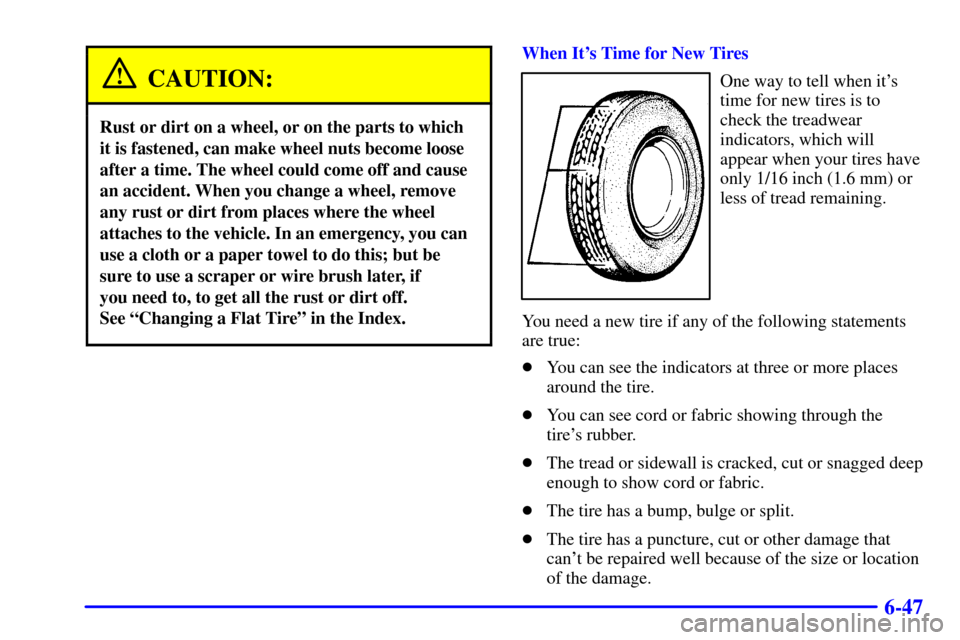
When It's Time for New Tires
One way to tell when it's
time for new tires is to
check the treadwear
indicators, which will
appear when your tires have
only 1/16 inch (1.6 mm) or
less of tread remaining.
You need a new tire if any of the following statements
are true:
�You can see the indicators at three or more places
around the tire.
�You can see cord or fabric showing through the
tire's rubber.
�The tread or sidewall is cracked, cut or snagged deep
enough to show cord or fabric.
�The tire has a bump, bulge or split.
�The tire has a puncture, cut or other damage that
can't be repaired well because of the size or location
of the damage.
Page 380 of 448
6-73 Capacities
Please refer to ªRecommended Fluids and Lubricantsº
in the Index for more information.
Cooling System*
Automatic Trans. 11.7 quarts (11.1 L). . . . . . . . . . . .
Manual Trans. 11.9 quarts (11.3 L). . . . . . . . . . . . . .
Crankcase* 4.5 quarts (4.3 L). . . . . . . . . . . . . . . . .
Automatic Transmission
(Drain and Refill)* 5.0 quarts (4.7 L). . . . . . . . .
Differential Fluid
Rear 4.0 pints (1.9 L). . . . . . . . . . . . . . . . . . . . . . . .
Front 2.6 pints (1.2 L). . . . . . . . . . . . . . . . . . . . . . .
Fuel Tank
(2
-Door Models) 19.0 U.S. gallons (72.0 L). . . .
Fuel Tank
(4
-Door Models) 18.0 U.S. gallons (68.0 L). . . .
A/C Refrigerant See refrigerant charge label. . . . . .
under the hood.
*All capacities are approximate. After refill, the level
must be checked.
Normal Maintenance
Replacement Parts
Replacement part numbers listed in this section are
based on the latest information available at the time of
printing, and are subject to change. If a part listed in this
manual is not the same as the part used in your vehicle
when it was built, or if you have any questions, please
contact your GM dealer.
Thermostat** 12559051. . . . . . . . . . . . . . . . . . . . . . .
Oil Filter* (2
-Wheel Drive) PF47 (PF52 Optional). . .
Oil Filter* (4
-Wheel Drive) PF52. . . . . . . . . . . . . . . .
Air Cleaner Filter* A1163C. . . . . . . . . . . . . . . . . . . . .
PCV Valve* CV769C. . . . . . . . . . . . . . . . . . . . . . . . .
Automatic Transmission Filter Kit** 24200796. . . .
Spark Plugs* 41
-932 . . . . . . . . . . . . . . . . . . . . . . . . . .
Fuel Filter* GF481. . . . . . . . . . . . . . . . . . . . . . . . . . . .
Front Windshield
Wiper Blade Trico 20 inches (50.8 cm). . . . . . . . . .
Backglass Wiper Blade Trico 14 inches (35.6 cm). . .
*ACDelco
� Part No.
**GM Part No.
Page 429 of 448
7-48 Engine Cooling System Inspection
Inspect the hoses and have them replaced if they
are cracked, swollen or deteriorated. Inspect all pipes,
fittings and clamps; replace as needed. Clean the
outside of the radiator and air conditioning condenser.
To help ensure proper operation, a pressure test of the
cooling system and pressure cap is recommended at
least once a year.
Throttle System Inspection
Inspect the throttle system for interference or binding,
and for damaged or missing parts. Replace parts as
needed. Replace any components that have high effort
or excessive wear. Do not lubricate accelerator and
cruise control cables.
Transfer Case and Front Axle
(Four-Wheel Drive) Inspection
Every 12 months or at engine oil change intervals,
check front axle and transfer case and add lubricant
when necessary. A fluid loss could indicate a problem;
check and have it repaired, if needed. Check vent hose
at transfer case for kinks and proper installation. More
frequent lubrication may be required on off
-road use.
Brake System Inspection
Inspect the complete system. Inspect brake lines and
hoses for proper hook
-up, binding, leaks, cracks,
chafing, etc. Inspect disc brake pads for wear and
rotors for surface condition. Inspect other brake parts,
including calipers, parking brake, etc. Check parking
brake adjustment. You may need to have your brakes
inspected more often if your driving habits or conditions
result in frequent braking.
Page:
< prev 1-8 9-16 17-24