2001 CHEVROLET BLAZER manual transmission
[x] Cancel search: manual transmissionPage 97 of 448
2-29
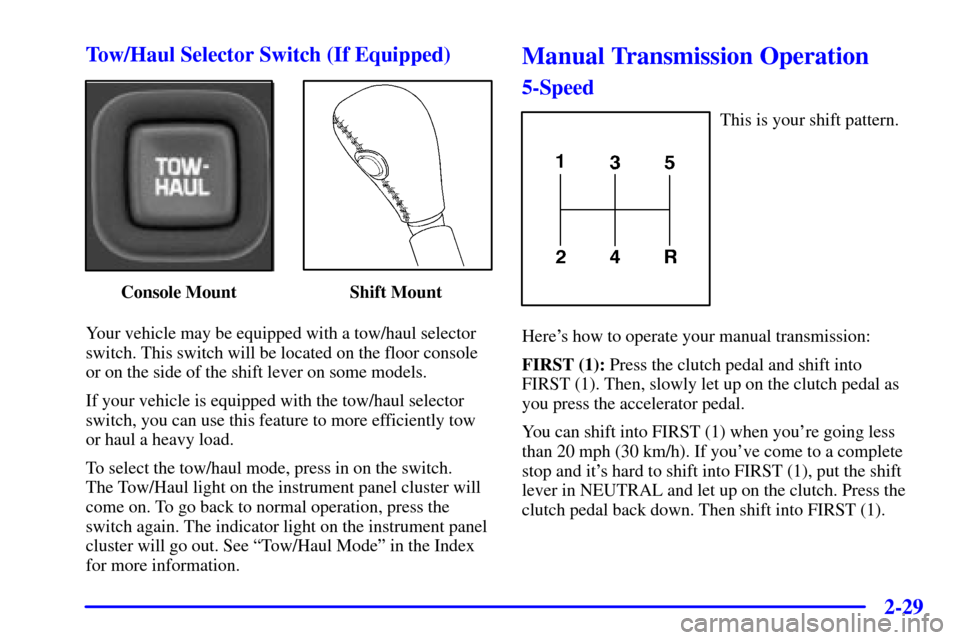
Tow/Haul Selector Switch (If Equipped)
Console Mount Shift Mount
Your vehicle may be equipped with a tow/haul selector
switch. This switch will be located on the floor console
or on the side of the shift lever on some models.
If your vehicle is equipped with the tow/haul selector
switch, you can use this feature to more efficiently tow
or haul a heavy load.
To select the tow/haul mode, press in on the switch.
The Tow/Haul light on the instrument panel cluster will
come on. To go back to normal operation, press the
switch again. The indicator light on the instrument panel
cluster will go out. See ªTow/Haul Modeº in the Index
for more information.
Manual Transmission Operation
5-Speed
This is your shift pattern.
Here's how to operate your manual transmission:
FIRST (1): Press the clutch pedal and shift into
FIRST (1). Then, slowly let up on the clutch pedal as
you press the accelerator pedal.
You can shift into FIRST (1) when you're going less
than 20 mph (30 km/h). If you've come to a complete
stop and it's hard to shift into FIRST (1), put the shift
lever in NEUTRAL and let up on the clutch. Press the
clutch pedal back down. Then shift into FIRST (1).
Page 98 of 448
2-30
SECOND (2): Press the clutch pedal as you let up
on the accelerator pedal and shift into SECOND (2).
Then, slowly let up on the clutch pedal as you press the
accelerator pedal.
THIRD, FOURTH AND FIFTH (3, 4 and 5): Shift
into THIRD (3), FOURTH (4) and FIFTH (5) the same
way you do for SECOND (2). Slowly let up on the
clutch pedal as you press the accelerator pedal.
To stop, let up on the accelerator pedal and press the brake
pedal. Just before the vehicle stops, press the clutch pedal
and the brake pedal, and shift to NEUTRAL.
NEUTRAL: Use this position when you start or idle
your engine.
REVERSE (R): To back up, press the clutch pedal,
wait about six seconds, then shift into REVERSE (R).
Then let up on the clutch pedal slowly while pressing
the accelerator pedal.
NOTICE:
Shift to REVERSE (R) only after your vehicle is
stopped. Shifting to REVERSE (R) while your
vehicle is moving could damage your transmission.
Use REVERSE (R), along with the parking brake, for
parking your vehicle.
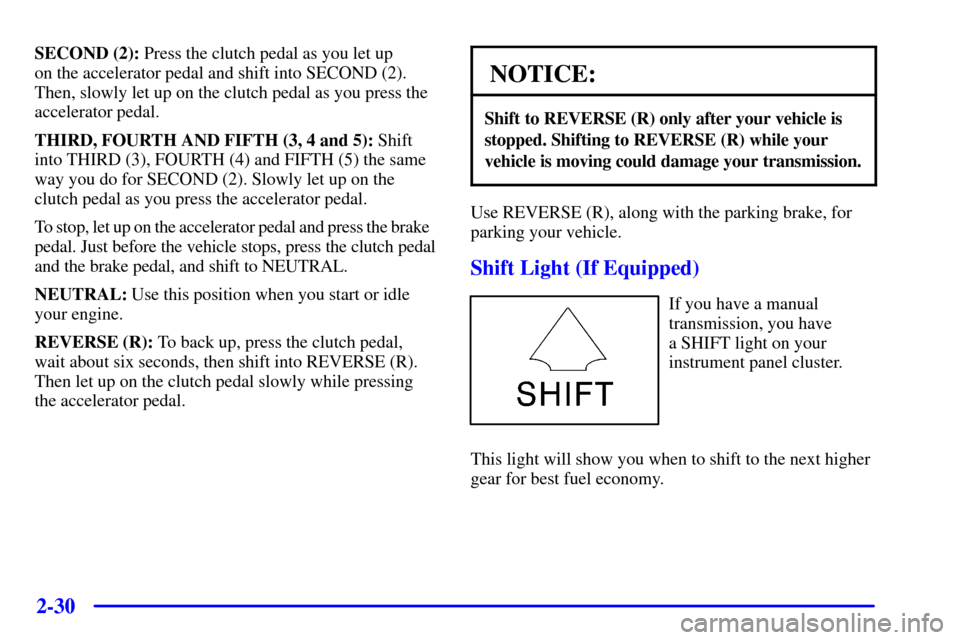
Shift Light (If Equipped)
If you have a manual
transmission, you have
a SHIFT light on your
instrument panel cluster.
This light will show you when to shift to the next higher
gear for best fuel economy.
Page 99 of 448
2-31
When this light comes on, you can shift to the next
higher gear if weather, road and traffic conditions let
you. For the best fuel economy, accelerate slowly and
shift when the light comes on.
While you accelerate, it is normal for the light to go
on and off if you quickly change the position of the
accelerator. Ignore the SHIFT light when you downshift.
CAUTION:
If you skip a gear when you downshift, you could
lose control of your vehicle. You could injure
yourself or others. Don't shift down more than
one gear at a time when you downshift.
If your vehicle has four-wheel drive and is equipped
with a manual transmission, disregard the SHIFT light
when the transfer case is in 4LO.
Four-Wheel Drive (If Equipped)
If your vehicle has four-wheel drive, you can send
your engine's driving power to all four wheels for extra
traction. To get the most satisfaction out of four
-wheel
drive, you must be familiar with its operation. Read the
part that follows before using four
-wheel drive.
You should use two
-wheel high (2HI) for most
normal driving conditions.
NOTICE:
Driving in the 4HI or 4LO positions for a long
time on dry or wet pavement could shorten the
life of your vehicle's drivetrain.
Page 101 of 448

2-33
with an automatic transmission or the clutch pedal
engaged in vehicles equipped with a manual
transmission. The preferred method for shifting into
4LO is to have your vehicle moving 1 to 2 mph
(1.6 to 3.2 km/h). Press and release the 4LO switch.
You must wait for the 4LO indicator light to stop
flashing and remain illuminated before shifting your
transmission into gear or releasing the clutch pedal.
If the 4LO switch is pressed when your vehicle is in
gear and/or moving, the 4LO indicator light will flash
for 30 seconds and not complete the shift unless your
vehicle is moving slower than 3 mph (4.8 km/h) and
the transmission is in NEUTRAL (N) or the clutch
pedal engaged.
On automatic transmission equipped vehicles, if your
transfer case does not shift into 4LO, your transmission
indicator switch may require adjustment. With your
transmission in NEUTRAL (N), press and release the
4LO switch. While the 4LO indicator light is flashing,
shift your transmission into PARK (P). Wait until the
4LO indicator light remains illuminated before shifting
your transmission into gear. This will get you into 4LO,
but you should take your vehicle in for service to restore
normal operation.Shifting from 4LO to 4HI or 2HI
To shift from 4LO to 4HI or 2HI, your vehicle must
be stopped or moving less than 3 mph (4.8 km/h) with
the transmission in NEUTRAL (N) or the clutch pedal
engaged. The preferred method for shifting out of
4LO is to have your vehicle moving 1 to 2 mph
(1.6 to 3.2 km/h). Press and release the 4HI switch.
You must wait for the 4HI indicator light to stop
flashing and remain illuminated before shifting your
transmission into gear or releasing the clutch pedal.
If the 4HI switch is pressed when your vehicle is in
gear and/or moving, the 4HI indicator light will flash
for 30 seconds but not complete the shift unless the
vehicle is moving slower than 3 mph (4.8 km/h) and
the transmission is in NEUTRAL (N) or the clutch
pedal engaged.
On automatic transmission equipped vehicles, if your
transfer case does not shift into 4HI, your transmission
indicator switch may require adjustment. With your
transmission in NEUTRAL (N), press and release the
4HI switch. While the 4HI indicator light is flashing,
shift your transmission into PARK (P). Wait until the
4HI indicator light remains illuminated before shifting
your transmission into gear. This will get you into 4HI,
but you should take your vehicle in for service to restore
normal operation.
Page 103 of 448
2-35
4HI: Use 4HI when you need extra traction, such as
on snowy or icy roads or in most off
-road situations.
This setting also engages your front axle to help drive
your vehicle.
4LO: This setting also engages your front axle and
delivers extra torque. You may never need 4LO. It sends
maximum power to all four wheels. You might choose
4LO if you are driving off
-road in deep sand, deep mud,
deep snow and climbing or descending steep hills.
CAUTION:
Shifting the transfer case to NEUTRAL can cause
your vehicle to roll even if the transmission is in
PARK (P), or if you have a manual transmission,
even if you are in gear. You or someone else could
be seriously injured. Be sure to set the parking
brake before placing the transfer case in
NEUTRAL. See ªParking Brakeº in the Index.
NEUTRAL: Shift the vehicle's transfer case to
NEUTRAL only when towing your vehicle. See
ªRecreational Vehicle Towingº or ªTowing Your
Vehicleº in the Index for more information.
Indicator lights in the switches show which setting you
are in. The indicator lights will come on briefly when
you turn on the ignition and one will stay on. If the
lights do not come on, you should take your vehicle
to your dealer for service. An indicator light will
flash while shifting the transfer case. It will remain
illuminated when the shift is complete. If for some
reason the transfer case cannot make a requested shift,
it will return to the last chosen setting.
If the SERVICE 4WD light stays on, you should take
your vehicle to your dealer for service. See ªService
4WDº in the Index for further information.
Shifting to 4HI or AUTO 4WD
Press and release the 4HI or AUTO 4WD switch.
This can be done at any speed, and the indicator light
will flash while shifting. It will remain illuminated when
the shift is complete.
Page 104 of 448

2-36
Shifting to 2HI
Press and release the 2HI switch. This can be done at
any speed.
Shifting to 4LO
To shift to 4LO, the vehicle's engine must be running
and the vehicle must be stopped or moving less
than 3 mph (4.8 km/h) with the transmission in
NEUTRAL (N) or with the clutch pedal pressed
for vehicles with manual transmission. The preferred
method for shifting into 4LO is to have your vehicle
moving 1 or 2 mph (1.6 to 3.2 km/h). Press and
release the 4LO switch. You must wait for the4LO
indicator light to stop flashing and remain illuminated
before shifting your transmission into gear.
If the 4LO switch is pressed when your vehicle is in
gear and/or moving, the 4LO indicator light will flash
for 30 seconds and not complete the shift unless your
vehicle is moving less than 3 mph (4.8 km/h) and the
transmission is in NEUTRAL (N) or with the clutch
pedal pressed for vehicles with manual transmission.
After 30 seconds, the transfer case will return to the
setting last chosen.Shifting Out of 4LO
To shift from 4LO to 4HI, AUTO 4WD or 2HI, your
vehicle must be stopped or moving less than 3 mph
(4.8 km/h) with the transmission in NEUTRAL (N),
or with the clutch pedal pressed for vehicles with manual
transmission, and the engine running. The preferred
method for shifting out of 4LO is to have your vehicle
moving 1 or 2 mph (1.6 to 3.2 km/h). Press and release
the 4HI, AUTO 4WD or 2HI switch. You must wait for
the 4HI, AUTO 4WD or 2HI indicator light to stop
flashing and remain illuminated before shifting your
transmission into gear.
If the 4HI, AUTO 4WD or 2HI switch is pressed when
your vehicle is in gear and/or moving, the 4HI, AUTO
4WD or 2HI indicator light will flash for 30 seconds but
will not complete the shift unless your vehicle is moving
less than 3mph (4.8 km/h) with the transmission in
NEUTRAL (N) or with the clutch pedal pressed for
vehicles with manual transmission.
Page 105 of 448

2-37
Shifting to NEUTRAL
To shift the transfer case to NEUTRAL, first make sure
the vehicle is parked so that it will not roll:
1. Set the parking brake.
2. Start the vehicle.
3. Connect the vehicle to the towing vehicle.
4. Put the transmission in NEUTRAL (N) or
have the clutch pedal pressed for vehicles with
manual transmission.
5. Shift the transfer case to 2HI.
6. Simultaneously press and hold the 2HI and 4LO
buttons for 10 seconds. The NEUTRAL light will
come on when the transfer case shift to NEUTRAL
is complete.
7. Shift the transmission to REVERSE (R) for one
second, then shift the transmission to DRIVE (D)
for one second or FIRST (1) for vehicles with
manual transmission.
8. Turn the ignition to OFF.
9. Place the transmission shift lever in PARK (P) or
FIRST (1) for vehicles with manual transmission.
10. Release the parking brake prior to towing.Shifting Out of NEUTRAL
To shift out of NEUTRAL:
1. Set the parking brake and apply the regular
brake pedal.
2. Start the vehicle with the transmission in PARK (P)
or FIRST (1) for vehicles with manual transmission.
3. Press the button for the desired transfer case position
(2HI, 4HI, AUTO 4WD or 4LO).
4. Put the transmission in NEUTRAL (N) or press the
clutch pedal for vehicles with manual transmission.
5. Shift the transmission lever to the desired position.
After the transfer case has shifted out of NEUTRAL,
the NEUTRAL light will go out.
6. A re
-engagement sound is normal when shifting out
of NEUTRAL.
Page 111 of 448
2-43
Shifting Out of PARK (P)
(Automatic Transmission Only)
Your vehicle has an automatic transmission shift lock
control system. You have to fully apply the regular
brakes before you can shift from PARK (P) when the
ignition is in RUN. See ªAutomatic Transmission
Operationº in the Index.
If you cannot shift out of PARK (P), ease pressure on
the shift lever
-- push the shift lever all the way into
PARK (P) as you maintain brake application. Then
move the shift lever into the gear you want. You must
press the shift lever button on the shift lever.
If you ever hold the brake pedal down but still can't
shift out of PARK (P), try this:
1. Turn the key to OFF.
2. Apply and hold the brake until the end of Step 4.3. Shift the transmission to NEUTRAL (N).
4. Start the vehicle and then shift to the drive gear
you want.
5. Have the vehicle fixed as soon as possible.
Parking Your Vehicle (Manual
Transmission Models Only)
Before you get out of your vehicle, move the shift
lever into REVERSE (R), and firmly apply the
parking brake. Once the shift lever has been placed into
REVERSE (R) with the clutch pedal pressed in, you can
turn the ignition key to OFF, remove the key and release
the clutch.
If you are parking on a hill, or if your vehicle is pulling
a trailer, see ªTowing a Trailerº in the Index.