Page 72 of 448
2-4
Express-Down Window
The driver's window has an express
-down feature
that allows you to lower it without holding the window
switch. Press the driver's window switch down briefly
to activate the express
-down feature. Lightly tap the
switch to open the window slightly. The express
-down
feature can be interrupted at any time by pressing the
up arrow end of the switch.
Lockout Switch
Four
-door vehicles have a lockout feature to prevent
passengers from operating the power windows. It is
located on the driver's door armrest. Press LOCK to
activate this feature. Press NORM and the windows
will return to normal operation.
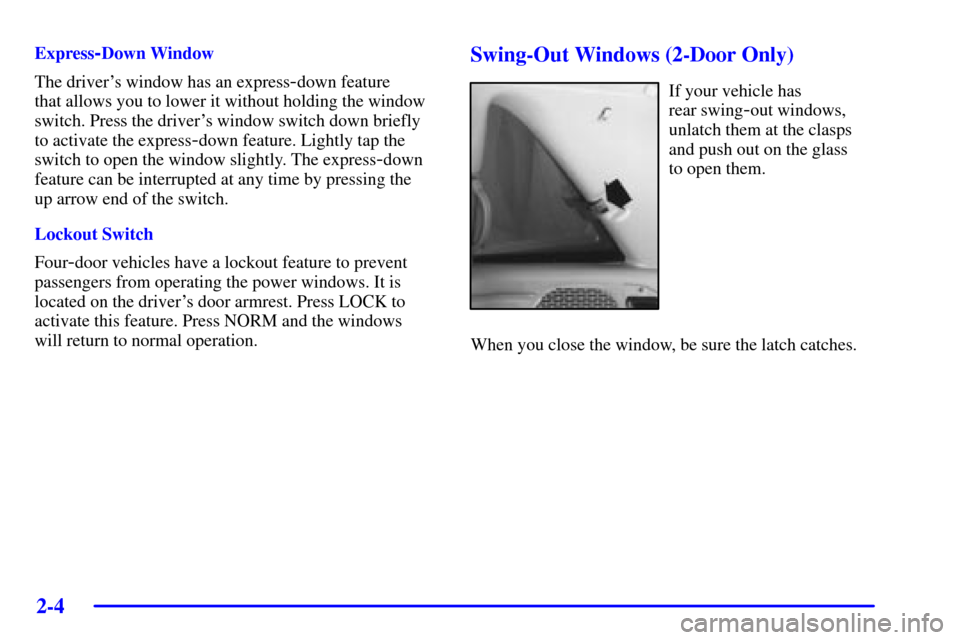
Swing-Out Windows (2-Door Only)
If your vehicle has
rear swing
-out windows,
unlatch them at the clasps
and push out on the glass
to open them.
When you close the window, be sure the latch catches.
Page 85 of 448
2-17
Emergency Release for Opening
Endgate/Liftgate
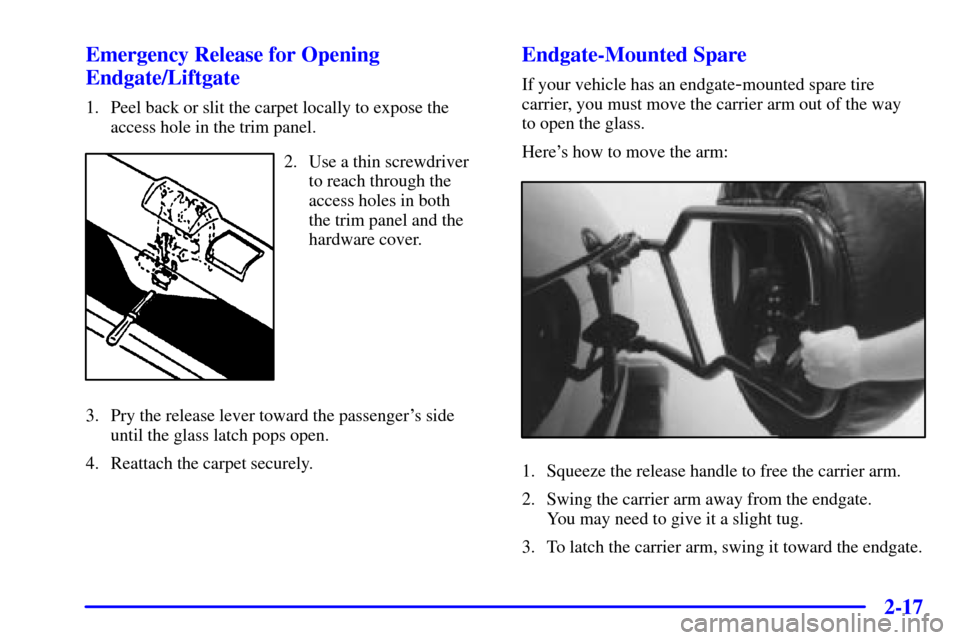
1. Peel back or slit the carpet locally to expose the
access hole in the trim panel.
2. Use a thin screwdriver
to reach through the
access holes in both
the trim panel and the
hardware cover.
3. Pry the release lever toward the passenger's side
until the glass latch pops open.
4. Reattach the carpet securely.
Endgate-Mounted Spare
If your vehicle has an endgate-mounted spare tire
carrier, you must move the carrier arm out of the way
to open the glass.
Here's how to move the arm:
1. Squeeze the release handle to free the carrier arm.
2. Swing the carrier arm away from the endgate.
You may need to give it a slight tug.
3. To latch the carrier arm, swing it toward the endgate.
Page 86 of 448

2-18
Theft
Vehicle theft is big business, especially in some cities.
Although your vehicle has a number of theft
-deterrent
features, we know that nothing we put on it can make
it impossible to steal. However, there are ways you
can help.
Key in the Ignition
If you leave your vehicle with the keys inside, it's an
easy target for joy riders or professional thieves
-- so
don't do it.
When you park your vehicle and open the driver's door,
you'll hear a chime reminding you to remove your key
from the ignition and take it with you. Always do this.
Your steering wheel will be locked, and so will your
ignition. If you have an automatic transmission,
taking your key out also locks your transmission.
Also remember to lock the doors.
Parking at Night
Park in a lighted spot, close all windows and lock your
vehicle. Remember to keep your valuables out of sight.
Put them in a storage area, or take them with you.
Parking Lots
Even if you park in a lot where someone will be
watching your vehicle, it's still best to lock it up and
take your keys. But what if you have to leave your
ignition key? What if you have to leave something
valuable in your vehicle?
�Put your valuables in a storage area, like your
glove box.
�If your vehicle has a remote keyless entry system,
take the transmitter with you.
�Lock all the doors except the driver's.
Page 87 of 448

2-19
Content Theft-Deterrent (If Equipped)
Your vehicle may be equipped with a content
theft
-deterrent alarm system.
With this system, the
SECURITY light will
flash as you open the door
(if your ignition is off).
This light reminds you to activate the theft
-deterrent
system. Here's how to do it:
1. Lock the door with the power door lock switch
(door must be open) or with the remote keyless
entry transmitter (door can be open or closed).
The SECURITY light should come on and stay on.
2. Close all doors. The SECURITY light should go off
after approximately 30 seconds. The alarm is not
armed until the SECURITY light goes off.If a door is opened without the key or the keyless entry
transmitter, the alarm will go off. Your vehicle's headlamps
will flash and the horn will sound for 110 seconds, then will
turn off to save the battery power.
Remember, the theft
-deterrent system won't activate if
you lock the doors with a key or use the manual door
lock. It activates only if you use a power door lock
switch (with the door open), or with the keyless entry
transmitter (door can be open or closed). You should
also remember that you can start your vehicle with the
correct ignition key if the alarm has been set off.
Here's how to avoid setting off the alarm by accident:
�If you don't want to activate the theft
-deterrent
system, the vehicle should be locked with the door
key after the doors are closed.
�Always unlock a door with a key, or use the keyless
entry transmitter. Unlocking a door any other way
will set off the alarm.
If you set off the alarm by accident, unlock any door
with the key. You can also turn off the alarm by
pressing UNLOCK on the keyless entry transmitter.
The alarm won't stop if you try to unlock a door any
other way.
Page 88 of 448

2-20
Testing the Alarm
The alarm can be tested by following these steps:
1. From inside the vehicle, lower the driver's window
and open the driver's door.
2. Activate the system by locking the doors with the
power door lock switch (while the door is open), or
with the keyless entry transmitter (with the door
open or closed).
3. Get out of the vehicle, close the door and wait for
the SECURITY light to go out.
4. Then reach in through the window, unlock the
door with the manual door lock and open the door.
This should set off the alarm.
If the alarm does not sound when it should, but the
vehicle's headlamps flash, check to see if the horn
works. The horn fuse may be blown. To replace the
fuse, see ªFuses and Circuit Breakersº in the Index.
If the alarm does not sound or the vehicle's headlamps
do not flash, the vehicle should be serviced by a dealer.
Passlock�
Your vehicle is equipped with the Passlock
theft
-deterrent system.
Passlock is a passive theft
-deterrent system. Passlock
enables fuel if the ignition lock cylinder is turned with a
valid key. If a correct key is not used or the ignition lock
cylinder is tampered with, fuel is disabled.
During normal operation, the SECURITY light will go
off approximately five seconds after the key is turned
to RUN.
If the engine stalls and the SECURITY light flashes,
wait about 10 minutes until the light stops flashing
before trying to restart the engine. Remember to release
the key from START as soon as the engine starts.
If the engine does not start after three tries, the vehicle
needs service.
If the engine is running and the SECURITY light
comes on, you will be able to restart the engine if you
turn the engine off. However, your Passlock system is
not working properly and must be serviced by your
dealer. Your vehicle is not protected by Passlock at
this time. You may also want to check the fuse
(see ªFuses and Circuit Breakersº in the Index).
See your dealer for service.
Page 97 of 448
2-29
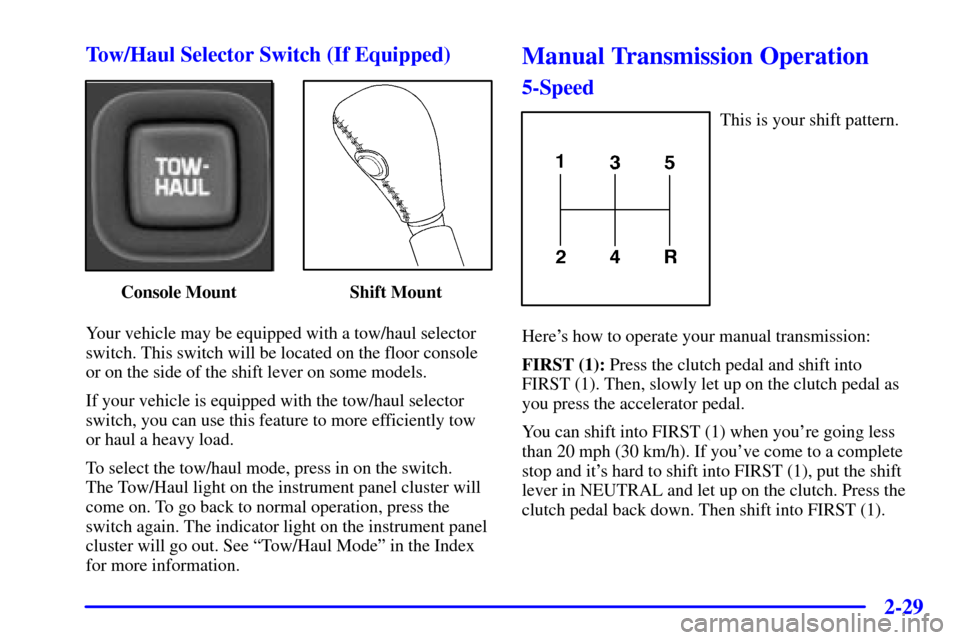
Tow/Haul Selector Switch (If Equipped)
Console Mount Shift Mount
Your vehicle may be equipped with a tow/haul selector
switch. This switch will be located on the floor console
or on the side of the shift lever on some models.
If your vehicle is equipped with the tow/haul selector
switch, you can use this feature to more efficiently tow
or haul a heavy load.
To select the tow/haul mode, press in on the switch.
The Tow/Haul light on the instrument panel cluster will
come on. To go back to normal operation, press the
switch again. The indicator light on the instrument panel
cluster will go out. See ªTow/Haul Modeº in the Index
for more information.
Manual Transmission Operation
5-Speed
This is your shift pattern.
Here's how to operate your manual transmission:
FIRST (1): Press the clutch pedal and shift into
FIRST (1). Then, slowly let up on the clutch pedal as
you press the accelerator pedal.
You can shift into FIRST (1) when you're going less
than 20 mph (30 km/h). If you've come to a complete
stop and it's hard to shift into FIRST (1), put the shift
lever in NEUTRAL and let up on the clutch. Press the
clutch pedal back down. Then shift into FIRST (1).
Page 98 of 448
2-30
SECOND (2): Press the clutch pedal as you let up
on the accelerator pedal and shift into SECOND (2).
Then, slowly let up on the clutch pedal as you press the
accelerator pedal.
THIRD, FOURTH AND FIFTH (3, 4 and 5): Shift
into THIRD (3), FOURTH (4) and FIFTH (5) the same
way you do for SECOND (2). Slowly let up on the
clutch pedal as you press the accelerator pedal.
To stop, let up on the accelerator pedal and press the brake
pedal. Just before the vehicle stops, press the clutch pedal
and the brake pedal, and shift to NEUTRAL.
NEUTRAL: Use this position when you start or idle
your engine.
REVERSE (R): To back up, press the clutch pedal,
wait about six seconds, then shift into REVERSE (R).
Then let up on the clutch pedal slowly while pressing
the accelerator pedal.
NOTICE:
Shift to REVERSE (R) only after your vehicle is
stopped. Shifting to REVERSE (R) while your
vehicle is moving could damage your transmission.
Use REVERSE (R), along with the parking brake, for
parking your vehicle.
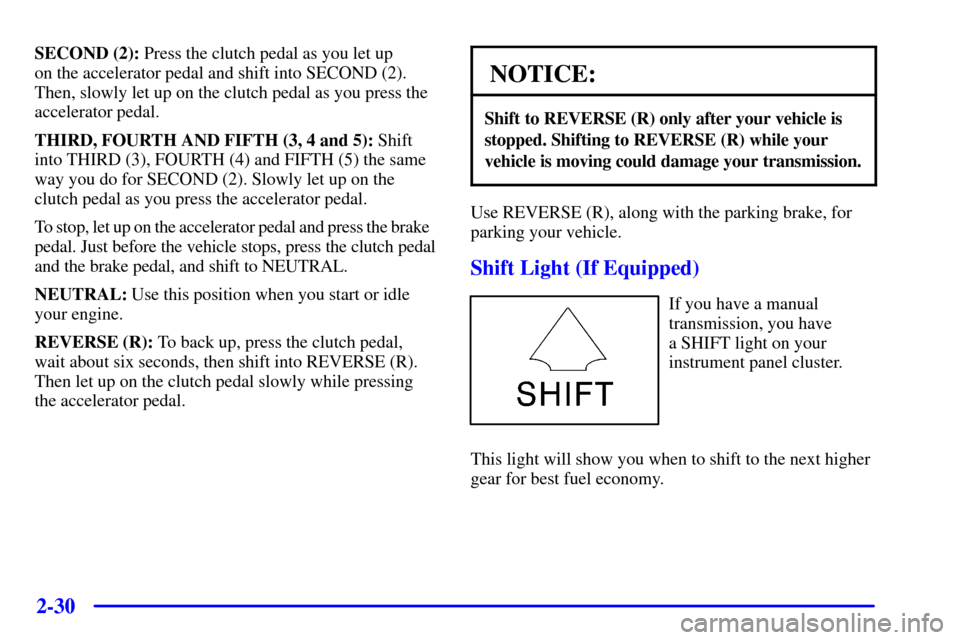
Shift Light (If Equipped)
If you have a manual
transmission, you have
a SHIFT light on your
instrument panel cluster.
This light will show you when to shift to the next higher
gear for best fuel economy.
Page 99 of 448
2-31
When this light comes on, you can shift to the next
higher gear if weather, road and traffic conditions let
you. For the best fuel economy, accelerate slowly and
shift when the light comes on.
While you accelerate, it is normal for the light to go
on and off if you quickly change the position of the
accelerator. Ignore the SHIFT light when you downshift.
CAUTION:
If you skip a gear when you downshift, you could
lose control of your vehicle. You could injure
yourself or others. Don't shift down more than
one gear at a time when you downshift.
If your vehicle has four-wheel drive and is equipped
with a manual transmission, disregard the SHIFT light
when the transfer case is in 4LO.
Four-Wheel Drive (If Equipped)
If your vehicle has four-wheel drive, you can send
your engine's driving power to all four wheels for extra
traction. To get the most satisfaction out of four
-wheel
drive, you must be familiar with its operation. Read the
part that follows before using four
-wheel drive.
You should use two
-wheel high (2HI) for most
normal driving conditions.
NOTICE:
Driving in the 4HI or 4LO positions for a long
time on dry or wet pavement could shorten the
life of your vehicle's drivetrain.