Page 299 of 388
6-47
CAUTION:
Mixing tires could cause you to lose control while
driving. If you mix tires of different sizes or types
(radial and bias
-belted tires), the vehicle may not
handle properly, and you could have a crash.
Using tires of different sizes may also cause
damage to your vehicle. Be sure to use the same
size and type tires on all wheels.
It's all right to drive with your compact spare,
though. It was developed for use on your vehicle.
CAUTION:
If you use bias-ply tires on your vehicle, the
wheel rim flanges could develop cracks after
many miles of driving. A tire and/or wheel could
fail suddenly, causing a crash. Use only radial
-ply
tires with the wheels on your vehicle.
Uniform Tire Quality Grading
Quality grades can be found where applicable on the tire
sidewall between tread shoulder and maximum section
width. For example:
Treadwear 200 Traction AA Temperature A
The following information relates to the system
developed by the United States National Highway
Traffic Safety Administration, which grades tires by
treadwear, traction and temperature performance. (This
applies only to vehicles sold in the United States.) The
grades are molded on the sidewalls of most passenger
car tires. The Uniform Tire Quality Grading system does
not apply to deep tread, winter
-type snow tires,
space
-saver or temporary use spare tires, tires with
nominal rim diameters of 10 to 12 inches (25 to 30 cm),
or to some limited
-production tires.
While the tires available on General Motors passenger
cars and light trucks may vary with respect to these
grades, they must also conform to federal safety
requirements and additional General Motors Tire
Performance Criteria (TPC) standards.
Page 305 of 388
6-53 Cleaning Vinyl
Use warm water and a clean cloth.
�Rub with a clean, damp cloth to remove dirt. You
may have to do it more than once.
�Things like tar, asphalt and shoe polish will stain if
you don't get them off quickly. Use a clean cloth
and a vinyl/leather cleaner. See your dealer for
this product.
Cleaning Leather
Use a soft cloth with lukewarm water and a mild soap or
saddle soap and wipe dry with a soft cloth. Then, let the
leather dry naturally. Do not use heat to dry.
�For stubborn stains, use a leather cleaner. See your
dealer for this product.
�Never use oils, varnishes, solvent
-based or abrasive
cleaners, furniture polish or shoe polish on leather.
�Soiled or stained leather should be cleaned
immediately. If dirt is allowed to work into the
finish, it can harm the leather.
Cleaning the Top of the Instrument Panel
Use only mild soap and water to clean the top surfaces
of the instrument panel. Sprays containing silicones or
waxes may cause annoying reflections in the windshield
and even make it difficult to see through the windshield
under certain conditions.
Cleaning Interior Plastic Components
Use only a mild soap and water solution on a soft
cloth or sponge. Commercial cleaners may affect the
surface finish.
Care of Safety Belts
Keep belts clean and dry.
CAUTION:
Do not bleach or dye safety belts. If you do, it
may severely weaken them. In a crash, they
might not be able to provide adequate protection.
Clean safety belts only with mild soap and
lukewarm water.
Page 327 of 388
Scheduled Maintenance
7-6
Short Trip/City Intervals
Every 60,000 Miles (100 000 km): Engine Accessory
Drive Belt Inspection.
Every 100,000 Miles (166 000 km): Spark Plug Wire
Inspection. Spark Plug Replacement. Positive
Crankcase Ventilation (PCV) Valve Inspection.
Every 150,000 Miles (240 000 km): Cooling System
Service (or every 60 months, whichever occurs first).
These intervals only summarize maintenance services.
Be sure to follow the complete scheduled maintenance
on the following pages.
Long Trip/Highway Definition
Follow this scheduled maintenance only if none of the
conditions from the Short Trip/City Scheduled
Maintenance are true. Do not use this schedule if the
vehicle is used for trailer towing, driven in a dusty area
or used off paved roads. Use the Short Trip/City
schedule for these conditions.
Driving a vehicle with a fully warmed engine under
highway conditions causes engine oil to break
down slower.
Page 328 of 388
Scheduled Maintenance
7-7
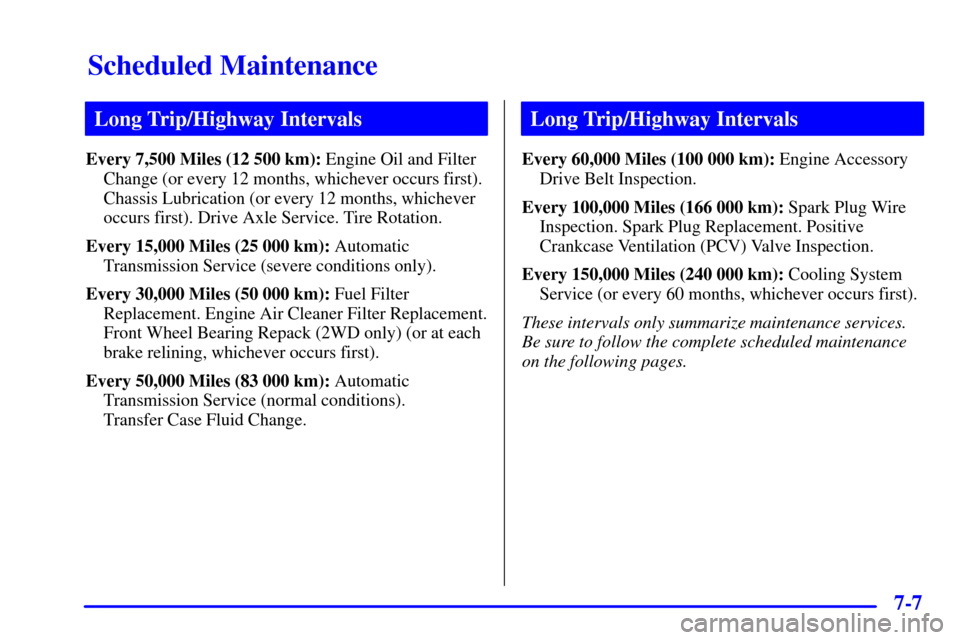
Long Trip/Highway Intervals
Every 7,500 Miles (12 500 km): Engine Oil and Filter
Change (or every 12 months, whichever occurs first).
Chassis Lubrication (or every 12 months, whichever
occurs first). Drive Axle Service. Tire Rotation.
Every 15,000 Miles (25 000 km): Automatic
Transmission Service (severe conditions only).
Every 30,000 Miles (50 000 km): Fuel Filter
Replacement. Engine Air Cleaner Filter Replacement.
Front Wheel Bearing Repack (2WD only) (or at each
brake relining, whichever occurs first).
Every 50,000 Miles (83 000 km): Automatic
Transmission Service (normal conditions).
Transfer Case Fluid Change.
Long Trip/Highway Intervals
Every 60,000 Miles (100 000 km): Engine Accessory
Drive Belt Inspection.
Every 100,000 Miles (166 000 km): Spark Plug Wire
Inspection. Spark Plug Replacement. Positive
Crankcase Ventilation (PCV) Valve Inspection.
Every 150,000 Miles (240 000 km): Cooling System
Service (or every 60 months, whichever occurs first).
These intervals only summarize maintenance services.
Be sure to follow the complete scheduled maintenance
on the following pages.
Page 341 of 388

Short Trip/City Scheduled Maintenance
7-20
60,000 Miles (100 000 km)
�Change engine oil and filter (or every 3 months, whichever occurs first).
An Emission Control Service.
�Lubricate chassis components (or every 3 months, whichever occurs first).
(See footnote #.)
�Check rear/front axle fluid level and add fluid as needed. Check constant
velocity joints and axle seals for leaking. (See footnote **.)
�For Two
-Wheel-Drive vehicles only: Clean and repack the front wheel
bearings (or at each brake relining, whichever occurs first).
�Change automatic transmission fluid and filter if the vehicle is mainly driven
under one or more of these conditions:
± In heavy city traffic where the outside temperature regularly reaches
90�F (32�C) or higher.
± In hilly or mountainous terrain.
± When doing frequent trailer towing.
± Uses such as found in taxi, police or delivery service.
If you do not use your vehicle under any of these conditions, change the fluid
and filter every 50,000 miles (83 000 km).
�Inspect engine accessory drive belt.
An Emission Control Service.
�Replace fuel filter.
An Emission Control Service. (See footnote�.)
ACTUAL
SERVICED BY:MILEAGE
DATE
Page 358 of 388
Long Trip/Highway Scheduled Maintenance
7-37
�Inspect engine accessory drive belt.
An Emission Control Service.
�Replace fuel filter.
An Emission Control Service. (See footnote�.)
�Replace engine air cleaner filter.
An Emission Control Service.
67,500 Miles (112 500 km)
�Change engine oil and filter (or every 12 months, whichever occurs first).
An Emission Control Service.
�Lubricate chassis components (or every 12 months, whichever occurs first).
(See footnote #.)
�Check rear/front axle fluid level and add fluid as needed. Check constant
velocity joints and axle seals for leaking. (See footnote **.)
�Rotate tires. See ªTire Inspection and Rotationº in the Index for proper
rotation pattern and additional information. (See footnote +.)ACTUAL
SERVICED BY:MILEAGE
DATE
Page 365 of 388
7-44 At Least Twice a Year
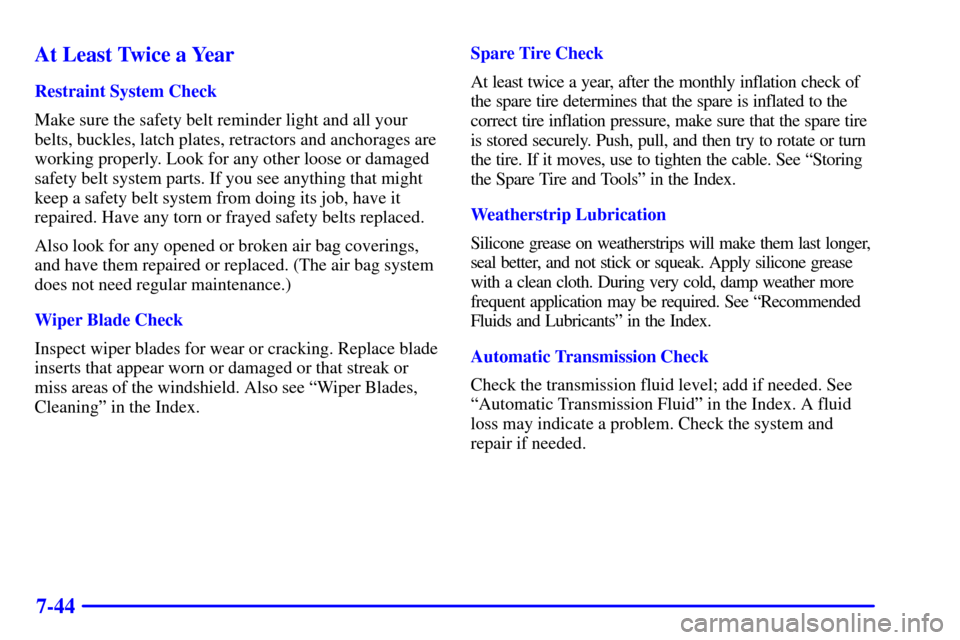
Restraint System Check
Make sure the safety belt reminder light and all your
belts, buckles, latch plates, retractors and anchorages are
working properly. Look for any other loose or damaged
safety belt system parts. If you see anything that might
keep a safety belt system from doing its job, have it
repaired. Have any torn or frayed safety belts replaced.
Also look for any opened or broken air bag coverings,
and have them repaired or replaced. (The air bag system
does not need regular maintenance.)
Wiper Blade Check
Inspect wiper blades for wear or cracking. Replace blade
inserts that appear worn or damaged or that streak or
miss areas of the windshield. Also see ªWiper Blades,
Cleaningº in the Index.Spare Tire Check
At least twice a year, after the monthly inflation check of
the spare tire determines that the spare is inflated to the
correct tire inflation pressure, make sure that the spare tire
is stored securely. Push, pull, and then try to rotate or turn
the tire. If it moves, use to tighten the cable. See ªStoring
the Spare Tire and Toolsº in the Index.
Weatherstrip Lubrication
Silicone grease on weatherstrips will make them last longer,
seal better, and not stick or squeak. Apply silicone grease
with a clean cloth. During very cold, damp weather more
frequent application may be required. See ªRecommended
Fluids and Lubricantsº in the Index.
Automatic Transmission Check
Check the transmission fluid level; add if needed. See
ªAutomatic Transmission Fluidº in the Index. A fluid
loss may indicate a problem. Check the system and
repair if needed.