Page 332 of 371
6-50
By pressing the INFO button, the DIC screen will show
which tire(s) has the low or high pressure condition.
See ªInflation
-- Tire Pressureº in the Index for
information regarding correct tire inflation. If a tire is
low, you should stop as soon as possible and check all
your tires for damage. If a tire is flat, see ªIf a Tire
Goes Flatº in the Index.
NOTICE:
Do not use a tire sealant if your vehicle is equipped
with Tire Pressure Monitors. The liquid sealant
can damage the tire pressure monitor sensors.
Once a low or high tire pressure condition is detected,
the TPM system will display the CHECK TIRE
MESSAGE each time the engine is started, until
the tire(s) are set to the correct inflation pressure.
The Tire Loading
-Information Label, which is located
on the rear edge of the driver's door, shows the correct
inflation pressure for the tires on your vehicle.The TPM system also allows the driver to check the
air pressure status of each road tire using the Driver
Information Center (DIC). Each tire's air pressure will
be listed individually, in the following order: LF (left
front or driver's side front tire), RF (right front or
passenger's side front tire), RR (right rear or passenger's
side rear tire) and LR (left rear or driver's side rear tire).
See ªInflation
-- Tire Pressureº in the Index for
information regarding correct tire inflation. Also, see
ªDriver Information Center (DIC)º in the Index for
information on the DIC controls and displays.
If the DIC display doesn't show tire pressures or
the SERVICE TPM SYSTEM message appears,
see your dealer for service. The TPM system may not
work properly while the compact spare tire is installed.
Anytime you replace one or more tires or rotate your
tires, the TPM system will need to be reset. A special
tool is needed to reset the sensor identification codes,
see your dealer for service.
The TPM system can alert you about a low or high tire
pressure condition, but it doesn't replace normal tire
maintenance. See ªTiresº in the Index.
Page 333 of 371
6-51 Tire Inspection and Rotation
Tires should be rotated every 6,000 to 8,000 miles
(10 000 to 13 000 km). Any time you notice unusual
wear, rotate your tires as soon as possible and check
wheel alignment. Also check for damaged tires or
wheels. See ªWhen It's Time for New Tiresº and
ªWheel Replacementº later in this section for
more information.
The purpose of regular rotation is to achieve more
uniform wear for all tires on the vehicle. The first
rotation is the most important. See ªScheduled
Maintenance Servicesº in the Maintenance Schedule
booklet for scheduled rotation intervals.
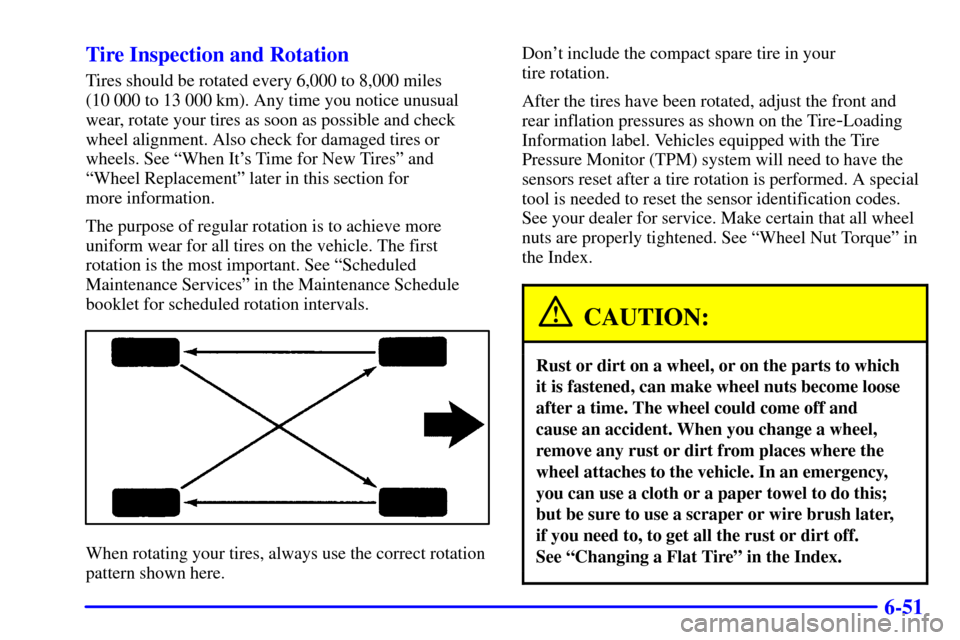
When rotating your tires, always use the correct rotation
pattern shown here.Don't include the compact spare tire in your
tire rotation.
After the tires have been rotated, adjust the front and
rear inflation pressures as shown on the Tire
-Loading
Information label. Vehicles equipped with the Tire
Pressure Monitor (TPM) system will need to have the
sensors reset after a tire rotation is performed. A special
tool is needed to reset the sensor identification codes.
See your dealer for service. Make certain that all wheel
nuts are properly tightened. See ªWheel Nut Torqueº in
the Index.
CAUTION:
Rust or dirt on a wheel, or on the parts to which
it is fastened, can make wheel nuts become loose
after a time. The wheel could come off and
cause an accident. When you change a wheel,
remove any rust or dirt from places where the
wheel attaches to the vehicle. In an emergency,
you can use a cloth or a paper towel to do this;
but be sure to use a scraper or wire brush later,
if you need to, to get all the rust or dirt off.
See ªChanging a Flat Tireº in the Index.
Page 350 of 371
6-68
Minifuses Usage
1 ALDL
2 Accessory
3 Windshield Wipers
4 Not Used
5 Headlamp Low Beam Left
6 Headlamp Low Beam RightMinifuses Usage
7 Instrument Panel
8 Powertrain Control
Module Battery
9 Headlamp High Beam Right
10 Headlamp High Beam Left
11 Ignition 1
12 Fog Lamps
13 Transmission
14 Cruise Control
15 Coil MDL
16 Injector Bank #2
17 Not Used
18 Not Used
19 Powertrain Control
Module Ignition
20 Oxygen Sensor
21 Injector Bank #1