Page 255 of 335

6-
6-1
Section 6 Service and Appearance Care
Here you will find information about the care of your vehicle. This section begins with service and fuel information,
and then it shows how to check important fluid and lubricant levels. There is also technical information about your
vehicle, and a part devoted to its appearance care.
6
-2 Service
6
-3 Fuel
6
-5 Fuels in Foreign Countries
6
-5 Filling Your Tank
6
-8 Filling a Portable Fuel Container
6
-8 Checking Things Under the Hood
6
-11 Engine Oil
6
-16 Engine Air Cleaner/Filter
6
-19 Automatic Transaxle Fluid
6
-22 Engine Coolant
6
-28 Windshield Washer Fluid
6
-29 Brakes
6
-32 Battery
6
-33 Bulb Replacement
6
-39 Windshield Wiper Blade Replacement
6
-40 Tires
6
-49 Appearance Care
6
-49 Cleaning the Inside of Your Vehicle6
-51 Care of Safety Belts
6
-51 Cleaning Glass Surfaces
6
-51 Cleaning the Outside of the Windshield and
Wiper Blades
6
-52 Weatherstrips
6
-52 Cleaning the Outside of Your Vehicle
6
-53 Cleaning Aluminum or Chrome-Plated
Wheels (If Equipped)
6
-54 Cleaning Tires
6
-54 Sheet Metal Damage
6
-55 Underbody Maintenance
6
-55 Chemical Paint Spotting
6
-56 GM Vehicle Care/Appearance Materials
6
-57 Vehicle Identification Number (VIN)
6
-58 Electrical System
6
-67 Replacement Bulbs
6
-67 Capacities and Specifications
6
-67 Normal Maintenance Replacement Parts
Page 256 of 335
6-2
Service
Your dealer knows your vehicle best and wants you to
be happy with it. We hope you'll go to your dealer for
all your service needs. You'll get genuine GM parts and
GM
-trained and supported service people.
We hope you'll want to keep your GM vehicle all GM.
Genuine GM parts have one of these marks:
Doing Your Own Service Work
If you want to do some of your own service work, you'll
want to use the proper service manual. It tells you much
more about how to service your vehicle than this
manual can. To order the proper service manual, see
ªService and Owner Publicationsº in the Index.
Your vehicle has an air bag system. Before attempting to
do your own service work, see ªServicing Your Air
Bag
-Equipped Vehicleº in the Index.
You should keep a record with all parts receipts and list
the mileage and the date of any service work you
perform. See ªMaintenance Recordº in the Maintenance
Schedule booklet.
Page 257 of 335
6-3
CAUTION:
You can be injured and your vehicle could be
damaged if you try to do service work on a
vehicle without knowing enough about it.
�Be sure you have sufficient knowledge,
experience, the proper replacement parts
and tools before you attempt any vehicle
maintenance task.
�Be sure to use the proper nuts, bolts and
other fasteners. ªEnglishº and ªmetricº
fasteners can be easily confused. If you use
the wrong fasteners, parts can later break
or fall off. You could be hurt.
Adding Equipment to the Outside of
Your Vehicle
Things you might add to the outside of your vehicle can
affect the airflow around it. This may cause wind noise
and affect windshield washer performance. Check with
your dealer before adding equipment to the outside of
your vehicle.
Fuel
Use regular unleaded gasoline rated at 87 octane or
higher. However, for best performance and for trailer
towing, you may wish to use middle grade or premium
unleaded gasoline.
It is recommended that the gasoline meet specifications
which were developed by the American Automobile
Manufacturers Association (AAMA) and endorsed by
the Canadian Motor Vehicle Manufacturers Association
for better vehicle performance and engine protection.
Gasolines meeting the AAMA specification could
provide improved driveability and emission control
system performance compared to other gasolines.
In Canada, look for the
ªAuto Makers' Choiceº
label on the fuel pump.
Canada Only
Page 271 of 335
6-17
3. Unhook both engine air cleaner/filter cover latches.
One latch is located near the radiator hose (not shown)
and the other latch is located next to the IAT sensor.
4. Pivot the air cleaner and air duct assembly toward
the front of the vehicle. Remove the cover.5. Take out the engine air cleaner/filter and remove any
loose debris that may be found in the base.
6. Install a new engine air cleaner/filter element. See
ªNormal Maintenance Replacement Partsº in the Index.
Page 272 of 335

6-18
Follow these steps to reinstall the engine air
cleaner/filter assembly:
1. Slide the lid into the slots in the front edge
of the base.
2. Pivot the cover and the air duct assembly
downward. Make sure that both latches are secure
and fully engaged.
3. Reinstall the clean air duct over the mass airflow
sensor. Make sure that the duct is secure around the
entire outer edge of the sensor.
4. Tighten the air duct clamp.
5. Reconnect the IAT sensor.
Refer to the Maintenance Schedule to determine when to
replace the air filter.
See ªScheduled Maintenance Servicesº in the
Maintenance Schedule booklet.
CAUTION:
Operating the engine with the air cleaner/filter
off can cause you or others to be burned. The air
cleaner not only cleans the air, it stops flame if
the engine backfires. If it isn't there, and the
engine backfires, you could be burned. Don't
drive with it off, and be careful working on the
engine with the air cleaner/filter off.
NOTICE:
If the air cleaner/filter is off, a backfire can cause
a damaging engine fire. And, dirt can easily
get into your engine, which will damage it.
Always have the air cleaner/filter in place when
you're driving.
Page 273 of 335
6-19
Automatic Transaxle Fluid
When to Check and Change
A good time to check your automatic transaxle fluid
level is when the engine oil is changed.
Change both the fluid and filter every 50,000 miles
(83 000 km) if the vehicle is mainly driven under one or
more of these conditions:
�In heavy city traffic where the outside temperature
regularly reaches 90�F (32�C) or higher.
�In hilly or mountainous terrain.
�When doing frequent trailer towing.
�Uses such as found in taxi, police or delivery service.
If you do not use your vehicle under any of these
conditions, the fluid and filter do not require change
until the message CHANGE TRANS FLUID appears on
the Driver Information Center.
See ªScheduled Maintenance Servicesº in the
Maintenance Schedule booklet.
How to Check
Because this operation can be a little difficult, you may
choose to have this done at the dealership service department.
If you do it yourself, be sure to follow all the instructions
here, or you could get a false reading on the dipstick.
NOTICE:
Too much or too little fluid can damage your
transaxle. Too much can mean that some of the
fluid could come out and fall on hot engine parts
or exhaust system parts, starting a fire. Be sure to
get an accurate reading if you check your
transaxle fluid.
Wait at least 30 minutes before checking the transaxle
fluid level if you have been driving:
�When outside temperatures are above 90�F (32�C).
�At high speed for quite a while.
�In heavy traffic
-- especially in hot weather.
�While pulling a trailer.
Page 275 of 335
6-21
2. Push it back in all the way, wait three seconds and
then pull it back out again.
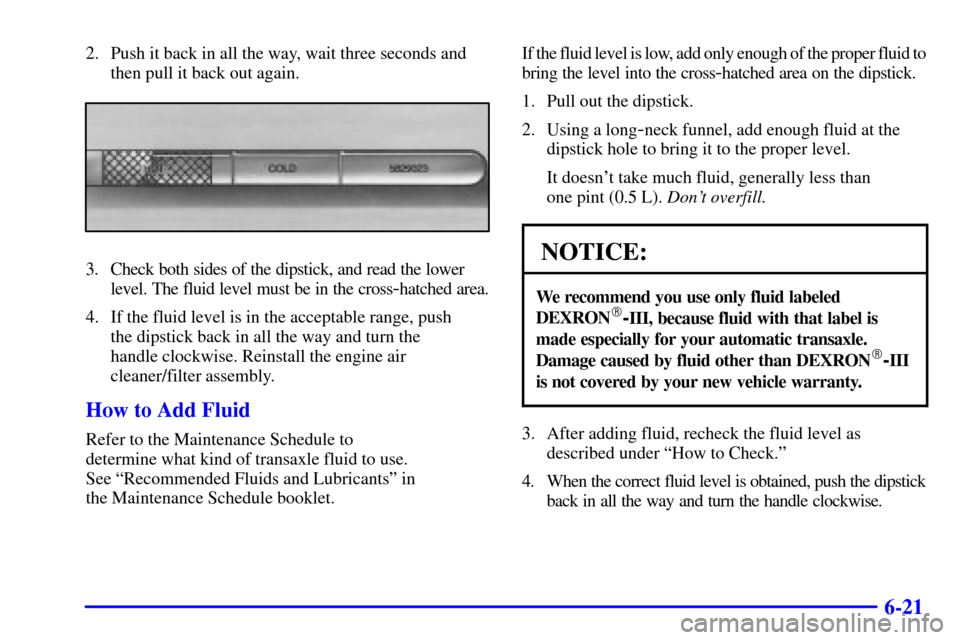
3. Check both sides of the dipstick, and read the lower
level. The fluid level must be in the cross
-hatched area.
4. If the fluid level is in the acceptable range, push
the dipstick back in all the way and turn the
handle clockwise. Reinstall the engine air
cleaner/filter assembly.
How to Add Fluid
Refer to the Maintenance Schedule to
determine what kind of transaxle fluid to use.
See ªRecommended Fluids and Lubricantsº in
the Maintenance Schedule booklet.If the fluid level is low, add only enough of the proper fluid to
bring the level into the cross
-hatched area on the dipstick.
1. Pull out the dipstick.
2. Using a long
-neck funnel, add enough fluid at the
dipstick hole to bring it to the proper level.
It doesn't take much fluid, generally less than
one pint (0.5 L). Don't overfill.
NOTICE:
We recommend you use only fluid labeled
DEXRON�-III, because fluid with that label is
made especially for your automatic transaxle.
Damage caused by fluid other than DEXRON
�-III
is not covered by your new vehicle warranty.
3. After adding fluid, recheck the fluid level as
described under ªHow to Check.º
4. When the correct fluid level is obtained, push the dipstick
back in all the way and turn the handle clockwise.
Page 276 of 335
6-22 How to Reset Transaxle Fluid
Change Indicator
Your vehicle is equipped with a transaxle fluid change
indicator. A CHANGE TRANS FLUID message will
display on the Driver Information Center (DIC) when
the powertrain computer determines that the transaxle
fluid needs to be changed or at each 100,000 miles
(160 000 km) interval, whichever occurs first. See your
Maintenance Schedule booklet for more information.
When this message appears, change the transaxle fluid
and reset the transaxle fluid life indicator as follows:
1. Turn the ignition on but do not start the engine.
2. Press and hold the OFF and rear defog buttons on the
climate control system at the same time until the
TRANS FLUID RESET message appears on
the DIC.
Engine Coolant
The cooling system in your vehicle is filled with
DEX
-COOL� engine coolant. This coolant is designed
to remain in your vehicle for 5 years or 150,000 miles
(240 000 km), whichever occurs first, if you add only
DEX
-COOL� extended life coolant.
The following explains your cooling system and how to add
coolant when it is low. If you have a problem with engine
overheating, see ªEngine Overheatingº in the Index.
A 50/50 mixture of clean, drinkable water and
DEX
-COOL� coolant will:
�Give freezing protection down to
-34�F (-37�C).
�Give boiling protection up to 265�F (129�C).
�Protect against rust and corrosion.
�Help keep the proper engine temperature.
�Let the warning lights and gages work as they should.