Page 36 of 335
1-24
How does an air bag restrain?
In moderate to severe frontal or near
-frontal collisions,
even belted occupants can contact the steering wheel or
the instrument panel. Air bags supplement the protection
provided by safety belts. Air bags distribute the force of
the impact more evenly over the occupant's upper body,
stopping the occupant more gradually. But air bags would
not help you in many types of collisions, including
rollovers, rear impacts and side impacts, primarily because
an occupant's motion is not toward those air bags.
Air bags should never be regarded as anything more than
a supplement to safety belts, and then only in moderate
to severe frontal or near
-frontal collisions.
What will you see after an air bag inflates?
After an air bag inflates, it quickly deflates, so quickly
that some people may not even realize the air bag
inflated. Some components of the air bag module
-- the
steering wheel hub for the driver's air bag, or the
instrument panel for the right front passenger's
bag
-- will be hot for a short time. The parts of the bag
that come into contact with you may be warm, but not
too hot to touch. There will be some smoke and dust
coming from vents in the deflated air bags. Air bag
inflation doesn't prevent the driver from seeing or from
being able to steer the vehicle, nor does it stop people
from leaving the vehicle.
CAUTION:
When an air bag inflates, there is dust in the air.
This dust could cause breathing problems for
people with a history of asthma or other
breathing trouble. To avoid this, everyone in the
vehicle should get out as soon as it is safe to do so.
If you have breathing problems but can't get out
of the vehicle after an air bag inflates, then get
fresh air by opening a window or door.
Your vehicle has a feature that will automatically unlock
the doors and turn the interior lamps on when the air
bags inflate (if battery power is available). You can lock
the doors again and turn the interior lamps off by using
the door lock and interior lamp controls.
In many crashes severe enough to inflate an air bag,
windshields are broken by vehicle deformation.
Additional windshield breakage may also occur from
the right front passenger air bag.
Page 38 of 335
1-26
Rear Seat Passengers
It's very important for rear seat passengers to buckle up!
Accident statistics show that unbelted people in the rear
seat are hurt more often in crashes than those who are
wearing safety belts.
Rear passengers who aren't safety belted can be thrown
out of the vehicle in a crash. And they can strike others
in the vehicle who are wearing safety belts.
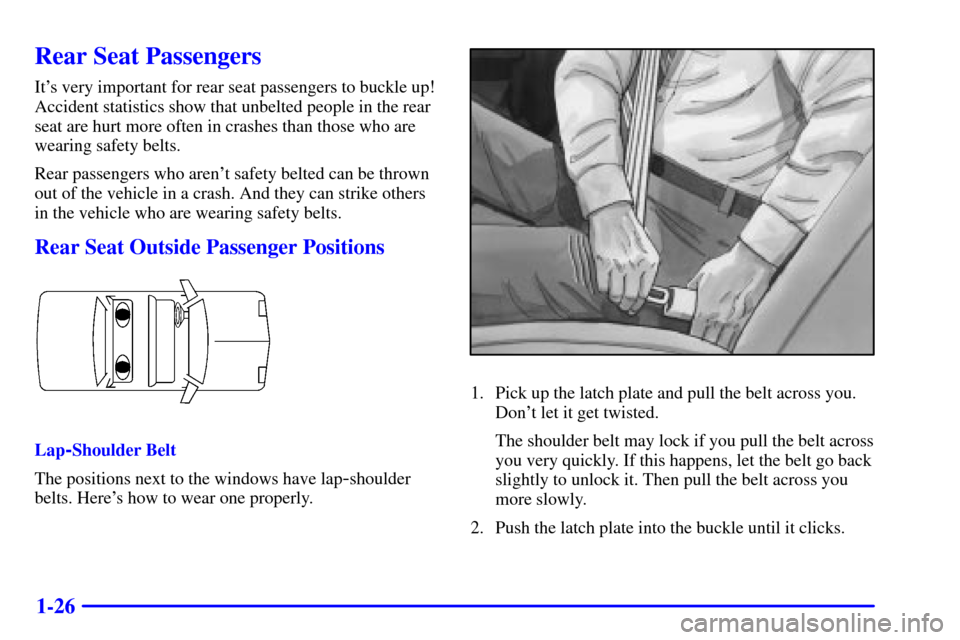
Rear Seat Outside Passenger Positions
Lap-Shoulder Belt
The positions next to the windows have lap
-shoulder
belts. Here's how to wear one properly.
1. Pick up the latch plate and pull the belt across you.
Don't let it get twisted.
The shoulder belt may lock if you pull the belt across
you very quickly. If this happens, let the belt go back
slightly to unlock it. Then pull the belt across you
more slowly.
2. Push the latch plate into the buckle until it clicks.
Page 40 of 335
1-28
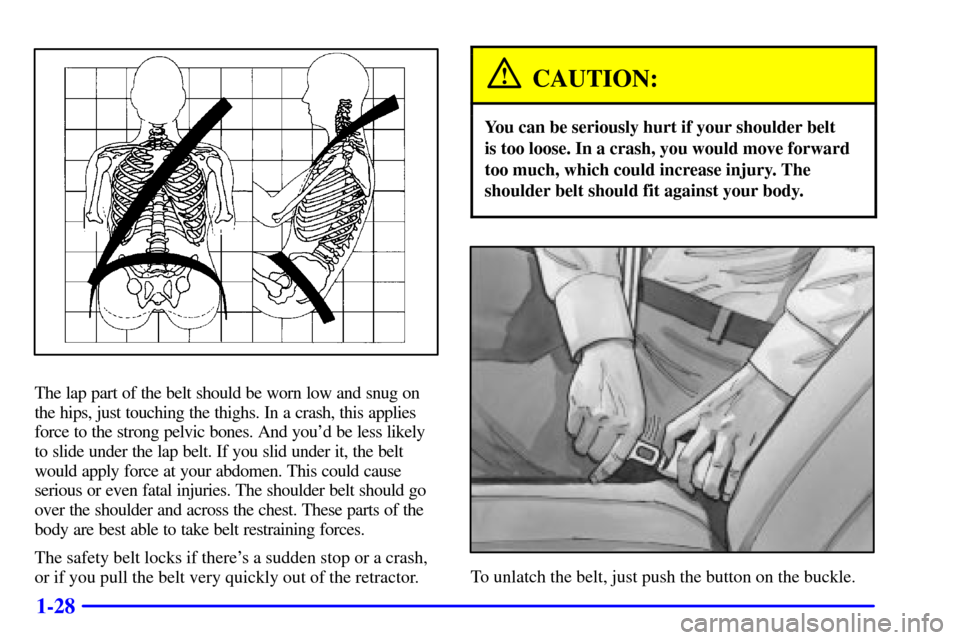
The lap part of the belt should be worn low and snug on
the hips, just touching the thighs. In a crash, this applies
force to the strong pelvic bones. And you'd be less likely
to slide under the lap belt. If you slid under it, the belt
would apply force at your abdomen. This could cause
serious or even fatal injuries. The shoulder belt should go
over the shoulder and across the chest. These parts of the
body are best able to take belt restraining forces.
The safety belt locks if there's a sudden stop or a crash,
or if you pull the belt very quickly out of the retractor.
CAUTION:
You can be seriously hurt if your shoulder belt
is too loose. In a crash, you would move forward
too much, which could increase injury. The
shoulder belt should fit against your body.
To unlatch the belt, just push the button on the buckle.
Page 56 of 335
1-44
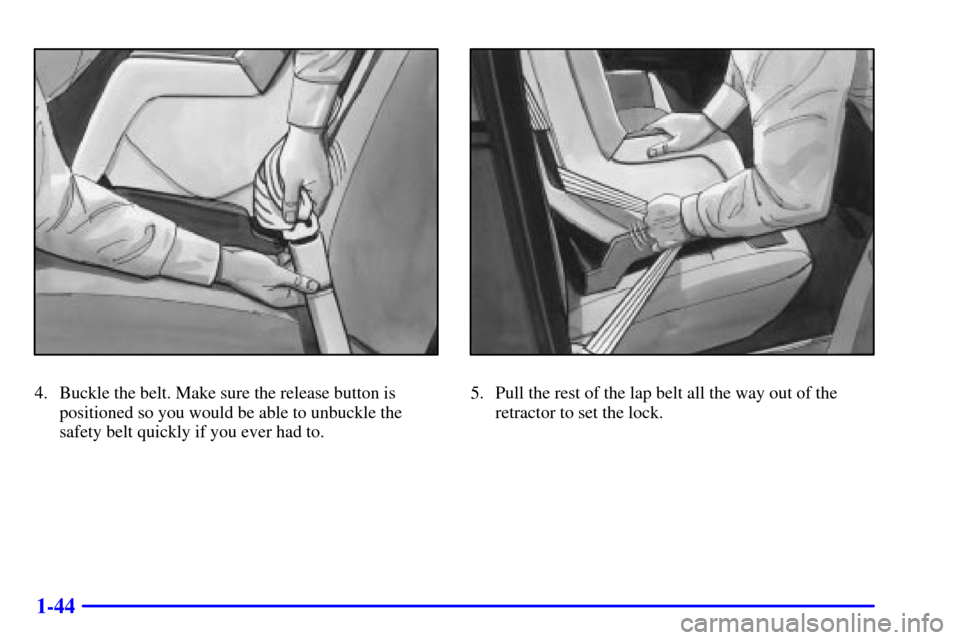
4. Buckle the belt. Make sure the release button is
positioned so you would be able to unbuckle the
safety belt quickly if you ever had to.5. Pull the rest of the lap belt all the way out of the
retractor to set the lock.
Page 62 of 335
2-
2-1
Section 2 Features and Controls
Here you can learn about the many standard and optional features on your vehicle, and information on starting,
shifting and braking. Also explained are the instrument panel and the warning systems that tell you if everything is
working properly
-- and what to do if you have a problem.
2
-2 Windows
2
-4 Keys
2
-6 Door Locks
2
-8 Remote Keyless Entry System
2
-12 Trunk
2
-14 Theft
2
-15 Theft-Deterrent System
2
-17 PASS-Key� II
2
-18 New Vehicle ªBreak-Inº
2
-19 Ignition Positions
2
-20 Starting Your Engine
2
-21 Engine Coolant Heater (If Equipped)
2
-23 Automatic Transaxle Operation
2
-26 Parking Brake
2
-28 Shifting Into PARK (P)
2
-30 Shifting Out of PARK (P)2
-31 Parking Over Things That Burn
2
-31 Engine Exhaust
2
-32 Running Your Engine While You're Parked
2
-33 Tilt Wheel
2
-33 Turn Signal/Multifunction Lever
2
-41 Exterior Lamps
2
-46 Interior Lamps
2
-47 Mirrors
2
-51 Storage Compartments
2
-53 Sun Visors
2
-54 OnStar� System (If Equipped)
2
-57 Sunroof (Option)
2
-58 HomeLink� Transmitter (Option)
2
-62 The Instrument Panel -- Your
Information System
2
-66 Warning Lights, Gages and Indicators
2
-76 Driver Information Center (DIC)
Page 66 of 335
2-5
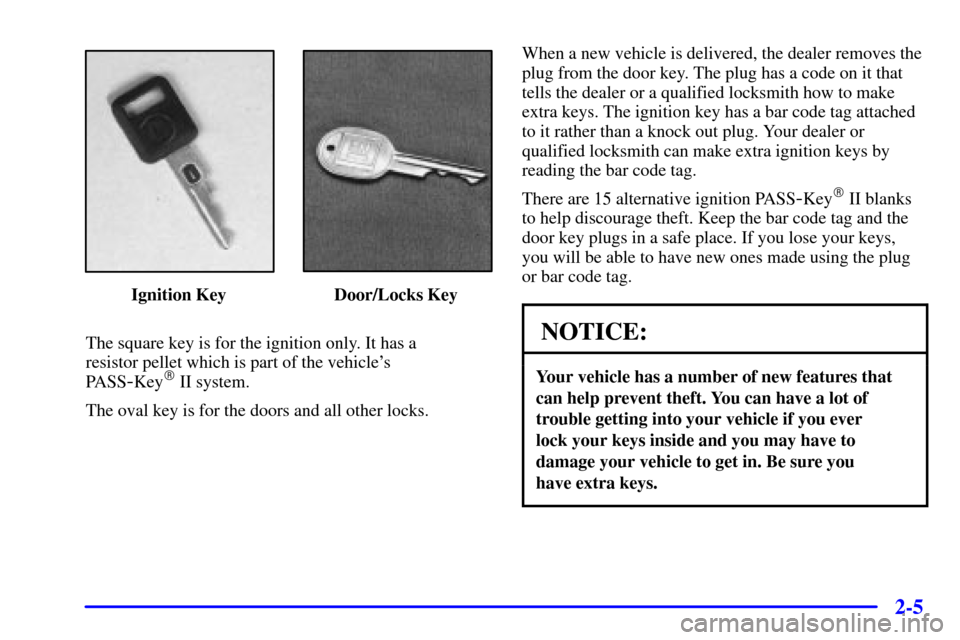
Ignition Key Door/Locks Key
The square key is for the ignition only. It has a
resistor pellet which is part of the vehicle's
PASS
-Key� II system.
The oval key is for the doors and all other locks.When a new vehicle is delivered, the dealer removes the
plug from the door key. The plug has a code on it that
tells the dealer or a qualified locksmith how to make
extra keys. The ignition key has a bar code tag attached
to it rather than a knock out plug. Your dealer or
qualified locksmith can make extra ignition keys by
reading the bar code tag.
There are 15 alternative ignition PASS
-Key� II blanks
to help discourage theft. Keep the bar code tag and the
door key plugs in a safe place. If you lose your keys,
you will be able to have new ones made using the plug
or bar code tag.
NOTICE:
Your vehicle has a number of new features that
can help prevent theft. You can have a lot of
trouble getting into your vehicle if you ever
lock your keys inside and you may have to
damage your vehicle to get in. Be sure you
have extra keys.
Page 67 of 335
2-6
Door Locks
CAUTION:
Unlocked doors can be dangerous.
�Passengers -- especially children -- can
easily open the doors and fall out of a
moving vehicle. When a door is locked,
the handle won't open it. You increase the
chance of being thrown out of the vehicle in
a crash if the doors aren't locked. So, wear
safety belts properly and lock the doors
whenever you drive.
�Young children who get into unlocked
vehicles may be unable to get out. A child
can be overcome by extreme heat and can
suffer permanent injuries or even death
from heat stroke. Always lock your vehicle
whenever you leave it.
�Outsiders can easily enter through an
unlocked door when you slow down or stop
your vehicle. Locking your doors can help
prevent this from happening.
There are several ways to lock and unlock your vehicle.
From the outside, use either the door key or the remote
keyless entry transmitter.
If your vehicle is equipped with the theft
-deterrent
system, you must unlock the doors with the key or
remote keyless entry transmitter to avoid setting off
the alarm.
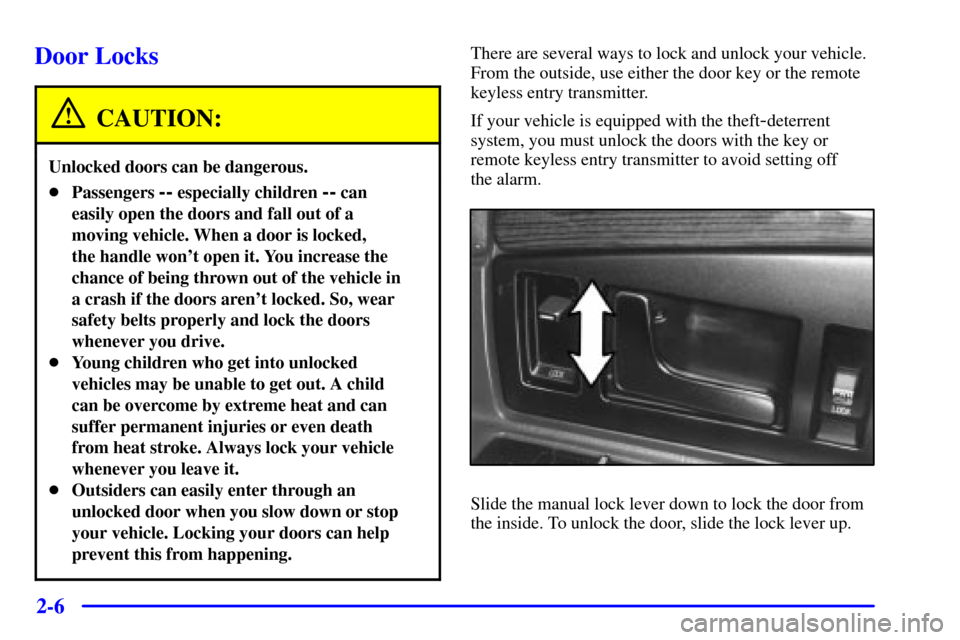
Slide the manual lock lever down to lock the door from
the inside. To unlock the door, slide the lock lever up.
Page 68 of 335
2-7 Central Door Unlocking System
Your vehicle will have this feature if it is equipped with
the theft
-deterrent system. When unlocking either door,
you can also unlock the other door by holding the key in
the turned position for a few seconds or by quickly
turning the door key twice in the lock cylinder.
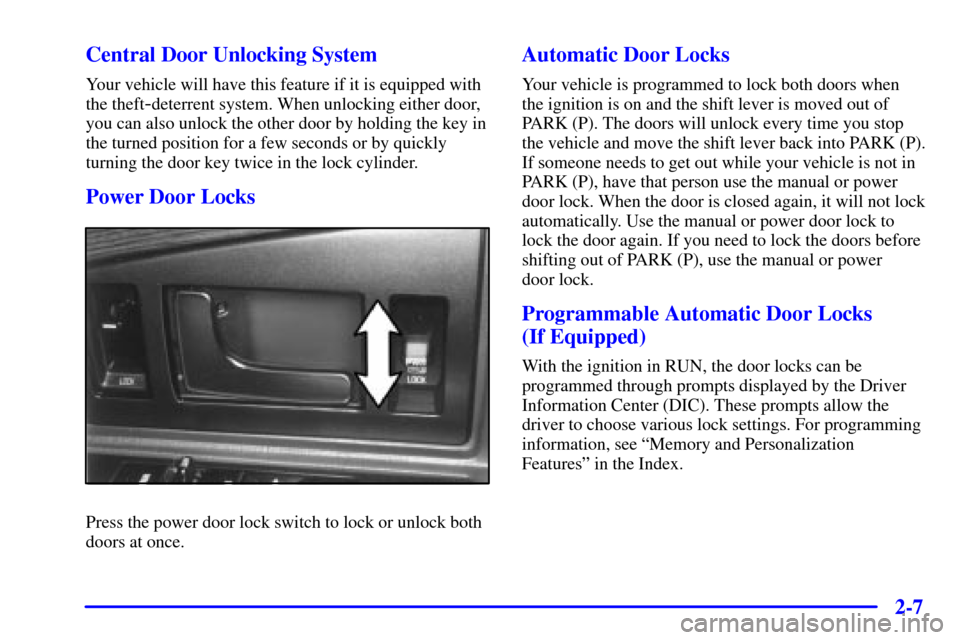
Power Door Locks
Press the power door lock switch to lock or unlock both
doors at once.
Automatic Door Locks
Your vehicle is programmed to lock both doors when
the ignition is on and the shift lever is moved out of
PARK (P). The doors will unlock every time you stop
the vehicle and move the shift lever back into PARK (P).
If someone needs to get out while your vehicle is not in
PARK (P), have that person use the manual or power
door lock. When the door is closed again, it will not lock
automatically. Use the manual or power door lock to
lock the door again. If you need to lock the doors before
shifting out of PARK (P), use the manual or power
door lock.
Programmable Automatic Door Locks
(If Equipped)
With the ignition in RUN, the door locks can be
programmed through prompts displayed by the Driver
Information Center (DIC). These prompts allow the
driver to choose various lock settings. For programming
information, see ªMemory and Personalization
Featuresº in the Index.