Page 4 of 397
ii
Table of Contents
Windows
Keys and Door Locks
Remote Keyless Entry System
Trunk Release
Automatic Transaxle
Parking Brake
Tilt Wheel
Turn Signal/Multifunction Lever
Windshield Wipers
Cruise Control
Exterior and Interior Lamps
MirrorsStorage Compartments
Convenience Net
Accessory Power Outlets
OnStar® System (If Equipped)
Sunroof (Option)
HomeLink® Transmitter (If Equipped)
Instrument Panel, Warning Lights and Gages
Driver Information Center (DIC)
Vehicle Programming and Personalization
Features (If Equipped)
Night Vision System (Option)
Ultrasonic Rear Parking Assist (URPA) (Option) Seats and Seat Controls
Safety BeltsAir Bag Systems
Restraint Systems for Children
Section
1
Section
2
Seats and Restraint Systems
Features and Controls
Page 11 of 397

ix
For example,
these symbols
are used on an
original battery:
CAUTION
POSSIBLE
INJURY
PROTECT
EYES BY
SHIELDING
CAUSTIC
BATTERY
ACID COULD
CAUSE
BURNS
AVOID
SPARKS OR
FLAMES
SPARK OR
FLAME
COULD
EXPLODE
BATTERY
These symbols
are important for
you and your
passengers
whenever your
vehicle is driven:
CHILD
RESTRAINT
TOP STRAP
ANCHOR
DOOR LOCK
UNLOCK
FASTEN
SEAT
BELTS
POWER
WINDOW
AIR BAG
These symbols
have to do with
your lamps:
MASTER
LIGHTING
SWITCH
TURN
SIGNALS
PARKING
LAMPS
HAZARD
WARNING
FLASHER
DAYTIME
RUNNING
LAMPS
FOG LAMPS
These symbols
are on some of
your controls:
WINDSHIELD
WIPER
WINDSHIELD
WASHER
WINDSHIELD
DEFROSTER
REAR
WINDOW
DEFOGGER
VENTILATING
FAN
These symbols
are used on
warning and
indicator lights:
ENGINE
COOLANT
TEMP
BATTERY
CHARGING
SYSTEM
BRAKE
COOLANT
ENGINE OIL
PRESSURE
ANTI-LOCK
BRAKES
Here are some
other symbols
you may see:
FUSE
LIGHTER
HORN
FUEL
Vehicle Symbols
These are some of the symbols you may find on your vehicle. Also see ªWarning Lights and Gagesº in the Index.
Page 71 of 397

2-
2-1
Section 2 Features and Controls
Here you can learn about the many standard and optional features on your vehicle, and information on starting,
shifting and braking. Also explained are the instrument panel and the warning systems that tell you if everything is
working properly
-- and what to do if you have a problem.
2
-2 Windows
2
-4 Keys
2
-6 Door Locks
2
-9 Remote Keyless Entry System
2
-13 Trunk
2
-16 Theft
2
-17 Theft-Deterrent System
2
-19 PASS-Key� III
2
-22 New Vehicle ªBreak-Inº
2
-22 Ignition Positions
2
-24 Starting Your Engine
2
-25 Engine Coolant Heater (If Equipped)
2
-26 Automatic Transaxle Operation
2
-31 Parking Brake
2
-33 Shifting Into PARK (P)
2
-36 Shifting Out of PARK (P)
2
-38 Parking Over Things That Burn
2
-39 Engine Exhaust
2
-39 Running Your Engine While You're Parked2
-40 Tilt Wheel
2
-42 Turn Signal/Multifunction Lever
2
-50 Exterior Lamps
2
-55 Interior Lamps
2
-57 Mirrors
2
-61 Storage Compartments
2
-65 Rear Power Sunshade (If Equipped)
2
-66 Cellular Telephone (Option)
2
-67 OnStar� System (If Equipped)
2
-71 Sunroof (Option)
2
-72 HomeLink� Transmitter (If Equipped)
2
-76 The Instrument Panel -- Your
Information System
2
-82 Warning Lights, Gages and Indicators
2
-96 Driver Information Center (DIC)
2
-114 Night Vision System (Option)
2
-117 Navigation (Option)
2
-118 Ultrasonic Rear Parking
Assist (URPA) (Option)
Page 74 of 397
2-4
Keys
CAUTION:
Leaving children in a vehicle with the ignition
key is dangerous for many reasons. A child or
others could be badly injured or even killed.
They could operate the power windows or other
controls or even make the vehicle move. If they
turned the ignition to ON and moved the shift
lever out of PARK (P), that would release the
parking brake. Don't leave the keys in a vehicle
with children.
Page 97 of 397
2-27
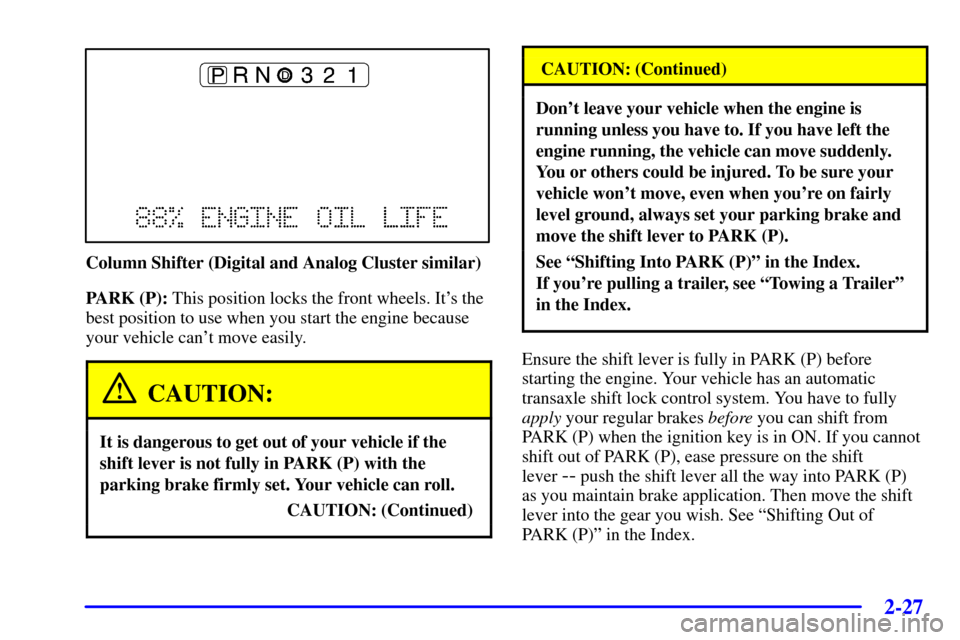
Column Shifter (Digital and Analog Cluster similar)
PARK (P): This position locks the front wheels. It's the
best position to use when you start the engine because
your vehicle can't move easily.
CAUTION:
It is dangerous to get out of your vehicle if the
shift lever is not fully in PARK (P) with the
parking brake firmly set. Your vehicle can roll.
CAUTION: (Continued)
CAUTION: (Continued)
Don't leave your vehicle when the engine is
running unless you have to. If you have left the
engine running, the vehicle can move suddenly.
You or others could be injured. To be sure your
vehicle won't move, even when you're on fairly
level ground, always set your parking brake and
move the shift lever to PARK (P).
See ªShifting Into PARK (P)º in the Index.
If you're pulling a trailer, see ªTowing a Trailerº
in the Index.
Ensure the shift lever is fully in PARK (P) before
starting the engine. Your vehicle has an automatic
transaxle shift lock control system. You have to fully
apply your regular brakes before you can shift from
PARK (P) when the ignition key is in ON. If you cannot
shift out of PARK (P), ease pressure on the shift
lever
-- push the shift lever all the way into PARK (P)
as you maintain brake application. Then move the shift
lever into the gear you wish. See ªShifting Out of
PARK (P)º in the Index.
Page 101 of 397

2-31
Parking Brake
Hold the regular brake
pedal down with your right
foot and push the parking
brake pedal down with
your left foot to set the
parking brake.
If the ignition is on, the BRAKE indicator light on the
instrument panel cluster should come on. If it doesn't,
you need to have your vehicle serviced.
When you move out of PARK (P) or NEUTRAL (N)
and the engine is running, the parking brake should
release. If the parking brake has not been fully released
and you try to drive off with the parking brake on, the
BRAKE indicator light will come on and stay on.If the parking brake doesn't fully release, you can
manually release the lever. Before attempting to
release the lever however, be sure to read the
following paragraphs.
CAUTION:
Always shift to PARK (P) before pulling the
manual release lever. If your hand or arm is in
the way of the pedal you could be hurt. The pedal
springs back quickly. Keep your hand and arm
away when you use the manual release lever.
Before releasing the manual parking brake, be sure
to put the vehicle in PARK (P) and turn the ignition
to OFF.
Page 102 of 397
2-32
Reach under the driver's side of the instrument panel
and pull on the manual release lever, which is located
above the parking brake pedal. If the parking brake does
not release, your vehicle needs service.
NOTICE:
Driving with the parking brake on can cause
your rear brakes to overheat. You may have to
replace them and you could also damage other
parts of your vehicle.
If you are towing a trailer and are parking on a hill, see
ªTowing a Trailerº in the Index. This section shows
what to do first to keep the trailer from moving. For
more information, see ªBrake System Warning and Park
Brake Indicator Lightº in the Index.
Page 103 of 397
2-33
Shifting Into PARK (P)
CAUTION:
It can be dangerous to get out of your vehicle if
the shift lever is not fully in PARK (P) with the
parking brake firmly set. Your vehicle can roll.
If you have left the engine running, the vehicle
can move suddenly. You or others could be
injured. To be sure your vehicle won't move,
even when you're on fairly level ground, use the
steps that follow. If you're pulling a trailer, see
ªTowing a Trailerº in the Index.
Steering Column Shift Lever (If Equipped)
1. Hold the brake pedal down with your right foot.
2. Move the shift lever into PARK (P) like this:
�Pull the lever toward you.


