Page 115 of 365

2-46 Cornering Lamps
The cornering lamps are designed to come on when
you signal a turn. This will provide more light for
cornering at night.
Interior Lamps
Instrument Panel Brightness Control
You can brighten or dim the instrument panel lights by
moving the LIGHTS dial. If you turn the dial past
MAX, your courtesy or interior lamps will come on.
Courtesy Lamps
When any door is opened, several lamps come on. These
lamps are courtesy lamps. They make it easy for you to
enter and leave your vehicle. You can also turn these
lamps on by twisting or turning the interior lights knob
all the way to the right.
Illuminated Entry
Your courtesy lamps will come on and stay on for a set
time whenever you press UNLOCK on the remote
keyless entry transmitter.
If you open a door, the lamps will stay on while it's open
and then turn off automatically about 25 seconds after
you close it. If you press UNLOCK and don't open a
door, the lamps will turn off after about 40 seconds.
Illuminated entry includes a feature called theater
dimming. With theater dimming, the lamps don't just
turn off at the end of the delay time. Instead, they slowly
dim after the delay time until they go out. The delay
time is canceled if you turn the ignition key to RUN or
START, so the lamps will dim right away.
When the ignition is on, illuminated entry is inactive,
which means the courtesy lamps won't come on unless a
door is opened.
ProCarManuals.com
Page 117 of 365

2-48 Perimeter Lighting
Perimeter lighting provides a period of exterior vehicle
lighting as the driver and passengers approach the
vehicle. Perimeter lighting is only activated when the
function is enabled, the doors are closed, the ignition
is in OFF and the security feedback feature is in
Mode 3 or 4. (See ªSecurity Feedbackº in the Index for
more information.) The vehicle headlamps and back
-up
lamps are then activated for a period of 25 seconds or
until the ignition switch is turned to RUN.
You may enable or disable the perimeter lighting feature
when the driver performs the following sequence with
the engine not running, the doors closed:
1. Turn the ignition to RUN.
2. Close all the doors.
3. Apply your brakes.
4. Press and hold the power door lock switch.
While holding the door lock switch press and
release the remote alarm button on the remote
keyless entry transmitter.This will initialize the customization mode. While in the
customization mode, the feature will sound the number
of chimes corresponding to the current mode. In
Mode 1, one chime means the feature is disabled. In
Mode 2, two chimes signal that the perimeter lighting
feature is enabled. Each additional press will advance
the mode by one, starting from the current mode.
During this procedure, the feature will sound the
number of chimes corresponding to the mode.
When the lock switch is released, the vehicle will
remain in the last mode.
Disconnecting the vehicle's battery for up to a year will
not change the programmed operation of this feature.
Rearview Mirror Reading Lamps
The reading lamps are located on the underside of the
rearview mirror.
Use the switch next to each lamp to turn them
on and off.
Dome Lamp (If Equipped)
The dome lamp will come on when you open a door.
ProCarManuals.com
Page 131 of 365
2-62
The Instrument Panel -- Your Information System
The main components of the instrument panel are the following:
A. Lamp Controls
B. Turn Signal/Multifunction Lever
C. Instrument Panel Cluster
D. Steering Wheel Audio Controls
(If Equipped)E. Vents
F. Side Window Defog Vent
G. Hood Release
H. Tilt Wheel
I. HornJ. Audio System
K. Ashtray
L. Climate Control
M. Glove Box
N. Instrument Panel Fuse Block
ProCarManuals.com
Page 135 of 365

2-66
Warning Lights, Gages
and Indicators
This part describes the warning lights and gages that
may be on your vehicle. The pictures will help you
locate them.
Warning lights and gages can signal that something is
wrong before it becomes serious enough to cause an
expensive repair or replacement. Paying attention to
your warning lights and gages could also save you or
others from injury.
Warning lights come on when there may be or is a
problem with one of your vehicle's functions. As you
will see in the details on the next few pages, some
warning lights come on briefly when you start the
engine just to let you know they're working. If you are
familiar with this section, you should not be alarmed
when this happens.
Gages can indicate when there may be or is a problem
with one of your vehicle's functions. Often gages and
warning lights work together to let you know when
there's a problem with your vehicle.When one of the warning lights comes on and stays on
when you are driving, or when one of the gages shows
there may be a problem, check the section that tells you
what to do about it. Please follow this manual's advice.
Waiting to do repairs can be costly
-- and even
dangerous. So please get to know your warning lights
and gages. They're a big help.
Your vehicle may also have a driver information center
that works along with the warning lights and gages.
See ªDriver Information Centerº in the Index.
Safety Belt Reminder Light
When the key is turned to RUN or START, a chime will
come on for about eight seconds to remind people to
fasten their safety belts, unless the driver's safety belt is
already buckled.
The safety belt light will
also come on and stay on
for about 20 seconds,
then it will flash for
about 55 seconds.
If the driver's belt is already buckled, neither the chime
nor the light will come on.
ProCarManuals.com
Page 194 of 365

4-16
�Do not get too close to the vehicle you want to pass
while you're awaiting an opportunity. For one thing,
following too closely reduces your area of vision,
especially if you're following a larger vehicle.
Also, you won't have adequate space if the vehicle
ahead suddenly slows or stops. Keep back a
reasonable distance.
�When it looks like a chance to pass is coming up,
start to accelerate but stay in the right lane and don't
get too close. Time your move so you will be
increasing speed as the time comes to move into the
other lane. If the way is clear to pass, you will have a
ªrunning startº that more than makes up for the
distance you would lose by dropping back. And if
something happens to cause you to cancel your pass,
you need only slow down and drop back again and
wait for another opportunity.
�If other cars are lined up to pass a slow vehicle, wait
your turn. But take care that someone isn't trying to
pass you as you pull out to pass the slow vehicle.
Remember to glance over your shoulder and check
the blind spot.�Check your mirrors, glance over your shoulder, and
start your left lane change signal before moving out
of the right lane to pass. When you are far enough
ahead of the passed vehicle to see its front in your
inside mirror, activate your right lane change signal
and move back into the right lane. (Remember that
your right outside mirror is convex. The vehicle you
just passed may seem to be farther away from you
than it really is.)
�Try not to pass more than one vehicle at a time
on two
-lane roads. Reconsider before passing the
next vehicle.
�Don't overtake a slowly moving vehicle too rapidly.
Even though the brake lamps are not flashing, it may
be slowing down or starting to turn.
�If you're being passed, make it easy for the
following driver to get ahead of you. Perhaps you
can ease a little to the right.
ProCarManuals.com
Page 198 of 365

4-20
Driving in Rain and on Wet RoadsRain and wet roads can mean driving trouble. On a wet
road, you can't stop, accelerate or turn as well because
your tire
-to-road traction isn't as good as on dry roads.
And, if your tires don't have much tread left, you'll get
even less traction. It's always wise to go slower and be
cautious if rain starts to fall while you are driving. The
surface may get wet suddenly when your reflexes are
tuned for driving on dry pavement.
The heavier the rain, the harder it is to see. Even if your
windshield wiper blades are in good shape, a heavy rain
can make it harder to see road signs and traffic signals,
pavement markings, the edge of the road and even
people walking.
It's wise to keep your windshield wiping equipment in
good shape and keep your windshield washer tank filled
with washer fluid. Replace your windshield wiper
inserts when they show signs of streaking or missing
areas on the windshield, or when strips of rubber start to
separate from the inserts.
ProCarManuals.com
Page 201 of 365
4-23
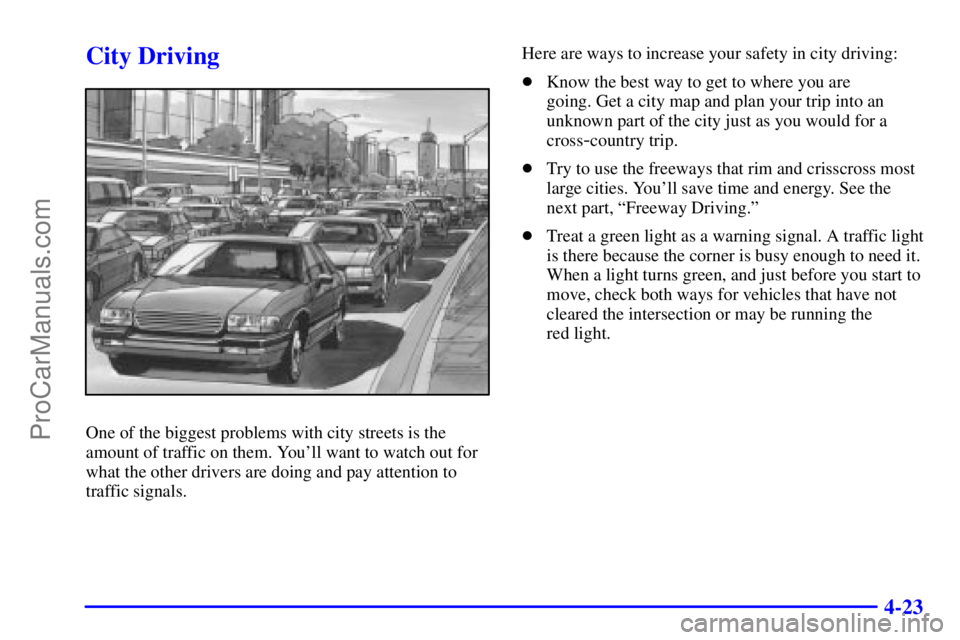
City Driving
One of the biggest problems with city streets is the
amount of traffic on them. You'll want to watch out for
what the other drivers are doing and pay attention to
traffic signals.Here are ways to increase your safety in city driving:
�Know the best way to get to where you are
going. Get a city map and plan your trip into an
unknown part of the city just as you would for a
cross
-country trip.
�Try to use the freeways that rim and crisscross most
large cities. You'll save time and energy. See the
next part, ªFreeway Driving.º
�Treat a green light as a warning signal. A traffic light
is there because the corner is busy enough to need it.
When a light turns green, and just before you start to
move, check both ways for vehicles that have not
cleared the intersection or may be running the
red light.
ProCarManuals.com
Page 202 of 365
4-24
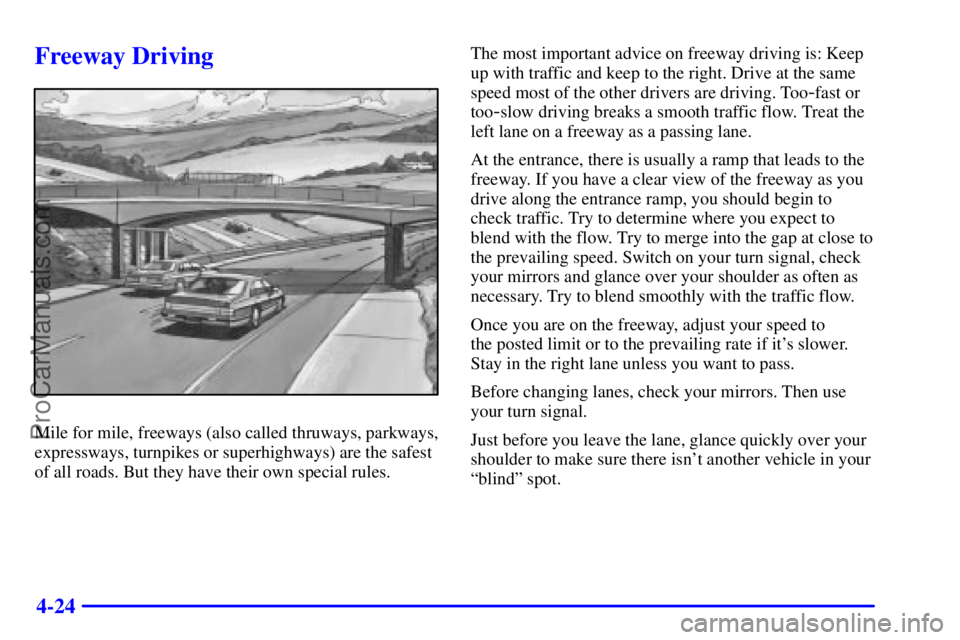
Freeway Driving
Mile for mile, freeways (also called thruways, parkways,
expressways, turnpikes or superhighways) are the safest
of all roads. But they have their own special rules.The most important advice on freeway driving is: Keep
up with traffic and keep to the right. Drive at the same
speed most of the other drivers are driving. Too
-fast or
too
-slow driving breaks a smooth traffic flow. Treat the
left lane on a freeway as a passing lane.
At the entrance, there is usually a ramp that leads to the
freeway. If you have a clear view of the freeway as you
drive along the entrance ramp, you should begin to
check traffic. Try to determine where you expect to
blend with the flow. Try to merge into the gap at close to
the prevailing speed. Switch on your turn signal, check
your mirrors and glance over your shoulder as often as
necessary. Try to blend smoothly with the traffic flow.
Once you are on the freeway, adjust your speed to
the posted limit or to the prevailing rate if it's slower.
Stay in the right lane unless you want to pass.
Before changing lanes, check your mirrors. Then use
your turn signal.
Just before you leave the lane, glance quickly over your
shoulder to make sure there isn't another vehicle in your
ªblindº spot.
ProCarManuals.com