Page 218 of 365

4-40 When You Are Ready to Leave After
Parking on a Hill
1. Apply your regular brakes and hold the pedal down
while you:
�Start your engine;
�Shift into a gear; and
�Release the parking brake.
2. Let up on the brake pedal.
3. Drive slowly until the trailer is clear of the chocks.
4. Stop and have someone pick up and store the chocks.
Maintenance When Trailer Towing
Your vehicle will need service more often when you're
pulling a trailer. See the Maintenance Schedule for more
on this. Things that are especially important in trailer
operation are automatic transaxle fluid (don't overfill),
engine oil, drive belt, cooling system and brake system.
Each of these is covered in this manual, and the Index
will help you find them quickly. If you're trailering, it's
a good idea to review this information before you start
your trip.
Check periodically to see that all hitch nuts and
bolts are tight.
Engine Cooling When Trailer Towing
Your cooling system may temporarily overheat during
severe operating conditions. See ªEngine Overheatingº
in the Index.
ProCarManuals.com
Page 227 of 365

5-9
Towing Your Vehicle
Consult your dealer or a professional towing service if
you need to have your vehicle towed. See ªRoadside
Assistanceº and ªRecreational Vehicle Towingº in
the Index.
Engine Overheating
You will find a coolant temperature gage and a hot
engine warning light on your instrument panel. See
ªEngine Coolant Temperature Gageº and ªEngine
Coolant Temperature Warning Lightº in the Index.
You also have a LOW COOLANT warning light on
your instrument panel. See ªLow Coolant Warning
Lightº in the Index.
Overheated Engine Protection
Operating Mode
This emergency operating mode allows your vehicle to
be driven to a safe place in an emergency situation.
Should an overheated engine condition exist, an
overheat protection mode which alternates firing groups
of cylinders helps prevent engine damage. In this mode,
you will notice a significant loss in power and engine
performance. The low coolant light may come on and
the temperature gage will indicate an overheat condition
exists. Towing a trailer in the overheat protection mode
should be avoided.
NOTICE:
After driving in the overheated engine protection
operating mode, to avoid engine damage, allow
the engine to cool before attempting any repair.
The engine oil will be severely degraded.
Repair the cause of coolant loss and change the
oil. See ªEngine Oilº in the Index.
ProCarManuals.com
Page 230 of 365
5-12
Cooling System
When you decide it's safe to lift the hood, here's what
you'll see:
A. Electric Engine Cooling Fans
B. Radiator Pressure Cap
C. Coolant Recovery Tank
CAUTION:
An electric engine cooling fan under the hood can
start up even when the engine is not running and
can injure you. Keep hands, clothing and tools
away from any underhood electric fan.
If the coolant inside the coolant recovery tank is boiling,
don't do anything else until it cools down.
When the engine is
cold, the coolant level
should be at or above
the COLD mark on the
coolant recovery tank.
If it isn't, you may
have a leak in the
radiator hoses, heater
hoses, radiator, water
pump or somewhere
else in the
cooling system.
ProCarManuals.com
Page 232 of 365
5-14 How to Add Coolant to the Coolant
Recovery Tank
If you haven't found a problem yet, but the coolant level
isn't at the COLD mark, add a 50/50 mixture of clean,
drinkable water and DEX
-COOL� engine coolant at the
coolant recovery tank. See ªEngine Coolantº in the
Index for more information.
CAUTION:
Adding only plain water to your cooling system
can be dangerous. Plain water, or some other
liquid like alcohol, can boil before the proper
coolant mixture will. Your vehicle's coolant
warning system is set for the proper coolant
mixture. With plain water or the wrong mixture,
your engine could get too hot but you wouldn't
get the overheat warning. Your engine could
catch fire and you or others could be burned.
Use a 50/50 mixture of clean, drinkable water
and DEX
-COOL� coolant.
NOTICE:
In cold weather, water can freeze and crack the
engine, radiator, heater core and other parts.
Use the recommended coolant and the proper
coolant mixture.
ProCarManuals.com
Page 235 of 365
5-17
CAUTION:
You can be burned if you spill coolant on hot
engine parts. Coolant contains ethylene glycol
and it will burn if the engine parts are hot
enough. Don't spill coolant on a hot engine.
3. Remove the 3800 Series II V6 engine cover shield to
access the bleed valve.
A. Clean the area around the engine oil fill tube and cap
before removing. Twist the oil fill tube, with cap
attached, counterclockwise and remove it.
B. If you have the supercharged engine, remove the nut
in the center of the cover shield.
C. Lift the engine cover shield at the front, slide the
catch tab out of the engine bracket and remove the
cover shield.
D. Put the oil fill tube, with cap attached, in the
valve cover oil fill hole until you're ready to replace
the cover shield.
ProCarManuals.com
Page 236 of 365
5-18
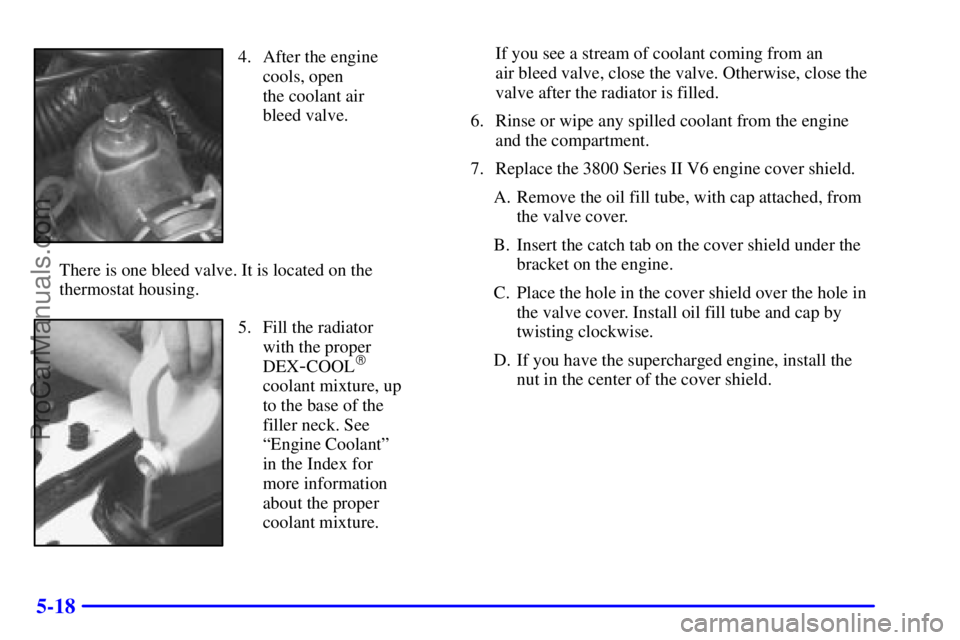
4. After the engine
cools, open
the coolant air
bleed valve.
There is one bleed valve. It is located on the
thermostat housing.
5. Fill the radiator
with the proper
DEX
-COOL�
coolant mixture, up
to the base of the
filler neck. See
ªEngine Coolantº
in the Index for
more information
about the proper
coolant mixture.If you see a stream of coolant coming from an
air bleed valve, close the valve. Otherwise, close the
valve after the radiator is filled.
6. Rinse or wipe any spilled coolant from the engine
and the compartment.
7. Replace the 3800 Series II V6 engine cover shield.
A. Remove the oil fill tube, with cap attached, from
the valve cover.
B. Insert the catch tab on the cover shield under the
bracket on the engine.
C. Place the hole in the cover shield over the hole in
the valve cover. Install oil fill tube and cap by
twisting clockwise.
D. If you have the supercharged engine, install the
nut in the center of the cover shield.
ProCarManuals.com
Page 252 of 365

6-
6-1
Section 6 Service and Appearance Care
Here you will find information about the care of your vehicle. This section begins with service and fuel information,
and then it shows how to check important fluid and lubricant levels. There is also technical information about your
vehicle, and a part devoted to its appearance care.
6
-2 Service
6
-3 Fuel
6
-5 Fuels in Foreign Countries
6
-6 Filling Your Tank
6
-8 Filling a Portable Fuel Container
6
-8 Checking Things Under the Hood
6
-14 Engine Oil
6
-20 Engine Air Cleaner/Filter
6
-21 Passenger Compartment Air Filter
6
-22 Supercharger Oil
6
-23 Automatic Transaxle Fluid
6
-27 Engine Coolant
6
-31 Power Steering Fluid
6
-32 Windshield Washer Fluid
6
-33 Brakes
6
-37 Battery
6
-38 Bulb Replacement6
-46 Windshield Wiper Blade Replacement
6
-47 Tires
6
-57 Appearance Care
6
-57 Cleaning the Inside of Your Vehicle
6
-59 Care of Safety Belts
6
-60 Cleaning the Outside of the Windshield and
Wiper Blades
6
-61 Cleaning the Outside of Your Vehicle
6
-62 Cleaning Aluminum or Chrome-Plated
Wheels (If Equipped)
6
-62 Cleaning Tires
6
-64 GM Vehicle Care/Appearance Materials
6
-65 Vehicle Identification Number (VIN)
6
-66 Electrical System
6
-72 Replacement Bulbs
6
-73 Capacities and Specifications
6
-74 Normal Maintenance Replacement Parts
ProCarManuals.com
Page 256 of 365

6-5
Some gasolines that are not reformulated for low
emissions may contain an octane
-enhancing additive
called methylcyclopentadienyl manganese tricarbonyl
(MMT); ask your service station operator whether or
not the fuel contains MMT. General Motors does not
recommend the use of such gasolines. If fuels containing
MMT are used, spark plug life may be reduced and your
emission control system performance may be affected.
The malfunction indicator lamp on your instrument
panel may turn on. If this occurs, return to your
authorized Buick dealer for service.
To provide cleaner air, all gasolines in the United States
are now required to contain additives that will help
prevent deposits from forming in your engine and fuel
system, allowing your emission control system to
function properly. Therefore, you should not have to
add anything to the fuel. In addition, gasolines
containing oxygenates, such as ethers and ethanol, and
reformulated gasolines may be available in your area to
contribute to clean air. General Motors recommends
that you use these gasolines, particularly if they comply
with the specifications described earlier.NOTICE:
Your vehicle was not designed for fuel that
contains methanol. Don't use it. It can corrode
metal parts in your fuel system and also damage
plastic and rubber parts. That damage wouldn't
be covered under your warranty.
Fuels in Foreign Countries
If you plan on driving in another country outside the
United States or Canada, the proper fuel may be hard
to find. Never use leaded gasoline or any other fuel not
recommended in the previous text on fuel. Costly repairs
caused by use of improper fuel wouldn't be covered by
your warranty.
To check on fuel availability, ask an auto club, or
contact a major oil company that does business in
the country where you'll be driving.
ProCarManuals.com