2001 BMW Z8 warning
[x] Cancel search: warningPage 103 of 170

103n
IndexDataTechnologyRepairsCar careControlsOverview
Approved wheel and tire specifications Snow chains
*
It is impossible to install snow chains
when using summer tires
275/40 R 18 99 W.
Do not activate the RDW system
while using snow chains.
Malfunction warnings and undetected
losses in pressure are possible when
driving with snow chains.
For further information, refer to
page 67.< BMW tests certain tire brands for each tire size, classifies them as road-safe and
approves them. Your BMW center can provide further information.
Observe any regulations applicable in the country of use, e.g. requiring entry in
the vehicle documents.
Tire specifications Light-alloy wheel
BMW Z8
Summer tires
Front: 245/45 R 18 96 W 8Jx18EH2
Rear: 275/40 R 18 99 W 9Jx18EH2
Winter tires
245/45 R 18 96 H M+S 8Jx18EH2
The use of rims and wheel bolts
that do not meet the specifications
of the original factory-installed equip-
ment will affect the safe operation of
your vehicle and may cause an accident
and personal injury.
Never mix tires of different design, such
as steel-belted radials with radial bias
belted or bias-ply tires, etc. Mixing tire
types will adversely affect roadholding
and can lead to loss of vehicle control.<
Page 111 of 170

111n
IndexDataTechnologyRepairsCar careControlsOverview
Engine oil Coolant
Comply with the applicable envi-
ronmental laws regulating the
disposal of used oil.<
Recommendation: have the oil changed
by your BMW center only.
Continuous exposure to used oil
has caused cancer in laboratory
testing.
For this reason, thoroughly wash any
areas of skin that come into contact
with oil using soap and water.
Always store oils, grease, etc. so that
they are inaccessible to children, and
follow warning labels on containers.<
Do not add coolant to the cooling
system when the engine is hot,
since escaping coolant can cause
burns.
To avoid the possibility of damage later
on, never use anything other than
factory-approved, nitrite- and amino-
free, extended-duty antifreeze with
corrosion inhibitor. Your BMW center is
familiar with the official specifications.
Antifreeze and corrosion inhibitor is
hazardous to health. Always store in
tightly closed original containers kept
well out of the reach of children.
Extended-duty antifreeze with corro-
sion inhibitor contains the flammable
substance ethyleneÐglycol: never allow
the antifreeze to spill onto hot engine
components, as fire and serious
personal injury in the form of burns
could result.<
Comply with the applicable envi-
ronmental laws regulating the
disposal of extended-duty antifreeze
with corrosion inhibitor.<
Checking coolant levelThe correct coolant level when the
engine is cold (approx. 68 7/20 6):
Up to the "MAX" mark on the
translucent expansion tank.520de156
Page 112 of 170

112n
Coolant Brake fluidAdding coolant To guard against the possibility of
scalding injuries, always wait until the
engine cools (temperature gauge
needle in blue sector) before
unscrewing the cap on the expansion
tank.
1 Turn the cap slightly counterclock-
wise in order to allow accumulated
pressure to escape, then continue
turning to remove.
2 If the coolant is low, slowly add
coolant until the correct level is
reached Ð do not overfill.
The coolant is a mixture of water and
extended-duty antifreeze with corrosion
inhibitor. Always maintain the
prescribed all-season 50:50 mixture
ratio for year-round protection against
internal corrosion. No other additives
are required.
Replace the coolant every three years.The brake warning lamp comes on and
the parking brake has been released:
Check the brake fluid level. Fill it to the
top mark ("MAX") if necessary.
For adding brake fluid or for deter-
mining and correcting the cause of
brake fluid loss, consult your BMW
center. Your BMW center is familiar
with the specifications for factory-
approved brake fluids (DOT 4).
Brake fluid loss can increase brake
pedal travel. For this type of situation,
refer to the notes on page 91.
520de157
Brake fluid is hygroscopic, that is,
it absorbs moisture from the air
over time.
In order to ensure the safety and reli-
ability of the brake system, have the
brake fluid changed every two years by
a BMW center. Refer also to the Service
and Warranty Information Booklet (US
models) or the Warranty and Service
Guide Booklet (Canadian models).
Brake fluid is toxic and attacks the
vehicle's paintwork. You should always
store it in its original container and in a
location that is inaccessible to children.
Do not spill the fluid and do not fill the
brake fluid reservoir beyond the "MAX"
mark. The brake fluid could ignite upon
contact with hot engine parts and
cause serious burns.<
Comply with the applicable envi-
ronmental laws regulating the
disposal of brake fluid.<
Page 120 of 170

120n
Caring for your vehicleLeather care The leather upholstery used by BMW is
a natural product of the highest quality,
processed using state-of-the-art
methods to ensure that it will maintain
its high quality for years to come,
provided that it is properly cared for.
Because the leather upholstery is
crafted using unadulterated natural
materials, it will display individual char-
acteristics and possible surface irregu-
larities. You should also bear in mind
that this kind of material needs special
care and attention.
Regular periodic cleaning and care are
essential, as dust and road dirt act as
abrasives in the pores and creases of
the material. This leads to wear spots
and premature brittleness on the
surface of the leather. We therefore
suggest that you clean the leather with
a vacuum cleaner or cloth at frequent
intervals.
For cleaning, use BMW leather cleaning
foam.Since dirt and grease gradually attack
the protective layer of the leather, the
cleaned surfaces should be treated
with BMW leather care agent. This also
prevents static electricity.
For protection against dampness or
moisture, treat the leather with a BMW
impregnating agent.
We recommend that you perform this
procedure twice a year on leather
exposed to normal use.
Spills should be wiped up immediately.
Remove grease and oil stains without
rubbing, but rather by dabbing with
spot remover.
If the upholstery is to be exposed to
intense sunlight or if the vehicle is to be
stored for an extended period, cover all
leather surfaces (or, better yet, the
windows) to prevent fading.
Use the cleaning and car-care
products available at your BMW
center.<
Cleaning agents can contain
dangerous or health-threatening
substances. Therefore, always comply
with the warnings and danger notices
on the package.
Open the doors or windows on your
vehicle when cleaning the interior
(when the convertible top is closed).
Never clean your vehicle with solvents
or other materials not specifically
intended for this application.<
Page 123 of 170

123n
IndexDataTechnologyRepairsCar careControlsOverview
Technical modifications California Proposition 65 WarningAny BMW center will be happy to
advise you concerning the advisability,
legal requirements and factory recom-
mendations for technical modifications
to the vehicle. The BMW center will
require the Vehicle Identification
Number and, in some cases, the
engine number as well. Light-Emitting Diodes (LEDs)Light-emitting diodes installed behind
translucent lenses serve as the light
source for many of the controls and
displays in your vehicle. These light-
emitting diodes are similar to conven-
tional lasers.
Do not remove the protective lens
and avoid staring directly at the
unfiltered beam for extended periods
(several hours). To do so could result in
inflammation of the iris.<
California laws require us to state the
following warning:
Engine exhaust, some of its
constituents, and certain vehicle
components contain or emit chemicals
known to the State of California to
cause cancer and birth defects or other
reproductive harm.<
Page 124 of 170

124n
OBD interface socket The OBD interface socket for onboard
diagnostics is located on the driver's
side at the left-hand bottom of the in-
strument panel and under a cover panel.
The cover has the letters "OBD" on it.
The purpose of the OBD system is to
ensure proper operation of the emis-
sion control system throughout the
vehicle's lifetime by monitoring emis-
sion-related components and systems
for deterioration and malfunction.520de130
An illuminated indicator informs
you of the need for service, but
not of the need to stop the
vehicle. However, the systems should
be checked by your BMW center at the
earliest possible opportunity.
Under certain conditions, the indicator
will blink or flash. This indicates severe
engine misfire. When this occurs, you
should reduce speed and consult the
nearest BMW center as soon as possi-
ble. Severe engine misfire over only a
short period of time can seriously dam-
age emission control components, es-
pecially the catalytic converter.
Service Engine Soon warning
lamp for Canadian models.
When the filler cap is not properly
tightened, the OBD system can
detect the vapor leak and the indicator
will light up. If the filler cap is subse-
quently tightened, the indicator should
go out within a few days.<
Page 132 of 170
132n
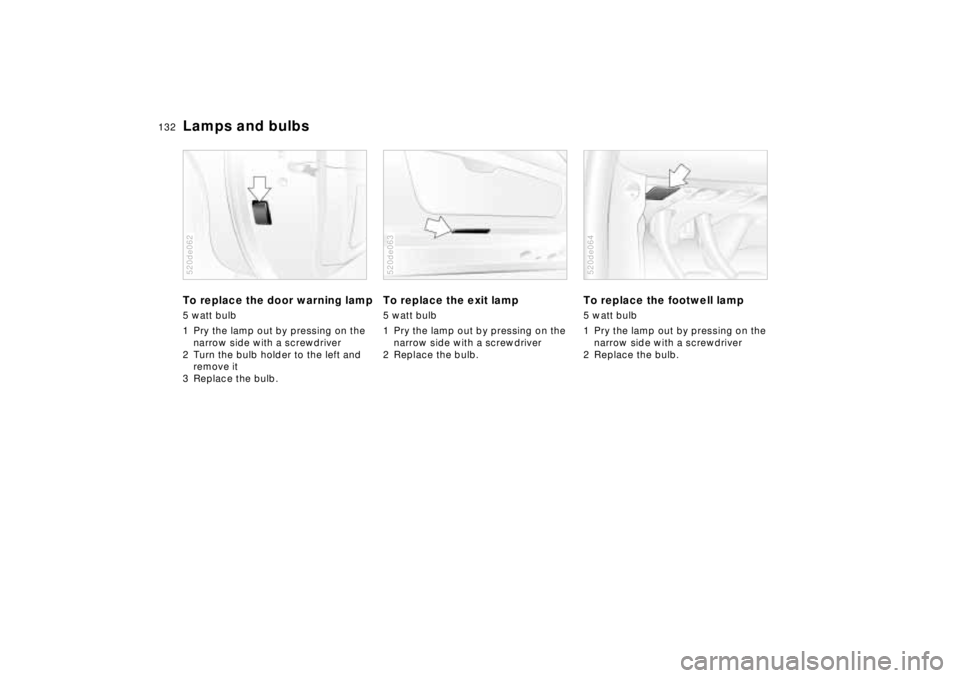
Lamps and bulbsTo replace the door warning lamp5 watt bulb
1 Pry the lamp out by pressing on the
narrow side with a screwdriver
2 Turn the bulb holder to the left and
remove it
3 Replace the bulb.520de062
To replace the exit lamp5 watt bulb
1 Pry the lamp out by pressing on the
narrow side with a screwdriver
2 Replace the bulb.520de063
To replace the footwell lamp 5 watt bulb
1 Pry the lamp out by pressing on the
narrow side with a screwdriver
2 Replace the bulb.520de064
Page 145 of 170

145n
IndexDataTechnologyRepairsCar careControlsOverview
Towing the vehicle
Avoid "off-center" towing. Be sure
that the tow rope is pulled tightly
when the towing vehicle begins to
move.<
The towed vehicle should always
be the lighter of the two vehicles.
If this is not the case, it is no longer
possible to control vehicle response.<
Tow-startingFor instructions on jump starting, refer
to page 143.
Never attempt to use your vehicle to
push another vehicle, since damage to
the energy-absorbing bumpers could
result.
Towing a vehicle1 Put the manual-shift gear lever in
neutral
2 Towing speed:
Max. 45 mph (70 km/h)
3 Towing distance:
Max. 95 miles (150 km)
4 Leave the ignition key in position 1
to ensure that the brake lamps, turn
signals, horn and windshield wipers
remain operative, and to prevent the
steering lock detent from engaging
5 Switch on the hazard-warning system
(comply with country-specific regula-
tions).
Find some means of identifying the
vehicle in tow, e. g. place a sign or
warning triangle in the rear window.
Make sure that the ignition key
remains in position 1 even
when the electrical system has failed
to prevent the steering lock from
engaging. The steering and brakes are
without power assist when the engine is
not running. This means that increased
effort is required for steering and
braking.<
Towing with a commercial tow
truck>Do not tow with sling-type equipment
>Use a wheel lift or flat bed equipment
>Please comply with applicable towing
laws.
Never allow passengers to ride in a
towed vehicle for any reason.<520us014