2001 BMW Z8 belt
[x] Cancel search: beltPage 119 of 170

119n
IndexDataTechnologyRepairsCar careControlsOverview
Caring for your vehicleWindow careYou can use window and glass cleaner
to clean inside window surfaces and
mirrors without smearing and streaking.
Never use polishing pastes or abrasive
(quartz) cleansers on mirror lenses.
Clean the wiper blades with soapy
water. The wiper blades should be
replaced twice a year Ð before and after
the cold season.
Use only wiper blades approved
by BMW.<
Caring for other vehicle
components and materials Light-alloy wheels should be treated
with alloy wheel cleaner, especially
during the winter months. However, do
not use aggressive products containing
acids, strong alkalis or abrasives. Do
not use steam cleaners operating at
temperatures above 140 7 (60 6).
Follow the manufacturer's instructions.
Carefully clean chrome parts such as
lamp socket assemblies, door handles
and similar items with an ample amount
of clean water Ð and shampoo, too, if
necessary Ð especially if there is an
accumulation of road salt. Use a
chrome polish for an additional treat-
ment.
Use water to clean plastic components,
headliners, lamp lenses, and surfaces
sprayed dull black Ð adding vinyl
shampoo, if necessary. Do not allow
moisture to soak through the seats or
headliner. Never use solvents such as
lacquer thinner, heavy-duty grease
remover, fuels, or similar substances.
Use a soft, clean cloth to wipe off the
clear covers of the instruments, using
methylated spirits with distilled water
as a cleaning solvent, if necessary, at a
mixing ratio of 1:1.Rubber components should be cleaned
with water only; a rubber treatment or
silicone spray may also be applied.
The safety belts should be cleaned with
a mild soap and water solution without
being removed from the vehicle. Never
attempt chemical or dry cleaning, as
damage to the belt fabric could result.
After cleaning, never allow the inertia
reel to retract the belts until they are
completely dry. Dirty safety belts
prevent the inertia reel mechanism from
retracting the strap properly, thus
constituting a safety hazard.
Heavily soiled floor carpets and mats
*
can be cleaned with an interior cleaner.
The floor mats can be removed from
the vehicle for cleaning.
Clean the aluminum surfaces with water
and, if necessary, with a mild soap.
Never use solvents such as lacquer
thinner, heavy-duty grease remover,
fuels, or similar substances.
Use only a wet cloth to clean the painted
inner parts. Dry them afterwards with a
soft cloth.
Use the cleaning and car-care
products available at your BMW
center.<
Page 147 of 170

Overview
Controls and features
Operation, care
and maintenance
Owner service procedures
Technical data
Index Advanced technology
147n
IndexDataTechnologyRepairsCar careControlsOverview
Airbags148
Radio reception148
Dynamic Stability Control
(DSC)149
Safety belt tensioner149
Interior rearview mirror with
automatic dimmer150
Xenon lamps151
Technology
Page 148 of 170
148n
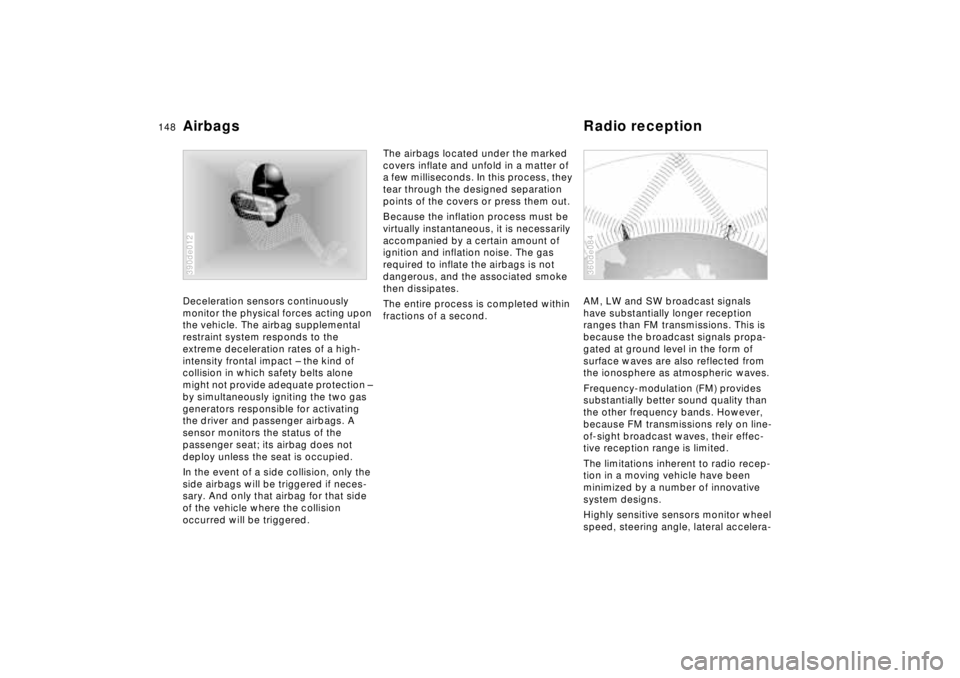
Deceleration sensors continuously
monitor the physical forces acting upon
the vehicle. The airbag supplemental
restraint system responds to the
extreme deceleration rates of a high-
intensity frontal impact Ð the kind of
collision in which safety belts alone
might not provide adequate protection Ð
by simultaneously igniting the two gas
generators responsible for activating
the driver and passenger airbags. A
sensor monitors the status of the
passenger seat; its airbag does not
deploy unless the seat is occupied.
In the event of a side collision, only the
side airbags will be triggered if neces-
sary. And only that airbag for that side
of the vehicle where the collision
occurred will be triggered.
390de012
The airbags located under the marked
covers inflate and unfold in a matter of
a few milliseconds. In this process, they
tear through the designed separation
points of the covers or press them out.
Because the inflation process must be
virtually instantaneous, it is necessarily
accompanied by a certain amount of
ignition and inflation noise. The gas
required to inflate the airbags is not
dangerous, and the associated smoke
then dissipates.
The entire process is completed within
fractions of a second.AM, LW and SW broadcast signals
have substantially longer reception
ranges than FM transmissions. This is
because the broadcast signals propa-
gated at ground level in the form of
surface waves are also reflected from
the ionosphere as atmospheric waves.
Frequency-modulation (FM) provides
substantially better sound quality than
the other frequency bands. However,
because FM transmissions rely on line-
of-sight broadcast waves, their effec-
tive reception range is limited.
The limitations inherent to radio recep-
tion in a moving vehicle have been
minimized by a number of innovative
system designs.
Highly sensitive sensors monitor wheel
speed, steering angle, lateral accelera-
360de084
Airbags Radio reception
Page 149 of 170

149n
IndexDataTechnologyRepairsCar careControlsOverview
tion, braking pressures and the
vehicle's yaw rate around its vertical
axis.
When the system detects substantial
differences in rotation rates between
wheels, it acts to inhibit uncontrolled
wheelspin by reducing the drive torque
transmitted to the affected wheel(s),
while also initiating selective braking
intervention as needed.
In addition, DSC permanently monitors
the vehicle's current operating condi-
tion and compares it with an ideal
status calculated based on sensor
signals. DSC reacts to deviations from
this ideal status such as incipient
understeer or oversteer by instanta-
neously reducing engine torque to
restore vehicle stability. This strategy
can be supplemented by selective
braking intervention, available at all four
wheels. DSC acts to prevent traction
loss and skids before the situation can
become critical.You may need some time to become
accustomed to this system's interven-
tion. However, it provides optimum
drive force and vehicle stability.
The braking intervention may be
accompanied by sounds specific to
the system.
The safety belt tensioner responds to
severe frontal collisions by tightening
the belt to ensure that occupants
remain firmly positioned in their seats.
A gas-pressure system retracts the
buckle assembly to tension the
shoulder and lap belts within fractions
of a second. This reduces the tendency
to slide under the lap belt.
520de148
Dynamic Stability Control (DSC) Safety belt tensioner
Page 153 of 170
Overview
Controls and features
Operation, care
and maintenance
Technical data
Index Advanced technology
153n
IndexDataTechnologyRepairsCar careControlsOverview
Engine data154
Dimensions155
Weights156
Capacities157
Electrical system158
Drive belts158
Data
Owner service procedures
Page 158 of 170

158n
Electrical system Drive belts Battery 12V, 90 AhSpark plugs NGK BKR 6 EQUP
This spark ignition system meets all
requirements of the Canadian Interfer-
ence-Causing Equipment Regulations
(ICES-2).Water pump Ð Generator Ð Power
steering
Ribbed V-belt 7 PK 1440
A/C compressor
Ribbed V-belt 5 PK 980You can obtain Original BMW
Parts and Accessories, as well
as professional advice from your BMW
center.<
Page 162 of 170

Everything from A to ZAABS (Antilock Brake
System)21, 88
Accessories6
Activated charcoal filter75
Add
brake fluid112t
engine coolant112t
engine oil109t
washer fluid108, 157
Adjust
seats45
temperature74
washer nozzles108t
Adjustment setting
configuration48
Air conditioner72
Air distribution74
Air outlets72
Air pressure98
Air supply74
Airbags21, 51, 121, 148
Alarm system38
Antenna94
Antifreeze111
radiator92
Antifreeze/corrosion
protection92
Antilock Brake System
(ABS)21, 88
Anti-theft alarm system38
Anti-theft protection32Approved gross vehicle
weight156
Aquaplaning98
Ashtray81
Attach vehicle vacuum
cleaner82
Automatic car washes115
Automatic headlamp
washers60
Automatic windshield
washer60
Avoiding a false alarm39t
Axle loads156
BBackrest
adjusting45
unlock46
Backup lamps58
bulb replacement130t
Battery136, 158
add distilled water136t
capacity158
charge current20
charging137t
discharged143
recycling138t
removing and
installing137t
Belts50
Beverage can holder80
Blower74BMW High Performance
Synthetic Oil110
Bore154
Brake hydraulic
system20, 91
Brake system91
faults91t
fluid112t
pads22, 92
refer also to ABS, DBC and
Disc brakes
Break-in procedure86
Bulbs and lamps129t
CCalifornia Proposition
65 Warning123
Can holder80
Car Memory48
Car phone81
Car radio64
reception94, 148
refer also to the radio
Owner's Manual
Car wash115
Care
exterior117
for the vehicle finish118
interior119
CBC (Cornering Brake
Control)21, 89CD player, refer to the radio
Owner's Manual
Cellular phone94
refer also to the separate
Owner's Manual
Central locking system32
key36
Changing a wheel135t
Changing the oil filter157
Changing tires135t
Checking air pressure26t
Checking engine oil
level109t
Child restraint
systems53, 54
Child seat safety54
Child seats53
Cigarette lighter82
Clean headlamps60
Clock64
Cockpit16
Code, refer to the radio
Owner's Manual
Combination switch, turn
signal indicator/headlamp
flasher58
Compartments79
for stowing items78
Compression154
Connector for On-Board-
Diagnostics124
Consumption display62
A-Z
Page 163 of 170

Everything from A to Z
163n
IndexDataTechnologyRepairsCar careControlsOverview
Controls16
Convertible top41
closing in event of
electrical
malfunction140t
manual operation141t
Coolant111, 157
Coolant temperature
gauge63
Copyright4
Cornering Brake Control
(CBC)21, 89
Curb weight156
Current check indicator20DDashboard16
Data
dimensions155
engine154
technical154
weights156
Daytime-driving lamp69
DBC (Dynamic Brake
Control)90
Deactivating the tilt sensor
alarm system and interior
motion sensor34
Deep water87
Defrosting the
windows60, 75
Difficult steering20, 94Dimensions155
Dipstick109
Disc brakes90
Displacement154
Display lighting69
Displays18
Disposal
engine oil111
used batteries138t
Door keys30
Door warning lamp, bulb
replacement132t
Doors
emergency
actuation32t
mirrors47
remote control33
unlocking and locking32
DOT Quality Grades99
Draft-free ventilation75
Drink holder78, 80
Drive belts158
Driving in winter92
Driving notes87
DSC (Dynamic Stability
Control)22, 65, 149
Dynamic Brake Control
(DBC)90
Dynamic Performance
Control66
Dynamic Stability Control
(DSC)22, 65, 149
EElectric defrosting of
mirrors47
Electric power seat45
Electric power windows40
Electrical equipment
failure138t
Electrical failure
convertible top140t
doors32t
fuel filler door140t
luggage
compartment140t
passenger-side
door141t
Electrical system158
Electronic vehicle
immobilizer31
Emergency operation
convertible top140t
doors32t
fuel filler door140t
luggage
compartment140t
passenger-side
door141t
Engine
coolant111, 157
data154
output154
speed154
starting56
switching off56Engine compartment106
Engine oil109
add109t
consumption109
filling capacity157
filter change157
pressure indicator
lamp20
quality110
specifications110
viscosity110
Engine oil level21
check109
Equipment
options and accessories5
Exit lamps, bulb
replacement132t
Exterior finish117
Exterior mirrors47
FFailure to start144t
Fault in ABS89
Filler cap cover25
Filling capacities157
Filling the washer
reservoir157
First-aid kit24
Fittings, tow starting and
towing144t
Flashlight79
Flat tire135t