2001 BMW X5 4.4I ESP
[x] Cancel search: ESPPage 185 of 223

IndexDataTechnologyRepairsCar careControlsOverview
185n
Battery
Battery posts, terminals and
related accessories contain lead
and lead compounds. Wash hands after
handling.
Battery location The battery is located in the floor of the
vehicle below the spare wheel. Battery careThe battery is maintenance-free, that is,
the original electrolyte will normally last
for the service life of the battery under
moderate climatic conditions.
For all questions that regard the
battery, please consult your BMW
center. Since the battery is mainte-
nance-free, the following is for your
information only.<
SymbolsYou will find the following symbols on
your vehicle battery. To avoid injury,
please comply with the corresponding
precautions whenever you work with or
near the battery.
Before handling the battery,
please read the following infor-
mation.
Wear eye protection. Do not
allow particles containing
battery acid or lead to come into
contact with your eyes, your skin, or
your clothing.
Battery acid is extremely corro-
sive. Wear eye protection and
protective gloves. Do not tip the
battery. Battery acid can leak from the
ventilation openings.
Do not allow children to have
access to batteries and battery
acid.
Never allow sparks or open
flame near the battery. Do not
smoke in the vicinity of the
battery. Avoid sparks from electrical
cables or electrical equipment. Turn the
key to position 0 in the steering lock
when you are disconnecting or
connecting the battery. Never short-
circuit the battery terminals. This
creates a risk of injury from high-energy
sparks.
A highly-explosive gas is
generated when the battery is
charged.
If you happen to get acid in your
eyes, rinse thoroughly for
15 minutes with clear water.
Following that, consult a physician
immediately. If you get acid spray on
your skin or clothing, rinse with plenty
of water. If electrolyte is accidentally
swallowed, consult a physician immedi-
ately.
In order to protect the battery
case from ultraviolet radiation,
do not place it in direct sunlight.
A discharged battery can freeze. Store
the battery in areas where temperature
remains above freezing.
Page 186 of 223

186n
BatteryCharging the battery Charge the battery in the vehicle only
when the engine is not running. Use the
connections provided in the engine
compartment (for correct connections,
refer to "Jump-starting" on page 190).
The service life specified for the
battery can be achieved only if it
is always kept adequately charged.
Have the charge condition of the
battery checked frequently if the vehicle
is used primarily for driving short
distances.<
Before performing any work on
the electrical system, disconnect
the cable from the negative terminal. If
you do not, short circuits can create the
risk of fire or personal injury.<
If you plan to park the vehicle longer
than 4 weeks, have the battery discon-
nected from the vehicle's electrical
system by disconnecting the cable from
the negative terminal. Then have the
battery charged with an appropriate
battery charger.
If the vehicle will not be driven for a
period longer than 12 weeks, have the
battery removed, charged and store it
in a clean and cool (frost-free) area.
Recharge the battery at least every
three months during storage. Also,
recharge the battery before it is
installed. If you fail to do so, it will not
be serviceable. Every time the battery is
discharged, especially over extended
periods, its service life is reduced. Do not disconnect the battery
when the engine is running. If
you do so, the ensuing voltage surge
will damage the vehicle's onboard elec-
tronics.
Do not make any modifications in the
wires to the positive terminal. If you do
so, the protective function of the safety
battery terminal is no longer ensured.
Repair and disposal must be performed
by trained technicians only.<
Return used batteries to a recy-
cling point or your BMW center.
Maintain the battery in an upright posi-
tion for transport and storage. Secure
the battery against tilting during trans-
port.<
Page 187 of 223

IndexDataTechnologyRepairsCar careControlsOverview
187n
FusesWhen an electrical accessory fails to
operate, switch it off and inspect the
fuse. In the glove compartment1 Open the glove compartment and
turn the two quick-release fasteners
to the left. Spare fuses and plastic
tweezers are located on the fuse
holder.
2 Use the plastic tweezers to remove
the fuse for the accessory or equip-
ment that has stopped working.
3 If the fuse is burned through (the
metal strip will have melted and
separated), replace it with a new fuse
of the same ampere rating (color
code).530us121
A list of the fuses, their respective
ampere ratings and the equipment in
their circuits is provided below the fuse
holder.
Close the fuse holder by holding the top
of the cover in place and screwing the
two quick-release fasteners to the right.
Additional fuses are provided in the
cargo area.
The fuse for continuous positive current
is located in a separate fuse box in front
of the spare wheel. If this fuse is defec-
tive, refer the problem to your BMW
center for repair.
Do not attempt to repair a burned
fuse or replace it with a fuse
having a different color or ampere
rating. To do this could cause a fire in
the vehicle resulting from a circuit over-
load.<
If the fuse continues to burn through,
have the problem corrected by a BMW
center.
In the cargo area Open the right cover by pulling the
handle.
A list of the fuses, their respective
ampere ratings and the equipment in
their circuits is provided on the rear of
the side trim panel. 530us122
Page 192 of 223

192n
Towing the vehicle
The towed vehicle should always
be the lighter of the two vehicles.
If this is not the case, it is no longer
possible to control vehicle response.<
Tow-starting It is not possible to start the engine of a
vehicle equipped with an automatic
transmission by towing or pushing.
For instructions on jump starting: refer
to page 190.
Never attempt to use your vehicle to
push another car. If you do so, damage
to the energy-absorbing bumpers could
result.
Towing a vehicle with automatic
transmission1 Place the selector lever in position N.
2 Towing speed:
Max. 45 mph (70 km/h).
3 Towing distance:
Max. 95 miles (150 km).
4 Leave the ignition key at position 1 to
ensure that the brake lamps, turn
signals, horn and windshield wipers
remain operative, and to prevent the
steering lock from engaging.
5 Switch on the hazard warning
flashers (comply with country-
specific regulations).
Find some means of identifying the
vehicle in tow, for instance, place a sign
or warning triangle in the rear window.
Make sure that the ignition key
remains in position 1 even when
the electrical system has failed. This will
prevent the steering lock from
engaging. The steering and brakes are
without power assist when the engine is
not running. This means that increased
effort is required for steering and
braking.<
Towing with a commercial tow
truck>Do not tow with sling-type equip-
ment.
>Use a wheel lift or flat bed carrier.
>Please comply with applicable towing
laws.
Never allow passengers to ride in
a towed vehicle for any reason.< 530us138
Page 197 of 223

IndexDataTechnologyRepairsCar careControlsOverview
197n
The transmission of power to the four
drive wheels is provided permanently
through a transfer box. The distribution
of torque between the front and rear
axles is 38% to 62%.
Traditional differential locks at the front
and rear axles and in the transfer box
are not required. Their function is taken
over by automatic braking intervention
at all four wheels. These traction inter-
ventions are governed by Automatic
Differential Brake (ADB-X), a sub-func-
tion of DSC.
If a wheel tends to slip, it is braked
automatically by ADB-X until it once
again gains traction, and drive force
can be transmitted to that wheel. In
addition, the drive force is distributed
to the remaining wheels during this
530us133
system intervention. Engine output is
also reduced if necessary.
When the DSC is deactivated, the
ADB-X traction intervention is set for
the maximum drive force. However,
the engine intervention and the stability
controls are no longer available. For
this reason, DSC should only be deacti-
vated in the exceptional circumstances
described on page 95.
The BMW X5 is a vehicle for all types of
roads. The permanent four-wheel drive
provides a significant degree of vehicle
stability and tractive power under all
road conditions. It assists in critical
situations such as driving in extreme
winter conditions or on bad roads. Precision sensors monitor the wheel
speeds, the steering angle, lateral
acceleration, brake pressure and the
movement of the vehicle around its
vertical axis.
If differences in wheel speeds occur, the
system recognizes the danger of wheel-
spin and reduces the engine's drive
torque. If necessary, the system also
responds with additional braking inter-
vention at all four wheels.
In addition, DSC permanently monitors
the vehicle's current operating condition
and compares it with an ideal condition
that is calculated from the sensor
signals. If deviations from this occur
(understeering or oversteering, for
instance), DSC can stabilize the vehicle
in fractions of a second by adapting
engine output and with the assistance of
braking intervention at individual
wheels. This way, as long as the skid
can still be managed under the laws of
physics, these kinds of dangerous skids
are prevented even before they can
start.
You may need some time to become
accustomed to this system intervention.
However, it provides optimum drive
force and vehicle stability. The braking
intervention may be accompanied by
certain sounds specific to the system.
Four-wheel drive DSC
Page 198 of 223

198nRadio reception Safety belt tensioner
Radio waves — mediumwave, long-
wave and shortwave — offer a wide
range of reception, because the broad-
cast signals travel not only along the
ground as surface waves, but also as
waves bounced back to earth from the
ionosphere.
Frequency-modulation (FM) provides
substantially better sound quality than
AM. However, because FM transmis-
sions rely on line-of-sight broadcast
waves, their effective reception range is
limited.
360de084
Although numerous factors combine
to impose inherent limitations on the
reception quality available from mobile
radios, specially designed systems can
be employed to minimize their effects:
The Diversity Antenna system employs
several FM antennas integrated within
the rear window. An integral processor
automatically selects the antenna with
the best FM reception quality at any
given time. Because the ongoing
antenna selection process is completed
within milliseconds, it remains inaudible
to the radio listener. The safety belt tensioner responds to
severe collisions by tightening the belts
to ensure that occupants remain firmly
positioned in their seats. A gas-pres-
sure system retracts the buckle
assembly to tension the shoulder and
lap belts within fractions of a second.
This reduces the tendency to slide
under the lap belt.
390de330
Page 199 of 223

Index
Data
Technology
Repairs
Car care
Controls
Overview
199nDSP sound system* Rearview mirrors with automatic dimmer*
The DSP Professional premium sound
system features a special amplifier
combined with Digital Sound
Processing (DSP) and integrated
speakers to surround you with crisp,
true-to-life sound reproduction. The
speaker system's subwoofers, woofers,
midrange speakers and tweeters
furnish you with an impressively full-
bodied listening experience. The indi-
vidual components are oriented so as
to produce the aural sensation that you
would experience facing the stage in a
concert hall. The system also automati-
cally adjusts the bass and treble
settings to compensate for changes in
volume and vehicle speed.
530us142
The interior and exterior rearview
mirrors with automatic dimming feature
reduce glare from following traffic by
adapting the intensity of the reflected
images to correspond to levels of light
registered by the unit's sensors. The
mirrors revert to their undimmed setting
as soon as the light source disappears.
A forward facing sensor is mounted on
the front of the interior mirror housing
and is designed to monitor light levels
in the area forward of the vehicle.
A second sensor is integrated within
the mirror's glass. The electronic
control system operates by comparing
the respective levels of luminous inten-
sity in front of and behind the vehicle.
390de113
The difference provides the basic
parameter used to modulate an elec-
trical current and induce chemical
changes in a semisolid layer incorpo-
rated in the lenses.
The semisolid reacts chemically to this
electrical current, thus providing
dimming of the mirrors through an infi-
nitely-variable range (electrochromic
technology).
As a result, it is no longer necessary to
dim the interior mirror manually, and the
driver can concentrate completely on
traffic conditions.
Page 202 of 223
202nXenon lamps*
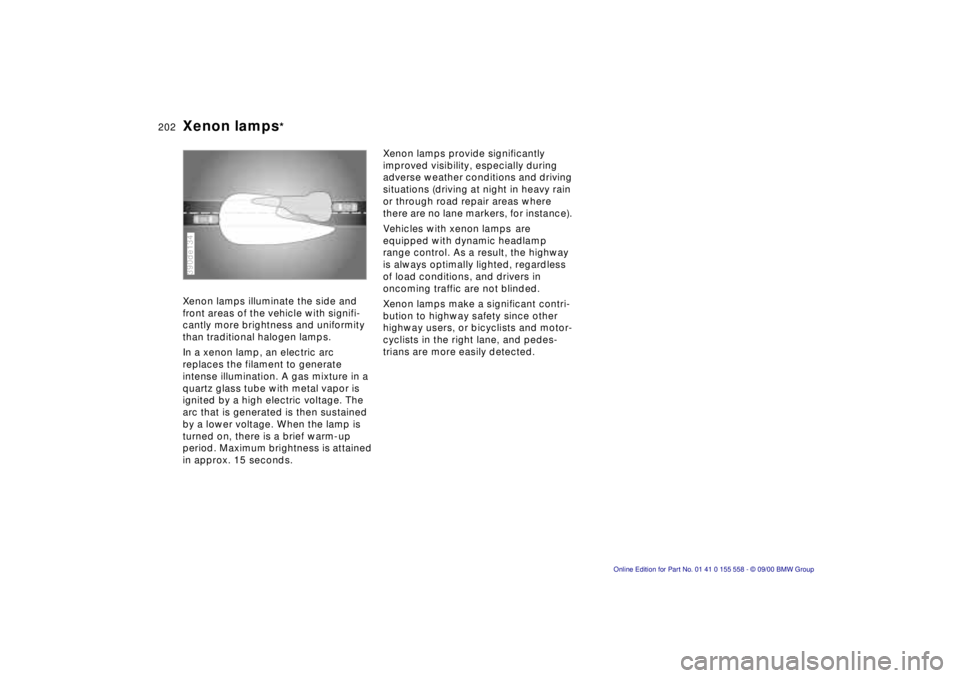
Xenon lamps illuminate the side and
front areas of the vehicle with signifi-
cantly more brightness and uniformity
than traditional halogen lamps.
In a xenon lamp, an electric arc
replaces the filament to generate
intense illumination. A gas mixture in a
quartz glass tube with metal vapor is
ignited by a high electric voltage. The
arc that is generated is then sustained
by a lower voltage. When the lamp is
turned on, there is a brief warm-up
period. Maximum brightness is attained
in approx. 15 seconds.
390de134
Xenon lamps provide significantly
improved visibility, especially during
adverse weather conditions and driving
situations (driving at night in heavy rain
or through road repair areas where
there are no lane markers, for instance).
Vehicles with xenon lamps
are
equipped with dynamic headlamp
range control. As a result, the highway
is always optimally lighted, regardless
of load conditions, and drivers in
oncoming traffic are not blinded.
Xenon lamps make a significant contri-
bution to highway safety since other
highway users, or bicyclists and motor-
cyclists in the right lane, and pedes-
trians are more easily detected.