2001 BMW X5 3.0I oil
[x] Cancel search: oilPage 162 of 223
162n
The BMW Maintenance System has
been designed as a reliable means of
providing maximum driving and oper-
ating safety – and as cost-effectively as
possible for you.
Please keep in mind that regular main-
tenance is not only necessary for the
safety of your vehicle, but also plays a
significant role in maintaining the resale
value of the vehicle.
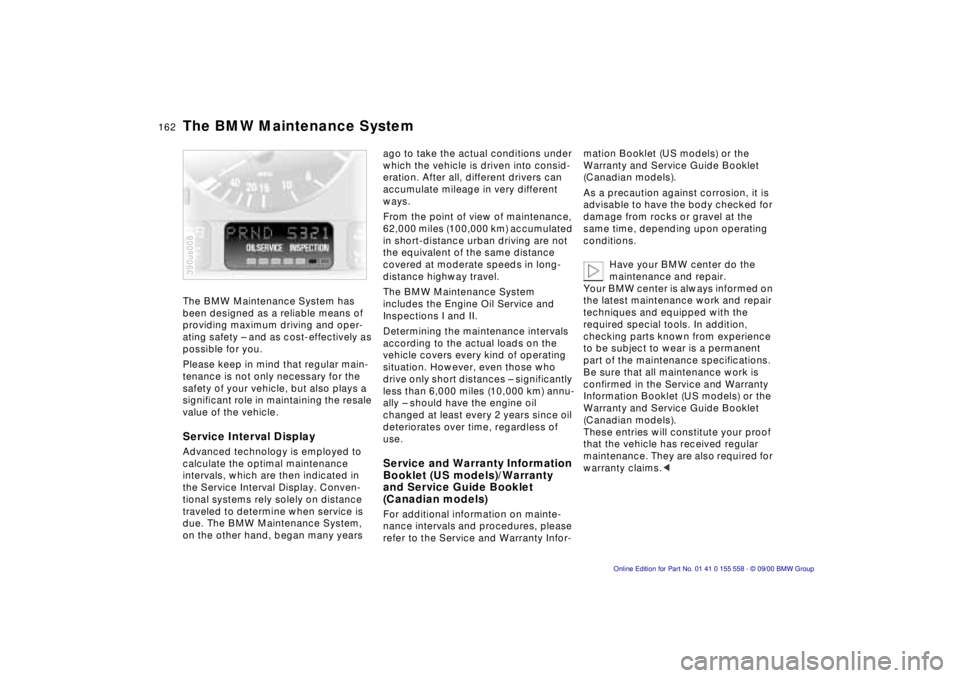
Service Interval DisplayAdvanced technology is employed to
calculate the optimal maintenance
intervals, which are then indicated in
the Service Interval Display. Conven-
tional systems rely solely on distance
traveled to determine when service is
due. The BMW Maintenance System,
on the other hand, began many years 390us008
ago to take the actual conditions under
which the vehicle is driven into consid-
eration. After all, different drivers can
accumulate mileage in very different
ways.
From the point of view of maintenance,
62,000 miles (100,000 km) accumulated
in short-distance urban driving are not
the equivalent of the same distance
covered at moderate speeds in long-
distance highway travel.
The BMW Maintenance System
includes the Engine Oil Service and
Inspections I and II.
Determining the maintenance intervals
according to the actual loads on the
vehicle covers every kind of operating
situation. However, even those who
drive only short distances – significantly
less than 6,000 miles (10,000 km) annu-
ally – should have the engine oil
changed at least every 2 years since oil
deteriorates over time, regardless of
use.Service and Warranty Information
Booklet (US models)/Warranty
and Service Guide Booklet
(Canadian models)For additional information on mainte-
nance intervals and procedures, please
refer to the Service and Warranty Infor-mation Booklet (US models) or the
Warranty and Service Guide Booklet
(Canadian models).
As a precaution against corrosion, it is
advisable to have the body checked for
damage from rocks or gravel at the
same time, depending upon operating
conditions.
Have your BMW center do the
maintenance and repair.
Your BMW center is always informed on
the latest maintenance work and repair
techniques and equipped with the
required special tools. In addition,
checking parts known from experience
to be subject to wear is a permanent
part of the maintenance specifications.
Be sure that all maintenance work is
confirmed in the Service and Warranty
Information Booklet (US models) or the
Warranty and Service Guide Booklet
(Canadian models).
These entries will constitute your proof
that the vehicle has received regular
maintenance. They are also required for
warranty claims.<
The BMW Maintenance System
Page 163 of 223

IndexDataTechnologyRepairsCar careControlsOverview
163n
Caring for your vehicleWashing your vehicle You can have your new BMW washed
in an automatic car wash. Car wash
systems that do not employ brushes
are preferable.
Wipe away tough dirt and loosen and
remove dead insects before washing
the vehicle.
To prevent spots, avoid washing when
the hood is still warm, or immediately
after and during exposure to strong
sunlight.
When using an automatic car wash, be
sure that:
>The car wash system is suited for the
dimensions of your vehicle.
Before washing the vehicle in a
car wash, fold in the exterior
mirrors manually, otherwise they may
be damaged on account of the width of
the vehicle.<
>No damage will occur on vehicles
with attached body accessories (such
as spoilers or antennas). If you are
uncertain, consult the manager of the
car wash.
>The wheels and tires of your vehicle
cannot be damaged by the convey-
ance devices of the car wash system.
>The vehicle is cleaned with minimum
brush pressure, and that ample water
is available for washing and rinsing.
Vehicles with rain sensor
*:
Clean the windshield regularly. Wax
from automatic car washes or insects,
for example, can cause malfunctions in
the function of the rain sensor.
Deactivate the rain sensor in auto-
matic car washes. If you do not,
damage may occur if the wipers switch
on unintentionally.<
Parts of the vehicle that are inacces-
sible to the automatic car wash — such
as door sills, door and hood edges, etc.
— should be cleaned by hand.
In the winter months, it is especially
important to ensure that the vehicle is
washed on a regular basis. Large quan-
tities of dirt and road salt are difficult to
remove, and they also cause damage to
the vehicle.
If spray wands or high-pressure
washers are used, be sure to
maintain an adequate distance between
the spray source and the vehicle's
surface. Inadequate distance and
excessive pressure can damage or
weaken the finish, making it more
susceptible to subsequent attack. In
addition, moisture could penetrate to
vehicle components, leading to long-
term damage.<
When cleaning the headlamps,
please observe the following:
>Do not wipe dry (scratches). Never
use abrasives or strong solvents to
clean the covers.
>Remove dirt and contamination (such
as insects) by soaking with BMW Car
Shampoo and then rinsing with plenty
of water.
>Always use a deicer spray to remove
accumulated ice and snow – never
use a scraper.<
After washing the vehicle, apply
the brakes briefly to dry them.
Braking efficiency might otherwise be
reduced by the moisture and the brake
rotors could also be corroded.<
Page 164 of 223

164n
Caring for your vehicleExterior finish To provide effective corrosion protec-
tion, multilayer paintwork is applied
at the factory. Cataphoretic immersion
priming techniques are supplemented
using special body-cavity protectants,
with the application of specially-devel-
oped and extensively tested materials.
A layer of flexible PVC is first applied to
the undercarriage. Following this, a
comprehensive undercoating treat-
ment with a wax-based protectant is
applied.
Regular maintenance makes an impor-
tant contribution to maintaining the
safety and value of your vehicle.
Increasing awareness of the effects of
harmful environmental factors on
vehicle finishes have led paint and
vehicle manufacturers to initiate
ongoing programs designed to further
improve the durability of their finishes.
Despite this, environmental factors that
occur locally or regionally can have
negative effects on the finish of your
vehicle. These should guide you in
determining the frequency and extent of
your efforts to maintain the vehicle
finish.Depending upon material and type
of impact (perforation of paint layer),
physical stresses from sand, road salt,
gravel, etc., can cause corrosion to
start extending beneath the finish,
starting at the point of impact.
Road dirt, tar spots, dead insects,
animal droppings (strong alkali effect)
and tree excretions (resins and pollen)
all contain substances capable of
causing damage when allowed to
remain on the finish of your vehicle for
any period of time (spots, etching,
flaking, separation in the top coat).
In industrial areas, deposits from fly
ash, lime, oil deposits, sulfur-dioxide in
precipitation (acid rain) and other envi-
ronmental pollutants will all damage the
surface of the vehicle unless adequate
protection is provided.In coastal regions, high levels of atmo-
spheric salt and humidity promote
corrosion.
In tropical zones, temperatures of over
+105 7 (+40 6) in the shade prevail,
in addition to heavy ultraviolet radiation
and high humidity. Under those condi-
tions, light paints can reach tempera-
tures up to +175 7 (+80 6) and dark
paints up to +250 7 (+120 6).
Page 165 of 223

IndexDataTechnologyRepairsCar careControlsOverview
165n
Caring for your vehicleCaring for the vehicle finish Regular washing is a preventive
measure against long-term effects from
substances that are harmful to the
vehicle's finish, especially if you drive
your vehicle in areas with high levels of
air pollution or aggressive natural
substances (tree resins, pollen).
Nevertheless, you should immediately
remove especially aggressive
substances. Failure to do so can lead to
changes in the paint's chemical struc-
ture or to discoloration. Fuel spilled
during refueling, oil, grease and brake
fluid should always be cleaned away
immediately, as should bird droppings
(finish damage).
Any contamination remaining on the
surface of the vehicle will be especially
conspicuous after washing. Use
cleaning fluid or alcohol with a clean
cloth or cotton pad to remove these
stains. Remove tar spots with tar
remover. After cleaning, the affected
areas should be waxed to ensure
continued protection.
Waxing your vehicle Protect the finish using carnauba or
synthetic-based waxes only.
The best way to determine when the
finish needs to be waxed is by noting
when water stops beading on the
surface.
You can use a glass cleaner to remove
any wax or silicone that may have been
left on the windows during waxing.
Paint damageYou can touch up small areas of
damage with BMW spray paint or a
BMW touchup stick.
The color code of your vehicle is
provided on a tag on the right-hand
panel under the hood and on the first
page of the Service and Warranty Infor-
mation Booklet (US models) or the
Warranty and Service Guide Booklet
(Canadian models).
Damage caused by flying stones,
scratches, etc., must be touched up
without delay to prevent rust from
forming.
If corrosion has started to form in an
area with paint damage, remove all rust
and clean the area. Then prime the area
with a BMW Primer Stick. Finally, apply
the finish coat. After a few days, polish
and protect the touched-in areas.
More extensive paint damage should
be professionally repaired in accor-
dance with the manufacturer's instruc-
tions. Your BMW center uses original
BMW finish materials in accordance
with factory repair procedures.
A full range of car-care products is
available from your BMW center.<
Page 166 of 223

166n
Caring for your vehicleWindow care You can use window and glass cleaner
to clean inside window surfaces and
mirrors without smearing and streaking.
Never use polishing pastes or abrasive
(quartz) cleansers on mirror lenses.
Clean the wiper blades with soapy
water. The wiper blades should be
replaced twice a year, before and after
the cold season.
Use only wiper blades that have
been approved by BMW.<
Caring for other vehicle
components and materialsLight-alloy wheels should be treated
with alloy wheel cleaner, especially
during the winter months. However, do
not use aggressive products containing
acids, strong alkalis or abrasives. Do
not use steam cleaners operating at
temperatures above +140 7 (+60 6).
Follow the manufacturer's instructions.
If your vehicle has chrome parts
* such
as window moldings, door handles or
other items, clean these parts carefully
with ample clean water, especially if
they have an accumulation of road salt.
Use chrome polish as an additional
treatment.
Plastic components, vinyl upholstery,
headliners, lamp lenses, the clear cover
of the instrument cluster and compo-
nents with a sprayed dull black surface
can be cleaned with water (add plastic
cleaner as required). Do not allow mois-
ture to soak through the seats or head-
liner. Never use solvents such as
lacquer thinner, heavy-duty grease
remover, fuels, etc. Rubber components should be cleaned
with water only; a rubber treatment or
silicone spray may also be applied.
The safety belts should be cleaned with
a mild soap and water solution without
being removed from the vehicle. Never
attempt chemical or dry cleaning, as
damage to the belt fabric could result.
After cleaning, never allow the inertia
reel to retract the belts until they are
completely dry. Dirty safety belts
prevent the inertia reel mechanism from
retracting the strap properly, and thus
constitute a safety hazard.
Heavily soiled floor carpets and mats
*
can be cleaned with an interior cleaner.
The floor mats can be removed from
the vehicle for cleaning.
Please use only a damp cloth to clean
wooden fascia panels and components.
Follow up by drying with a soft cloth.
A full range of car-care products is
available from your BMW center.<
Page 167 of 223

IndexDataTechnologyRepairsCar careControlsOverview
167n
Caring for your vehicleLeather care The leather
* upholstery used by BMW
is a natural product of the highest
quality, processed using state-of-the-
art methods to ensure that it will main-
tain its high quality for years to come,
provided that it is properly cared for.
Because this product is manufactured
using natural materials, you must make
allowance for its special characteristics
as well as for the peculiarities of its use
and care.
Regular periodic cleaning and care are
essential, as dust and road dirt act as
abrasives in the pores and creases of
the material. This leads to wear spots
and premature brittleness on the
surface of the leather. We therefore
suggest that you clean the leather with
a vacuum cleaner or dust cloth at
frequent intervals.
For cleaning use BMW leather cleaning
foam.
Since dirt and grease gradually affect
the protective surface layer of the
leather, the cleaned surfaces should be
treated with a BMW leather care agent.
This also acts as an antistatic agent. For protection against dampness or
moisture, treat the leather with a BMW
impregnating agent.
We recommend that you perform this
procedure twice a year on leather
exposed to normal use.
Spills should be wiped up immediately.
Remove grease and oil stains without
rubbing, but rather by dabbing with
spot remover.
If the upholstery is to be exposed to
intense sunlight or if the vehicle is to be
stored for an extended period, cover all
leather surfaces (or, better yet, the
windows) to prevent fading.
A full range of car-care products is
available from your BMW center.<
Cleaning agents can contain
substances that are dangerous or
pose health risks. For this reason,
always read and comply with the warn-
ings and danger notices on the
package.
Open the doors or windows on your
vehicle before cleaning the interior.
Never clean your vehicle with cleaning
agents (or solvents) not specifically
intended for this purpose.<
Page 177 of 223
IndexDataTechnologyRepairsCar careControlsOverview
177n
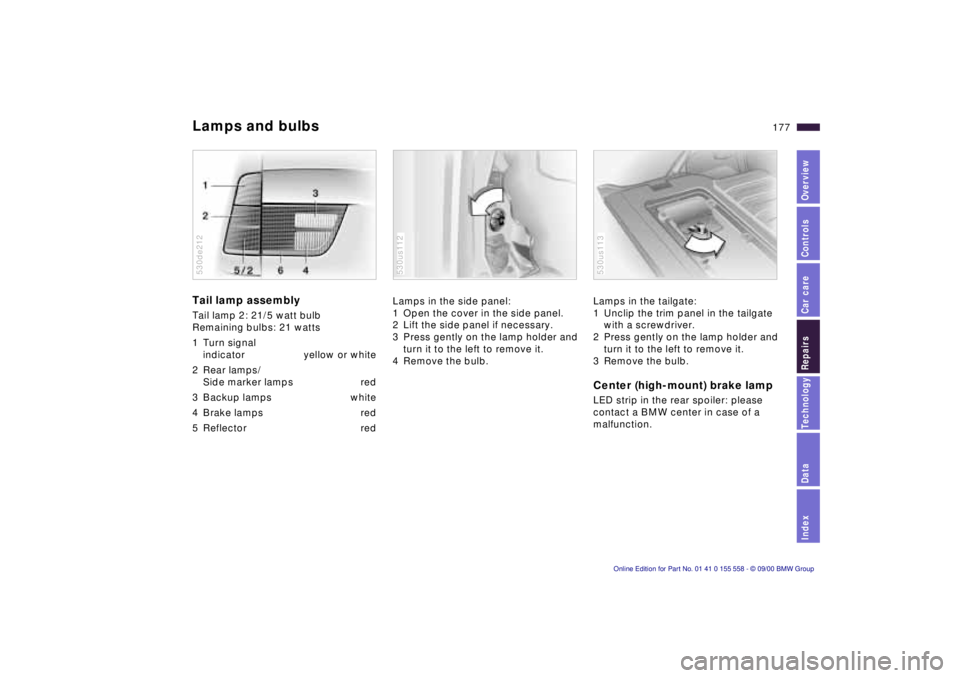
Lamps and bulbsTail lamp assembly Tail lamp 2: 21/5 watt bulb
Remaining bulbs: 21 watts
1 Turn signal
indicator yellow or white
2 Rear lamps/
Side marker lamps red
3 Backup lamps white
4 Brake lamps red
5 Reflector red530de212
Lamps in the side panel:
1 Open the cover in the side panel.
2 Lift the side panel if necessary.
3 Press gently on the lamp holder and
turn it to the left to remove it.
4 Remove the bulb. 530us112
Lamps in the tailgate:
1 Unclip the trim panel in the tailgate
with a screwdriver.
2 Press gently on the lamp holder and
turn it to the left to remove it.
3 Remove the bulb. Center (high-mount) brake lampLED strip in the rear spoiler: please
contact a BMW center in case of a
malfunction. 530us113
Page 200 of 223
200nRain sensor* Front axle
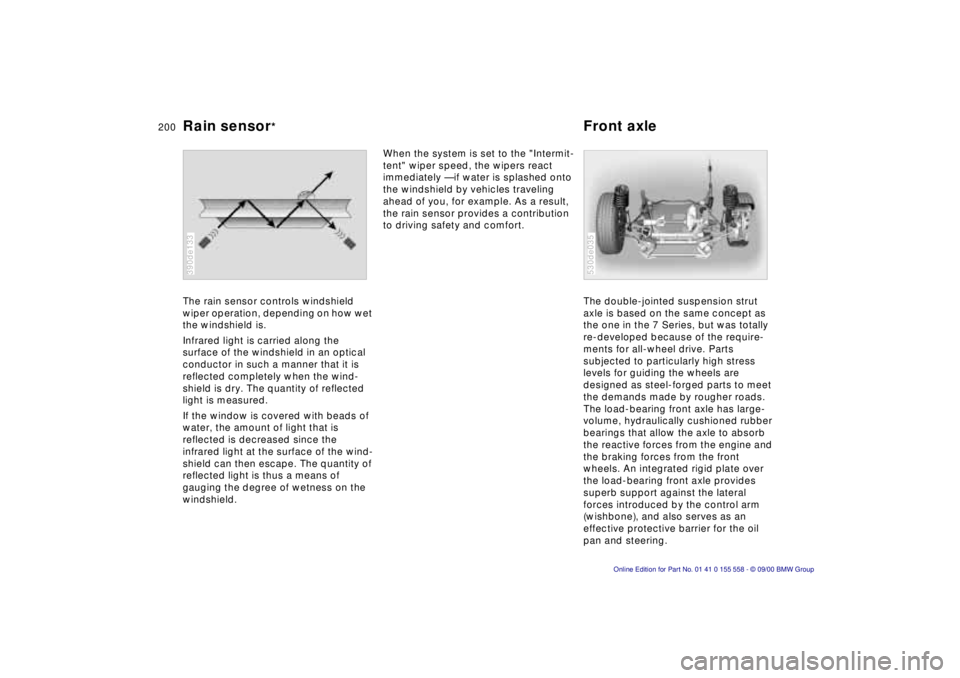
The rain sensor controls windshield
wiper operation, depending on how wet
the windshield is.
Infrared light is carried along the
surface of the windshield in an optical
conductor in such a manner that it is
reflected completely when the wind-
shield is dry. The quantity of reflected
light is measured.
If the window is covered with beads of
water, the amount of light that is
reflected is decreased since the
infrared light at the surface of the wind-
shield can then escape. The quantity of
reflected light is thus a means of
gauging the degree of wetness on the
windshield.
390de133
When the system is set to the "Intermit-
tent" wiper speed, the wipers react
immediately — if water is splashed onto
the windshield by vehicles traveling
ahead of you, for example. As a result,
the rain sensor provides a contribution
to driving safety and comfort.
The double-jointed suspension strut
axle is based on the same concept as
the one in the 7 Series, but was totally
re-developed because of the require-
ments for all-wheel drive. Parts
subjected to particularly high stress
levels for guiding the wheels are
designed as steel-forged parts to meet
the demands made by rougher roads.
The load-bearing front axle has large-
volume, hydraulically cushioned rubber
bearings that allow the axle to absorb
the reactive forces from the engine and
the braking forces from the front
wheels. An integrated rigid plate over
the load-bearing front axle provides
superb support against the lateral
forces introduced by the control arm
(wishbone), and also serves as an
effective protective barrier for the oil
pan and steering.
530de035