2001 BMW X5 3.0I ignition
[x] Cancel search: ignitionPage 54 of 223

54nMirrors
Interior rearview mirror
To reduce glare from vehicles behind
you when you are driving at night, tilt
the mirror by turning the button.
Lighted vanity mirror
Fold down the sun visor and slide the
cover panel to the side as required.
The mirror lamps operate from ignition
key position 1 and up.
Sun visors
These can be folded down toward the
windshield or swiveled out against the
side windows.
530us030
Interior and exterior rearview
mirror with automatic dimmer
*
By responding to the effects of ambient
light and the glare from following traffic,
these mirrors automatically dim through
an infinitely-variable range.
There are 2 photocells located in the
interior rearview mirror for this purpose.
One photocell (arrow) is in the mirror
glass, while the other is offset some-
what on the back of the mirror.
The mirrors automatically revert to their
clear, undimmed setting whenever you
select "Reverse."
530us031
For trouble-free operation, keep the
photocells clean and do not cover the
area between the interior rearview
mirror and the windshield. Do not
attach any kind of stickers on the wind-
shield in front of the mirror, either.
For an explanation of the electro-
chromic technology used in these
mirrors, refer to page 199.
Page 55 of 223

Index
Data
Technology
Repairs
Car care
Controls
Overview
55nSeat, mirror and steering wheel memory*
You can store and call up three different
seat, exterior mirror and steering wheel
positions. The illustration shows the
buttons on the seat for making these
position adjustments.
The adjustment of the lumbar support is
not stored in the memory.
To store
1 Turn the ignition key to position 1 or 2.
2 Adjust the desired positions for the
seat, exterior mirror and steering
wheel.
3 Press the
MEMORY button: the indi-
cator lamp in the button comes on.
4 Press memory button 1, 2 or 3, as desired: the indicator lamp goes out.
530us032
To select a stored setting
Convenience function:
1 Open the driver's door after unlocking the vehicle or place the
ignition key in position 1.
2 Briefly press memory button 1, 2 or 3, as desired.
Movement stops immediately when
one of the seat-adjustment or
memory buttons is activated during
the adjustment process.
Security function:
1 With the driver's door closed and the ignition key either removed or in posi-
tion 0 or 2.
2 Maintain pressure on the desired memory button (1, 2 or 3) until the
adjustment process is completed.
If you press the
MEMORY button acci-
dentally: press the button a second
time — the indicator lamp goes out.
Do not call up a position from the
memory while the vehicle is
moving. There is a risk of accident from
unexpected movement of the seat or
steering wheel. <
Passenger side exterior mirror tilt
function
(automatic curb monitor)
1 Move the mirror selector switch
(arrow) to the "driver's mirror" posi-
tion.
2 When the selector lever is placed in "Reverse," the passenger-side mirror
tilts downward to help the driver
monitor the area directly adjacent to
the vehicle during parking (curbs,
etc.).
You can deactivate this automatic
feature by setting the mirror selection
switch to the "passenger side" position.
530us033
Page 58 of 223
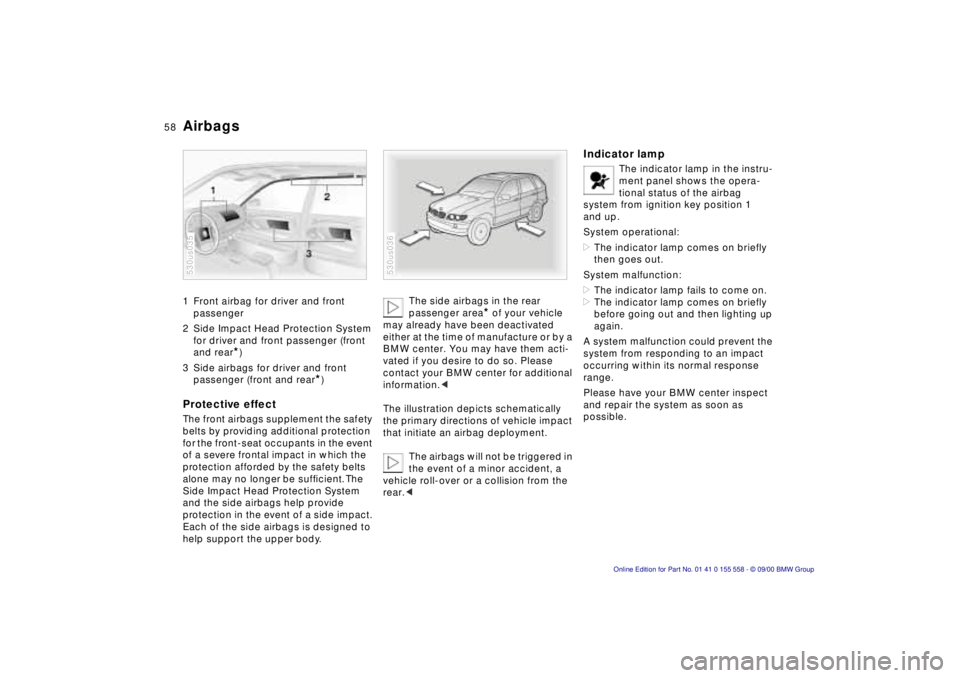
58nAirbags
1 Front airbag for driver and front
passenger
2 Side Impact Head Protection System for driver and front passenger (front
and rear
*)
3 Side airbags for driver and front passenger (front and rear
*)
Protective effect
The front airbags supplement the safety
belts by providing additional protection
for the front-seat occupants in the event
of a severe frontal impact in which the
protection afforded by the safety belts
alone may no longer be sufficient. The
Side Impact Head Protection System
and the side airbags help provide
protection in the event of a side impact.
Each of the side airbags is designed to
help support the upper body.
530us035
The side airbags in the rear
passenger area
* of your vehicle
may already have been deactivated
either at the time of manufacture or by a
BMW center. You may have them acti-
vated if you desire to do so. Please
contact your BMW center for additional
information. <
The illustration depicts schematically
the primary directions of vehicle impact
that initiate an airbag deployment. The airbags will not be triggered in
the event of a minor accident, a
vehicle roll-over or a collision from the
rear. <
530us036
Indicator lamp
The indicator lamp in the instru-
ment panel shows the opera-
tional status of the airbag
system from ignition key position 1
and up.
System operational:
> The indicator lamp comes on briefly
then goes out.
System malfunction:
> The indicator lamp fails to come on.
> The indicator lamp comes on briefly
before going out and then lighting up
again.
A system malfunction could prevent the
system from responding to an impact
occurring within its normal response
range.
Please have your BMW center inspect
and repair the system as soon as
possible.
Page 60 of 223

60nAirbags
The rear seat side airbags may already
have been deactivated, either at the
time of manufacture or by a BMW
center. Labels in the rear door opening
should indicate the status of your rear
seat side airbags. If you are uncertain of
their status, or wish to have the airbags
activated or deactivated, please
contact your BMW center. <
Even when all these guidelines are
observed, there is still a small residual
risk of injuries to the face, hands and
arms occurring from airbag deployment
in isolated instances. The ignition and
inflation noise may provoke a mild
temporary hearing loss in extremely
sensitive individuals.
Airbag warning information is also
provided on the sun visors.
For additional information concerning
the airbag system, refer to pages 168
and 196. This is the right way for a child to sit in a
child restraint when rear side airbags
(arrow) are provided.
530us026
This is the right way for a larger child to
sit wearing the safety belt when rear
side airbags (arrow) are provided.
530us099
Page 64 of 223

64n
0 Steering lock engaged
The key can only be inserted and
removed in this position.
After removing the key, turn the
steering wheel slightly to the left or right
until you hear the lock engage.
Once the ignition has been switched off
(ignition key in position 0 or pulled out),
the radio functions are still available for
approx. 20 minutes. Turn the radio back
on to use it.
An acoustic warning is sounded when
you fail to remove the ignition key after
opening the driver's door.
390de010
Vehicles with automatic trans-
mission:
Do not move the selector lever from the
"Park" position until the engine is
running (ignition key in position 2).
In order to turn the key to position 0 or
to remove it, first move the selector
lever to the "Park" position (Interlock). <
1 Steering lock disengaged
You will find that it is often easier to turn
the ignition key from position 0 to posi-
tion 1 when you move the steering
wheel slightly to help disengage the
lock.
Individual electrical devices are ready
for operation.
2 Ignition on
All electrical devices are ready for
operation.
3 Starting the engine
Vehicles with manual transmis-
sion: depress the clutch when
starting the engine. If you do not, a lock
prevents the engine from starting. <
Before starting
> Engage the parking brake.
> Be sure that the transmission
selector is in "Neutral" (or "Park" if
the vehicle is equipped with an auto-
matic transmission).
> Depress the clutch pedal.
Do not allow the engine to run in
enclosed spaces. The exhaust
gases contain carbon monoxide, an
odorless and colorless, but highly toxic
gas. Breathing the exhaust gases poses
an extreme health risk, and can lead to
unconsciousness and death.
Do not leave the vehicle unattended
with the engine running. An unattended
vehicle with a running engine repre-
sents a potential safety hazard. <
Steering/Ignition lock Starting the engine
Page 65 of 223

Index
Data
Technology
Repairs
Car care
Controls
Overview
65nStarting the engine Switching off the engine
Do not press the accelerator pedal
while starting the engine.
BMW X5 3.0i:
Do not actuate the starter for too
short a time. Do not turn it for more
than approx. 20 seconds. Release the
ignition key immediately as soon as the
engine starts.
BMW X5 4.4i:
Your BMW is equipped with the conve-
nience starting feature. Simply turn the
key to position 3 (starter) and then
release it immediately.
The starter continues to operate auto-
matically.
The automatic starting mode will not
operate if the battery voltage is low.
The engine can be started by means of
jump-starting (refer to page 190).<
Do not allow the engine to warm up
by leaving it running while the vehicle
remains stationary. Instead, begin to
drive immediately at a moderate engine
speed.Should the engine fail to start on the
first attempt (if it is very hot or cold, for
instance):
> Press the accelerator pedal halfway
down while engaging the starter.
Cold starts at very low temperatures,
from approx. +5 7 (–15 6) and at alti-
tudes above 3,300 ft (1,000 meters):
> For the initial start attempt, allow the
starter to remain engaged somewhat
longer (approx. 10 seconds).
> Press the accelerator pedal halfway
down while engaging the starter.
Engine idle speed is controlled by the
engine computer system. Increased
speeds at startup are normal and
should decrease as the engine warms
up. If engine speed does not decrease,
service is required.
To prevent the battery from discharging,
always deactivate electrical devices
that are not in use. Switch the ignition
off when the vehicle is not being driven. Turn the ignition key to position 1 or 0.
Never remove the ignition key
while the vehicle is rolling. If you
did so, the ignition lock would engage
when the steering wheel is turned.
Always remove the ignition key and
engage the steering lock before leaving
the vehicle.
Vehicles with manual transmission:
Always engage the parking brake when
parking on slopes and inclined
surfaces. Even placing the lever in
1st gear or reverse may not provide
adequate resistance to rolling.
Vehicles with automatic transmission:
Place the selector lever in "Park." <
Vehicles with automatic transmission:
The vehicle must be stationary and the
selector lever in "Park" before you can
remove the ignition key.
Page 66 of 223

66nParking brake
The parking brake is primarily designed
to prevent the vehicle from rolling while
parked. It operates against the rear
wheels.
To engage
The lever engages automatically and
the "PARKING BRAKE" or "BRAKE" (in
Canada "P") indicator lamp comes on in
the instrument cluster in ignition key
position 2. Refer to pages 22 and 23.
To release
Pull up slightly on the lever, press the
button and lower the lever.
530us039
If, in exceptional circumstances, it
should be necessary to engage
the parking brake while the vehicle is in
motion, do not pull it with excessive
pressure. Keep your thumb pressed
against the release button while care-
fully pulling up the lever to apply
moderate pressure.
Excessive pressure can lead to over-
braking and loss of traction (fishtailing)
at the rear axle.
The brake lamps do not come on when
the parking brake is applied.
Vehicles with manual transmission:
Always engage the parking brake when
parking on slopes and inclined
surfaces. Even placing the lever in
1st gear or reverse may not provide
adequate resistance to rolling.
Vehicles with automatic transmission:
Place the selector lever in "Park." <
To avoid corrosion, apply the parking
brake lightly from time to time when
coasting to a standstill (at a traffic
signal, for instance), provided that it is
safe to do so.
Page 67 of 223

Index
Data
Technology
Repairs
Car care
Controls
Overview
67nManual transmission
Press the clutch pedal all the way down
each time you shift, pressing the
manual-shift gear lever into its proper
end position.
Depress the clutch when starting the
vehicle, too, otherwise, lockout will
prevent the engine from starting if the
clutch is not depressed.
The shift lever's neutral gate (dot in the
illustration) is located between 3rd and
4th gear.
When shifting from each gear through
"Neutral," the shift lever returns auto-
matically to this neutral position
because of its spring loading.
360de044
Reverse
Select "Reverse" only when the vehicle
is completely stopped. Press the shift
lever to the left to overcome the resis-
tance.
As you do this, the backup lamps will
turn on automatically when the ignition
key is in position 2.
Do not hold the vehicle in place on
slopes by slipping or "riding" the
clutch. Use the parking brake instead.
A slipping clutch increases clutch
wear. <