2001 BMW SPORT WAGON steering
[x] Cancel search: steeringPage 69 of 238

IndexDataTechnologyRepairsCar careControlsOverview
69n
Starting the engine Switching off the engineStarting the engine>Start the engine. Do not press the
accelerator pedal.
Do not actuate the starter for too
short a time. Do not turn it for
more than approx. 20 seconds. Release
the ignition key immediately as soon as
the engine starts.
Do not allow the engine to warm up by
leaving it running while the vehicle re-
mains stationary. Instead, begin driving
immediately at a moderate engine
speed.
BMW 540i with automatic transmission:
Your BMW is equipped with the conve-
nience starting feature. Simply turn the
key to position 3 (starter) and then re-
lease it immediately.
The starter continues to operate auto-
matically.
The automatic starting mode will not
operate if the battery voltage is low.
Should this condition arise, it remains
possible to jump-start the engine (refer
to page 200).<
Should the engine fail to start on the
first attempt (if it is very hot or cold, for
instance):
>Press the accelerator pedal halfway
down while engaging the starter.
Cold starts at extremely low tempera-
tures, from approx. +57 (–156)
and at elevations above 3,300 ft
(1,000 meters):
>Be sure to let the starter remain
engaged somewhat longer the first
time (approx. 10 seconds).
>Press the accelerator pedal halfway
down while engaging the starter.
Engine idle speed is controlled by the
engine computer system. Increased
speeds at start-up are normal and
should decrease as the engine warms
up. If engine speed does not decrease,
service is required.
To prevent the battery from discharg-
ing, always deactivate electrical de-
vices which are not in use. Switch the
ignition off when the vehicle is not
being driven.Turn the ignition key to position 1 or 0.
Never remove the ignition key
while the vehicle is rolling. The
steering locks, making it impossible to
steer the vehicle.
Always remove the ignition key and en-
gage the steering lock before leaving
the vehicle.
Vehicles with manual transmission:
Always engage the parking brake
when parking on slopes and inclined
surfaces, since not even placing the
lever in 1st gear or reverse may not
provide adequate resistance to rolling.
Vehicles with automatic transmission:
Place the selector lever in "Park."<
Vehicles with automatic transmission
*:
The vehicle must be stationary and the
selector lever in "Park" before you can
remove the ignition key.
Page 89 of 238
IndexDataTechnologyRepairsCar careControlsOverview
89n
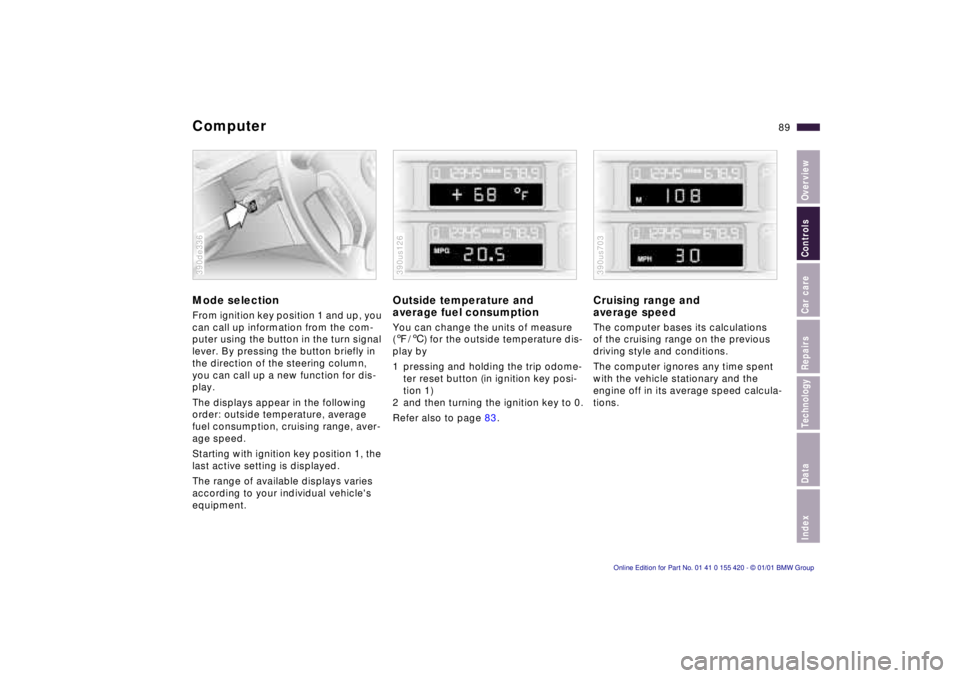
ComputerMode selectionFrom ignition key position 1 and up, you
can call up information from the com-
puter using the button in the turn signal
lever. By pressing the button briefly in
the direction of the steering column,
you can call up a new function for dis-
play.
The displays appear in the following
order: outside temperature, average
fuel consumption, cruising range, aver-
age speed.
Starting with ignition key position 1, the
last active setting is displayed.
The range of available displays varies
according to your individual vehicle's
equipment.390de336
Outside temperature and
average fuel consumptionYou can change the units of measure
(7/6) for the outside temperature dis-
play by
1 pressing and holding the trip odome-
ter reset button (in ignition key posi-
tion 1)
2 and then turning the ignition key to 0.
Refer also to page 83.390us126
Cruising range and
average speed The computer bases its calculations
of the cruising range on the previous
driving style and conditions.
The computer ignores any time spent
with the vehicle stationary and the
engine off in its average speed calcula-
tions.390us703
Page 111 of 238
IndexDataTechnologyRepairsCar careControlsOverview
111n
Air conditionerRecirculated air mode
If there are unpleasant
odors in the outside air, you
can temporarily block the flow of air.
The system then recirculates the air
currently within the vehicle
If you have a multifunction steering
wheel with the button for recirculated
air, you can also use this button to
switch to the recirculated air mode
(refer to page 25).
If the windows fog over in the re-
circulated air mode, switch the re-
circulated air off and increase the air
supply as required.<
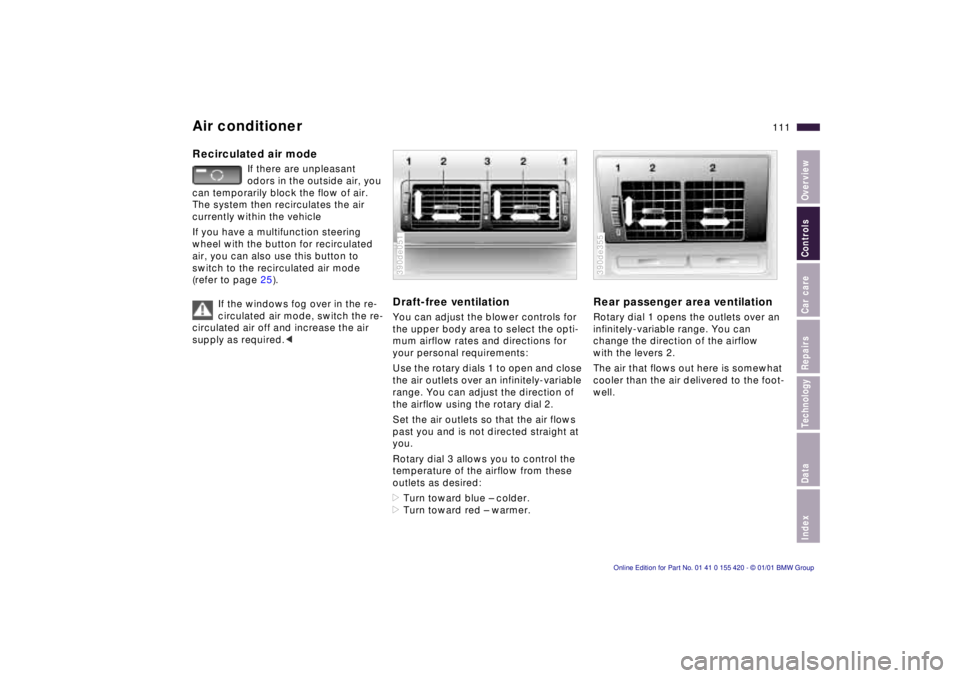
Draft-free ventilation You can adjust the blower controls for
the upper body area to select the opti-
mum airflow rates and directions for
your personal requirements:
Use the rotary dials 1 to open and close
the air outlets over an infinitely-variable
range. You can adjust the direction of
the airflow using the rotary dial 2.
Set the air outlets so that the air flows
past you and is not directed straight at
you.
Rotary dial 3 allows you to control the
temperature of the airflow from these
outlets as desired:
>Turn toward blue – colder.
>Turn toward red – warmer.390de051
Rear passenger area ventilationRotary dial 1 opens the outlets over an
infinitely-variable range. You can
change the direction of the airflow
with the levers 2.
The air that flows out here is somewhat
cooler than the air delivered to the foot-
well.390de355
Page 118 of 238
118n
Automatic climate control
*
>Left-hand indicator lamp on – AUC
mode: the system recognizes pollut-
ants in the outside air and blocks the
flow of air when necessary. The sys-
tem then recirculates the air currently
within the vehicle.
Depending on the air quality, the au-
tomatic system then switches back
and forth between outside air supply
and recirculation of the air within the
vehicle.
>Right-hand indicator lamp on: the
flow of external air into the vehicle is
permanently blocked. The system
then recirculates the air currently
within the vehicle.
If you have a multifunction steering
wheel with the recirculated-air button
(refer to page 25), you can also use it to
switch between "Off" and the recircu-
lated-air mode or AUC and the recircu-
lated-air mode.
If the windows should fog over in
the recirculated air mode, switch
the recirculated air mode off and in-
crease the air supply as required.<
Rear window defroster
When the rear window de-
froster is activated, the indica-
tor lamp comes on. The rear window
defroster switches off automatically.
Residual heating mode
The heat which is stored in
the engine is utilized for
heating the interior when the engine
has been switched off (while waiting at
a railroad crossing, for instance).
In ignition key position 1, you can alter
the settings of the automatic climate
control. In ignition key position 0, the
system automatically directs heated air
to the windshield, side windows and
footwells.
This function may be activated
when the outside temperature is
below approx. 597 (156), the engine
is at operating temperature, and the
battery is adequately charged. The LED
on the button will light up when all con-
ditions have been met.<
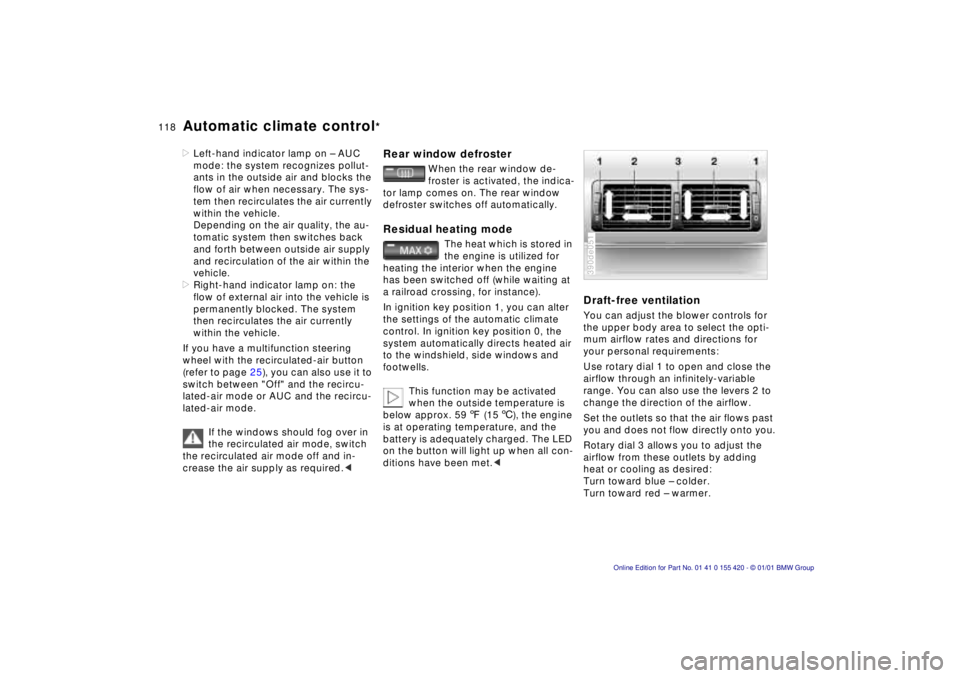
Draft-free ventilationYou can adjust the blower controls for
the upper body area to select the opti-
mum airflow rates and directions for
your personal requirements:
Use rotary dial 1 to open and close the
airflow through an infinitely-variable
range. You can also use the levers 2 to
change the direction of the airflow.
Set the outlets so that the air flows past
you and does not flow directly onto you.
Rotary dial 3 allows you to adjust the
airflow from these outlets by adding
heat or cooling as desired:
Turn toward blue – colder.
Turn toward red – warmer.390de051
Page 120 of 238
120n
Steering wheel heating
*
Roller sun blind
*
Independent ventilation
*
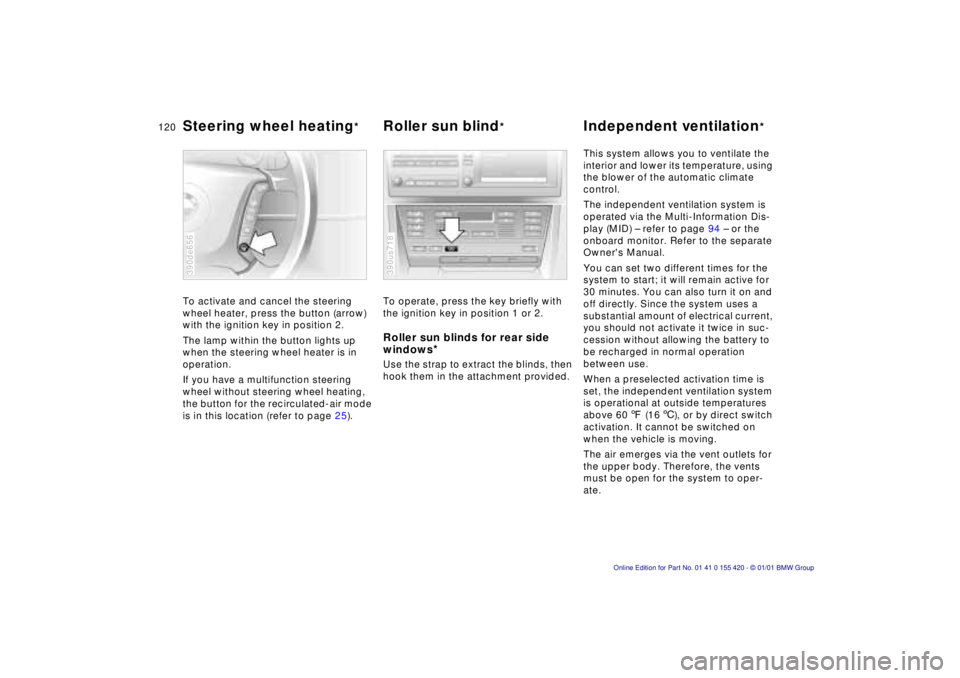
To activate and cancel the steering
wheel heater, press the button (arrow)
with the ignition key in position 2.
The lamp within the button lights up
when the steering wheel heater is in
operation.
If you have a multifunction steering
wheel without steering wheel heating,
the button for the recirculated-air mode
is in this location (refer to page 25).390de656
To operate, press the key briefly with
the ignition key in position 1 or 2.Roller sun blinds for rear side
windows
*
Use the strap to extract the blinds, then
hook them in the attachment provided.390us718
This system allows you to ventilate the
interior and lower its temperature, using
the blower of the automatic climate
control.
The independent ventilation system is
operated via the Multi-Information Dis-
play (MID) – refer to page 94 – or the
onboard monitor. Refer to the separate
Owner's Manual.
You can set two different times for the
system to start; it will remain active for
30 minutes. You can also turn it on and
off directly. Since the system uses a
substantial amount of electrical current,
you should not activate it twice in suc-
cession without allowing the battery to
be recharged in normal operation
between use.
When a preselected activation time is
set, the independent ventilation system
is operational at outside temperatures
above 607 (166), or by direct switch
activation. It cannot be switched on
when the vehicle is moving.
The air emerges via the vent outlets for
the upper body. Therefore, the vents
must be open for the system to oper-
ate.
Page 137 of 238
Index
Data
Technology
Repairs
Car care
Controls
Overview
137nRoof-mounted luggage rack
Mounting points
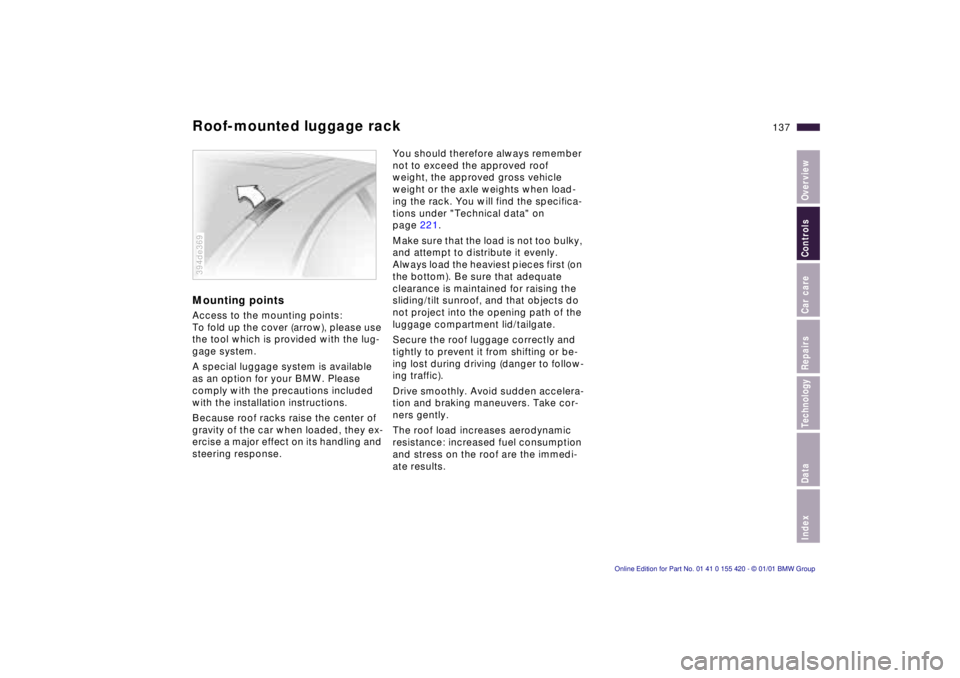
Access to the mounting points:
To fold up the cover (arrow), please use
the tool which is provided with the lug-
gage system.
A special luggage system is available
as an option for your BMW. Please
comply with the precautions included
with the installation instructions.
Because roof racks raise the center of
gravity of the car when loaded, they ex-
ercise a major effect on its handling and
steering response.
394de369
You should therefore always remember
not to exceed the approved roof
weight, the approved gross vehicle
weight or the axle weights when load-
ing the rack. You will find the specifica-
tions under "Technical data" on
page 221.
Make sure that the load is not too bulky,
and attempt to distribute it evenly.
Always load the heaviest pieces first (on
the bottom). Be sure that adequate
clearance is maintained for raising the
sliding/tilt sunroof, and that objects do
not project into the opening path of the
luggage compartment lid/tailgate.
Secure the roof luggage correctly and
tightly to prevent it from shifting or be-
ing lost during driving (danger to follow-
ing traffic).
Drive smoothly. Avoid sudden accelera-
tion and braking maneuvers. Take cor-
ners gently.
The roof load increases aerodynamic
resistance: increased fuel consumption
and stress on the roof are the immedi-
ate results.
Page 139 of 238
Index
Data
Technology
Repairs
Car care
Controls
Overview
Overview
Controls and features Operation, care
and maintenance
Owner service procedures
Technical dataIndex
Advanced technology
139
n
Special operating instructions:
Break-in procedure 140
Driving notes 141
Catalytic converter 142
Antilock Brake System (ABS) 143
Disc brakes 144
Brake system 146
Winter operation 146
Power steering 148
Level control system 148
Cellular phone 149
Radio reception 149
Wheels and tires:
Tire inflation pressure 150
Tire condition 150
Tire replacement 151
Tire rotation 152
Wheel and tire combinations 153
Winter tires 154
Snow chains 155
Approved wheel and tire specifications 156 Under the hood:
Hood
159
Engine compartment 160
Washer fluids 164
Washer nozzles 164
Engine oil 165
Coolant 167
Brake fluid 168
Vehicle Identification Number 169
Care and maintenance:
The BMW Maintenance System 170
Caring for your car 171
Airbags 176
Vehicle storage 176
Laws and regulations:
Technical modifications 177
California Proposition 65 Warning 177
OBD interface socket 178
Page 141 of 238

Index
Data
Technology
Repairs
Car care
Controls
Overview
141nDriving notes
Brakes:
Do not drive with your foot resting
on the brake pedal. Even light but con-
sistent pedal pressure can lead to high
temperatures, brake wear and possibly
even brake failure.
Aquaplaning:
When driving on wet or slushy roads,
reduce road speed. If you do not, a
wedge of water can form between tires
and road surface. This phenomenon is
referred to as aquaplaning or hydro-
planing. It is characterized by a partial
or complete loss of contact between
the tires and the road surface. The ulti-
mate results are loss of steering and
braking control.
Driving through water:
Do not drive through water more than
1 ft (30 cm) deep. Drive only at walking
speed. Driving at a faster speed could
cause damage to the engine, the elec-
trical system and the transmission.Rear parcel tray:
Do not use the rear parcel tray to store
heavy or bulky objects. They could
pose a danger to the occupants during
braking, evasive maneuvers, or in an
accident.
Clothes hooks:
Hang items of clothing from the hooks
so that they will not obstruct the driver's
vision. Do not hang any heavy objects
on the hooks, as otherwise passengers
could be injured, e.g. during any hard
braking or evasive maneuvers, or dur-
ing an accident. <