2001 BMW M ROADSTER COUPE key
[x] Cancel search: keyPage 34 of 171
34n
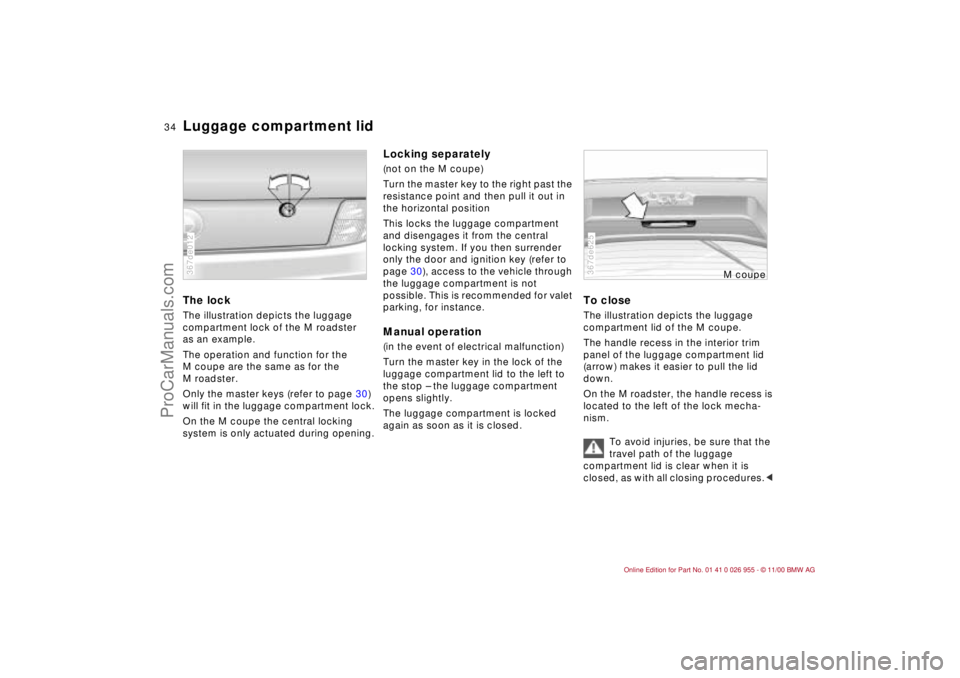
Luggage compartment lidThe lockThe illustration depicts the luggage
compartment lock of the M roadster
as an example.
The operation and function for the
M coupe are the same as for the
M roadster.
Only the master keys (refer to page 30)
will fit in the luggage compartment lock.
On the M coupe the central locking
system is only actuated during opening.367de012
Locking separately(not on the M coupe)
Turn the master key to the right past the
resistance point and then pull it out in
the horizontal position
This locks the luggage compartment
and disengages it from the central
locking system. If you then surrender
only the door and ignition key (refer to
page 30), access to the vehicle through
the luggage compartment is not
possible. This is recommended for valet
parking, for instance.Manual operation(in the event of electrical malfunction)
Turn the master key in the lock of the
luggage compartment lid to the left to
the stop – the luggage compartment
opens slightly.
The luggage compartment is locked
again as soon as it is closed.
To closeThe illustration depicts the luggage
compartment lid of the M coupe.
The handle recess in the interior trim
panel of the luggage compartment lid
(arrow) makes it easier to pull the lid
down.
On the M roadster, the handle recess is
located to the left of the lock mecha-
nism.
To avoid injuries, be sure that the
travel path of the luggage
compartment lid is clear when it is
closed, as with all closing procedures.< 367de625
M coupe
ProCarManuals.com
Page 35 of 171
35n
IndexDataTechnologyRepairsCar careControlsOverview
Luggage compartment lid Electric power windows
Do not drive with the luggage
compartment lid open, since
exhaust fumes could penetrate the inte-
rior of the vehicle. Should it be abso-
lutely necessary to operate the vehicle
with the luggage compartment lid open
(coupe; roadster with closed convert-
ible top):
>Close all windows. On the coupe,
close the sunroof.
>Increase the air supply of the heating
and ventilation system to a high level.
Refer to page 72.<
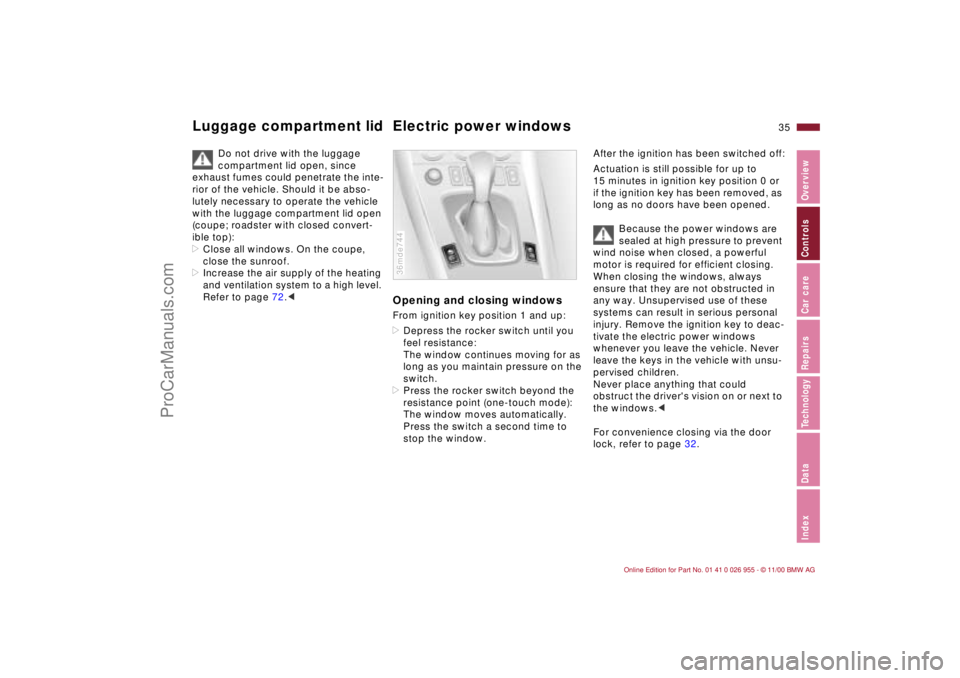
Opening and closing windowsFrom ignition key position 1 and up:
>Depress the rocker switch until you
feel resistance:
The window continues moving for as
long as you maintain pressure on the
switch.
>Press the rocker switch beyond the
resistance point (one-touch mode):
The window moves automatically.
Press the switch a second time to
stop the window.36mde744
After the ignition has been switched off:
Actuation is still possible for up to
15 minutes in ignition key position 0 or
if the ignition key has been removed, as
long as no doors have been opened.
Because the power windows are
sealed at high pressure to prevent
wind noise when closed, a powerful
motor is required for efficient closing.
When closing the windows, always
ensure that they are not obstructed in
any way. Unsupervised use of these
systems can result in serious personal
injury. Remove the ignition key to deac-
tivate the electric power windows
whenever you leave the vehicle. Never
leave the keys in the vehicle with unsu-
pervised children.
Never place anything that could
obstruct the driver's vision on or next to
the windows.<
For convenience closing via the door
lock, refer to page 32.
ProCarManuals.com
Page 36 of 171
36n
Electric power windows Sunroof
* – coupe
Jam protectionIf one of the windows comes into
contact with an object between the
window and roof frame when it is
closing, the closing cycle is interrupted
immediately and the window will open
again slightly.
This jam protection function can
be overridden by pressing the
switch beyond the resistance point and
holding it.<
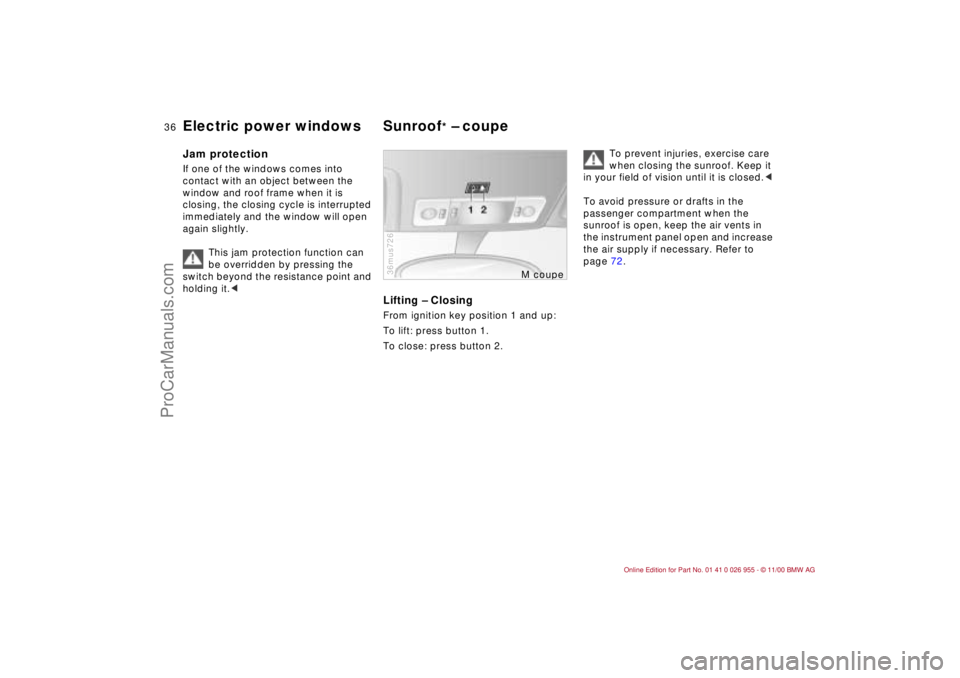
Lifting – ClosingFrom ignition key position 1 and up:
To lift: press button 1.
To close: press button 2.36mus726
M cou
pe
To prevent injuries, exercise care
when closing the sunroof. Keep it
in your field of vision until it is closed.<
To avoid pressure or drafts in the
passenger compartment when the
sunroof is open, keep the air vents in
the instrument panel open and increase
the air supply if necessary. Refer to
page 72.
ProCarManuals.com
Page 47 of 171
47n
IndexDataTechnologyRepiarsCar careControlsOverview
Seat adjustment Mirrors Backrest anglePull the lever and apply or remove
weight as required.
Read and comply with the adjust-
ment instructions on page 46.
Failure to do so can result in diminished
personal safety.< Head restraintsThe head restraints are integrated into
the backrests.
Head restraints reduce the risk of spinal
injury in the event of an accident.367de076
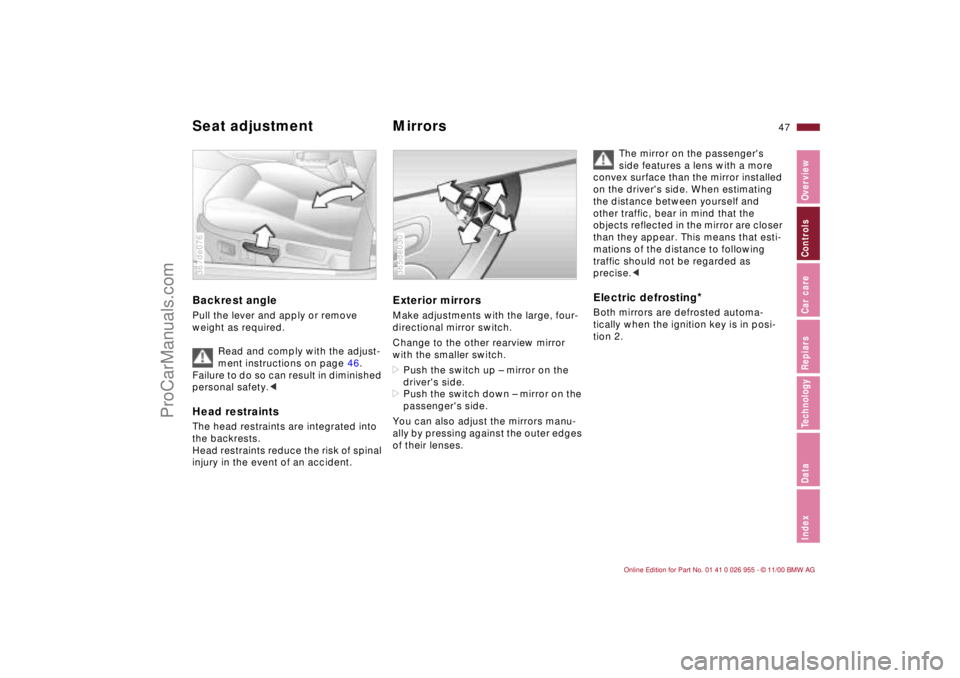
Exterior mirrorsMake adjustments with the large, four-
directional mirror switch.
Change to the other rearview mirror
with the smaller switch.
>Push the switch up – mirror on the
driver's side.
>Push the switch down – mirror on the
passenger's side.
You can also adjust the mirrors manu-
ally by pressing against the outer edges
of their lenses.365de030
The mirror on the passenger's
side features a lens with a more
convex surface than the mirror installed
on the driver's side. When estimating
the distance between yourself and
other traffic, bear in mind that the
objects reflected in the mirror are closer
than they appear. This means that esti-
mations of the distance to following
traffic should not be regarded as
precise.<
Electric defrosting
*
Both mirrors are defrosted automa-
tically when the ignition key is in posi-
tion 2.
ProCarManuals.com
Page 51 of 171
51n
IndexDataTechnologyRepairsCar careControlsOverview
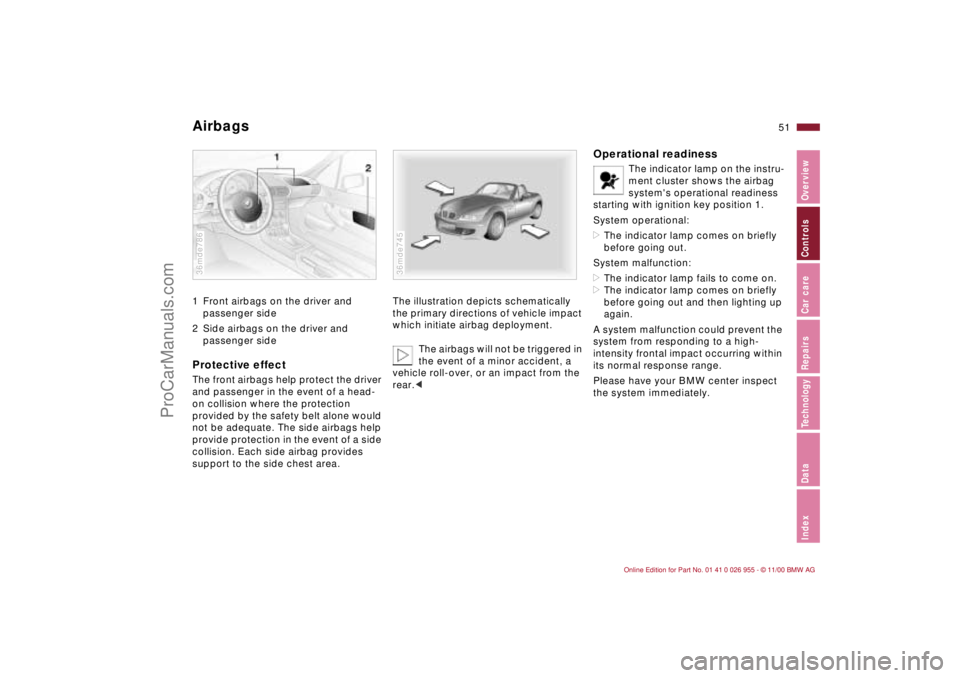
Airbags1 Front airbags on the driver and
passenger side
2 Side airbags on the driver and
passenger sideProtective effectThe front airbags help protect the driver
and passenger in the event of a head-
on collision where the protection
provided by the safety belt alone would
not be adequate. The side airbags help
provide protection in the event of a side
collision. Each side airbag provides
support to the side chest area.36mde786
The illustration depicts schematically
the primary directions of vehicle impact
which initiate airbag deployment.
The airbags will not be triggered in
the event of a minor accident, a
vehicle roll-over, or an impact from the
rear.< 36mde745
Operational readiness
The indicator lamp on the instru-
ment cluster shows the airbag
system's operational readiness
starting with ignition key position 1.
System operational:
>The indicator lamp comes on briefly
before going out.
System malfunction:
>The indicator lamp fails to come on.
>The indicator lamp comes on briefly
before going out and then lighting up
again.
A system malfunction could prevent the
system from responding to a high-
intensity frontal impact occurring within
its normal response range.
Please have your BMW center inspect
the system immediately.
ProCarManuals.com
Page 55 of 171
55n
IndexDataTechnologyRepairsCar careControlsOverview
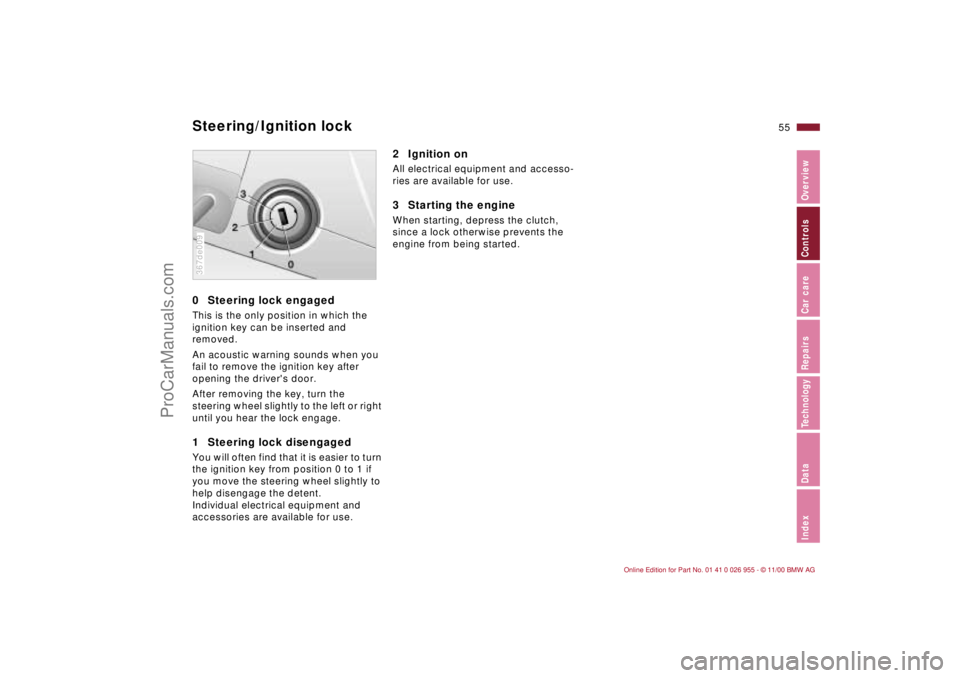
0 Steering lock engagedThis is the only position in which the
ignition key can be inserted and
removed.
An acoustic warning sounds when you
fail to remove the ignition key after
opening the driver's door.
After removing the key, turn the
steering wheel slightly to the left or right
until you hear the lock engage.1 Steering lock disengagedYou will often find that it is easier to turn
the ignition key from position 0 to 1 if
you move the steering wheel slightly to
help disengage the detent.
Individual electrical equipment and
accessories are available for use.367de009
2 Ignition onAll electrical equipment and accesso-
ries are available for use.3 Starting the engineWhen starting, depress the clutch,
since a lock otherwise prevents the
engine from being started.
Steering/Ignition lock
ProCarManuals.com
Page 56 of 171

56n
Starting the engineBefore starting>Engage the parking brake.
>Put manual-shift gear lever in idling
position.
>Depress the clutch pedal.
Do not run the engine in enclosed
spaces. The exhaust gases
contain carbon monoxide, an odorless
and colorless, but highly toxic gas.
Breathing the exhaust gases poses an
extreme health risk, and can lead to
unconsciousness and death.
Do not leave the vehicle unattended
with the engine running. An unattended
vehicle with a running engine repre-
sents a potential safety hazard.<
Starting the engineStart the engine. Do not press the
accelerator pedal.
Do not actuate the starter for too
short a time. Do not turn it for
more than approx. 20 seconds. Release
the ignition key immediately after the
engine starts.<
Do not allow the engine to warm up by
allowing it to run while the vehicle
remains stationary. Instead, begin
driving immediately at a moderate
engine speed.
Should the engine fail to start on the
first attempt (if it is very hot or cold, for
instance):
>Press the accelerator pedal halfway
down while engaging the starter.
Cold starts at very low temperatures,
from approx. +5 7 (–15 6) and at
altitudes above approx. 3,300 ft
(1,000 meters):
>On the first start attempt, engage the
starter for a longer period (approx.
10 seconds).
>Press the accelerator pedal halfway
down while engaging the starter.
Usually, it is not necessary to depress
the accelerator pedal. However, at high
altitudes or in very hot or very cold
weather, depress the pedal halfway
down when starting the engine.
Engine idle speed is controlled by the
engine computer system. Increased
speeds at start-up are normal and
should decrease as the engine warms
up. If engine speed does not decrease,
service is required.
To prevent the battery from
discharging, always switch off any
accessories which are not required.
Switch off the ignition when the vehicle
is not being driven.
ProCarManuals.com
Page 57 of 171
57n
IndexDataTechnologyRepairsCar careControlsOverview
Switching off the engine Parking brakeTurn the ignition key to position 1 or 0.
Never remove the ignition key
while the vehicle is rolling. The
steering locks and it is impossible to
steer the vehicle.
Always remove the ignition key and
engage the steering lock before leaving
the vehicle.
Always engage the parking brake when
parking on slopes and inclined
surfaces, since even placing the lever in
1st gear or reverse may not provide
adequate resistance to rolling.<
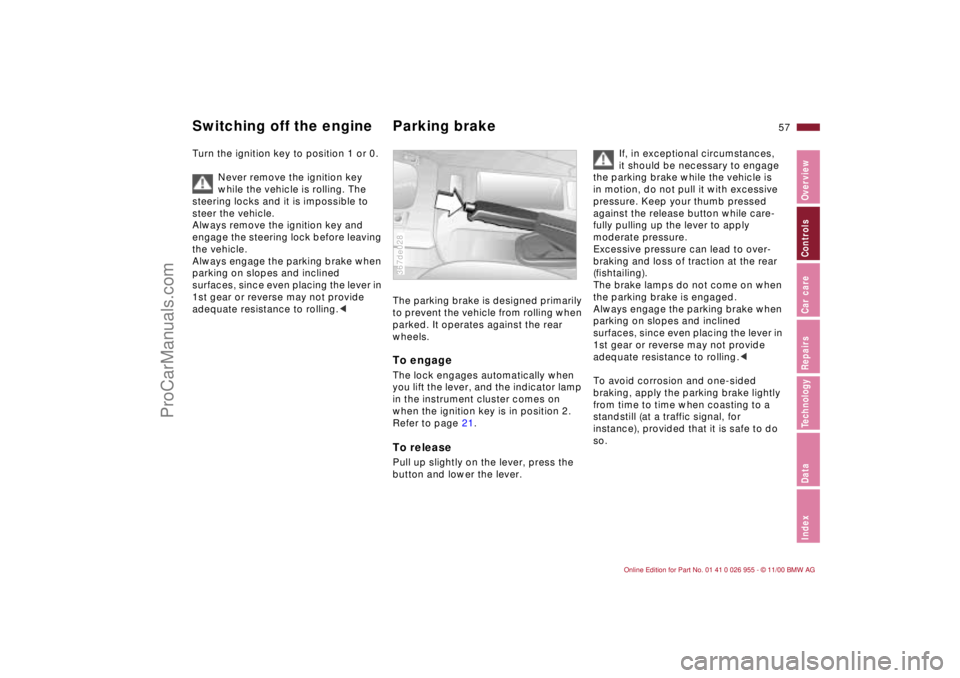
The parking brake is designed primarily
to prevent the vehicle from rolling when
parked. It operates against the rear
wheels.To engageThe lock engages automatically when
you lift the lever, and the indicator lamp
in the instrument cluster comes on
when the ignition key is in position 2.
Refer to page 21.To releasePull up slightly on the lever, press the
button and lower the lever.367de028
If, in exceptional circumstances,
it should be necessary to engage
the parking brake while the vehicle is
in motion, do not pull it with excessive
pressure. Keep your thumb pressed
against the release button while care-
fully pulling up the lever to apply
moderate pressure.
Excessive pressure can lead to over-
braking and loss of traction at the rear
(fishtailing).
The brake lamps do not come on when
the parking brake is engaged.
Always engage the parking brake when
parking on slopes and inclined
surfaces, since even placing the lever in
1st gear or reverse may not provide
adequate resistance to rolling.<
To avoid corrosion and one-sided
braking, apply the parking brake lightly
from time to time when coasting to a
standstill (at a traffic signal, for
instance), provided that it is safe to do
so.
ProCarManuals.com