2001 BMW 750IL Rear seat
[x] Cancel search: Rear seatPage 1 of 80

Table of Contents
SubjectPage
Central Body Electronics (ZKE III) . . . . . . . . . . . . . . . . . . . . . . . . . . . . . .2
Objectives of the Module . . . . . . . . . . . . . . . . . . . . . . . . . . . . . . . . . . . . .2
Purpose of the System . . . . . . . . . . . . . . . . . . . . . . . . . . . . . . . . . . . . . . .3
System Components . . . . . . . . . . . . . . . . . . . . . . . . . . . . . . . . . . . . . . . .4
Power Distribution . . . . . . . . . . . . . . . . . . . . . . . . . . . . . . . . . . . . . . . . . .7
Windshield Wiping/Washing . . . . . . . . . . . . . . . . . . . . . . . . . . . . . . . . . . . 9
Headlight Washing . . . . . . . . . . . . . . . . . . . . . . . . . . . . . . . . . . . . . . . . . . 10
Rear Window Wiper/Washer . . . . . . . . . . . . . . . . . . . . . . . . . . . . . . . . . . 11
Rain Sensor . . . . . . . . . . . . . . . . . . . . . . . . . . . . . . . . . . . . . . . . . . . . . . 12
Central Locking. . . . . . . . . . . . . . . . . . . . . . . . . . . . . . . . . . . . . . . . . . . 17
Trunklid/Tailgate . . . . . . . . . . . . . . . . . . . . . . . . . . . . . . . . . . . . . . . . . . . 25
Remote (Keyless) Entry. . . . . . . . . . . . . . . . . . . . . . . . . . . . . . . . . . . . . . 26
Car Memory/Key Memory. . . . . . . . . . . . . . . . . . . . . . . . . . . . . . . . . . . . . 27
Anti-Theft (DWA) System . . . . . . . . . . . . . . . . . . . . . . . . . . . . . . . . . . . . . 33
Power Windows/Sunroof . . . . . . . . . . . . . . . . . . . . . . . . . . . . . . . . . . . . . 42
Interior Lighting. . . . . . . . . . . . . . . . . . . . . . . . . . . . . . . . . . . . . . . . . . . 51
Visual Entry Aid . . . . . . . . . . . . . . . . . . . . . . . . . . . . . . . . . . . . . . . . . . . . 55
Seat/Mirror/Steering Column Memory. . . . . . . . . . . . . . . . . . . . . . . . . . 58
Seat Functions . . . . . . . . . . . . . . . . . . . . . . . . . . . . . . . . . . . . . . . . . . . . 65
Steering Functions . . . . . . . . . . . . . . . . . . . . . . . . . . . . . . . . . . . . . . . . . . 66
General Functions. . . . . . . . . . . . . . . . . . . . . . . . . . . . . . . . . . . . . . . . . . .75
Consumer Cut Off/Overload Protection . . . . . . . . . . . . . . . . . . . . . . . . . . . 75
Sleep Mode . . . . . . . . . . . . . . . . . . . . . . . . . . . . . . . . . . . . . . . . . . . . . . . 76
Review Questions. . . . . . . . . . . . . . . . . . . . . . . . . . . . . . . . . . . . . . . . . . . 79
Page 27 of 80

The Remote Entry System incorporated minor changes since the original introduction
which includes:
• The control electronics are incorporated into the GM III.
• The antenna is incorporated into the rear window lower heater grid.
• The remote key receiver is installed in the left “C” pillar. The receiver produces a digital
signal based on the transmitter command and sends it to the GM for processing. The GM
then carries out all remote entry operations either directly or through the door modules
for the front doors. The frequency at which the key transmits the radio signal to the ant-
enna amplifier is 315 MHz.
Vehicle/Key Memory
The Vehicle/Key Memory feature provides the flexibility of allowing the owner to customize
certain functions of select vehicle systems and automatically identifies users of the vehicle
by a key identification signal provided by the remote keyless entry system (FZV).
Vehicle & Key memory is marketed as a combined feature but is actually two separate func-
tions of the select vehicle control systems.
27
Central Body Electronics ZKE III
A
IHKA
K-BUSKEY #1
KEY #2
KEY #3
KEY #4
GMV
SM
Adjust Setting of Seat
For Key #1 IHKA Features Key #1
Being Used
KEY 4
KEY 3
KEY 2
KEY 1
KEY 1
- Selective Unlocking
- Automatic Locking
615200099.eps
Page 54 of 80

Rear Seat Interior/Reading Light Units: In
each C pillar trim panel is an interior/reading light
unit.
These units each contain an interior light that is
controlled with the front interior light and a
mechanically switched reading light on the con-
sumer cut off circuit.
Front Footwell Lights: In each front footwell,
there is also a courtesy light. These lights are
only operated when the GM provides power to
the interior lighting circuit.
On E38 and E53 the doors also contain courtesy
lights at the lower edge of the door panel (1).
Door Warning Lights (E38): The additional
“red” warning lights are installed in the edge of
the doors (2). These lights are illuminated when
the doors are opened.
Illuminated Transmission Shift Indicator
(E38): The E38 uses a microprocessor for dis-
playing the shifter position in the center console.
The processor receives shift position signals
from a console mounted range switch. The
processor illuminates the LED corresponding to
the position of the range selector.
The park position LED will remain “on” after the
ignition is switched off and stay on until the GM
goes into the “sleep” mode.
Soft Lighting Feature: The GM provides progressive voltage (up to 12v) providing the soft
on feature
to the interior lighting circuit when the interior lights are required. The GM grad-
ually reduces the full 12 volt power supply providing soft off
when interior light deactivation
is required.
54
Central Body Electronics ZKE III
Park
Position
LED
Page 58 of 80

Seat/Mirror/Steering Column Memory
Purpose of the System
The front seats, outside rearview mirrors and steering column (if equipped) positions are
electrically adjustable. The “customized” adjustment positions can be memorized and
stored for three diferent users and recalled back to the individual positions (with the excep-
tion of the passenger seat - not in memory).
The basic features of seat/mirror/steering column operation, as well as the memory posi-
tions is integrated into the ZKE III system.
• Seat/Steering Column Memory
Module (PM SM).
• Driver’s Door Switchblock Mod-
ule (PM FT/SB - early E38 was
separate).
• Passenger’s Door Module (PM
BT - E53 combined with window
switch).
• General Module (GM III).
• 3 Position Memory Switch.
• Seat Switch.
• Steering Column Switch.
• Seat/Steering Column/Mirror
Motors.
The Seat/Steering Column Memory Module communicates with the DISplus or MoDiC for
diagnosis and Vehicle Memory encoding.
58
Central Body Electronics ZKE III
System Components: Inputs - Processing - Outputs
E38/E39 Shown
Page 66 of 80
Principle of Operation
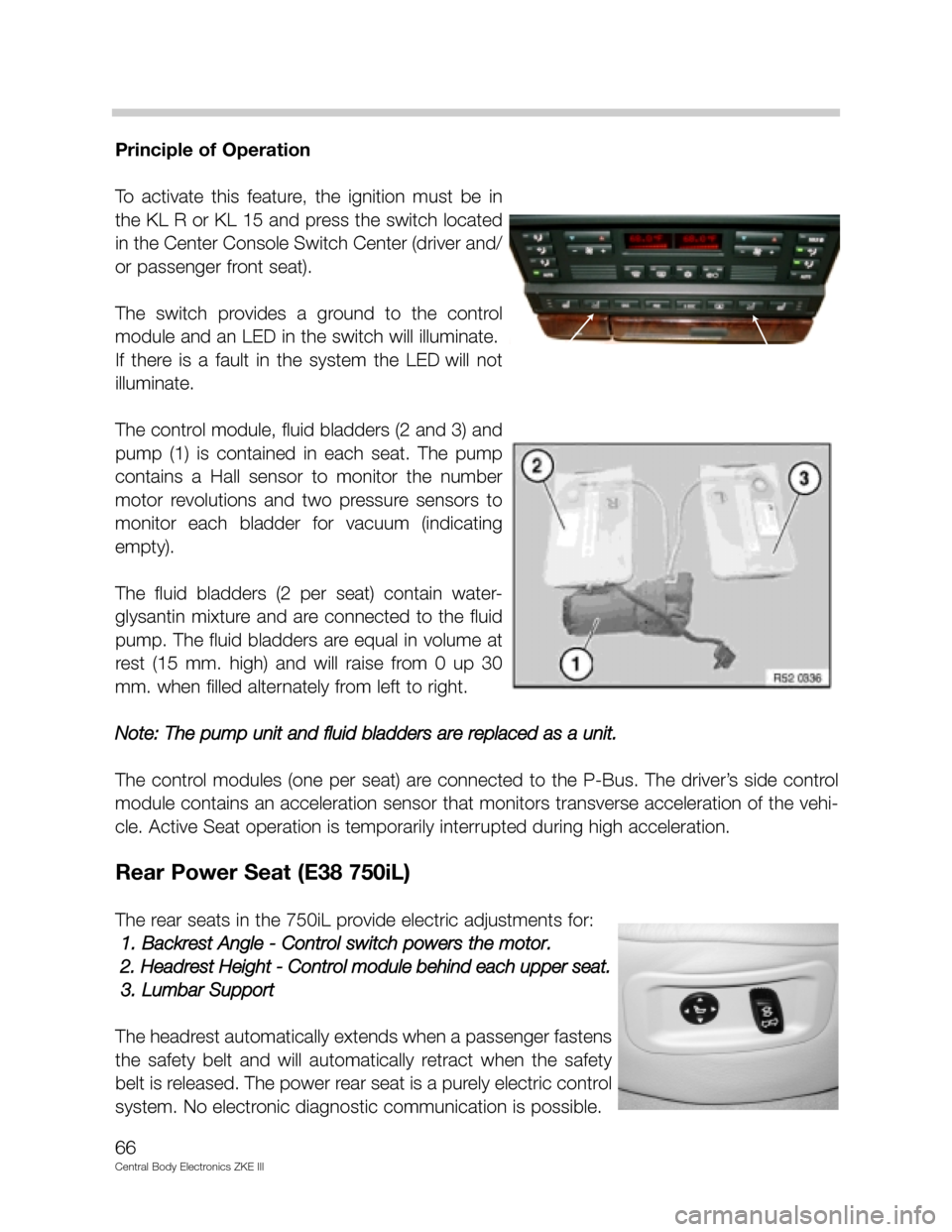
To activate this feature, the ignition must be in
the KL R or KL 15 and press the switch located
in the Center Console Switch Center (driver and/
or passenger front seat).
The switch provides a ground to the control
module and an LED in the switch will illuminate.
If there is a fault in the system the LED will not
illuminate.
The control module, fluid bladders (2 and 3) and
pump (1) is contained in each seat. The pump
contains a Hall sensor to monitor the number
motor revolutions and two pressure sensors to
monitor each bladder for vacuum (indicating
empty).
The fluid bladders (2 per seat) contain water-
glysantin mixture and are connected to the fluid
pump. The fluid bladders are equal in volume at
rest (15 mm. high) and will raise from 0 up 30
mm. when filled alternately from left to right.
Note: The pump unit and fluid bladders are replaced as a unit.
The control modules (one per seat) are connected to the P-Bus. The driver’s side control
module contains an acceleration sensor that monitors transverse acceleration of the vehi-
cle. Active Seat operation is temporarily interrupted during high acceleration.
Rear Power Seat (E38 750iL)
The rear seats in the 750iL provide electric adjustments for:
1. Backrest Angle - Control switch powers the motor.
2. Headrest Height - Control module behind each upper seat.
3. Lumbar Support
The headrest automatically extends when a passenger fastens
the safety belt and will automatically retract when the safety
belt is released. The power rear seat is a purely electric control
system. No electronic diagnostic communication is possible.
66
Central Body Electronics ZKE III
Page 68 of 80
68
Central Body Electronics ZKE III
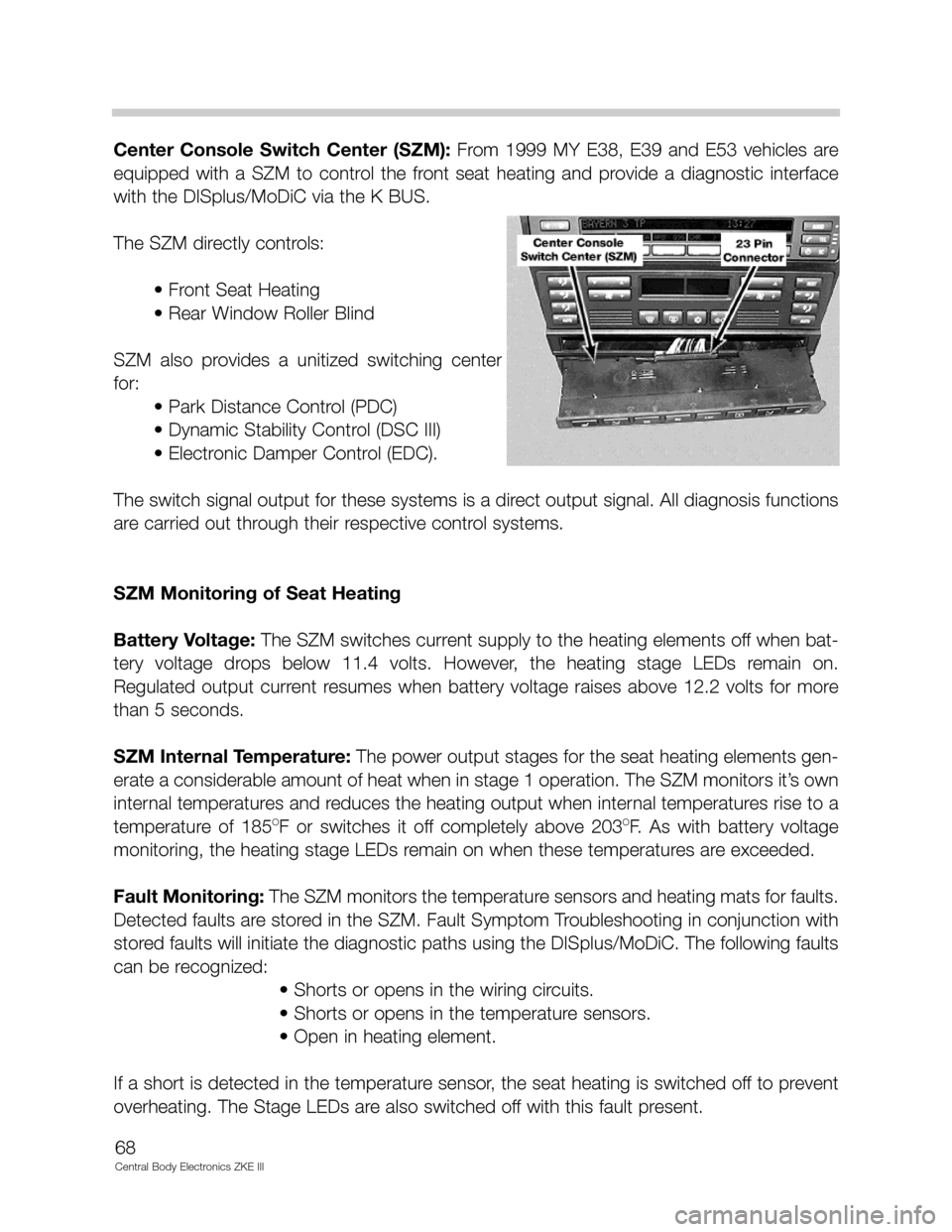
Center Console Switch Center (SZM): From 1999 MY E38, E39 and E53 vehicles are
equipped with a SZM to control the front seat heating and provide a diagnostic interface
with the DISplus/MoDiC via the K BUS.
The SZM directly controls:
• Front Seat Heating
• Rear Window Roller Blind
SZM also provides a unitized switching center
for:
• Park Distance Control (PDC)
• Dynamic Stability Control (DSC III)
• Electronic Damper Control (EDC).
The switch signal output for these systems is a direct output signal. All diagnosis functions
are carried out through their respective control systems.
SZM Monitoring of Seat Heating
Battery Voltage:The SZM switches current supply to the heating elements off when bat-
tery voltage drops below 11.4 volts. However, the heating stage LEDs remain on.
Regulated output current resumes when battery voltage raises above 12.2 volts for more
than 5 seconds.
SZM Internal Temperature: The power output stages for the seat heating elements gen-
erate a considerable amount of heat when in stage 1 operation. The SZM monitors it’s own
internal temperatures and reduces the heating output when internal temperatures rise to a
temperature of 185
OF or switches it off completely above 203OF. As with battery voltage
monitoring, the heating stage LEDs remain on when these temperatures are exceeded.
Fault Monitoring:The SZM monitors the temperature sensors and heating mats for faults.
Detected faults are stored in the SZM. Fault Symptom Troubleshooting in conjunction with
stored faults will initiate the diagnostic paths using the DISplus/MoDiC. The following faults
can be recognized:
• Shorts or opens in the wiring circuits.
• Shorts or opens in the temperature sensors.
• Open in heating element.
If a short is detected in the temperature sensor, the seat heating is switched off to prevent
overheating. The Stage LEDs are also switched off with this fault present.
Page 69 of 80
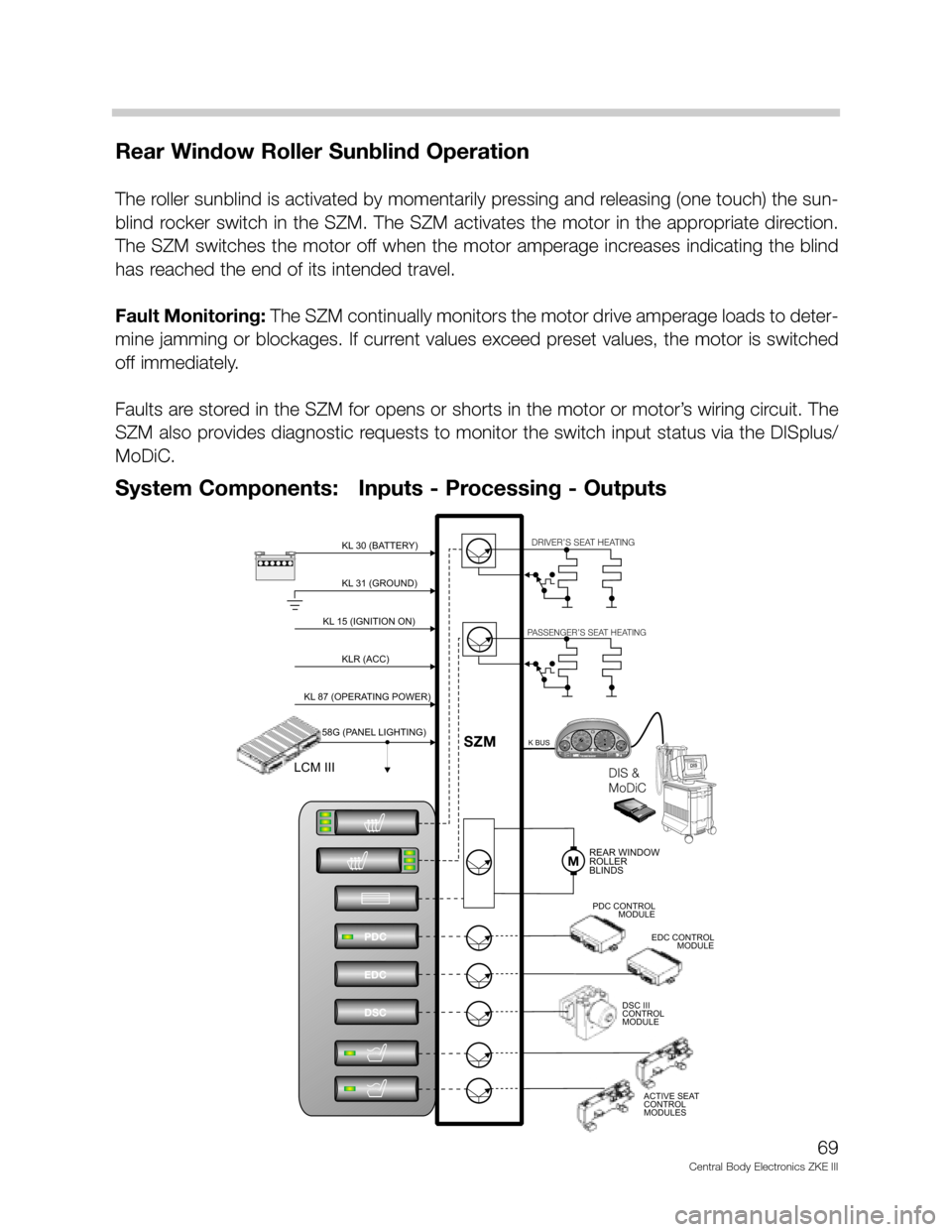
Rear Window Roller Sunblind Operation
The roller sunblind is activated by momentarily pressing and releasing (one touch) the sun-
blind rocker switch in the SZM. The SZM activates the motor in the appropriate direction.
The SZM switches the motor off when the motor amperage increases indicating the blind
has reached the end of its intended travel.
Fault Monitoring: The SZM continually monitors the motor drive amperage loads to deter-
mine jamming or blockages. If current values exceed preset values, the motor is switched
off immediately.
Faults are stored in the SZM for opens or shorts in the motor or motor’s wiring circuit. The
SZM also provides diagnostic requests to monitor the switch input status via the DISplus/
MoDiC.
69
Central Body Electronics ZKE III
KL 31 (GROUND)KL 31 (GROUND)
DIS
DIS
BMWDIS
B
M
WD
I
S
BMWDIS
BMW
DIS
D
ia
g
n
o
s
e
-
a
n
d
In
fo
r
m
a
ti
o
n
S
y
s
t
e
mDIS &
MoDiCDIS &
MoDiC
M
o
Di
C
0½
CHECK
ENGINE
CHECK
ENGINEOIL SERVICEOIL SERVICEINSPECTIONINSPECTIONP
1/min
x1000km/hELECTRONICMPH1
2020404060608080100180160140 1201002001202201402400234
5
6
7!!ABS20 DIGIT READOUT20 DIGIT READOUT
123456
prnd432
m
prnd432
m
122.4 +72.0 fo
+72.0 fomiles0
10
15 20 40
KL 30 (BATTERY)KL 30 (BATTERY)-+
KL 15 (IGNITION ON)KL 15 (IGNITION ON)
KLR (ACC)KLR (ACC)
KL 87 (OPERATING POWER)KL 87 (OPERATING POWER)
58G (PANEL LIGHTING)58G (PANEL LIGHTING)
LCM IIILCM III
PDC
EDC
DSC
MREAR WINDOW
ROLLER
BLINDSREAR WINDOW
ROLLER
BLINDS
DRIVER’S SEAT HEATINGDRIVER’S SEAT HEATING
PASSENGER’S SEAT HEATINGPASSENGER’S SEAT HEATING
K BUSK BUS
PDC CONTROL
MODULEPDC CONTROL
MODULE
EDC CONTROL
MODULEEDC CONTROL
MODULE
SZMSZM
DSC III
CONTROL
MODULEDSC III
CONTROL
MODULE
ACTIVE SEAT
CONTROL
MODULESACTIVE SEAT
CONTROL
MODULES
System Components: Inputs - Processing - Outputs