Page 165 of 238

Index
Data
Technology
Repairs
Car care
Controls
Overview
165nEngine oil
Checking oil level
1 Park the vehicle on a level surface.
2 Shut the engine off after it has
reached normal operating
temperature.
3 After approx. 5 minutes, pull the dipstick out and wipe it off with a
clean lint-free cloth, paper towel, or
similar material.
4 Carefully push the dipstick all the way into the guide tube and pull it out
again.
5 The oil level should be in between the
two marks on the dipstick.
As with fuel economy, oil consumption
is directly influenced by your driving
style and vehicle operating conditions.
390de647
The oil volume between the two marks
on the dipstick corresponds to approx.
1.1 US quarts (1 liter). Do not fill beyond
the upper mark on the dipstick. Excess
oil will damage the engine.
460de189
To add oil
Wait until the level has dropped to just
above the lower mark before adding oil.
However, do not wait until the oil level
drops below the lower mark.
BMW engines are designed to op-
erate without oil additives; the use
of additives could lead to damage in
some cases. This is also true for the
manual transmission, the automatic
transmission, the differential, and the
power steering system. <
390de646
Page 173 of 238

Index
Data
Technology
Repairs
Car care
Controls
Overview
173nCaring for your car
Caring for the vehicle finish
Regular washing is a preventive mea-
sure against long-term effects from
substances that are harmful to the vehi-
cle's finish, especially if you drive your
vehicle in areas with high levels of air
pollution or aggressive natural sub-
stances (tree resins, pollen).
Nevertheless, you should immediately
remove especially aggressive sub-
stances. Failure to do so can lead to
changes in the paint's chemical struc-
ture or to discoloration. Gasoline spilled
during refueling, oil, grease and brake
fluid should always be cleaned away
immediately, as should bird droppings
(finish damage).
Any contamination remaining on the
surface of the vehicle will be especially
conspicuous after washing. Use clean-
ing fluid or alcohol with a clean cloth or
cotton pad to remove. Remove tar
spots with tar remover. After cleaning,
the affected areas should be waxed to
ensure continued protection.
Use cleaning and car-care
products that you can obtain
at your BMW center. <
Waxing your car
Protect the finish using carnauba or
synthetic-based waxes only.
The best way to determine when the
finish needs to be waxed is by noting
when water stops beading on the sur-
face.
You can use a glass cleaner to remove
any wax or silicone that may have been
left on the windows during waxing.
Use cleaning and car-care
products that you can obtain
at your BMW center. <
Paint damage
You can touch up small areas of dam-
age with BMW spray paint or a BMW
touch-up stick.
The paint color code for your vehicle is
provided on a sticker located on the
right hand side under the hood and on
the first page of your Service and War-
ranty Information Booklet.
Damage caused by flying stones,
scratches, etc., must be touched up
without delay to prevent rust from form-
ing.
If corrosion has started to form in an
area with paint damage, remove all rust
and clean the area. Then prime the area
with a BMW Primer Stick. Finally, apply
the finish coat. After a few days, polish
and protect the touched-in areas.
More extensive paint damage should
be repaired professionally in accor-
dance with the manufacturer's instruc-
tions. Your BMW center uses original
BMW finish materials in accordance
with approved repair procedures.
Page 174 of 238

174nCaring for your car
Window care
You can use window and glass cleaner
to clean inside window surfaces and
mirrors without smearing and streaking.
Never use polishing pastes or abrasive
(quartz) cleansers on mirror lenses.
When caring for break-resistant
security glass
*, observe the fol-
lowing instructions:
The inner surface of the side windows
is coated with a plastic film. For this
reason, do not affix any decals or adhe-
sive stickers on the inside of these win-
dows unless they are to be placed there
permanently.
Wash the glass with clean water. If nec-
essary, you may add a commercially-
available mild household cleaner. Do
not use abrasive cleaners.
If the windows are fogged or iced over,
treat them with an anti-misting cloth or
a deicer spray – do not use an ice
scraper. <
Clean the wiper blades with soapy wa-
ter. The wiper blades should be re-
placed twice a year, before and after
the cold season.
Use only wiper blades which have
been approved by BMW. <
Caring for other vehicle
components and materials
Light-alloy wheels should be treated
with alloy wheel cleaner, especially
during the winter months. However, do
not use aggressive products contain-
ing acids, strong alkalis or abrasives.
Do not use steam cleaners operating at
temperatures above 140 7 (60 6).
(Follow the manufacturer's instruc-
tions.)
If your vehicle has chrome parts
* such
as window moldings, door handles or
other items, clean these parts carefully
with ample clean water, especially if
they have an accumulation of road salt.
Use a chrome polish for an additional
treatment.
Plastic components, vinyl upholstery,
headliners, lamp lenses, the clear cover
of the instrument cluster and compo-
nents with a sprayed dull black surface
can be cleaned with water (add plastic
cleaner as required). Do not allow mois-
ture to soak through the seats or head-
liner. Never use solvents such as lac-
quer thinner, heavy-duty grease
remover, fuels, etc. Rubber components should be cleaned
with water only; a rubber treatment or
silicone spray may also be applied.
The safety belts should be cleaned with
a mild soap and water solution without
being removed from the vehicle. Never
attempt chemical or dry cleaning, as
damage to the belt fabric could result.
After cleaning, never allow the inertia
reel to retract the belts until they are
completely dry. Dirty safety belts pre-
vent the inertia reel mechanism from
retracting the strap properly, and thus
constitute a safety hazard.
Heavily soiled floor carpets and mats
*
can be cleaned with an interior cleaner.
The floor mats can be removed from
the vehicle for cleaning.
Please use only a damp cloth to clean
wooden fascia panels and components.
Follow up by drying with a soft cloth.
Use cleaning and car-care
products that you can obtain
at your BMW center. <
Page 181 of 238
Index
Data
Technology
Repairs
Car care
Controls
Overview
Overview
Controls and features Operation, care
and maintenance
Owner service procedures
Technical dataIndex
Advanced technology
181
n
Replacement procedures:
Onboard tool kit 182
Wiper blades 182
Lamps and bulbs 183
Changing a wheel 190
Battery 193
Fuses 196
In case of electrical
malfunction:
Fuel filler door 198
Sliding/Tilt sunroof 198
Tailgate 199
Assistance, giving and
receiving:
Jump-starting 200
Towing the vehicle 201
Page 198 of 238
198n
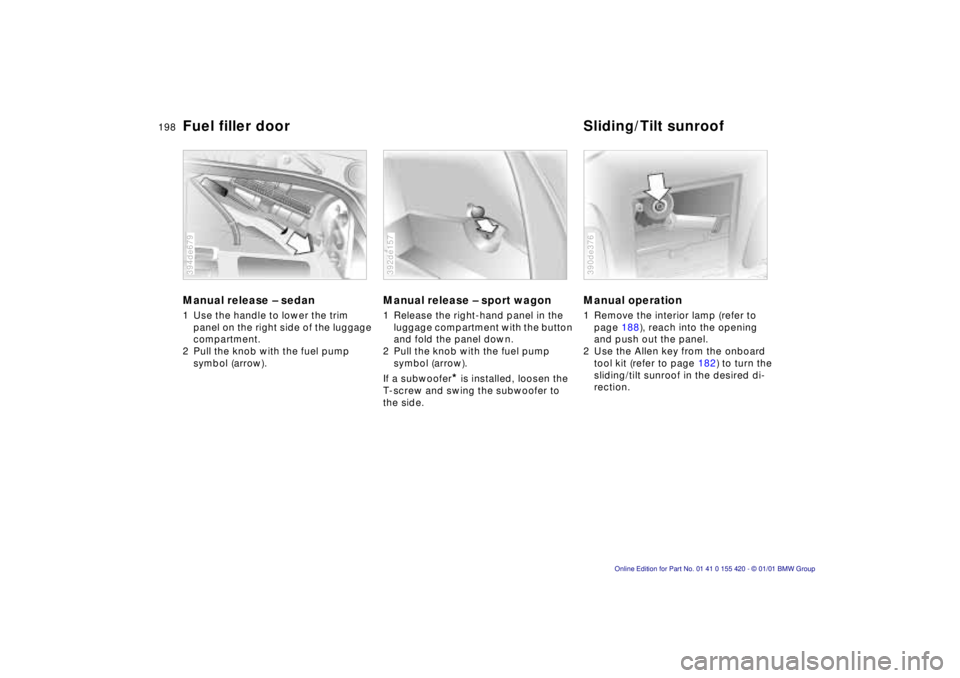
Manual release – sedan
1 Use the handle to lower the trim
panel on the right side of the luggage
compartment.
2 Pull the knob with the fuel pump symbol (arrow).
394de679
Manual release – sport wagon
1 Release the right-hand panel in the luggage compartment with the button
and fold the panel down.
2 Pull the knob with the fuel pump symbol (arrow).
If a subwoofer
* is installed, loosen the
T-screw and swing the subwoofer to
the side.
392de157
Manual operation
1 Remove the interior lamp (refer to page 188), reach into the opening
and push out the panel.
2 Use the Allen key from the onboard tool kit (refer to page 182) to turn the
sliding/tilt sunroof in the desired di-
rection.
390de376
Fuel filler door Sliding/Tilt sunroof
Page 218 of 238
218n
BMW 525i/sport wagon BMW 530i BMW 540i/sport wagon
Displacement
Number of cylinders cu in (cm
m) 152.2 (2,494)
6 181.8 (2,979)
6268.4 (4,398)
8
Maximum output
at engine speed hp
rpm184
6,000 225
5,900282
5,400
Maximum torque
at engine speed Ib ft (Nm)
rpm175 (236)
3,500 214 (289)
3,500324 (440)
3,600
Compression ratio e10.5 10.2 10.0
Stroke
Bore in (mm)
in (mm)2.95 (75.0)
3.31 (84.0) 3.53 (89.6)
3.31 (84.0)3.26 (82.7)
3.62 (92.0)
Fuel-injection system Digital-electronic engine-management system
Engine specifications
Page 221 of 238
Index
Data
Technology
Repairs
Car care
Controls
Overview
221nWeights – sedan
BMW 525i BMW 530i BMW 540i
Curb weight (with one person, ready for operation, full tank of fuel, o\
ptions not included)
with manual transmission
with automatic transmission lbs. (kg)
lbs. (kg)3,450 (1,565)
3,505 (1,590)3,494 (1,585)
3,549 (1,610) 3,748 (1,700)
3,803 (1,725)
Approved gross vehicle weight
with manual transmission
with automatic transmission lbs. (kg)
lbs. (kg)4,464 (2,025)
4,520 (2,050)4,509 (2,045)
4,563 (2,070) 4,762 (2,160)
4,817 (2,185)
Approved front axle weight lbs. (kg) 2,116 (960)2,138 (970) 2,381 (1,080)
Approved rear axle weight lbs. (kg) 2,579 (1,170) 2,579 (1,170) 2,635 (1,195)
Approved roof load capacity lbs. (kg) 220 (100) 220 (100) 220 (100)
Approved axle loads and approved gross vehicle weight may not be exceede\
d.
Luggage compartment capacity cu ft (l) 16.2 (460) 16.2 (460) 16.2 (460)
Page 222 of 238
222nWeights – sport wagon
BMW 525i BMW 540i
Curb weight (with one person, ready for operation, full tank of fuel, o\
ptions not included)
with manual transmission
with automatic transmission lbs (kg)
lbs (kg)3,682 (1,670)
3,736 (1,695) –
4,056 (1,840)
Approved gross vehicle weight
with manual transmission
with automatic transmission lbs (kg)
lbs (kg)4,773 (2,165)
4,828 (2,190) –
5,093 (2,310)
Approved front axle weight lbs (kg) 2,116 (960)2,381 (1,080)
Approved rear axle weight lbs (kg) 2,844 (1,290) 2,910 (1,320)
Approved roof load capacity lbs (kg) 220 (100) 220 (100)
Approved axle loads and approved gross vehicle weight may not be exceede\
d.
Luggage compartment capacity cu ft (l) 14.5 – 53.9 (410 – 1,525) 14.5 – 53.9 (410 – 1,525)

")

with manual transmission
with automatic transmission lbs (k")