Page 234 of 1002

Downloaded from www.Manualslib.com manuals search engine
Table d. Valve guide specifications
Specifications
All engines (1997-2002)
Valve guide wear, maximum 0.5 mrn (0.020 in)
(valve tilt clearance
measured
with new valve)
Valve guide inside diameter,
installed
(tolerance per IS0 allowance H7)
Standard 6.0 mm (0.236 in)
Oversize
1 6.1 mrn (0.240 in)
Oversize 2 6.2
mm (0.244 in)
Valve stem oil seals
The purpose of the valve stem oil seal is to prevent excess oil
from entering the combustion chamber. The sign of faulty
valve stem oil seals is excessive oil consumption and smoke
from the exhaust immediately after starting and during decel-
eration.
NOTE-
Valve stem oil seals should not be reused. If valves are re-
moved, new valve stem oil seals should be installed.
Valve stem oil seal replacement requires that the cylinder
head be disassembled and the valves removed as described
above under Valves, removing and installing.
NOTE-
BMW special tools are available to remove the valve stem oil
seals. As an alternative, standard valve seal removal tools
are available from most automotive parts stores.
Lubricate new seal and install using hand pressure only. Be
sure to install valve spring
seat(s) before installing seal.
Page 235 of 1002

Downloaded from www.Manualslib.com manuals search engine
Cylinder Head and valvetrain1
Valve seats
< The valve seats should be resurfaced whenever new valves
or valve guides are installed. Cutters are required to resur-
face the seats. Always check the valves for leaks after recon-
ditioning a valve seat as described above. Table e. Valve
seat specifications lists valve seat dimensions.
Table e. Valve seat specifications (refer to figure)
All
6 cylinder All 8 cylinder
engines (1997- engines (1997- Specification 2002) 2002)
Blllloc A -Valve seat angle 45" --. -- 45"
B - Correction angle, 15" 15"
outside
C - Correction angle, 60"
inside
D -Valve seat width
intalte
1.65 i0.25 rnrn 1.25 +0.25 rnm
(0.065 c0.010 in) (0.049 f 0.010 in)
exhaust
1.65 c0.25 rnm 1.65 i0.35 rnm
(0.065 fO.O1O in) (0.065 c0.014 in)
E - Valve seat outside diameter
intake
32.4 mm (1.276 in) 34.5 mm (1.358 in)
exhaust
M52: 29.4 rnm 30.0 rnm (1.181 in)
(1.157 in)
- M52 TU,
M54: 30.0 mrn
(1.181 in)
NOTE-
Standard size replacement valve seats are not available from
BMW Replacement valve seats are only available from BMW
in 0.4 mm oversize (oversized in both height and diameter).
The manufacturer does not provide specifications for valve
seat replacement for the engines covered by this manual.
Page 236 of 1002
Downloaded from www.Manualslib.com manuals search engine
11 6-60
Cylinder Head and Valvetrain
Valve springs
The valve springs should be checked for fatigue. To quickly
check the springs, line them up in a row. Place astraight edge
across the top of the springs. Any spring that is significantly
shorter than the others is worn and should be replaced.
Valve spring specifications and wear limits are not available
from
BMW.
Page 238 of 1002

Downloaded from www.Manualslib.com manuals search engine
1 17-2
Camshaft Timing Chain
This repair group covers timing chain and VANOS repair
information for the following engines:
M52 (Single VANOS 6-cylinder engine)
M52
TU and M54 (Double VANOS engines)
M62 (Non VANOS
V-8 engine)
NOTE-
The M62 TU V-8 engine with VANOS Variable Camshaft
Timing repair information is not included.
NOTE-
See 100 Engine General for engine code and application
information.
Worn timing chains and sprocltets can lead to noisy operation
and erratic valve timing. Afaulty tensionercan also cause tim-
ing chain noises.
For specific repair procedures, refer to the appropriate repair
group:
020 Maintenance
113 Cylinder Head Removal and Installation
119 Lubrication System
121 Ignition System
170 Radiator and Cooling System
Special tools
Special BMW service tools are needed to perform the service
and repairs procedures covered in this repair group. Many of
these tools are expensive and only available through an au-
thorized BMW dealer. Be sure to read each procedure thor-
oughly before starting a job to determine which special tools
will be necessary.
In addition, Double VANOS system diagnosis can only be
carried out by using BMW specific electronic scan tools, such
as BMW
DISplus, MoDiC or equivalent.
4 Torque wrench wl flex extension
(Tool No. BMW 00
9 250)
Page 250 of 1002

Downloaded from www.Manualslib.com manuals search engine
I Camshaft Timing Chain
Mark 0" location on socket (arrow). Tighten hub bolt in four
stages.
Tightening torque Vibration damper
hub to cranlrshaft
Stage 1 100 Nm (74 it-lb)
Stage
2 60" Torque angle
Stage
3 60" Torque angle
Stage
4 30" Torque angle
- install vibration damper and mounting bolts
NOTE-
Male sure to align vibration damper with locating dowel pin
in hub.
Tightening torque Vibration damper to
cranltshait hub (ME) 22 Nm (16 ft-lb)
- Install drive belts. See 020 Maintenance.
- Install cooling fan. See 170 Radiator and Cooling System.
- Replace under engine splash shield, then reconnect nega-
tive battery cable.
!/ANBS CONTROL UNIT AND
TIMING CHAIN (M52 ENGINE)
VANOS control unit, removing (M52 engine)
NOTE-
Special BMW service tools are required to remove and in-
stall the
VANOS control unit. Read the procedure through
before starting the job.
If the camshafts are notproperly timed, the pistons can
contact the valves.
- Disconnect negative (-) cable from battery.
CAUTION-
Disconnecting the battery may erase fault code(s) stored in
control module memory. Prior to disconnecting the
battev,
check for fault codes using special BMW diagnostic equip-
ment.
* Prior to disconnecting the battery, read the battery dis-
connection cautions given in
001 General Cautions
and Warnings.
Page 258 of 1002
Downloaded from www.Manualslib.com manuals search engine
Camshaft Timing Chain
VANOS timing, checking and adjusting
(M52 engine)
NOTE-
* Special BMW service tools are required to remove and in-
stall the VANOS control unit. Read the procedure through
before starting the job.
If the camshafts are not properly timed, the pistons can
contact the valves.
- Disconnect negative (-) cable from battery.
CAUTIOG Disconnecting the battery may erase
faultcode(s) storedin
control module memory. Prior to disconnecting the battery,
checlc for fault codes using special BMW diagnostic equip-
ment.
Prior to disconnecting the battery, read the battery dis-
connection cautions given in
001 General Cautions
and Warnings.
- Remove viscous clutch cooling fan. See 170 Radiator and
Cooling
System.
CAUTIOG The radiator cooling fan nut
(32 mm wrench) has left-hand
threads.
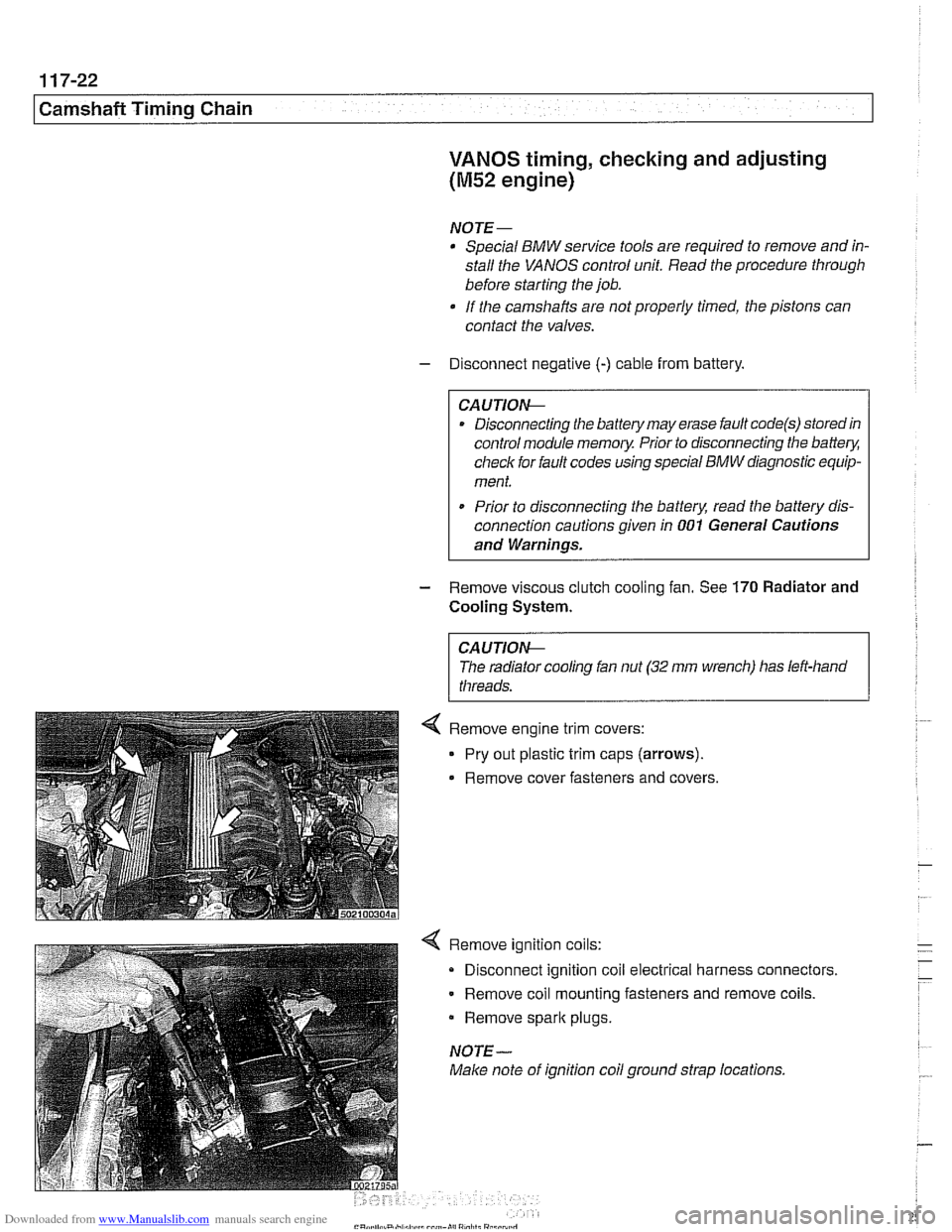
4 Remove ignition coils:
Disconnect ignition coil electrical harness connectors.
Remove coil mounting fasteners and remove coils.
Remove
spark plugs.
NOTE-
Make note of ignition coil ground strap locations.
Page 260 of 1002
Downloaded from www.Manualslib.com manuals search engine
1 17-24
I Camshaft Timing Chain
4 Remove banjo bolt from VANOS unit oil feed line and install
BMW special tool 11 3 450.
NOTE-
Oil will drain from oil feed line.
- Connect compressed air line (with pressure set to 2-8 bar or
30-1 10 psi.) to air fitting.
4 Measure gap (A) between secondary timing chain tensioner
and
intake camshaft sensor wheel. Make note of distance.
4 Connect cable test (BMW special tool 11 6 410) to VANOS
connector. Connect positive clip to positive battery terminal.
- Connect negative clip to battery negative terminal.
CAUTION-
Reversing terminals on special tool will damage diode on
VANOS solenoid valve.
Page 262 of 1002

Downloaded from www.Manualslib.com manuals search engine
Camshaft Timing Chain Timing chains, removing
(M52 engine)
Camshaft timing chain removal on M52 engines requires en-
gine oil pan removal.
Special
BMW sewice tools are needed for timing chain re-
moval and installation procedures. The special tools assure
propertiming of thevalvetrain. Precise marks to
setthe timing
on the camshafts are not provided for reassembly. Read the
procedures through before beginning the job.
NOTE-
If the camshafts are not properly timed, the pistons can con-
tact the valves.
- Remove VANOS control unit. See VANOS control unit, re-
moving (M52 engine).
- Remove radiator cooling fan and shroud. See 170 Radiator
and Cooling System.
- Drain cooling system. See 170 Radiator and Cooling Sys-
tem.
- Remove coolant hoses from thermostat housing and remove
thermostat housing from front of cylinder head.
- Loosen bolts for coolant pump pulley.
- Remove drive belts for alternator and AIC compressor. See
020 Maintenance.
- Remove coolant pump pulley.
Remove drive belt tensioner mounting bolts (arrows) and re-
move tensioner from front of engine.
- Remove engine speed sensor from lower timing chain cover.