2001 BMW 525I SPORT WAGON manual transmission
[x] Cancel search: manual transmissionPage 10 of 238

Contents
Overview
Controls and features
Cockpit16
Instrument cluster18
Indicator and warning lamps22
Multifunction steering wheel
(MFL) 25
Sports steering wheel26
Hazard warning flashers27
Warning triangle 27
First-aid kit 27
Refueling28
Fuel specifications29
Tire inflation pressure29
Locks and security systems:
Keys36
Electronic vehicle
immobilizer37
Opening and closing –
from the outside38
With the key38
With the remote control39
Opening and closing –
from the inside42
Luggage compartment lid/
Tailgate43
Rear window43
Luggage compartment46
Alarm system47
Electric power windows49
Sliding/Tilt sunroof50
Adjustments:
Seats52
Steering wheel56
Mirrors56
Seat, mirror and steering wheel
memory58
Car Memory, Key Memory60
Passenger safety systems:
Safety belts61
Airbags62
Transporting children safely66
Driving:
Steering/Ignition lock68
Starting the engine68
Switching off the engine69
Parking brake70
Manual transmission70
Automatic transmission72
Automatic transmission with
Steptronic75
Indicator/Headlamp flasher78
Wiper/Washer system78
Rear window defroster80
Cruise control81
Everything under control:
Odometer, outside temperature
display83
Tachometer84
Energy control84
Fuel gauge84
Coolant temperature gauge85
Service Interval Display85
Check Control86
Computer89
Multi-information display
(MID)91
Digital clock in the MID92
Computer in the MID95
Page 34 of 238

34n
Locks and security systems:
Keys 36
Electronic vehicle immobilizer 37
Central locking system 38
Opening and closing –
from the outside 38
With the key 38
With the remote control 38
Opening and closing – from the inside 42
Luggage compartment lid/ Tailgate 43
Rear window 44
Luggage compartment 46
Alarm system 47
Electric power windows 49
Sliding/Tilt sunroof 50
Adjustments:
Seats 52
Steering wheel 56
Mirrors 56
Seat, mirror and steering wheel memory 58
Car Memory, Key Memory 60
Passenger safety systems:
Safety belts 61
Airbags 62
Transporting children safely 66Driving:
Steering/Ignition lock
68
Starting the engine 68
Switching off the engine 69
Parking brake 70
Manual transmission 70
Automatic transmission 72
Automatic transmission with Steptronic 75
Indicator/Headlamp flasher 78
Wiper/Washer system 78
Rear window defroster 80
Cruise control 81
Everything under control:
Odometer, outside temperature display 83
Tachometer 84
Energy control 84
Fuel gauge 84
Coolant temperature gauge 85
Service Interval Display 85
Check Control 86
Computer 89
Multi-information display (MID) 91
Digital clock in the MID 92
Computer in the MID 95
Page 68 of 238
68n
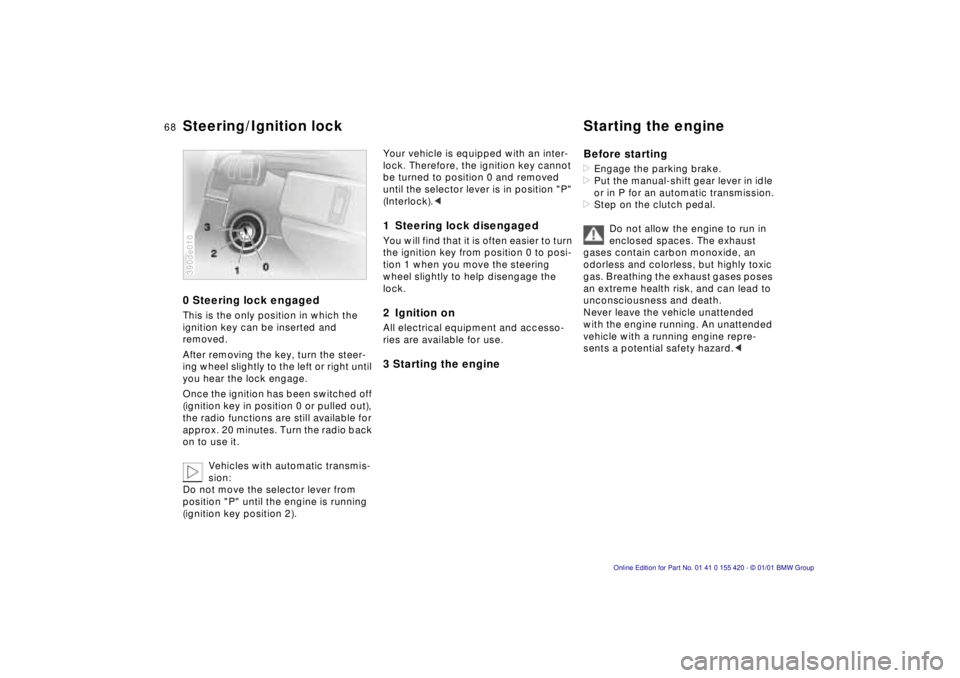
0 Steering lock engagedThis is the only position in which the
ignition key can be inserted and
removed.
After removing the key, turn the steer-
ing wheel slightly to the left or right until
you hear the lock engage.
Once the ignition has been switched off
(ignition key in position 0 or pulled out),
the radio functions are still available for
approx. 20 minutes. Turn the radio back
on to use it.
Vehicles with automatic transmis-
sion:
Do not move the selector lever from
position "P" until the engine is running
(ignition key position 2).390de010
Your vehicle is equipped with an inter-
lock. Therefore, the ignition key cannot
be turned to position 0 and removed
until the selector lever is in position "P"
(Interlock).< 1 Steering lock disengagedYou will find that it is often easier to turn
the ignition key from position 0 to posi-
tion 1 when you move the steering
wheel slightly to help disengage the
lock.2 Ignition onAll electrical equipment and accesso-
ries are available for use.3 Starting the engineBefore starting
>Engage the parking brake.
>Put the manual-shift gear lever in idle
or in P for an automatic transmission.
>Step on the clutch pedal.
Do not allow the engine to run in
enclosed spaces. The exhaust
gases contain carbon monoxide, an
odorless and colorless, but highly toxic
gas. Breathing the exhaust gases poses
an extreme health risk, and can lead to
unconsciousness and death.
Never leave the vehicle unattended
with the engine running. An unattended
vehicle with a running engine repre-
sents a potential safety hazard.<
Steering/Ignition lock Starting the engine
Page 69 of 238

IndexDataTechnologyRepairsCar careControlsOverview
69n
Starting the engine Switching off the engineStarting the engine>Start the engine. Do not press the
accelerator pedal.
Do not actuate the starter for too
short a time. Do not turn it for
more than approx. 20 seconds. Release
the ignition key immediately as soon as
the engine starts.
Do not allow the engine to warm up by
leaving it running while the vehicle re-
mains stationary. Instead, begin driving
immediately at a moderate engine
speed.
BMW 540i with automatic transmission:
Your BMW is equipped with the conve-
nience starting feature. Simply turn the
key to position 3 (starter) and then re-
lease it immediately.
The starter continues to operate auto-
matically.
The automatic starting mode will not
operate if the battery voltage is low.
Should this condition arise, it remains
possible to jump-start the engine (refer
to page 200).<
Should the engine fail to start on the
first attempt (if it is very hot or cold, for
instance):
>Press the accelerator pedal halfway
down while engaging the starter.
Cold starts at extremely low tempera-
tures, from approx. +57 (–156)
and at elevations above 3,300 ft
(1,000 meters):
>Be sure to let the starter remain
engaged somewhat longer the first
time (approx. 10 seconds).
>Press the accelerator pedal halfway
down while engaging the starter.
Engine idle speed is controlled by the
engine computer system. Increased
speeds at start-up are normal and
should decrease as the engine warms
up. If engine speed does not decrease,
service is required.
To prevent the battery from discharg-
ing, always deactivate electrical de-
vices which are not in use. Switch the
ignition off when the vehicle is not
being driven.Turn the ignition key to position 1 or 0.
Never remove the ignition key
while the vehicle is rolling. The
steering locks, making it impossible to
steer the vehicle.
Always remove the ignition key and en-
gage the steering lock before leaving
the vehicle.
Vehicles with manual transmission:
Always engage the parking brake
when parking on slopes and inclined
surfaces, since not even placing the
lever in 1st gear or reverse may not
provide adequate resistance to rolling.
Vehicles with automatic transmission:
Place the selector lever in "Park."<
Vehicles with automatic transmission
*:
The vehicle must be stationary and the
selector lever in "Park" before you can
remove the ignition key.
Page 70 of 238
70n
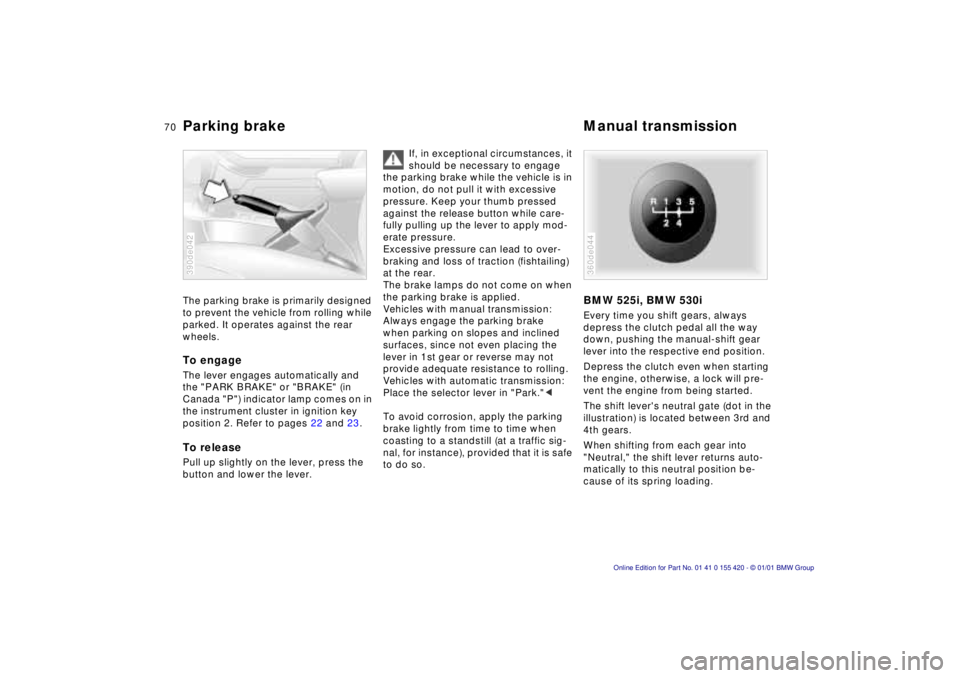
Parking brake Manual transmissionThe parking brake is primarily designed
to prevent the vehicle from rolling while
parked. It operates against the rear
wheels.To engageThe lever engages automatically and
the "PARK BRAKE" or "BRAKE" (in
Canada "P") indicator lamp comes on in
the instrument cluster in ignition key
position 2. Refer to pages 22 and 23.To releasePull up slightly on the lever, press the
button and lower the lever.390de042
If, in exceptional circumstances, it
should be necessary to engage
the parking brake while the vehicle is in
motion, do not pull it with excessive
pressure. Keep your thumb pressed
against the release button while care-
fully pulling up the lever to apply mod-
erate pressure.
Excessive pressure can lead to over-
braking and loss of traction (fishtailing)
at the rear.
The brake lamps do not come on when
the parking brake is applied.
Vehicles with manual transmission:
Always engage the parking brake
when parking on slopes and inclined
surfaces, since not even placing the
lever in 1st gear or reverse may not
provide adequate resistance to rolling.
Vehicles with automatic transmission:
Place the selector lever in "Park."<
To avoid corrosion, apply the parking
brake lightly from time to time when
coasting to a standstill (at a traffic sig-
nal, for instance), provided that it is safe
to do so.
BMW 525i, BMW 530iEvery time you shift gears, always
depress the clutch pedal all the way
down, pushing the manual-shift gear
lever into the respective end position.
Depress the clutch even when starting
the engine, otherwise, a lock will pre-
vent the engine from being started.
The shift lever's neutral gate (dot in the
illustration) is located between 3rd and
4th gears.
When shifting from each gear into
"Neutral," the shift lever returns auto-
matically to this neutral position be-
cause of its spring loading.360de044
Page 71 of 238
IndexDataTechnologyRepairsCar careControlsOverview
71n
Manual transmissionBMW 540iEvery time you shift gears, always
depress the clutch pedal all the way
down, pushing the manual-shift gear
lever into the respective end position.
Depress the clutch even when starting
the engine, otherwise, a lock will pre-
vent the engine from being started.
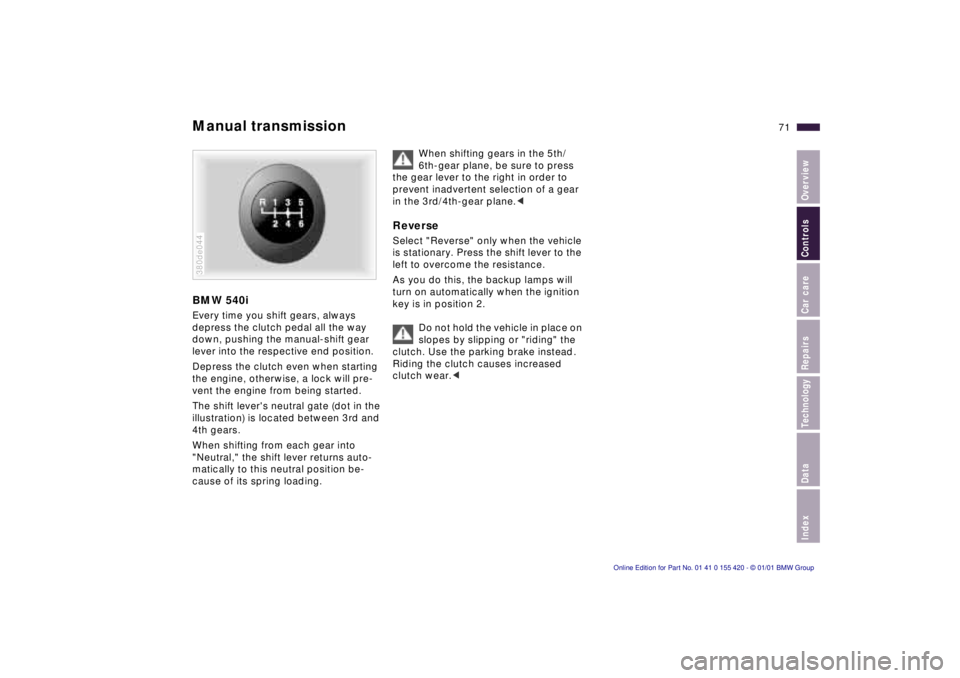
The shift lever's neutral gate (dot in the
illustration) is located between 3rd and
4th gears.
When shifting from each gear into
"Neutral," the shift lever returns auto-
matically to this neutral position be-
cause of its spring loading.380de044
When shifting gears in the 5th/
6th-gear plane, be sure to press
the gear lever to the right in order to
prevent inadvertent selection of a gear
in the 3rd/4th-gear plane.<
ReverseSelect "Reverse" only when the vehicle
is stationary. Press the shift lever to the
left to overcome the resistance.
As you do this, the backup lamps will
turn on automatically when the ignition
key is in position 2.
Do not hold the vehicle in place on
slopes by slipping or "riding" the
clutch. Use the parking brake instead.
Riding the clutch causes increased
clutch wear.<
Page 76 of 238

76n
Automatic transmission with Steptronic
*
Before leaving the vehicle when
the engine is running, shift the se-
lector lever to the "Park" or "Neutral"
position and apply the parking brake.
The vehicle could move if this is not
done. Do not leave the car unattended
with the engine running. An unattended
vehicle with a running engine repre-
sents a potential safety hazard.
If you should inadvertently select "Neu-
tral" while traveling at high speed, re-
move your foot from the accelerator
pedal immediately. Allow the engine
speed to drop to idle before selecting
the desired drive position. Damage
could otherwise occur due to excessive
engine speed.<
P ParkSelect "Park" only when the vehicle is
stationary. The transmission locks to
prevent the rear wheels from turning.R ReverseSelect "Reverse" only when the vehicle
is stationary.N NeutralSelect "Neutral" only if your journey is
interrupted for a long period.
D Drive
(automatic shift program)This position is designed for driving un-
der all normal operating conditions. All
forward gears are available."Kickdown" In the "Kickdown" mode, you achieve
maximum performance.
To activate this mode, depress the ac-
celerator pedal beyond the full-throttle
position, at which a resistance point
must be overcome.
M/S Manual mode and
Sport ProgramWhen you change from "D" to "M/S,"
the Sport Program is activated. This is
indicated by "D S" in the gear selection
display. The Sport Program is designed
for performance-oriented driving.
With the first brief touch, the automatic
transmission shifts from the Sport Pro-
gram to the manual mode. Whenever
you move the selector lever forward in
the "+" direction, the transmission shifts
up, and when you move it backward in
the "–" direction, the transmission will
shift down. M1...M5 will be displayed in
the gear indicator.390de323
Page 77 of 238
IndexDataTechnologyRepairsCar careControlsOverview
77n
Automatic transmission with Steptronic
*
Upshifts or downshifts will be carried
out by the ATC only at appropriate
engine speeds and road speeds. For
instance, if engine speed is too high, a
downshift will not be executed. The
gear selected will appear briefly in the
instrument cluster followed by the
current gear.
If you are driving in the manual
mode and wish to accelerate
rapidly from low road speeds (when
passing, for instance), you must shift
down manually or with the "Kickdown"
function.<
You can only change from "M/S" to
selector lever positions "P," "R," and
"N" via the "D" position.
In the following situations, the Step-
tronic "thinks" for you in the manual
mode:
>In order to prevent engine over-
speeding, the transmission shifts
automatically to the next higher gear.
shortly before the RPM cutoff point
>At low speeds, the transmission
shifts down automatically – you do
not have to act.
>In the "Kickdown" mode, the trans-
mission shifts down to the lowest
gear which is possible, depending on
the engine speed.
>According to the situation, for
instance in wintry conditions, the
vehicle can be started in 2nd or
3rd gear.Electronic transmission control
module
If the indicator lamp comes on
or the message "TRANS.FAIL-
SAFE PROG" appears in the
Check Control
*, there is a fault in the
transmission system.
Bring the vehicle to a stop. Move the
transmission selector lever to "P." Set
the parking brake and turn the engine
off (ignition key to position 0).
Wait a few seconds, then start the
engine.
If the indicator lamp goes out after a
few seconds, normal transmission
performance has been restored. You
may continue to drive as usual. If the
indicator lamp does not go out, you can
place the selector lever in all positions.
However, the vehicle will now only drive
forward with limited gear selection.
If this happens, avoid extreme engine
loads and consult the nearest BMW
center.
Do not work in the engine com-
partment when a drive gear (for-
ward or reverse) is engaged. If you do
this, the vehicle could move.<
For jump-starting, towing and tow-
starting, refer to pages 200 and 201.