Page 29 of 203
29n
IndexDataTechnologyRepairsCar careControlsOverview
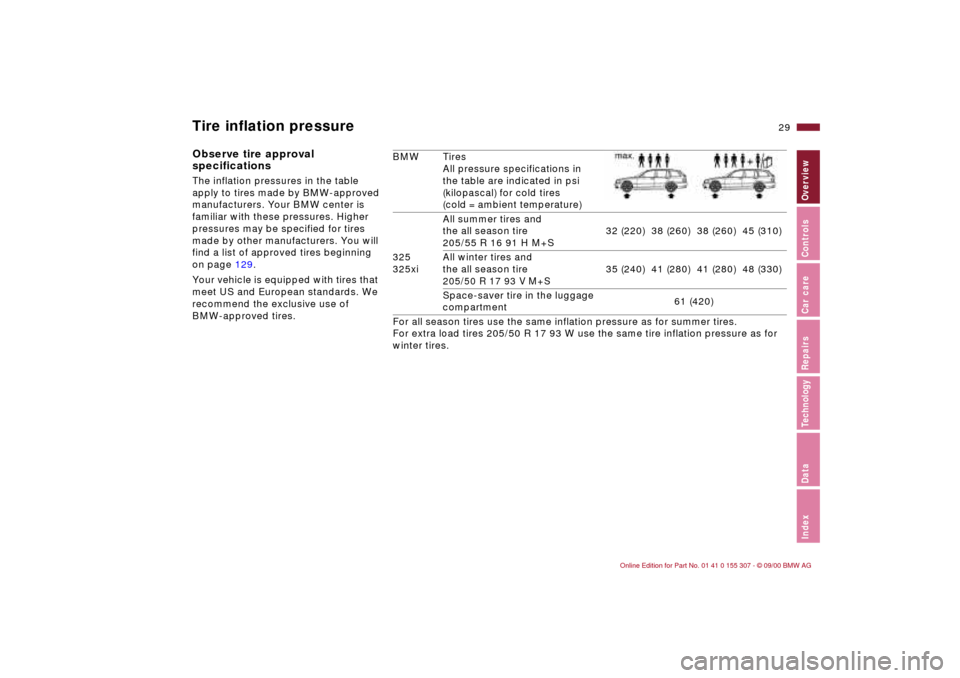
BMW Tires
All pressure specifications in
the table are indicated in psi
(kilopascal) for cold tires
(cold = ambient temperature)
325
325xiAll summer tires and
the all season tire
205/55 R 16 91 H M+S32 (220) 38 (260) 38 (260) 45 (310)
All winter tires and
the all season tire
205/50 R 17 93 V M+S
35 (240) 41 (280) 41 (280) 48 (330)
Space-saver tire in the luggage
compartment61 (420)
For all season tires use the same inflation pressure as for summer tires.
For extra load tires 205/50 R 17 93 W use the same tire inflation pressure as for
winter tires.
Tire inflation pressureObserve tire approval
specificationsThe inflation pressures in the table
apply to tires made by BMW-approved
manufacturers. Your BMW center is
familiar with these pressures. Higher
pressures may be specified for tires
made by other manufacturers. You will
find a list of approved tires beginning
on page 129.
Your vehicle is equipped with tires that
meet US and European standards. We
recommend the exclusive use of
BMW-approved tires.
Page 31 of 203

Overview
Controls and features
Operation, care
and maintenance
Owner service procedures
Technical data
Index Advanced technology
31n
IndexDataTechnologyRepairsCar careControlsOverview
Driving:
Steering/Ignition lock61
Starting the engine61
Switching off the engine62
Parking brake63
Manual transmission64
Automatic transmission
with Steptronic65
Turn signal indicator/Headlamp
flasher68
Washer/Wiper system68
Rear window defroster70
Cruise control71
Everything under control:
Odometer73
Tachometer73
Energy Control73
Fuel gauge74
Coolant temperature gauge74
Service Interval Display74
Check Control75
Clock75
Computer76
Technology for safety and
driving convenience:
Park Distance Control (PDC)78
Automatic Stability Control plus
Traction (ASC+T)79
Dynamic Stability Control
(DSC)80
Tire Pressure Control (RDC)85Lamps:
Side lamps/Low beams87
Instrument lighting87
High beams/Parking lamps88
Fog lamps88
Interior lamps88
Controlling the climate
for pleasant driving:
Air conditioner90
Automatic climate control96
Seat heating100
Cabin convenience:
HiFi system101
Glove compartment101
Storage compartments102
Cellular phone103
Ashtray, front104
Cigarette lighter104
Ashtray, rear105
Power outlet105
Loading and transporting:
Ski bag106
Cargo area107
Cargo loading110
Roof-mounted luggage rack111
Page 43 of 203
43n
IndexDataTechnologyRepairsCar careControlsOverview
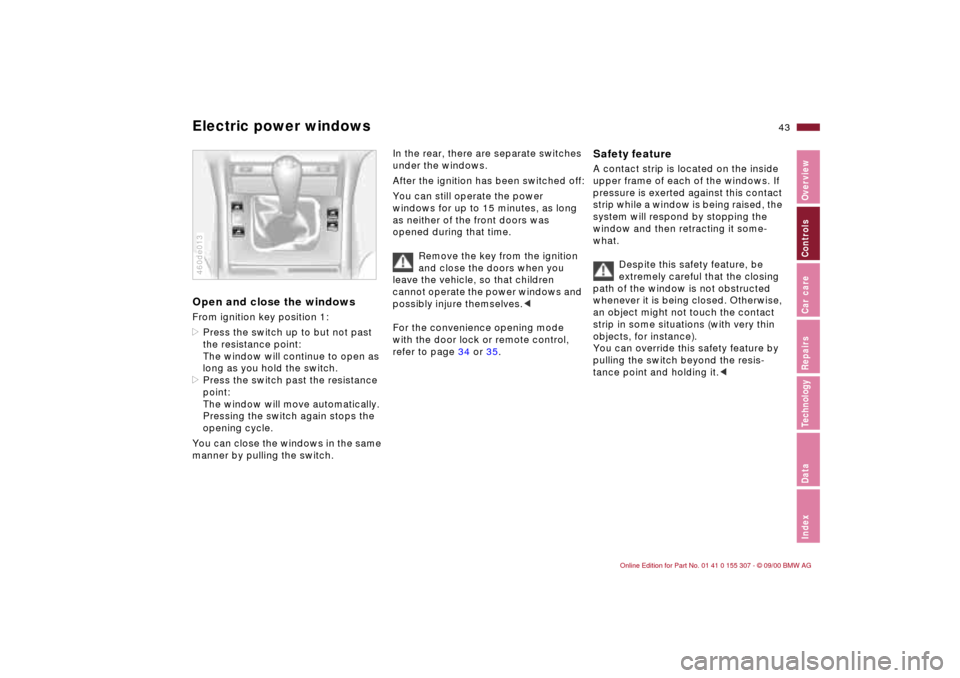
Electric power windowsOpen and close the windowsFrom ignition key position 1:
>Press the switch up to but not past
the resistance point:
The window will continue to open as
long as you hold the switch.
>Press the switch past the resistance
point:
The window will move automatically.
Pressing the switch again stops the
opening cycle.
You can close the windows in the same
manner by pulling the switch.460de013
In the rear, there are separate switches
under the windows.
After the ignition has been switched off:
You can still operate the power
windows for up to 15 minutes, as long
as neither of the front doors was
opened during that time.
Remove the key from the ignition
and close the doors when you
leave the vehicle, so that children
cannot operate the power windows and
possibly injure themselves.<
For the convenience opening mode
with the door lock or remote control,
refer to page 34 or 35.
Safety feature A contact strip is located on the inside
upper frame of each of the windows. If
pressure is exerted against this contact
strip while a window is being raised, the
system will respond by stopping the
window and then retracting it some-
what.
Despite this safety feature, be
extremely careful that the closing
path of the window is not obstructed
whenever it is being closed. Otherwise,
an object might not touch the contact
strip in some situations (with very thin
objects, for instance).
You can override this safety feature by
pulling the switch beyond the resis-
tance point and holding it.<
Page 47 of 203
47n
IndexDataTechnologyRepairsCar careControlsOverview
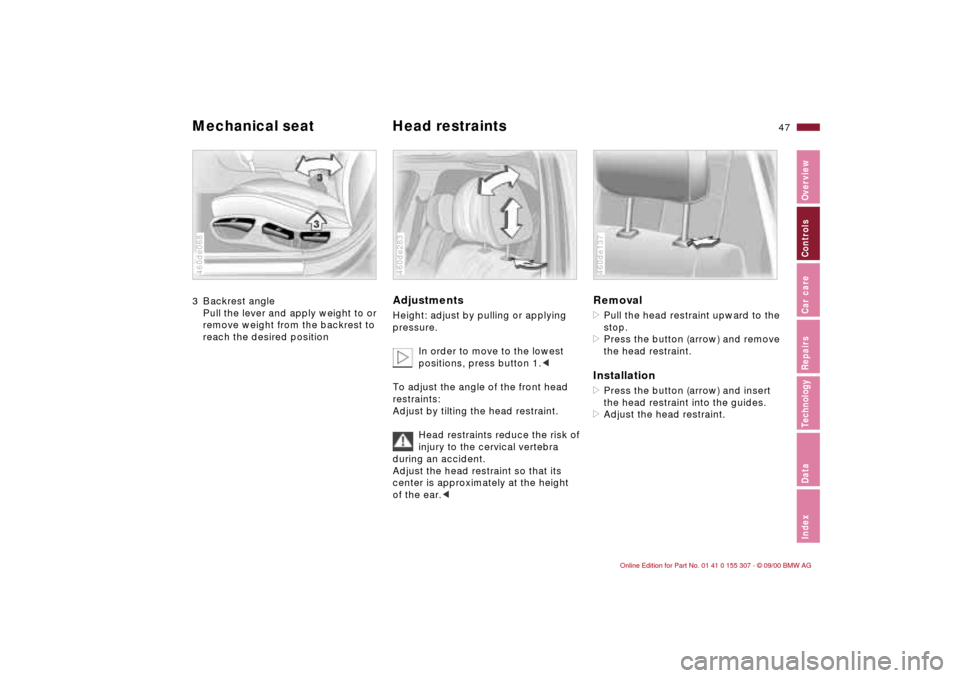
Mechanical seat Head restraints 3 Backrest angle
Pull the lever and apply weight to or
remove weight from the backrest to
reach the desired position460de068
Adjustments Height: adjust by pulling or applying
pressure.
In order to move to the lowest
positions, press button 1.<
To adjust the angle of the front head
restraints:
Adjust by tilting the head restraint.
Head restraints reduce the risk of
injury to the cervical vertebra
during an accident.
Adjust the head restraint so that its
center is approximately at the height
of the ear.<460de283
Removal>Pull the head restraint upward to the
stop.
>Press the button (arrow) and remove
the head restraint.Installation>Press the button (arrow) and insert
the head restraint into the guides.
>Adjust the head restraint.460de137
Page 49 of 203
49n
IndexDataTechnologyRepairsCar careControlsOverview
Power seat
*
Seat and mirror memory
*
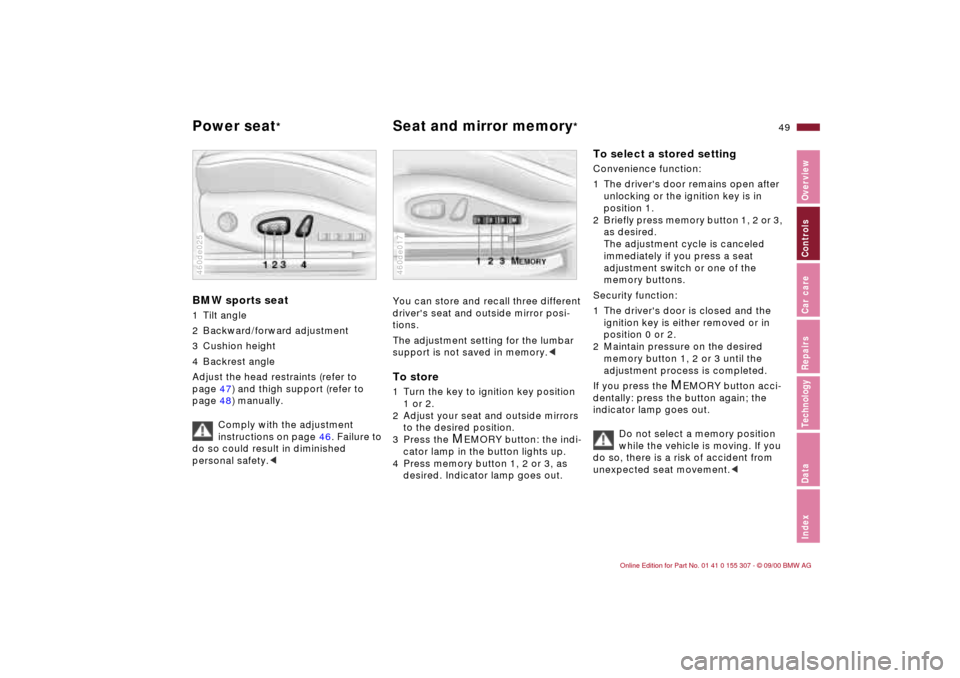
BMW sports seat1 Tilt angle
2 Backward/forward adjustment
3 Cushion height
4 Backrest angle
Adjust the head restraints (refer to
page 47) and thigh support (refer to
page 48) manually.
Comply with the adjustment
instructions on page 46. Failure to
do so could result in diminished
personal safety.<460de025
You can store and recall three different
driver's seat and outside mirror posi-
tions.
The adjustment setting for the lumbar
support is not saved in memory.
1 or 2.
2 Adjust your seat and outside mirrors
to the desired position.
3 Press the
M
EMORY button: the indi-
cator lamp in the button lights up.
4 Press memory button 1, 2 or 3, as
desired. Indicator lamp goes out.
460de017
To select a stored settingConvenience function:
1 The driver's door remains open after
unlocking or the ignition key is in
position 1.
2 Briefly press memory button 1, 2 or 3,
as desired.
The adjustment cycle is canceled
immediately if you press a seat
adjustment switch or one of the
memory buttons.
Security function:
1 The driver's door is closed and the
ignition key is either removed or in
position 0 or 2.
2 Maintain pressure on the desired
memory button 1, 2 or 3 until the
adjustment process is completed.
If you press the
M
EMORY button acci-
dentally: press the button again; the
indicator lamp goes out.
Do not select a memory position
while the vehicle is moving. If you
do so, there is a risk of accident from
unexpected seat movement.<
Page 54 of 203

54n
Safety beltstion the lap belt against the lower hips,
where it will not exert pressure against
the abdominal area.<
For child restraint system installation,
refer to page 59.
If the safety belt system has been
subjected to the stresses involved
in an accident or otherwise damaged,
have the entire safety belt mechanism
replaced by your BMW center,
including the safety belt tensioner. In
addition, have your BMW center
inspect the safety belt anchors. If a
child restraint system was in the vehicle
during an accident, consult the manu-
facturer's instructions regarding
replacement.<
Child restraint systems
*
Never install a rear-facing child
restraint system on the front
passenger seat. If you do so, the child
could be injured when the airbag is trig-
gered.
Children should always ride in the rear
and the restraint systems should be
secured with the outer belts.
The center seat belt should only be
used when it is necessary to secure
three child restraint systems.
Do not modify the child restraint system
in any way. If you do so, it will not
provide your child with maximum
protection.<
Page 63 of 203
63n
IndexDataTechnologyRepairsCar careControlsOverview
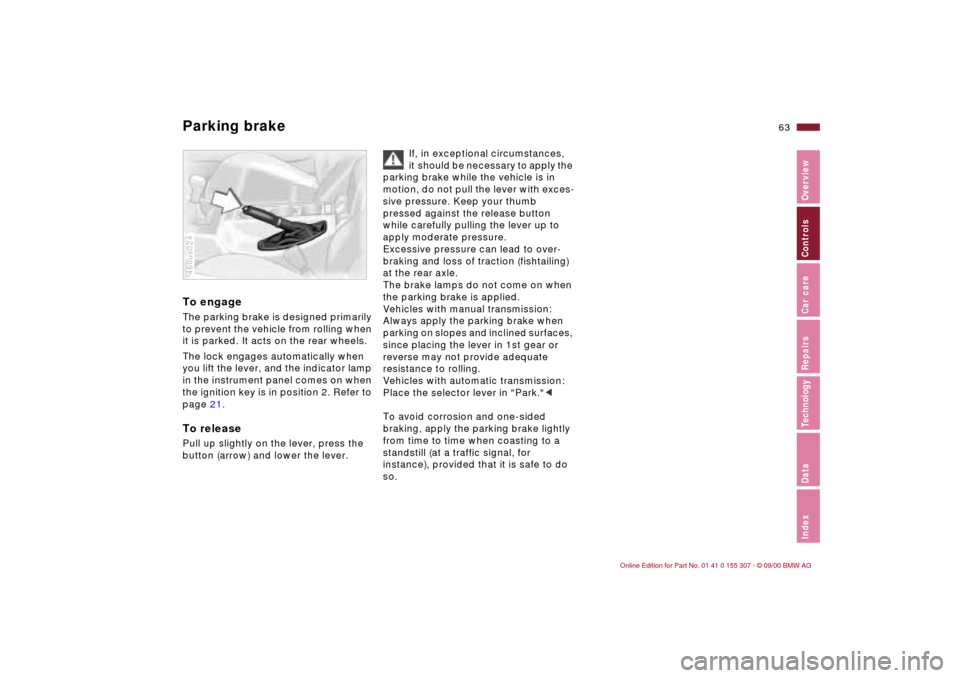
Parking brake To engageThe parking brake is designed primarily
to prevent the vehicle from rolling when
it is parked. It acts on the rear wheels.
The lock engages automatically when
you lift the lever, and the indicator lamp
in the instrument panel comes on when
the ignition key is in position 2. Refer to
page 21.To releasePull up slightly on the lever, press the
button (arrow) and lower the lever.460us024
If, in exceptional circumstances,
it should be necessary to apply the
parking brake while the vehicle is in
motion, do not pull the lever with exces-
sive pressure. Keep your thumb
pressed against the release button
while carefully pulling the lever up to
apply moderate pressure.
Excessive pressure can lead to over-
braking and loss of traction (fishtailing)
at the rear axle.
The brake lamps do not come on when
the parking brake is applied.
Vehicles with manual transmission:
Always apply the parking brake when
parking on slopes and inclined surfaces,
since placing the lever in 1st gear or
reverse may not provide adequate
resistance to rolling.
Vehicles with automatic transmission:
Place the selector lever in "Park."<
To avoid corrosion and one-sided
braking, apply the parking brake lightly
from time to time when coasting to a
standstill (at a traffic signal, for
instance), provided that it is safe to do
so.
Page 78 of 203

78n
The conceptThe PDC assists you when you are
parking. A signal warns you of the real
distance to an obstacle. To do this, four
ultrasonic sensors in the rear bumper
measure the distance to the nearest
object. The range for the sensors at the
two rear corners ends approx. 2 ft
(60 cm) from the bumper. The range for
the two center sensors is approx. 4.9 ft
(1.50 meters) wide.
The system starts to operate automati-
cally about one second after you select
"Reverse" with the ignition key in posi-
tion 2. PDC is deactivated when you shift
back out of reverse.
Acoustical signalsThe distance to the nearest object is
indicated by a tone sounding at various
intervals. As the distance between
vehicle and object decreases, the inter-
vals between the tones become shorter.
If the distance between the vehicle and
a detected object is less than 1ft
(30 cm), then a continuous tone will go
off.
The warning signal is canceled after
approx. three seconds if the distance to
the obstacle remains constant during
this time (if you are moving parallel to
a wall, for instance).
System malfunctions will be indicated
by a continuous high-pitched tone
when the system is activated the first
time. Please refer the problem to your
BMW center.The PDC does not remove the
driver's personal responsibility for
evaluating the distance between the
vehicle and any obstacles. Even when
sensors are involved, there is a blind
spot in which objects cannot be
detected. This applies especially in
those cases where the system
approaches the physical limits of ultra-
sonic measurement, as occurs with tow
bars and trailer couplings, and in the
vicinity of thin and painted objects.
Certain sources of sound, such as a
loud radio, could drown the PDC signal
tone.<
Keep the sensors clean and free
of ice or snow in order to ensure
that they continue to operate effec-
tively.
Do not apply high-pressure spray to the
sensors for a prolonged period of time.
Maintain a distance of more than 4 in
(10 cm).<
Park Distance Control (PDC)
*