2001 BMW 330Ci COUPE instrument
[x] Cancel search: instrumentPage 116 of 203

116n
Antilock Brake System (ABS)Antilock Brake System (ABS)/
Cornering Brake Control (CBC) CBC is an advanced engineering
design of the ABS. When braking while
cornering at high speed or braking
during high lateral acceleration, or
when braking during a lane change,
vehicle stability is improved and
steering response is enhanced.In the event of a malfunction
If the ABS warning lamp in the
instrument cluster lights up,
refer to page 22. The brake
system then reverts to conventional
operation as on vehicles without ABS.
However, have the brake system
checked by your BMW center as soon
as possible. To prevent undetected
defects and cumulative faults from
adversely affecting the brake system,
refer any problems to your BMW center
at the earliest opportunity.
ABS warning lamp for Canadian
models.
If the brake warning lamp, and
the ABS and ASC+T/DSC
indi-
cator lamps come on, refer to
page 21, then the entire ABS,
CBC, ASC+T/DSC control
system has failed. Continue
driving cautiously and defen-
sively. Avoid full brake applica-
tions. This could cause the vehicle to
lose stability and you might no longer
be able to control it.
Have the system checked by your BMW
center as soon as possible.
Indicator and warning lamps for
CBC, ABS and ASC+T/DSC and
ADB for Canadian models.
Dynamic Brake Control (DBC)*DBC is included in the DSC, refer to
information beginning on page 83.
If you step on the brake rapidly, this
system automatically produces
maximum braking force boost and thus
helps to achieve the shortest possible
braking distance during "panic stops."
All of the benefits of the ABS system
are exploited under these circum-
stances.
Do not reduce the pressure on the
brake pedal for the duration of the
brake application. When the brake
pedal is released, the DBC is deacti-
vated.
In the event of a malfunction,
the yellow brake warning lamp
comes on. Normal braking effi-
ciency and ABS are still fully available.
Have the system checked and repaired
at your BMW center as soon as
possible.
Please observe the section "Infor-
mation for your safety" concerning
the ABS system, which also applies to
the DSC system.<
Page 130 of 203
130n
Do not work on your vehicle with-
out appropriate skills. Always
switch off the engine and allow it to
cool down before working in the engine
compartment. Always disconnect the
battery before working on any electrical
systems or equipment. Comply with all
applicable instructions and warnings.
Failure to work in an informed, profes-
sional manner when servicing compo-
nents and materials constitutes a safety
hazard for vehicle occupants and other
road users. If you are not familiar with
the guidelines, please have the opera-
tions performed by your BMW center.<
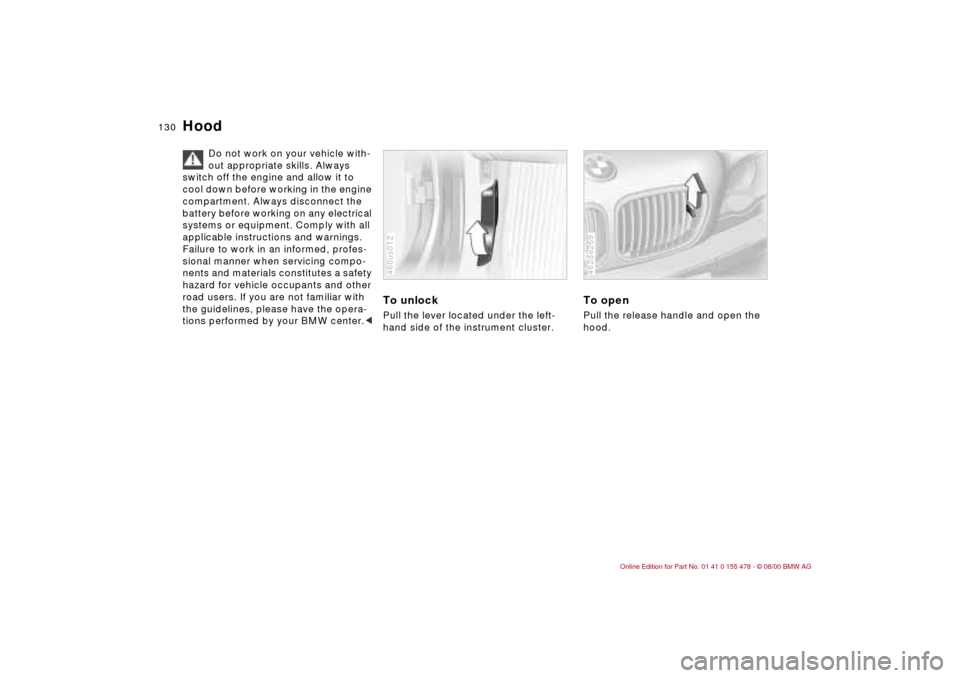
To unlock Pull the lever located under the left-
hand side of the instrument cluster. 460us012
To openPull the release handle and open the
hood.462de269
Hood
Page 138 of 203

138n
Coolant Brake fluidAdding coolant Wait until the engine cools before
removing the cap from the expansion
tank. The needle of the coolant
temperature gauge in the instrument
cluster must be located in the blue
zone. If it is not, there is a danger of
scalding.
1 Turn the cap slightly counterclock-
wise in order to allow accumulated
pressure to escape. Then open.
2 If the coolant is low, slowly add
coolant until the correct level is
reached Ð do not overfill.
The coolant is a mixture of water and
extended-duty antifreeze with corrosion
inhibitor. Always maintain the pre-
scribed all-season 50:50 mixture ratio
for year-round protection against inter-
nal corrosion. No other additives are
required.
Replace the coolant every four years.If the brake warning lamp comes on
and the parking brake has been
released:
Check the brake fluid level and if nec-
essary, fill it back up to the "MAX" mark.
For adding brake fluid or for determin-
ing and correcting the cause of brake
fluid loss, consult your BMW center.
Your BMW center is familiar with the
specifications for factory-approved
brake fluids (DOT 4).
Brake fluid loss can result in extended
pedal travel. Comply with the informa-
tion provided on page 118.
460de128
Brake fluid is hygroscopic, that is,
it absorbs moisture from the air
over time.
In order to ensure the safety and reli-
ability of the brake system, have the
brake fluid changed every two years by
an authorized BMW center. Refer also
to the Service and Warranty Information
Booklet (US models) or the Warranty
and Service Guide Booklet (Canadian
models). Brake fluid is hazardous to
health and damages the vehicle's paint.
You should always store it in its original
container and in a location that is
inaccessible to children.
Do not spill the fluid and do not fill the
brake fluid reservoir beyond the "MAX"
mark. The brake fluid could ignite upon
contact with hot engine parts and
cause serious burns.<
Comply with the applicable
environmental laws regulating
the disposal of brake fluid.<
Page 144 of 203

144n
Caring for your vehicleWindow careYou can use window and glass cleaner
to clean inside window surfaces and
mirrors without smearing and streaking.
Never use polishing pastes or abrasive
(quartz) cleansers on mirror lenses.
Clean the wiper blades with soapy
water. The wiper blades should be
replaced twice a year Ð before and after
the winter months. This is especially
important for vehicles with a rain
sensor.
Use only wiper blades approved
by BMW.<
Caring for other vehicle
components and materials Light-alloy wheels should be treated
with alloy wheel cleaner, especially
during the winter months. However, do
not use aggressive products containing
acids, strong alkalis or abrasive
cleaning agents, nor steam cleaners
operating at temperatures above
140 7 (+60 6). (Follow the manufac-
turer's instructions.)
If your vehicle has chrome parts
*, such
as the window frames and door handles,
clean these parts carefully with ample
clean water and a shampoo supplement
if desired, especially if they have an
accumulation of road salt. Use a chrome
polish for an additional treatment.
Plastic components, vinyl upholstery,
headliners, lamp lenses, the clear cover
of the instrument panel and compo-
nents with a sprayed dull black surface
can be cleaned with water (add plastic
shampoo as required). Do not allow
moisture to soak through the seats or
headliner. Never use solvents such as
lacquer thinner, heavy-duty grease
remover, fuels, or similar substances.
Rubber components should be cleaned
with water only; a rubber treatment or
silicone spray may also be applied.Do not remove safety belts to clean
them. Clean them with mild soapy
water only. Do not use chemicals or dry
cleaners to clean safety belts, since this
could damage the belt fabric.
After cleaning, never allow the inertia
reel to retract the belts until they are
completely dry. Dirty safety belts
prevent the inertia reel mechanism from
retracting the strap properly, and thus
constitute a safety hazard.
Heavily soiled floor carpets and mats
*
can be cleaned with an interior cleaner.
The floor mats can be removed from
the vehicle for cleaning.
Use only a damp cloth to clean trim
panels made of real wood
* and other
parts constructed of real wood
*. Follow
up by drying with a soft cloth.
Use the cleaning and car-care
products available at your BMW
center.<
Page 149 of 203

149n
IndexDataTechnologyRepairsCar careControlsOverview
OBD interface socketThe OBD interface socket for onboard
diagnostics is located on the driver's
side, on the left-hand bottom of the
instrument panel and under a cover
panel. The cover has the letters "OBD"
on it.
The purpose of the OBD system is to
assure proper emission control system
operation for the vehicle's lifetime by
monitoring emission-related compo-
nents and systems for wear and
malfunction.460us250
An illuminated indicator informs
you of the need for service,
not that you need to stop the
vehicle. Your system should be
checked, however, at the earliest
possible opportunity.
If the indicator blinks or flashes, this
indicates a high level of engine misfire.
Reduce speed and contact your near-
est BMW center immediately. Severe
engine misfire over even a short period
of time can seriously damage emission
control components, especially the
catalytic converter.
Service Engine Soon warning
lamp for Canadian models.
If the fuel filler cap is not firmly
screwed on, the OBD system can
detect leaking vapor and the indicator
will light up. If the fuel filler cap is then
tightened, the indicator will usually go
out after a short period of time.<
Page 194 of 203

Everything from A to ZEngine oil135
adding135
capacity187
consumption135
level check135
pressure20
quality136
specifications136
viscosity136
Engine speed184
Engine, starting63
Engine, switching off64
Entry to the rear49
Exterior mirrors52
Eyelets, towing169 F
Failure messages77
Fault displays77
Fault, ABS116
Filling capacities187
Filling the washer
reservoir187
First-aid kit25
Fittings, towing and tow
starting169
Flashlight102
Flat tire122,159
Floor mat41
Floor panel, lift and hook41
Fog lamps88 Folding rear backrest106
Follow-Me-Home lamps87
Footbrake117
Footwell lamps88
bulb replacement158
Front fog lamps, bulb
replacement155
Front seat, adjusting47
Frost protection,
radiator137
Fuel27
Fuel consumption79
Fuel consumption
display76
Fuel filler cap26
Fuel filler door26
unlock in case of electrical
fault167
Fuel gauge76
Fuel quality27
Fuel reserve indicator
lamp76
Fuel specifications27
Fuel tank capacity187
Fuel tank gauge76
Functional status180
Fuses166
G
Gasoline27
Gasoline gauge76
Glove compartment102
Glove compartment lamp
bulb replacement158
Gross vehicle weight186 H
Handbrake65
Handsfree system104
Hazard warning flashers25
Hazard warning triangle25
Head restraints48
Headlamp cover,
care141,153
Headlamp flasher70,88
Headlamp washer
system72,134,187
Headlamps87
Heated seats101
Heating, rapid94
Heavy loads108
Height185
HiFi system Ð harman
kardon101
High beams23,70,88
bulb replacement153
High Performance Synthetic
Oil136
High-mount brake lamp157 Hood130
release130
Horn17
Hubcap161
Hydraulic Brake assistent,
refer to DBC
I
Ice warning79
Icy roads79
Identification,
tires125,127
Ignition key32
Ignition lock63
Imprint4
Indicator lamps20
Inflation
pressure27,85,122
monitoring27,85,179
INSPECTION76
Instrument cluster18
Instrument panel16,18
Instrument panel lighting87
Interaxle tire rotation124
Interface socket for Onboard
Diagnostics149
Interference, cellular
phones121
Interior lamps36,88
bulb replacement157
remote control36