2001 BMW 325i SEDAN Gas
[x] Cancel search: GasPage 6 of 211

6n
For your own safety
Use unleaded gasoline only.
Fuels containing up to 10%
ethanol or other oxygenates with up to
2.8% oxygen by weight (i.e. 15% MTBE
or 3% methanol plus an equivalent
amount of co-solvent) will not void the
applicable warranties with respect to
defects in materials or workmanship.
Field experience has indicated signifi-
cant differences in fuel quality (volatility,
composition, additives, for example)
among gasolines offered for sale in the
United States and Canada. The use of
poor-quality fuels may result in drive-
ability, starting and stalling problems,
especially under certain environmental
conditions, such as high ambient
temperature and high altitude.
Should you encounter driveability prob-
lems that you suspect could be related
to the fuel you are using, we recom-
mend that you respond by switching
to a recognized high-quality brand.
Failure to comply with these recom-
mendations may result in unscheduled
maintenance.
Follow the relevant safety rules when
you are handling gasoline.
<
Important safety information!
For your own safety, use genuine parts
and accessories approved by BMW.
When you purchase accessories tested
and approved by BMW and Original
BMW Parts, you simultaneously acquire
the assurance that they have been thor-
oughly tested by BMW to ensure
optimum performance when installed
on your vehicle.
BMW warrants these parts to be free
from defects in material and workman-
ship.
BMW will not accept any liability for
damage resulting from installation of
parts and accessories not approved by
BMW.
BMW cannot test every product from
other manufacturers to verify if it can be
used on a BMW safely and without risk
to either the vehicle, its operation, or its
occupants.
Original BMW Parts, BMW Accessories
and other products approved by BMW,
together with professional advice on
using these items, are available from all
BMW centers.
Installation and operation of non-BMW
approved accessories such as alarms,
radios, amplifiers, radar detectors,
wheels, suspension components, brake
dust shields, telephones (including
operation of any portable cellular phone
from within the vehicle without using an
externally mounted antenna) or trans-
ceiver equipment (such as C.B., walkie-
talkie, ham radio or similar) may cause
extensive damage to the vehicle,
compromise its safety, interfere with
the vehicle's electrical system or affect
the validity of the BMW Limited
Warranty. See your BMW center for
additional information.
Do not use a key or remote control to
lock the doors or luggage compartment
with anyone inside the car. Refer to
page 34 for more details.
<
Maintenance, replacement, or
repair of the emission control
devices and systems may be performed
by any automotive repair establishment
or individual using any certified auto-
motive part.
<
Symbol on vehicle parts
Indicates that you should consult
the relevant section of this
Owner's Manual for information on a
particular part or assembly.
For your own safety
Page 22 of 211
22n
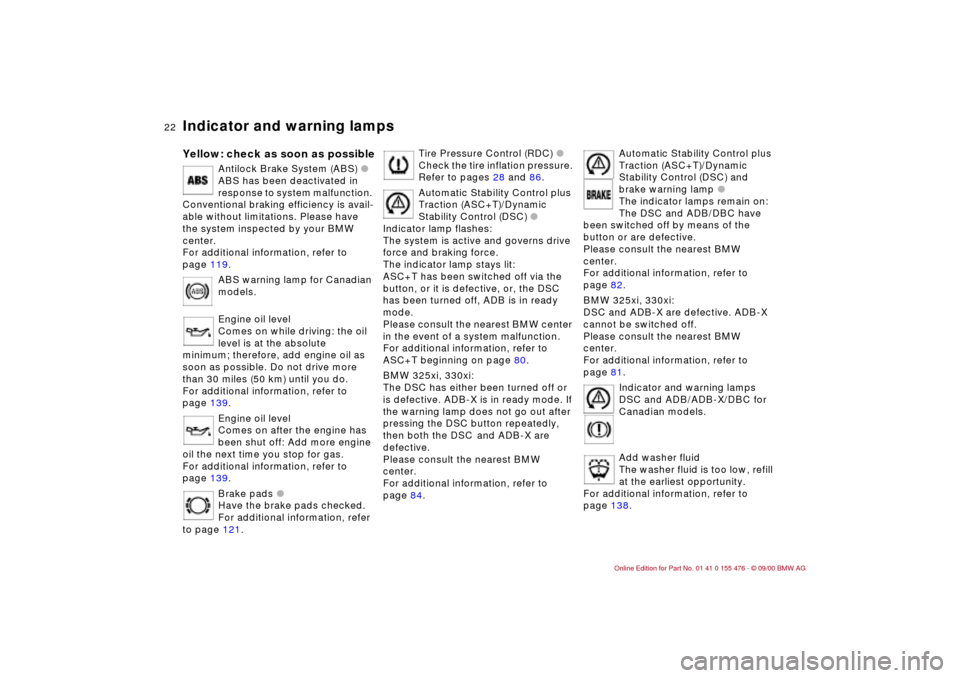
Indicator and warning lampsYellow: check as soon as possible
Antilock Brake System (ABS) l
ABS has been deactivated in
response to system malfunction.
Conventional braking efficiency is avail-
able without limitations. Please have
the system inspected by your BMW
center.
For additional information, refer to
page 119.
ABS warning lamp for Canadian
models.
Engine oil level
Comes on while driving: the oil
level is at the absolute
minimum; therefore, add engine oil as
soon as possible. Do not drive more
than 30 miles (50 km) until you do.
For additional information, refer to
page 139.
Engine oil level
Comes on after the engine has
been shut off: Add more engine
oil the next time you stop for gas.
For additional information, refer to
page 139.
Brake pads l
Have the brake pads checked.
For additional information, refer
to page 121.
Tire Pressure Control (RDC) l
Check the tire inflation pressure.
Refer to pages 28 and 86.
Automatic Stability Control plus
Traction (ASC+T)/Dynamic
Stability Control (DSC) l
Indicator lamp flashes:
The system is active and governs drive
force and braking force.
The indicator lamp stays lit:
ASC+T has been switched off via the
button, or it is defective, or, the DSC
has been turned off, ADB is in ready
mode.
Please consult the nearest BMW center
in the event of a system malfunction.
For additional information, refer to
ASC+T beginning on page 80.
BMW 325xi, 330xi:
The DSC has either been turned off or
is defective. ADB-X is in ready mode. If
the warning lamp does not go out after
pressing the DSC button repeatedly,
then both the DSC
and ADB-X are
defective.
Please consult the nearest BMW
center.
For additional information, refer to
page 84.
Automatic Stability Control plus
Traction (ASC+T)/Dynamic
Stability Control (DSC) and
brake warning lamp l
The indicator lamps remain on:
The DSC and ADB/DBC have
been switched off by means of the
button or are defective.
Please consult the nearest BMW
center.
For additional information, refer to
page 82.
BMW 325xi, 330xi:
DSC and ADB-X are defective. ADB-X
cannot be switched off.
Please consult the nearest BMW
center.
For additional information, refer to
page 81.
Indicator and warning lamps
DSC and ADB/ADB-X/DBC for
Canadian models.
Add washer fluid
The washer fluid is too low, refill
at the earliest opportunity.
For additional information, refer to
page 138.
Page 28 of 211

28n
Fuel specifications Tire inflation pressure The engine uses lead-free gasoline
only.
Required fuel:
>Premium Unleaded Gasoline,
min. 91 AKI.
AKI = Anti Knock Index
Do not use leaded fuels. The use
of leaded fuels will cause perma-
nent damage to the system's oxygen
sensor and the catalytic converter.<
Proper inflation pressures are on a
sticker attached to the B-pillar and
visible with the driver's door open.Check tire pressuresOn the next page you will find all the tire
pressure and ambient air temperature
specifications stated in the units usually
used in your country (psi; kilopascal).
For vehicles with Tire Pressure Control
(RDC):
After a correction of the tire inflation
pressure, reactivate the system. Refer
to page 86.460de163
Check tire inflation pressures Ð
including the space-saver spare
tire, or spare tire Ð regularly, at least
every two weeks and before beginning
a longer trip. Incorrect tire pressure can
otherwise lead to tire damage and acci-
dents.
Inflate the spare tire to the highest tire
inflation pressure specified for your
vehicle.<
Page 62 of 211
62n
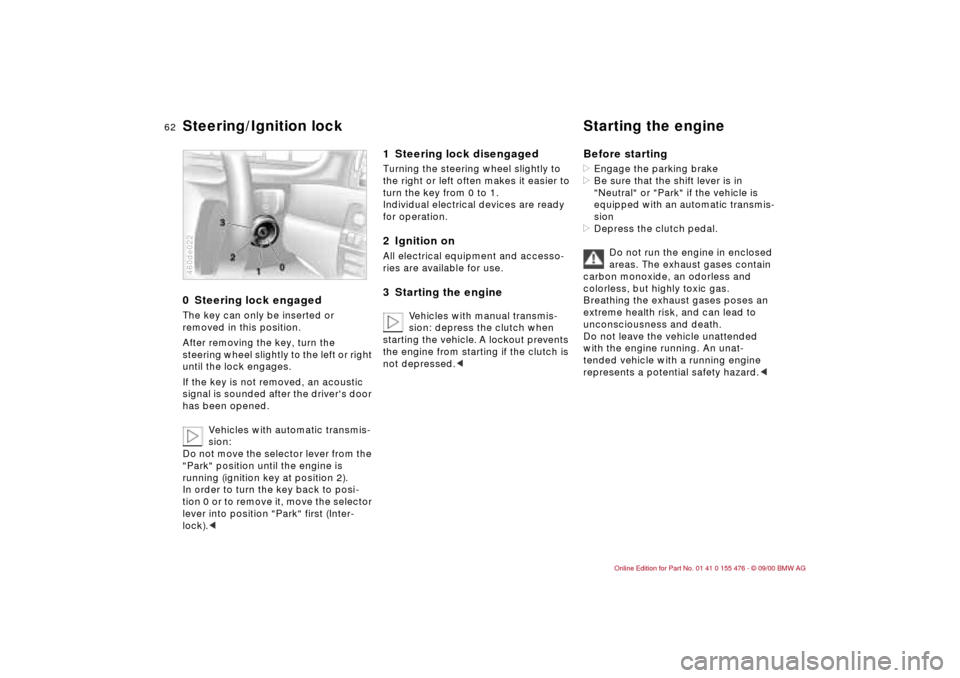
0 Steering lock engaged The key can only be inserted or
removed in this position.
After removing the key, turn the
steering wheel slightly to the left or right
until the lock engages.
If the key is not removed, an acoustic
signal is sounded after the driver's door
has been opened.
Vehicles with automatic transmis-
sion:
Do not move the selector lever from the
"Park" position until the engine is
running (ignition key at position 2).
In order to turn the key back to posi-
tion 0 or to remove it, move the selector
lever into position "Park" first (Inter-
lock).<460de022
1 Steering lock disengaged Turning the steering wheel slightly to
the right or left often makes it easier to
turn the key from 0 to 1.
Individual electrical devices are ready
for operation.2 Ignition onAll electrical equipment and accesso-
ries are available for use.3 Starting the engine
Vehicles with manual transmis-
sion: depress the clutch when
starting the vehicle. A lockout prevents
the engine from starting if the clutch is
not depressed.c
Before starting>Engage the parking brake
>Be sure that the shift lever is in
"Neutral" or "Park" if the vehicle is
equipped with an automatic transmis-
sion
>Depress the clutch pedal.
Do not run the engine in enclosed
areas. The exhaust gases contain
carbon monoxide, an odorless and
colorless, but highly toxic gas.
Breathing the exhaust gases poses an
extreme health risk, and can lead to
unconsciousness and death.
Do not leave the vehicle unattended
with the engine running. An unat-
tended vehicle with a running engine
represents a potential safety hazard.<
Steering/Ignition lock Starting the engine
Page 102 of 211
102n
Automatic climate control
*
Rear window defroster
When the rear window defroster
is activated, the indicator lamp
comes on. The rear window defroster
switches off automatically. Refer to
page 71.
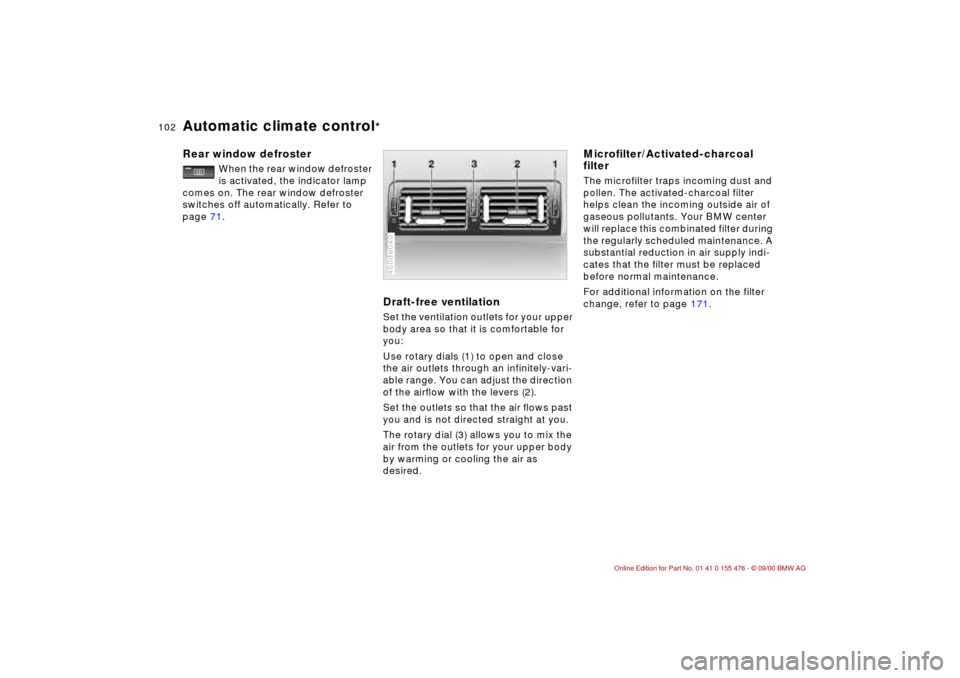
Draft-free ventilation Set the ventilation outlets for your upper
body area so that it is comfortable for
you:
Use rotary dials (1) to open and close
the air outlets through an infinitely-vari-
able range. You can adjust the direction
of the airflow with the levers (2).
Set the outlets so that the air flows past
you and is not directed straight at you.
The rotary dial (3) allows you to mix the
air from the outlets for your upper body
by warming or cooling the air as
desired.460de040
Microfilter/Activated-charcoal
filterThe microfilter traps incoming dust and
pollen. The activated-charcoal filter
helps clean the incoming outside air of
gaseous pollutants. Your BMW center
will replace this combinated filter during
the regularly scheduled maintenance. A
substantial reduction in air supply indi-
cates that the filter must be replaced
before normal maintenance.
For additional information on the filter
change, refer to page 171.
Page 148 of 211

148n
Caring for your vehicleCaring for the vehicle finish Regular washing is a preventive
measure against long-term effects from
substances that are harmful to the
vehicle's finish, especially if you drive
your vehicle in areas with high levels
of air pollution or aggressive natural
substances (tree resins, pollen).
Nevertheless, you should immediately
remove especially aggressive
substances. Failure to do so can lead
to changes in the paint's chemical
structure or to discoloration. Gasoline
spilled during refueling, oil, grease and
brake fluid should always be cleaned
away immediately, as should bird
droppings.
Any contamination remaining on the
surface of the vehicle will be especially
conspicuous after washing. Use clean-
ing fluid or alcohol with a clean cloth or
cotton pad to remove. Remove tar spots
with tar remover. After cleaning, the
affected areas should be waxed to
ensure continued protection.
Use cleaning and car-care
products that you can obtain at
your BMW center.<
Waxing your vehicle Protect the finish using carnauba or
synthetic-based waxes only.
The best way to determine when the
finish needs to be waxed is by noting
when water stops beading on the
surface.
You can use a glass cleaner to remove
any wax or silicone that may have been
left on the windows during waxing.
Use cleaning and car-care
products that you can obtain at
your BMW center.<
Paint damageYou can touch up small areas of paint
damage with a BMW spray paint or a
BMW touchup stick.
The paint color code for your vehicle is
provided on a sticker located on the
right hand side under the hood and on
the first page of your Service and War-
ranty Information Booklet (US models)
or Warranty and Service Guide Booklet
(Canadian models).
Damage caused by flying stones,
scratches, etc., must be touched
up without delay to prevent rust from
forming.
If corrosion has started to form in an
area with paint damage, remove all rust
and clean the area. Then prime the area
with a BMW Primer Stick. Finally, apply
the finish coat. Wait a few days, then
polish the repaired area. Finish by
applying a wax preservative.
More extensive paint damage should
be professionally repaired in accor-
dance with the manufacturer's instruc-
tions. Your BMW center uses original
BMW finish materials in accordance
with official repair procedures.
Page 152 of 211
152n
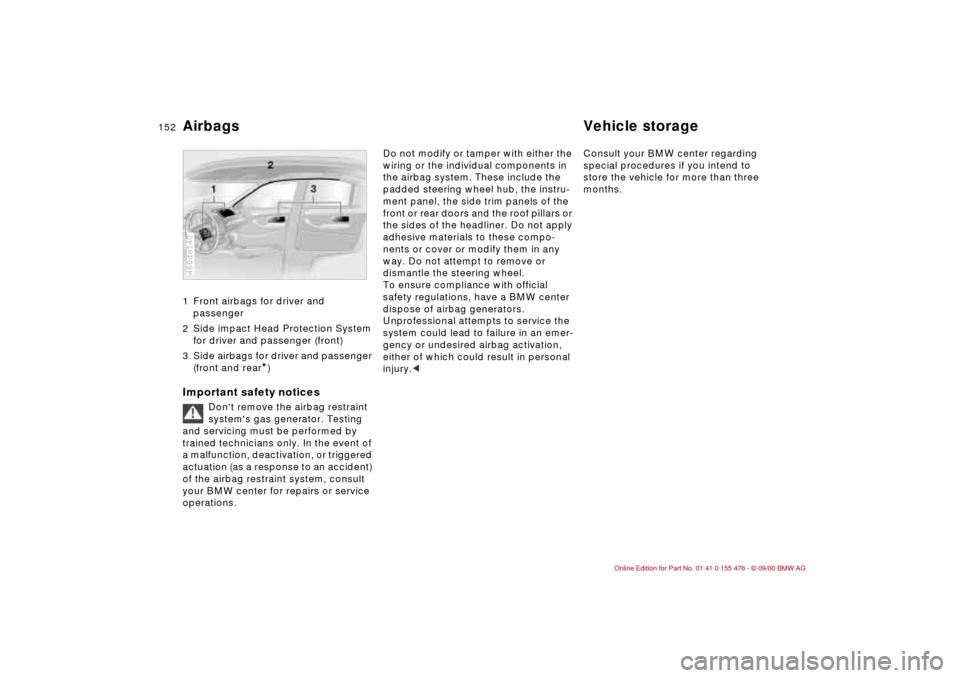
Airbags Vehicle storage1 Front airbags for driver and
passenger
2 Side impact Head Protection System
for driver and passenger (front)
3 Side airbags for driver and passenger
(front and rear
*)
Important safety notices
Don't remove the airbag restraint
system's gas generator. Testing
and servicing must be performed by
trained technicians only. In the event of
a malfunction, deactivation, or triggered
actuation (as a response to an accident)
of the airbag restraint system, consult
your BMW center for repairs or service
operations.
460de140
Do not modify or tamper with either the
wiring or the individual components in
the airbag system. These include the
padded steering wheel hub, the instru-
ment panel, the side trim panels of the
front or rear doors and the roof pillars or
the sides of the headliner. Do not apply
adhesive materials to these compo-
nents or cover or modify them in any
way. Do not attempt to remove or
dismantle the steering wheel.
To ensure compliance with official
safety regulations, have a BMW center
dispose of airbag generators.
Unprofessional attempts to service the
system could lead to failure in an emer-
gency or undesired airbag activation,
either of which could result in personal
injury.
store the vehicle for more than three
months.
Page 169 of 211
169n
IndexDataTechnologyRepairsCar careControlsOverview
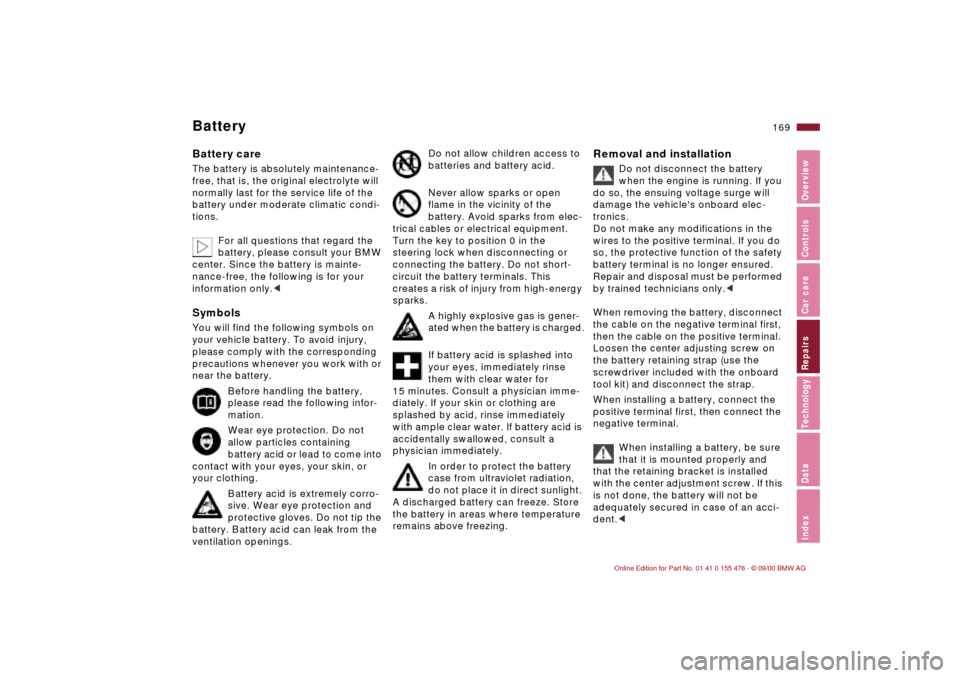
BatteryBattery careThe battery is absolutely maintenance-
free, that is, the original electrolyte will
normally last for the service life of the
battery under moderate climatic condi-
tions.
For all questions that regard the
battery, please consult your BMW
center. Since the battery is mainte-
nance-free, the following is for your
information only.
please comply with the corresponding
precautions whenever you work with or
near the battery.
Before handling the battery,
please read the following infor-
mation.
Wear eye protection. Do not
allow particles containing
battery acid or lead to come into
contact with your eyes, your skin, or
your clothing.
Battery acid is extremely corro-
sive. Wear eye protection and
protective gloves. Do not tip the
battery. Battery acid can leak from the
ventilation openings.
Do not allow children access to
batteries and battery acid.
Never allow sparks or open
flame in the vicinity of the
battery. Avoid sparks from elec-
trical cables or electrical equipment.
Turn the key to position 0 in the
steering lock when disconnecting or
connecting the battery. Do not short-
circuit the battery terminals. This
creates a risk of injury from high-energy
sparks.
A highly explosive gas is gener-
ated when the battery is charged.
If battery acid is splashed into
your eyes, immediately rinse
them with clear water for
15 minutes. Consult a physician imme-
diately. If your skin or clothing are
splashed by acid, rinse immediately
with ample clear water. If battery acid is
accidentally swallowed, consult a
physician immediately.
In order to protect the battery
case from ultraviolet radiation,
do not place it in direct sunlight.
A discharged battery can freeze. Store
the battery in areas where temperature
remains above freezing.
Removal and installation
Do not disconnect the battery
when the engine is running. If you
do so, the ensuing voltage surge will
damage the vehicle's onboard elec-
tronics.
Do not make any modifications in the
wires to the positive terminal. If you do
so, the protective function of the safety
battery terminal is no longer ensured.
Repair and disposal must be performed
by trained technicians only.<
When removing the battery, disconnect
the cable on the negative terminal first,
then the cable on the positive terminal.
Loosen the center adjusting screw on
the battery retaining strap (use the
screwdriver included with the onboard
tool kit) and disconnect the strap.
When installing a battery, connect the
positive terminal first, then connect the
negative terminal.
When installing a battery, be sure
that it is mounted properly and
that the retaining bracket is installed
with the center adjustment screw. If this
is not done, the battery will not be
adequately secured in case of an acci-
dent.<