2001 BMW 325I sensor
[x] Cancel search: sensorPage 97 of 203

97n
IndexDataTechnologyRepairsCar careControlsOverview
Automatic climate control
*
1 Air onto the windshield and the side
windows
2 Air flow toward the upper body
The side rotary dials provide infi-
nitely-variable regulation of the air
supply, while the levers change the
air-flow direction. The center rotary
dial controls the temperature of the
air as it flows out. Refer to page 100
3 Front footwell ventilation
There are corresponding air vents in
the rear footwell as well
4 Recirculated air mode/Automatic
recirculated air control (AUC)99
5 Air supply99
6 Temperature98
7 Automatic air distribution98
8 Individual air distribution98
9 Air grill for interior temperature
sensor Ð please keep clear and
unobstructed
10 Display for temperature and air
supply98
11 Defrost windows and remove
condensation99
12 Air conditioner99
13 Rear window defroster70, 99
Page 115 of 203

115n
IndexDataTechnologyRepairsCar careControlsOverview
Brakes:
Do not drive with your foot resting
on the brake pedal. Even light but
consistent pedal pressure can lead to
high temperatures, brake wear, and
possibly to brake failure.
Aquaplaning:
When driving on wet or slushy roads,
reduce vehicle speed. If you do not, a
wedge of water may form between the
tires and the road surface. This
phenomenon is referred to as aqua-
planing or hydroplaning. It is character-
ized by a partial or complete loss of
contact between the tires and the road
surface. The ultimate results are loss of
steering and braking control.
Driving through water:
When there is water on the roads, do
not drive in it if it is deeper than 1 ft
(30 cm), and then only at walking speed
at the most, otherwise the vehicle can
sustain damage to the engine, the elec-
trical systems and the transmission.
Roll-up cover:
Never use the rear window shelf to
store heavy or bulky objects. If you do
so, such objects could injure vehicle
occupants during braking or evasive
maneuvers or in a crash.
Clothes hooks:
When suspending clothing from the
hooks, ensure that they will not obstruct
the driver's vision. Do not hang heavy
objects on the hooks. If you do, such
objects could pose the risk of personal
injury during braking or evasive maneu-
vers.
use with unleaded fuel only.
Even minute quantities of lead would be
enough to permanently damage both
the catalytic converter and the system
oxygen sensor.
To ensure efficient, trouble-free engine
operation and to avoid potential
damage:
>Be sure to comply with the scheduled
maintenance requirements.
>Fill the fuel tank well before it is
empty.
>Tow-start only when the engine is
cold. If you attempt to tow-start with
a warm engine, unburned residual
fuel in the catalytic converter could
ignite and cause damage. It is better
to start the vehicle with an outside
starting aid.
>Avoid other situations in which the
fuel is not burned, or burns incom-
pletely, such as engaging the starter
frequently or for extended periods, or
repeated start attempts in which the
engine does not start (stopping and
restarting an engine which is running
properly does not present a problem).
Never allow the engine to run with
any of the spark plug cables
disconnected.
Driving notes Catalytic converter
Page 141 of 203

141n
IndexDataTechnologyRepairsCar careControlsOverview
Washing your vehicle You can wash your BMW at an auto-
matic car wash, even when it is new.
Brushless systems are preferable.
Wipe away tough dirt and loosen and
remove dead insects before washing
the vehicle.
In order to avoid spots, do not wash
the vehicle when the hood is warm, or
during or immediately after exposure to
strong sunlight.
When using an automatic car wash, be
sure that:
>The car wash system is suited for the
dimensions of your vehicle.
>No damage will occur to vehicles
with attached body accessories (such
as spoilers or antennas). Consult the
car wash operator if necessary.
>The wheels and tires of your vehicle
cannot be damaged by the convey-
ance devices of the car wash system.
>The vehicle is cleaned with minimum
brush pressure, and that ample water
is available for washing and rinsing.
Vehicles with rain sensor:
Clean the windshield regularly. Wax
from automatic car washes or insects
can cause malfunctions in the function
of the rain sensor.Turn the rain sensor off (refer to
page 69) when passing through an
automatic car wash. Failure to do so
could result in damage caused by unin-
tended wiper activation.<
Parts of the vehicle which are
inaccessible to the automatic washer Ð
such as door sills, door and hood
edges, etc. Ð should be cleaned by
hand.
In the winter months, it is especially
important to ensure that the vehicle is
washed on a regular basis. Large quan-
tities of dirt and road salt are difficult to
remove, and they also damage the
vehicle.
If spray wands or high-pressure
washers are used, be sure to
maintain an adequate distance between
the spray source and the vehicle's
surface. Inadequate distance and
excessive pressure can damage or
weaken the finish, making it more
susceptible to subsequent attack. In
addition, moisture could penetrate to
vehicle components, leading to long-
term damage.<
When cleaning the headlamps,
please observe the following:
do not clean by wiping with a dry cloth
(scratches). Never use abrasives or
strong solvents to clean the covers.
Remove dirt and contamination (such
as insects) by soaking with BMW Car
Shampoo and then rinsing with plenty
of water. Always use a deicer spray to
remove accumulated ice and snow Ð
never use a scraper.<
After washing the vehicle, apply
the brakes briefly to dry them.
Braking efficiency might otherwise be
reduced by the moisture and the brake
rotors could be corrode.<
Caring for your vehicle
Page 144 of 203

144n
Caring for your vehicleCaring for the windowsYou can use window and glass cleaner
to clean inside window surfaces and
mirrors without smearing and streaking.
Never use polishing pastes or abrasive
(quartz) cleansers on mirror lenses.
Clean the wiper blades with soapy
water. The wiper blades should be
replaced twice a year Ð before and after
winter. This is especially important for
vehicles with a rain sensor.
Use only wiper blades approved
by BMW.<
Caring for other vehicle
components and materials Light-alloy wheels should be treated
with alloy wheel cleaner, especially
during the winter months. However, do
not use aggressive products contain-
ing acids, strong alkalis or abrasives.
Do not use steam cleaners operating at
temperatures above +140 7 (+60 6).
Follow the manufacturer's instructions.
If your vehicle has chrome parts
*, such
as the window frames and door
handles, be especially careful about
cleaning them with plenty of water and
possibly a shampoo supplement as well
after the roads have been salted.
Use a chrome polish for an additional
treatment.
Plastic components, vinyl upholstery,
headliners, lamp lenses, the clear cover
of the instrument cluster and compo-
nents with a sprayed dull black surface
can be cleaned with water and a
synthetic cleaner (if necessary). Do not
allow moisture to soak through the
seats or headliner. Never use solvents
such as lacquer thinner, heavy-duty
grease remover, fuels, or similar
substances. Rubber components should be cleaned
with water only; a rubber treatment or
silicone spray may also be applied.
Safety belts should be cleaned with a
mild soap and water solution without
being removed from the car. Never
attempt chemical or dry cleaning, as
damage to the belt fabric could result.
After cleaning, never allow the inertia
reel to retract the belts until they are
completely dry. Dirty safety belts pre-
vent the inertia reel mechanism from
retracting the strap properly, and thus
constitute a safety hazard.
Heavily soiled floor carpets and mats
*
can be cleaned with an interior cleaner.
The floor mats can be removed from
the vehicle for cleaning.
Use only a damp cloth to clean trim
panels made of real wood
* and other
parts constructed of real wood
*. Follow
up by drying with a soft cloth.
Use the cleaning and car-care
products available at your BMW
center.<
Page 171 of 203
Overview
Controls and features
Operation, care
and maintenance
Owner service procedures
Technical data
Index Advanced technology
171n
IndexDataTechnologyRepairsCar careControlsOverview
Advanced technology:
Airbags172
Adaptive Transmission Control
(ATC)173
Automatic Stability Control plus
Traction ASC+T/Dynamic
Stability Control DSC173
Radio reception174
Four-wheel drive175
Safety belt tensioner175
Interior rearview mirror with
automatic dimmer176
Rain sensor177
Tire Pressure Control (RDC)178
Self-diagnostics179
Xenon lamps180
Technol-
Page 172 of 203
172n
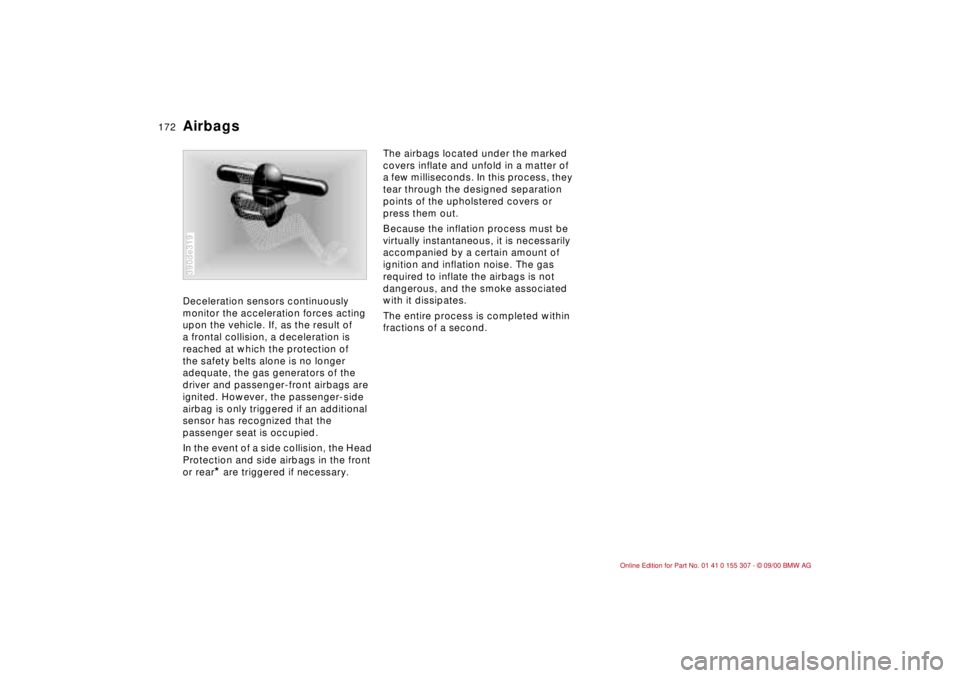
Deceleration sensors continuously
monitor the acceleration forces acting
upon the vehicle. If, as the result of
a frontal collision, a deceleration is
reached at which the protection of
the safety belts alone is no longer
adequate, the gas generators of the
driver and passenger-front airbags are
ignited. However, the passenger-side
airbag is only triggered if an additional
sensor has recognized that the
passenger seat is occupied.
In the event of a side collision, the Head
Protection and side airbags in the front
or rear
* are triggered if necessary.
390de319
The airbags located under the marked
covers inflate and unfold in a matter of
a few milliseconds. In this process, they
tear through the designed separation
points of the upholstered covers or
press them out.
Because the inflation process must be
virtually instantaneous, it is necessarily
accompanied by a certain amount of
ignition and inflation noise. The gas
required to inflate the airbags is not
dangerous, and the smoke associated
with it dissipates.
The entire process is completed within
fractions of a second.
Airbags
Page 173 of 203
173n
IndexDataTechnologyRepairsCar careControlsOverview
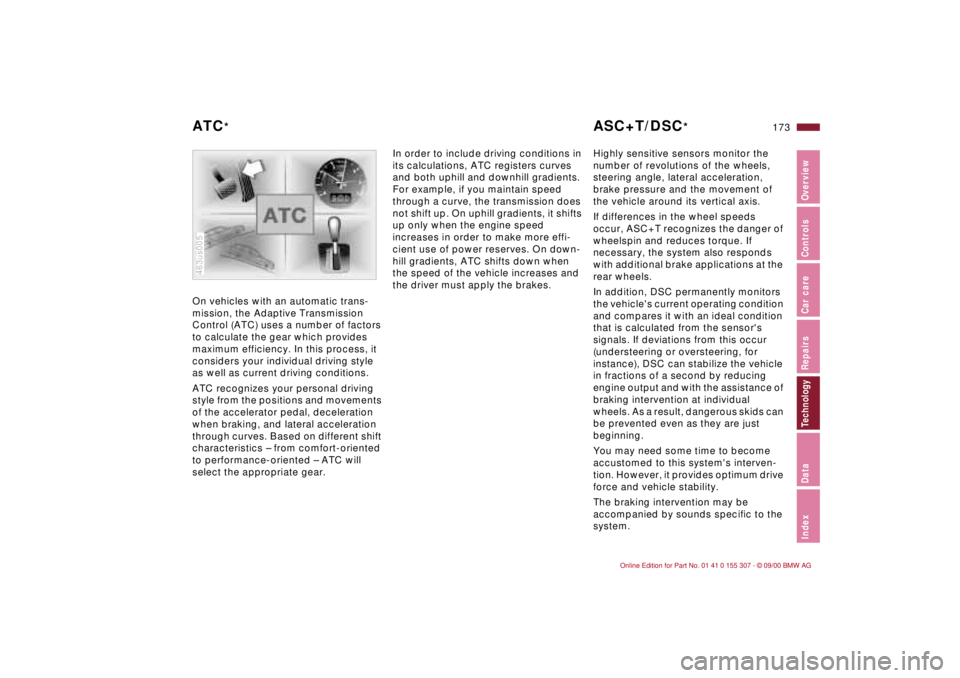
On vehicles with an automatic trans-
mission, the Adaptive Transmission
Control (ATC) uses a number of factors
to calculate the gear which provides
maximum efficiency. In this process, it
considers your individual driving style
as well as current driving conditions.
ATC recognizes your personal driving
style from the positions and movements
of the accelerator pedal, deceleration
when braking, and lateral acceleration
through curves. Based on different shift
characteristics Ð from comfort-oriented
to performance-oriented Ð ATC will
select the appropriate gear.463us005
In order to include driving conditions in
its calculations, ATC registers curves
and both uphill and downhill gradients.
For example, if you maintain speed
through a curve, the transmission does
not shift up. On uphill gradients, it shifts
up only when the engine speed
increases in order to make more effi-
cient use of power reserves. On down-
hill gradients, ATC shifts down when
the speed of the vehicle increases and
the driver must apply the brakes.Highly sensitive sensors monitor the
number of revolutions of the wheels,
steering angle, lateral acceleration,
brake pressure and the movement of
the vehicle around its vertical axis.
If differences in the wheel speeds
occur, ASC+T recognizes the danger of
wheelspin and reduces torque. If
necessary, the system also responds
with additional brake applications at the
rear wheels.
In addition, DSC permanently monitors
the vehicle's current operating condition
and compares it with an ideal condition
that is calculated from the sensor's
signals. If deviations from this occur
(understeering or oversteering, for
instance), DSC can stabilize the vehicle
in fractions of a second by reducing
engine output and with the assistance of
braking intervention at individual
wheels. As a result, dangerous skids can
be prevented even as they are just
beginning.
You may need some time to become
accustomed to this system's interven-
tion. However, it provides optimum drive
force and vehicle stability.
The braking intervention may be
accompanied by sounds specific to the
system.
ATC
*
ASC+T/DSC
*
Page 176 of 203
176n
Interior rearview mirror with automatic dimmer
*
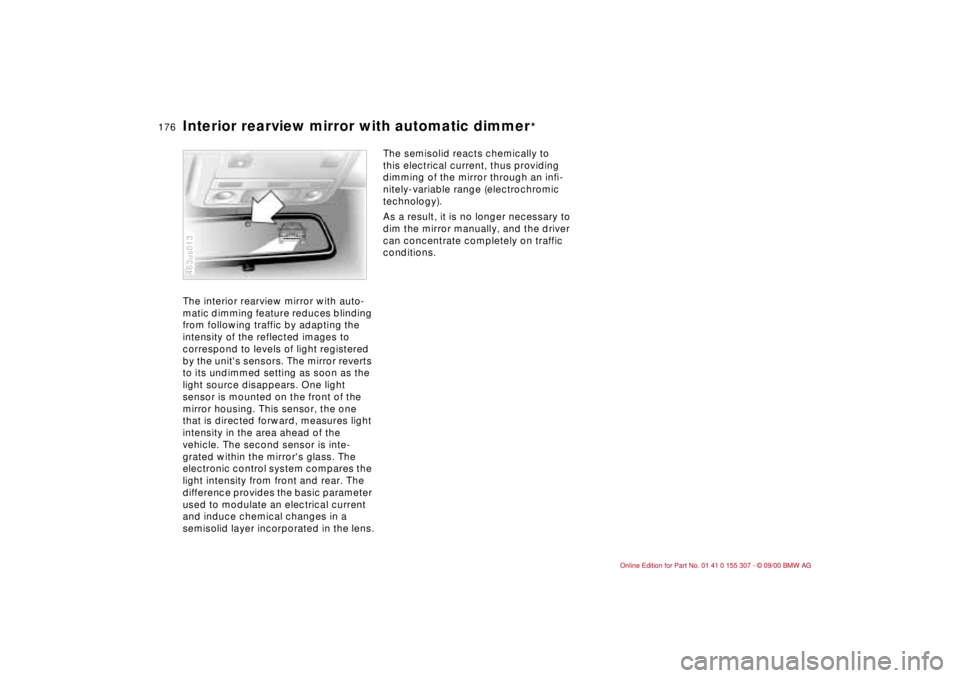
The interior rearview mirror with auto-
matic dimming feature reduces blinding
from following traffic by adapting the
intensity of the reflected images to
correspond to levels of light registered
by the unit's sensors. The mirror reverts
to its undimmed setting as soon as the
light source disappears. One light
sensor is mounted on the front of the
mirror housing. This sensor, the one
that is directed forward, measures light
intensity in the area ahead of the
vehicle. The second sensor is inte-
grated within the mirror's glass. The
electronic control system compares the
light intensity from front and rear. The
difference provides the basic parameter
used to modulate an electrical current
and induce chemical changes in a
semisolid layer incorporated in the lens.463us013
The semisolid reacts chemically to
this electrical current, thus providing
dimming of the mirror through an infi-
nitely-variable range (electrochromic
technology).
As a result, it is no longer necessary to
dim the mirror manually, and the driver
can concentrate completely on traffic
conditions.