2001 BMW 325I airbag
[x] Cancel search: airbagPage 56 of 203

56n
AirbagsSitting correctly with airbags
For your safety, comply with the
following instructions for the
airbags. If you do not, the airbags may
not be able to provide their maximum
protection. All passengers in the vehicle
should be aware of and comply with
this information:
The airbags are supplemental restraint
devices designed to provide extra
protection; they are not a substitute for
safety belts. Wear your safety belt at all
times. The airbags will not be triggered
in the event of a minor accident, a
vehicle roll-over, or collisions from the
rear. In these instances, the safety belt
provides optimal protection.
Airbags are located under cover panels
in the steering wheel, in the dashboard,
in the side trim panels in the front and
rear*, in the roof panels, and in the
sides of the inside roof lining.
Adjust your seat to a position that
provides maximum distance between
you and the steering wheel, the instru-
ment panel and the door while still allo-
wing comfortable and safe access to all
vehicle controls.
To avoid sustaining hand and arm inju-
ries, always grasp the steering wheel
on the rim with the hands at the 9 and
3 o'clock positions. Do not place your
hands on the center pad.
Never allow any objects to obstruct the
area between the airbag and an occu-
pant.
Do not use the cover panel above the
passenger-side airbag as a storage
area.
Do not apply adhesive materials to the
cover panels of the airbags, cover them
or modify them in any other way.
Do not install a rear-facing child
restraint system in the front passenger
seat of this car.
Children under 13 years of age and
children less than 5 feet (150 cm) tall
should only ride in the rear seat.
Infants or small children should never
be held on the lap of a passenger.
If your car is equipped with side airbags
in the rear passenger area
*, be sure
that child restraints are mounted
correctly and provided with the grea-
test-possible distance between the
airbags in the side trim panels. Do not
allow children to lean out of the child's
seat in the direction of the side trim
panels. If they do so, serious injuries
can occur if the airbag is triggered.
(infants and small children in appro-
priate child restraint systems; larger
children and adults using the safety
belts). Never let an occupant's head
rest near or on a side airbag, because
as the inflating airbag could cause a
serious or fatal injury. Please note that
the word "Airbag" imprinted on the door
trim panel indicates the airbag's loca-
tion.
Accident research shows that the
safest place for children in an
automobile is in the rear seat. However,
a child sitting in the rear seat and not
properly restrained may place his or her
head on or near the airbag, if so
equipped. For example, a child Ñ even
though belted Ñ may fall asleep with his
or her head against the side airbag. It
may be difficult for a driver to ensure
that children in the rear seat will remain
properly positioned at all times and not
place their heads on or near the side
airbag. Therefore, we recommend that
the rear seat side airbags, if so
equipped, be deactivated if children will
travel in the rear seat.
The rear seat side airbags may already
have been deactivated, either at the
time of manufacture or by a BMW
Page 57 of 203
57n
IndexDataTechnologyRepairsCar careControlsOverview
Airbagscenter. Labels in the rear door opening
should indicate the status of your rear
seat side airbags. If you are uncertain of
their status, or wish to have the airbags
activated or deactivated, please
contact your BMW center.<
Even when all these guidelines are
observed, there is still a small residual
risk of injuries to the face, hands and
arms occurring from airbag deployment
in isolated instances. The ignition and
inflation noise may induce a mild
temporary hearing loss in sensitive
individuals.
For additional information concerning
the airbag system, refer to pages 147
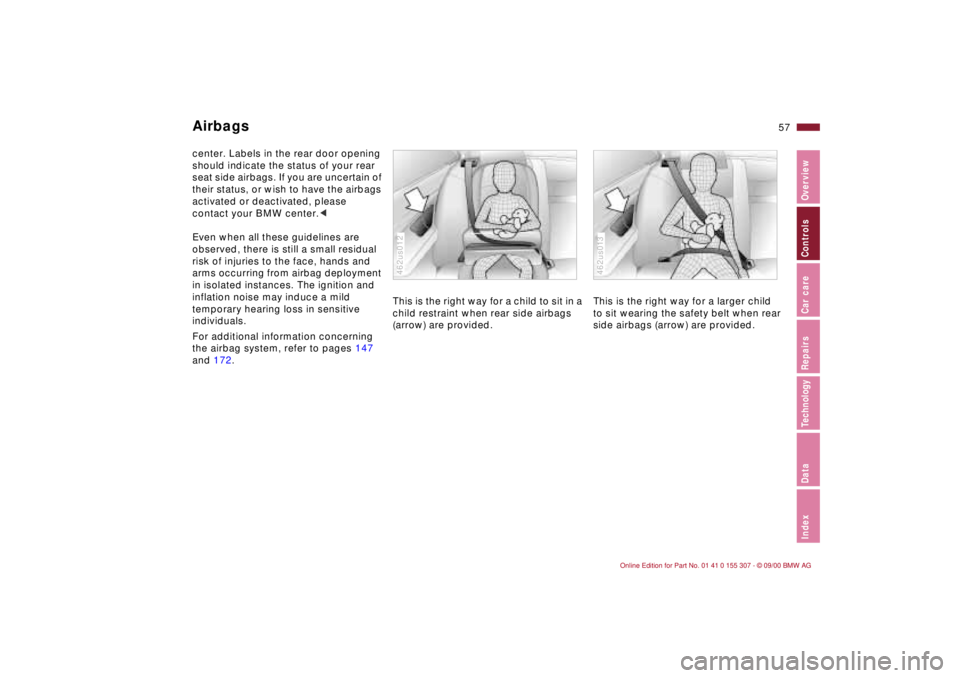
and 172.This is the right way for a child to sit in a
child restraint when rear side airbags
(arrow) are provided.
462us012
This is the right way for a larger child
to sit wearing the safety belt when rear
side airbags (arrow) are provided.462us013
Page 59 of 203
59n
IndexDataTechnologyRepairsCar careControlsOverview
Transporting children safelyCommercially available child seats
complying with the legal standard are
designed to be secured with a lap belt
or with the lap belt portion of a combi-
nation lap/shoulder belt.
Improperly or inadequately installed
restraint systems can increase the risk
of injury to children. Always read and
follow the instructions that come with
the system.
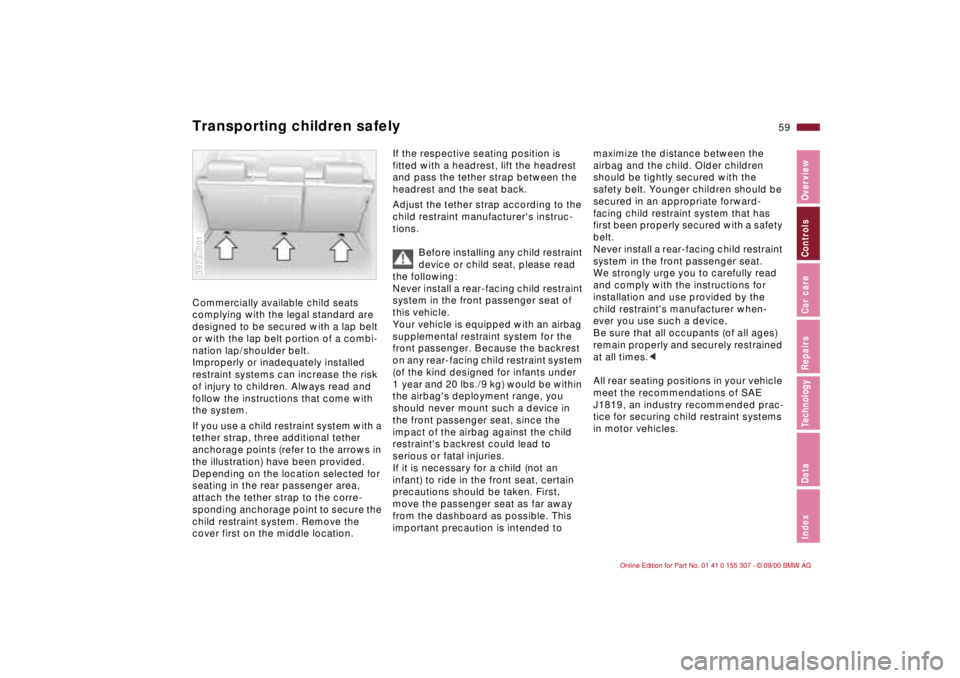
If you use a child restraint system with a
tether strap, three additional tether
anchorage points (refer to the arrows in
the illustration) have been provided.
Depending on the location selected for
seating in the rear passenger area,
attach the tether strap to the corre-
sponding anchorage point to secure the
child restraint system. Remove the
cover first on the middle location.392au001
If the respective seating position is
fitted with a headrest, lift the headrest
and pass the tether strap between the
headrest and the seat back.
Adjust the tether strap according to the
child restraint manufacturer's instruc-
tions.
Before installing any child restraint
device or child seat, please read
the following:
Never install a rear-facing child restraint
system in the front passenger seat of
this vehicle.
Your vehicle is equipped with an airbag
supplemental restraint system for the
front passenger. Because the backrest
on any rear-facing child restraint system
(of the kind designed for infants under
1 year and 20 lbs./9 kg) would be within
the airbag's deployment range, you
should never mount such a device in
the front passenger seat, since the
impact of the airbag against the child
restraint's backrest could lead to
serious or fatal injuries.
If it is necessary for a child (not an
infant) to ride in the front seat, certain
precautions should be taken. First,
move the passenger seat as far away
from the dashboard as possible. This
important precaution is intended to
maximize the distance between the
airbag and the child. Older children
should be tightly secured with the
safety belt. Younger children should be
secured in an appropriate forward-
facing child restraint system that has
first been properly secured with a safety
belt.
Never install a rear-facing child restraint
system in the front passenger seat.
We strongly urge you to carefully read
and comply with the instructions for
installation and use provided by the
child restraint's manufacturer when-
ever you use such a device.
Be sure that all occupants (of all ages)
remain properly and securely restrained
at all times.c
All rear seating positions in your vehicle
meet the recommendations of SAE
J1819, an industry recommended prac-
tice for securing child restraint systems
in motor vehicles.
Page 113 of 203
Overview
Controls and features
Operation, care
and maintenance
Owner service procedures
Technical data
Index Advanced technology
113n
Index DataTechnologyRepairs Car care Controls Overview
Special operating instructions:
Break-in procedures114
Driving notes115
Catalytic converter115
Antilock Brake System
(ABS)116
Disc brakes118
Brake system120
Winter operation121
Power steering123
Cellular phone123
Radio reception123
Wheels and tires:
Tire inflation pressure124
Tire condition124
Tire replacement125
Tire rotation126
Wheel and tire
combinations127
Winter tires128
Snow chains128
Approved wheel and tire
specifications129Under the hood:
Hood130
Engine compartment132
Washer fluids134
Washer nozzles134
Engine oil135
Coolant137
Brake fluid138
Vehicle Identification
Number139
Care and maintenance:
The BMW Maintenance
System140
Caring for your vehicle141
Airbags147
Vehicle storage147
Laws and regulations:
Technical modifications148
California Proposition
65 Warning148
OBD interface socket149
Car care
Page 147 of 203
147n
IndexDataTechnologyRepairsCar careControlsOverview
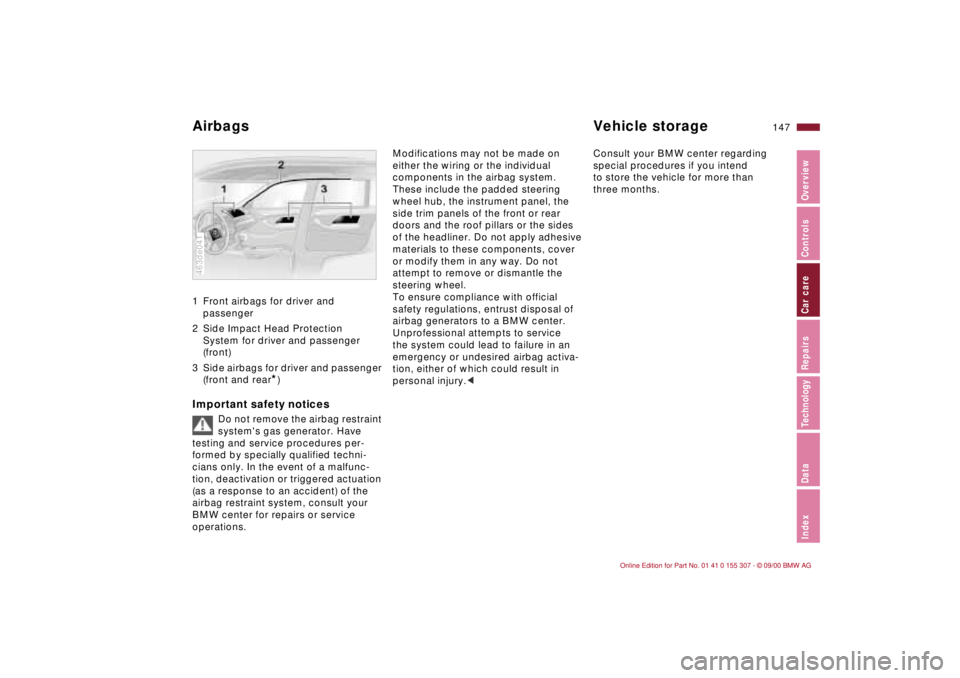
Airbags Vehicle storage1 Front airbags for driver and
passenger
2 Side Impact Head Protection
System for driver and passenger
(front)
3 Side airbags for driver and passenger
(front and rear
*)
Important safety notices
Do not remove the airbag restraint
system's gas generator. Have
testing and service procedures per-
formed by specially qualified techni-
cians only. In the event of a malfunc-
tion, deactivation or triggered actuation
(as a response to an accident) of the
airbag restraint system, consult your
BMW center for repairs or service
operations.
463de041
Modifications may not be made on
either the wiring or the individual
components in the airbag system.
These include the padded steering
wheel hub, the instrument panel, the
side trim panels of the front or rear
doors and the roof pillars or the sides
of the headliner. Do not apply adhesive
materials to these components, cover
or modify them in any way. Do not
attempt to remove or dismantle the
steering wheel.
To ensure compliance with official
safety regulations, entrust disposal of
airbag generators to a BMW center.
Unprofessional attempts to service
the system could lead to failure in an
emergency or undesired airbag activa-
tion, either of which could result in
personal injury.
to store the vehicle for more than
three months.
Page 171 of 203
Overview
Controls and features
Operation, care
and maintenance
Owner service procedures
Technical data
Index Advanced technology
171n
IndexDataTechnologyRepairsCar careControlsOverview
Advanced technology:
Airbags172
Adaptive Transmission Control
(ATC)173
Automatic Stability Control plus
Traction ASC+T/Dynamic
Stability Control DSC173
Radio reception174
Four-wheel drive175
Safety belt tensioner175
Interior rearview mirror with
automatic dimmer176
Rain sensor177
Tire Pressure Control (RDC)178
Self-diagnostics179
Xenon lamps180
Technol-
Page 172 of 203
172n
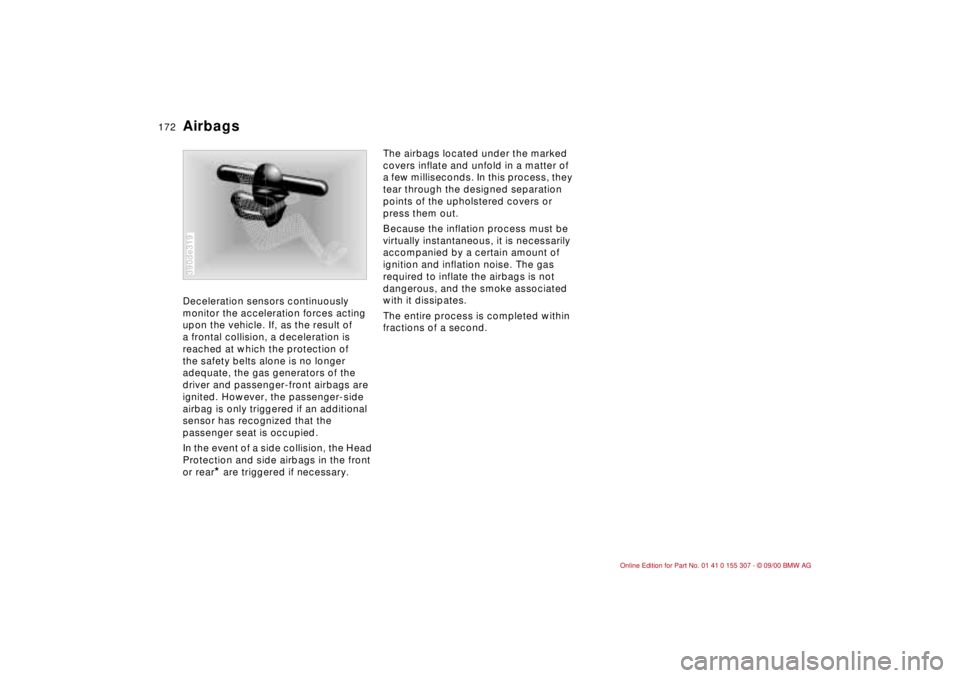
Deceleration sensors continuously
monitor the acceleration forces acting
upon the vehicle. If, as the result of
a frontal collision, a deceleration is
reached at which the protection of
the safety belts alone is no longer
adequate, the gas generators of the
driver and passenger-front airbags are
ignited. However, the passenger-side
airbag is only triggered if an additional
sensor has recognized that the
passenger seat is occupied.
In the event of a side collision, the Head
Protection and side airbags in the front
or rear
* are triggered if necessary.
390de319
The airbags located under the marked
covers inflate and unfold in a matter of
a few milliseconds. In this process, they
tear through the designed separation
points of the upholstered covers or
press them out.
Because the inflation process must be
virtually instantaneous, it is necessarily
accompanied by a certain amount of
ignition and inflation noise. The gas
required to inflate the airbags is not
dangerous, and the smoke associated
with it dissipates.
The entire process is completed within
fractions of a second.
Airbags
Page 179 of 203
179n
IndexDataTechnologyRepairsCar careControlsOverview
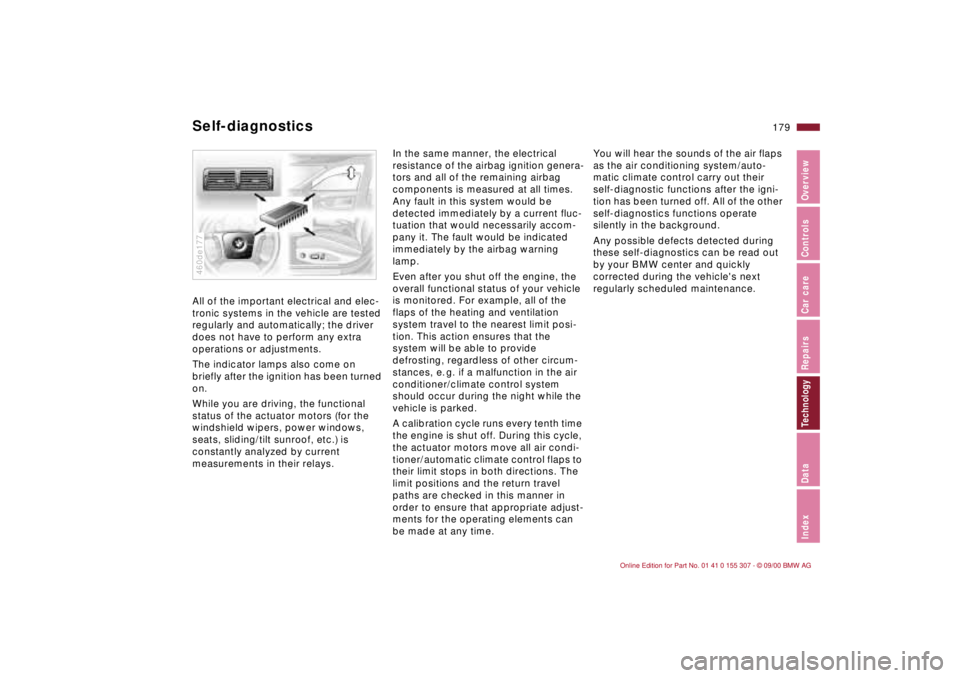
Self-diagnostics All of the important electrical and elec-
tronic systems in the vehicle are tested
regularly and automatically; the driver
does not have to perform any extra
operations or adjustments.
The indicator lamps also come on
briefly after the ignition has been turned
on.
While you are driving, the functional
status of the actuator motors (for the
windshield wipers, power windows,
seats, sliding/tilt sunroof, etc.) is
constantly analyzed by current
measurements in their relays.460de177
In the same manner, the electrical
resistance of the airbag ignition genera-
tors and all of the remaining airbag
components is measured at all times.
Any fault in this system would be
detected immediately by a current fluc-
tuation that would necessarily accom-
pany it. The fault would be indicated
immediately by the airbag warning
lamp.
Even after you shut off the engine, the
overall functional status of your vehicle
is monitored. For example, all of the
flaps of the heating and ventilation
system travel to the nearest limit posi-
tion. This action ensures that the
system will be able to provide
defrosting, regardless of other circum-
stances, e. g. if a malfunction in the air
conditioner/climate control system
should occur during the night while the
vehicle is parked.
A calibration cycle runs every tenth time
the engine is shut off. During this cycle,
the actuator motors move all air condi-
tioner/automatic climate control flaps to
their limit stops in both directions. The
limit positions and the return travel
paths are checked in this manner in
order to ensure that appropriate adjust-
ments for the operating elements can
be made at any time.You will hear the sounds of the air flaps
as the air conditioning system/auto-
matic climate control carry out their
self-diagnostic functions after the igni-
tion has been turned off. All of the other
self-diagnostics functions operate
silently in the background.
Any possible defects detected during
these self-diagnostics can be read out
by your BMW center and quickly
corrected during the vehicle's next
regularly scheduled maintenance.