Page 23 of 203

23n
IndexDataTechnologyRepairsCar careControlsOverview
Indicator and warning lamps
Engine electronics
* l
There is a fault in the engine's
electronic control system. The
electronics will allow you to continue
driving with reduced engine output or
reduced engine speed. Please have the
system inspected by your BMW center.
Add coolant
The coolant level is too low. Top
off the coolant at the earliest
opportunity.
For additional information, refer to
page 137.
Green: for your information
Turn signal indicator
Flashes when the turn signal is
on. Rapid flashing indicates a
system malfunction.
For additional information, refer to
page 70.
Cruise control
Lights up when the cruise
control is activated. Available for
operation via the multifunction steering
wheel.
For additional information, refer to
page 73.
Front fog lamps
Lights up whenever you switch
on the front fog lamps.
For additional information, refer to
page 88.
Blue: for your information
High beams
Comes on when the high beams
are on or the headlamp flasher
is actuated.
For additional information, refer to
pages 70, 88.
Page 25 of 203
25n
IndexDataTechnologyRepairsCar careControlsOverview
Hazard warning flashers Warning triangle
*
First-aid kit
*
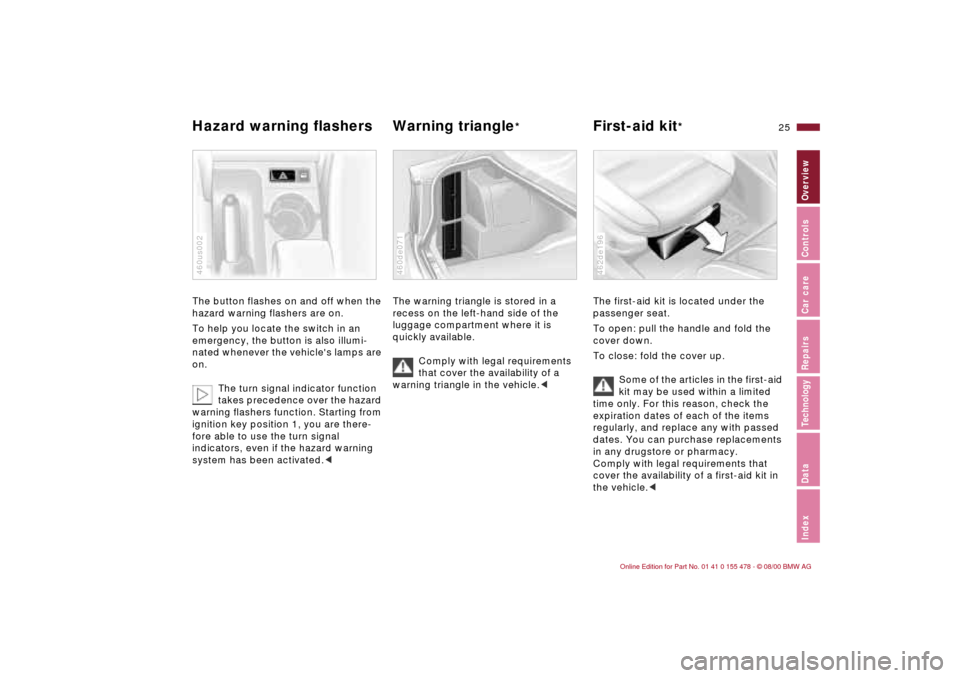
The button flashes on and off when the
hazard warning flashers are on.
To help you locate the switch in an
emergency, the button is also illumi-
nated whenever the vehicle's lamps are
on.
The turn signal indicator function
takes precedence over the hazard
warning flashers function. Starting from
ignition key position 1, you are there-
fore able to use the turn signal
indicators, even if the hazard warning
system has been activated.< 460us002
The warning triangle is stored in a
recess on the left-hand side of the
luggage compartment where it is
quickly available.
Comply with legal requirements
that cover the availability of a
warning triangle in the vehicle.<460de071
The first-aid kit is located under the
passenger seat.
To open: pull the handle and fold the
cover down.
To close: fold the cover up.
Some of the articles in the first-aid
kit may be used within a limited
time only. For this reason, check the
expiration dates of each of the items
regularly, and replace any with passed
dates. You can purchase replacements
in any drugstore or pharmacy.
Comply with legal requirements that
cover the availability of a first-aid kit in
the vehicle.< 462de196
Page 26 of 203
26n
Refueling Fuel filler door
Before filling the tank, shut off the
engine. If you do not, fuel cannot
be filled into the tank and the "Service
Engine Soon" lamp may come on.<
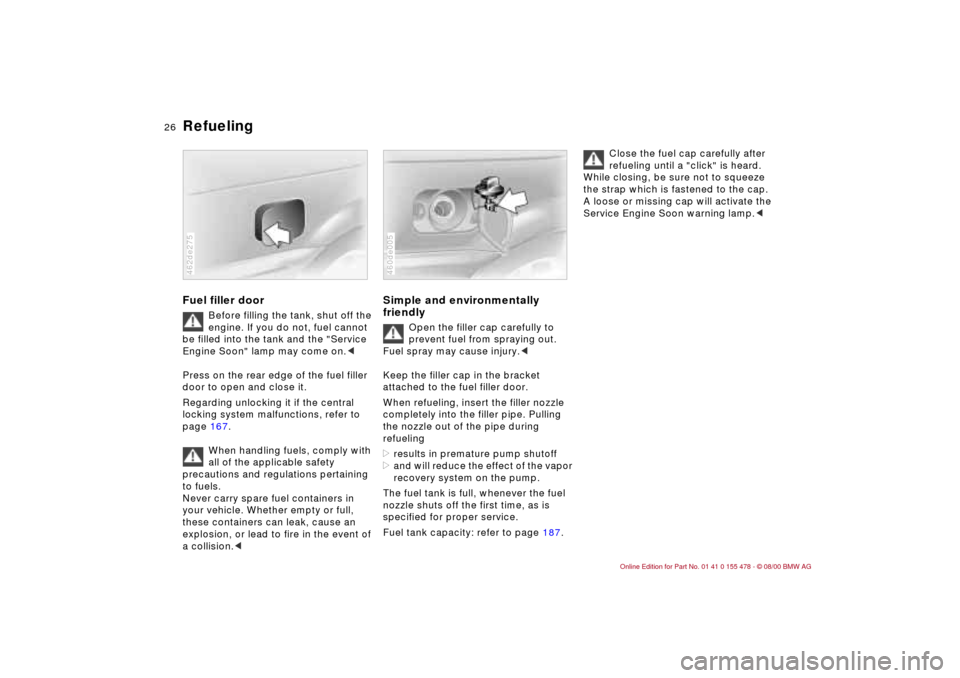
Press on the rear edge of the fuel filler
door to open and close it.
Regarding unlocking it if the central
locking system malfunctions, refer to
page 167.
When handling fuels, comply with
all of the applicable safety
precautions and regulations pertaining
to fuels.
Never carry spare fuel containers in
your vehicle. Whether empty or full,
these containers can leak, cause an
explosion, or lead to fire in the event of
a collision.<
462de275
Simple and environmentally
friendly
Open the filler cap carefully to
prevent fuel from spraying out.
Fuel spray may cause injury.<
Keep the filler cap in the bracket
attached to the fuel filler door.
When refueling, insert the filler nozzle
completely into the filler pipe. Pulling
the nozzle out of the pipe during
refueling
>results in premature pump shutoff
>and will reduce the effect of the vapor
recovery system on the pump.
The fuel tank is full, whenever the fuel
nozzle shuts off the first time, as is
specified for proper service.
Fuel tank capacity: refer to page 187.
460de005
Close the fuel cap carefully after
refueling until a "click" is heard.
While closing, be sure not to squeeze
the strap which is fastened to the cap.
A loose or missing cap will activate the
Service Engine Soon warning lamp.<
Page 34 of 203

34n
Central locking system Opening and closing Ð from the outside The conceptThe central locking system is ready for
operation whenever the driver's door
is closed. The system engages and
releases the locks on the
>doors
>luggage compartment lid
>fuel filler door at the same time.
The central locking system can be
operated
>from outside via the door lock and
using the remote control
>from inside by pressing a button.
Activating it from inside does not lock
the fuel filler door (see page 38). When
the system is actuated from the
outside, the anti-theft system is acti-
vated simultaneously. Both the door
locks and the safety lock buttons
remain locked. The alarm system is also
armed or disarmed.
The central locking system unlocks
automatically in the event of an acci-
dent. In addition, the hazard warning
flashers and interior lamps come on.
Using the keyOne turn of the key in the driver's door
lock unlocks the driver's door only.
Turning the key a second time will
unlock the passenger-side door, the
luggage compartment lid and the fuel
filler door.
You can have a signal set as an
acknowledgment message that
the vehicle is closed correctly.<460de006
Convenience operationYou can also operate the power
windows and sliding/tilt sunroof from
the door lock.
>To open: with the door closed, hold
the key in the "Unlock" position.
>To close: with the door closed, turn
the key to the "Lock" position and
hold it.
Watch during the closing process
to be sure that no one is injured.
Releasing the key stops the operation.
Turn the key to the extreme left or right
to unlock/lock the door.
Page 42 of 203

42n
Alarm system
*
The conceptThe vehicle alarm system responds:
>When a door, the hood or the
luggage compartment lid is opened.
>To movement inside the vehicle
(interior motion sensor).
>To a change of the vehicle's tilt Ð if
someone attempts to steal the
wheels or tow the vehicle without
authorization, for example.
>If there is an interruption in battery
voltage.
The system responds to unauthorized
vehicle entry and attempted theft by
simultaneously activating the following:
>Sounding an alarm for 30 seconds.
>The hazard warning flashers are acti-
vated for approx. five minutes.
>The high beams flash on and off in
sync with the hazard warning flashers.
To activate and deactivate the
alarm systemWhen the vehicle is locked or unlocked
by using a key or with the remote
control, the alarm system is also simul-
taneously armed or disarmed.
The interior motion sensor and the tilt
alarm sensor are activated approx.
30 seconds after you have finished
locking the vehicle.
If the alarm system has been armed
correctly, the hazard warning flashers
flash once.
You can have a signal set as
acknowledgment for both arming
and disarming the alarm system.<
You can also open the luggage
compartment lid when the system is
armed by pressing button 3 of the
remote control (refer to page 37). When
it is closed, the lid is once again
secured.
Indicator lamp displaysThe indicator lamp is located under the
interior rearview mirror.
>When the indicator lamp flashes
continuously: the system is armed.
>If the indicator lamp flashes during
arming of the system: the door(s), the
hood or luggage compartment lid are
not properly closed. Even if you do
not close the indicated area, the
system begins to monitor the
remaining areas, and the indicator
lamp flashes continuously after
>10 seconds. However, the interior
motion sensor is not activated.
>If the indicator lamp goes out when
the system is disarmed: no manipula-
tion or attempted intrusions have
been detected in the period since the
system was armed.463us010
Page 75 of 203
75n
IndexDataTechnologyRepairsCar careControlsOverview
1 Odometer You can activate the displays shown in
the illustration with the ignition key in
position 0 by pressing the button in the
instrument cluster (arrow).2 Trip odometerTo reset the trip odometer to zero,
press the button (arrow) with the igni-
tion key in position 1 and up.462us005
Avoid engine speeds in the red warning
zone of the gauge.
To protect the engine, the fuel supply is
automatically interrupted in this zone;
you will notice a loss of power.462us017
Indicates current fuel consumption in
mpg (in l/100 km on Canadian vehicles).
You can check your current driving
style to see whether it is conducive to
economy and minimum exhaust emis-
sions.
When the vehicle is stationary, the
display goes to "Maximum" (zero on
Canadian vehicles).462us018
Odometer Tachometer Energy Control
Page 77 of 203
77n
IndexDataTechnologyRepairsCar careControlsOverview
The following information and/or condi-
tions are indicated using symbols,
starting with the ignition key position 2,
until the condition has been corrected.
1 Inspect the low beam and high beam
headlamps, as well as the side lamps
2 Door open
3 Luggage compartment lid open
4 Check brake and tail lamps.
When you open the driver's door after
stopping with the lights still on, a
warning signal sounds for LIGHTS ON.462de272
Mode selectionFrom ignition key position 1 on, you can
call up information from the computer
using the button in the turn signal lever.
Every time you press the button briefly
in the direction of the steering column,
you can call up a new function for
display.
The displays appear in the following
order:
Time, outside temperature, average fuel
consumption, cruising range, average
vehicle speed.
From ignition key position 1 on, the last
active setting is displayed.46cde096
Check Control Computer
Page 79 of 203
79n
StichworteDatenTechnikSelbsthilfeWartungBedienung†berblick
Computer
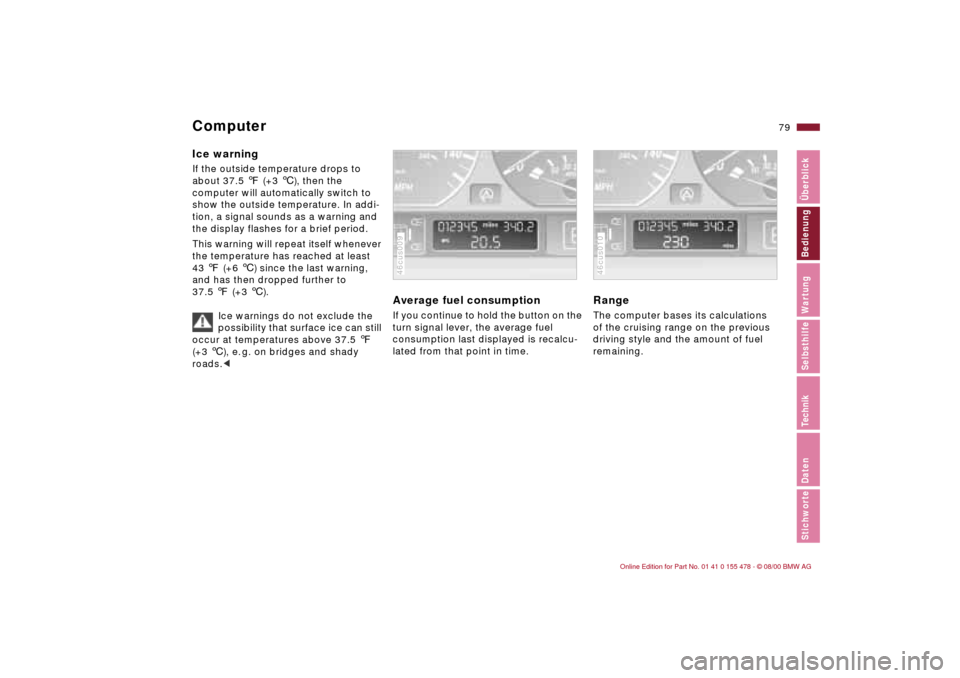
Ice warning
If the outside temperature drops to
about 37.5
7
(+3
6
), then the
computer will automatically switch to
show the outside temperature. In addi-
tion, a signal sounds as a warning and
the display flashes for a brief period.
This warning will repeat itself whenever
the temperature has reached at least
43
7
(+6
6
) since the last warning,
and has then dropped further to
37.5
7
(+3
6
).
Ice warnings do not exclude the
possibility that surface ice can still
occur at temperatures above 37.5
7
(+3
6
), e. g. on bridges and shady
roads. <
Average fuel consumption
If you continue to hold the button on the
turn signal lever, the average fuel
consumption last displayed is recalcu-
lated from that point in time.46cus009
Range
The computer bases its calculations
of the cruising range on the previous
driving style and the amount of fuel
remaining.46cus010