2001 BMW 320i inflation pressure
[x] Cancel search: inflation pressurePage 125 of 211
125n
IndexDataTechnologyRepairsCar careControlsOverview
Information for your safetyThe factory-approved radial tires are
matched to the vehicle and have been
selected to provide optimum safety and
driving comfort on your vehicle.
It is not merely the tire's service life, but
also driving comfort and Ð above all else
Ð driving safety that depend on the
condition of the tires and the mainte-
nance of the specified tire pressure.
Incorrect inflation pressure is a frequent
cause of tire damage. It also signifi-
cantly influences the roadholding ability
of your BMW.
Check tire inflation pressures
regularly Ð include the space-
saver spare tire or spare tire Ð at least
twice a month and before beginning a
longer trip (refer to page 29). If this is
not done, incorrect tire pressures can
cause driving instability and tire
damage, ultimately resulting in an acci-
dent.<
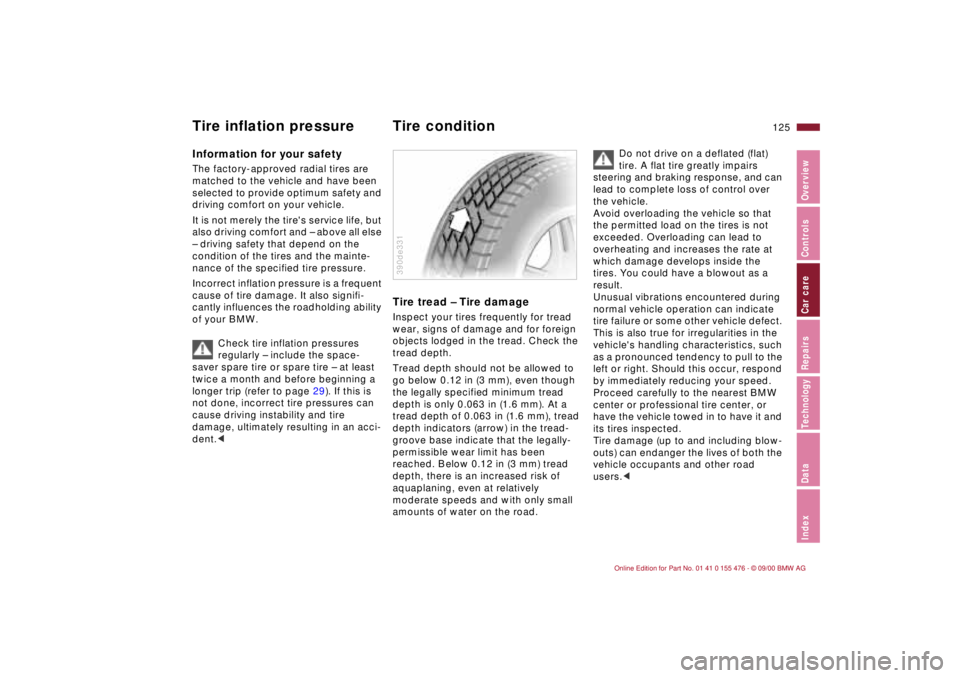
Tire tread Ð Tire damageInspect your tires frequently for tread
wear, signs of damage and for foreign
objects lodged in the tread. Check the
tread depth.
Tread depth should not be allowed to
go below 0.12 in (3 mm), even though
the legally specified minimum tread
depth is only 0.063 in (1.6 mm). At a
tread depth of 0.063 in (1.6 mm), tread
depth indicators (arrow) in the tread-
groove base indicate that the legally-
permissible wear limit has been
reached. Below 0.12 in (3 mm) tread
depth, there is an increased risk of
aquaplaning, even at relatively
moderate speeds and with only small
amounts of water on the road.390de331
Do not drive on a deflated (flat)
tire. A flat tire greatly impairs
steering and braking response, and can
lead to complete loss of control over
the vehicle.
Avoid overloading the vehicle so that
the permitted load on the tires is not
exceeded. Overloading can lead to
overheating and increases the rate at
which damage develops inside the
tires. You could have a blowout as a
result.
Unusual vibrations encountered during
normal vehicle operation can indicate
tire failure or some other vehicle defect.
This is also true for irregularities in the
vehicle's handling characteristics, such
as a pronounced tendency to pull to the
left or right. Should this occur, respond
by immediately reducing your speed.
Proceed carefully to the nearest BMW
center or professional tire center, or
have the vehicle towed in to have it and
its tires inspected.
Tire damage (up to and including blow-
outs) can endanger the lives of both the
vehicle occupants and other road
users.<
Tire inflation pressure Tire condition
Page 127 of 211

127n
IndexDataTechnologyRepairsCar careControlsOverview
Tire replacement Tire rotationTire ageThe date on which the tire was manu-
factured is indicated by the code on the
sidewall:
DOT ... 4100 means that the tire was
manufactured in week 41 of 2000.
BMW recommends the replacement of
all tires when the tires are no more than
6 years old, even if a tire life of 10 years
is possible.
Spare tires over 6 years old should be
used only in case of emergency. A tire
in this condition should be replaced by
a new tire immediately, and should not
be mounted together with new tires.
Between the axlesThe tread wear patterns at the front end
differ from those at the rear Ð the actual
patterns will vary according to indi-
vidual driving conditions. In the inter-
ests of safety and maintaining optimal
handling characteristics, tire rotation is
not recommended.
If a proposed interaxle rotation of tires
is based on economic considerations,
one should consider whether the costs
for the rotation are likely to be recap-
tured by any increase in the service life
of the tires that might be realized. In
principle, interaxle rotation must be
performed in short intervals, with a
maximum of 3,000 miles (5,000 km).
Consult your BMW center for more
information.
Should you decide to rotate the tires, it
is essential to comply with the following:
Rotate tires on the same side only, since
braking characteristics and road grip
could otherwise be adversely affected.
Following rotation, the tire inflation
pressure should always be corrected.If different tire sizes are mounted
on the front and rear axles (refer to
page 130), the wheels may not be
rotated from one axle to the other.<
Page 129 of 211

129n
IndexDataTechnologyRepairsCar careControlsOverview
Winter tires
Choosing the right tire
BMW recommends winter tires (M+S
radial tires) for driving in adverse winter
road conditions. Although all-season
M+S tires provide better winter traction
than standard summer tires with H, V,
W, Y and ZR speed ratings, they gener-
ally fail to provide the same levels of
performance as standard snow tires in
winter driving.
In the interest of safe tracking and
steering response, install winter tires
made by the same manufacturer having
the same tread configuration on all four
wheels.
Mount only winter tires approved by
BMW. Any BMW center will be glad to
provide you with information on the
best winter tires for your particular
driving conditions.
Do not exceed specified
maximum speeds
Never exceed the maximum speed
for which the tires are rated.
Unprofessional attempts by laymen to
service tires can lead to damage and
accidents.
Have this work performed by skilled
professionals only. Any BMW center
has the required technical knowledge
and the proper equipment and will be
happy to assist you.
<
Tire condition, tire pressure
Winter tires display a perceptible loss in
their ability to cope with winter driving
conditions once the tread wears to
below 0.16 inches (4 mm), and should
thus be replaced.
Comply with the specified tire inflation
pressures Ð and be sure to have the
wheel and tire assemblies balanced
every time you change the tires.
Storage
Always store tires in a cool, dry place.
Store them away from light whenever
possible. Protect the tires against
contact with oil, grease and fuel.
Snow chains
*
The use of narrow-link BMW snow
chains on winter tires is approved only
in pairs and only on the rear wheels.
BMW 325xi, 330xi: in a worst-case
scenario, if your vehicle is stuck on one
side or you cannot access one tire, then
a chain may be attached to one rear
wheel for a short period of time.
Comply with all manufacturer's safety
precautions when mounting the chains.
Page 167 of 211

167n
IndexDataTechnologyRepairsCar careControlsOverview
Changing a wheel9 Position the new wheel or the
space-saver spare tire on the hub
and screw at least two lug bolts
finger-tight into opposite bolt holes
10 Screw in the remaining lug bolts.
Tighten all the bolts securely
11 Lower the jack and remove it from
beneath the vehicle
12 Tighten the lug bolts in a diagonal
pattern462de267
13 Wheels with full wheel covers
*:
Position the wheel cover with the
valve opening over the valve (arrow)
and press it onto the wheel with
both hands
14 Check and correct the tire's inflation
pressure at the earliest possibility.
For vehicles with RDC (Tire Pres-
sure Control):
Reactivate the system after
mounting the spare wheel or
correcting the inflation pressure.
Refer to page 86.
Use original BMW full wheel
covers only. Other wheel covers
may not fit securely. The full wheel
cover may not be installed on the
space-saver spare tire, since this could
damage the cover.<
460de125
The vehicle jack is designed for
changing wheels only. Do not
attempt to raise another vehicle model
with it or to raise any load of any kind.
To do so could cause accidents and
personal injury.
Have the lug bolts checked for proper
tightness with a calibrated torque
wrench at the earliest possibility [torque
specification: 72 lb.ft. (100 Nm)].<
When storing the wheel, be sure that
you do not damage the retaining pin in
the spare tire recess.
If light-alloy wheels other than Original
BMW light-alloy wheels have been
mounted, it may be necessary to use
different lug bolts for those wheels.
Replace the defective tire as quickly as
possible and have the new wheel
balanced.
Page 202 of 211

Everything from A to ZFootwell lamps89
bulb replacement164
Four-wheel drive182
Front fog lamps89
bulb replacement161
Frost protection,
radiator142
Fuel28
Fuel consumption78
Fuel consumption
display75
Fuel filler door
releasing following an
electrical malfunction172
Fuel gauge75
Fuel injection192
Fuel quality28
Fuel reserve indicator
lamp75
Fuel specifications28
Fuel tank capacity195
Fuel tank gauge75
Functional status187
Fuses170 G
Gasoline28
Gasoline gauge75
Glove compartment104 Glove compartment lamp,
bulb replacement164
Gross vehicle weight194
H
Handbrake64
Handsfree system107
Hazard warning flashers26
Hazard warning triangle26
Head restraints48
Headlamp covers,
care146,159
Headlamp flasher69,89
Headlamp washer
system138,195
Headlamp washers71
Headlamps88
Heated seats103
Heating, rapid96
Heavy loads112
Height193
HiFi system Ð harman
kardon104
High beams23,69,89
bulb replacement159
High Performance Synthetic
Oils140
High-mount brake lamp163
Hood release134 Horn17
Hubcap166
Hydraulic Brake assistant,
refer to DBC
I
Ice warning77
Icy roads77
Identification, tires128
Ignition key32
Ignition lock62
Imprint4
Indicator lamps20
Inflated pressure28,125
Inflation pressure
monitoring86,186
INSPECTION75
Instrument cluster18
Instrument panel18
Interaxle tire rotation127
Interface socket108
for Onboard
Diagnostics154
Interference
cellular phone124
Interior lamps36,89
bulb replacement163
remote control36
Interior motion sensor42 Interior rearview mirror52
automatic dimming
feature53,184
Interlock62
Intermittent wipe69
J
Jack165
Jump-starting173 K
Key Memory53
Keys32
with remote control32 L
Lamps and bulbs158
LAMPS ON warning88
Lashing eyes112
LATCH attachment of the
child seat59
Leather care150
Length193
License plate lamp, bulb
replacement163
Light switch88
Light-alloy wheels130
Lighter108
Load-securing devices112
Page 205 of 211

Everything from A to Z
205n
IndexDataTechnologyRepairsCar careControlsOverview
Tire inflation
pressure28,125
Tire pressure
checking28
Tire Pressure Control
(RDC)86,186
Tire pressure
monitoring86,186
Tire Quality Grading126
Tire replacement126,127
Tire rotation127
Tire specifications130
Tire tread125
To switch on the interior
lamps36
Tools158
Torque192
Tow fittings174
Tow starting174
Towing174
Track193
Traction Control System,
refer to DSC80
Transmission65
Transporting children
safely59
Tread depth, tires125
Trip odometer74
Trunk39
Trunk lid, refer to luggage
compartment lid39 Turn signal
indicator23,69,160
bulb replacement160
Turning radius193
Two-way radios124
U
Uniform Tire Quality
Grading126
Used batteries170 V
Vacuum cleaner108
Vacuum cleaner,
connecting108
Vanity mirror52
bulb replacement164
V-belts196
Vehicle battery168,196
Vehicle care
exterior147
interior150
Vehicle Identification
Number (VIN)144
Vehicle immobilizer33
Vehicle painting147
Vehicle storage152 Vehicle weight194
Ventilation92,95,98
draft-free95,102
Vinyl care149
Voice recognition24,25
W
Warning lamp "Please fasten
safety belts"21
Warning lamps20
Warning messages76
Warranty and Service Guide
Booklet145
Washer fluids138
Washer nozzles138
Washer reservoir, filling138
Washing your car146
Water on roadways
deep water117
Waxing, paintwork148
Weights194
Wheel changing165
Wheel rims128
Wheelbase193
Wheels and tires128,130
Width193
Windows, convenience
operation34
Windshield washer nozzle
adjustment138
Windshield washer reservoir,
filling138,195 Windshield washer,
automatic70
Windshield wiper69
Windshield wiper blade
replacement158
Winter operation122
Winter tires128,129
Wiper blade
replacement158
Wiper system69
Work in the engine
compartment134
X
Xenon lamps159,188
Page 209 of 211
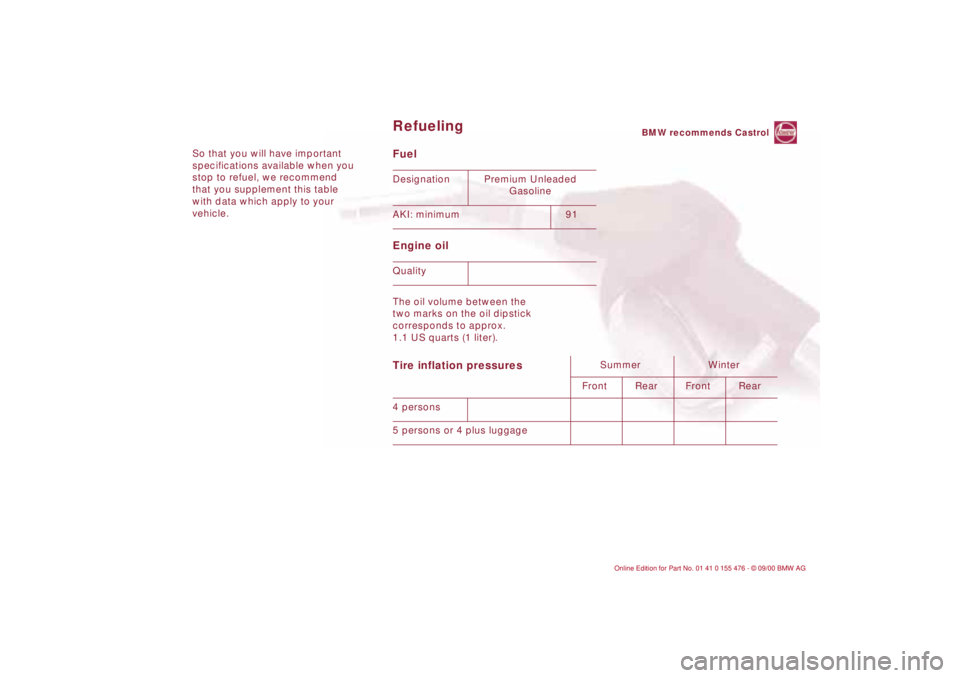
So that you will have important
specifications available when you
stop to refuel, we recommend
that you supplement this table
with data which apply to your
vehicle.
Fuel
Engine oil The oil volume between the
two marks on the oil dipstick
corresponds to approx.
1.1 US quarts (1 liter). Designation Premium Unleaded
Gasoline
AKI: minimum 91
QualityTire inflation pressures
Summer Winter
Front Rear Front Rear
4 persons
5 persons or 4 plus luggage
Refueling
BMW recommends Castrol