2001 Acura RL air condition
[x] Cancel search: air conditionPage 244 of 333

Air Conditioning System
Your car's air conditioning is a sealed system. Any major maintenance,such as recharging, should be done
by a qualified mechanic. You can do a couple of things to make sure the
air conditioning works efficiently.
Periodically check the engine's
radiator and air conditioning
condenser for leaves, insects, anddirt stuck to the front surface. These
block the air flow and reduce cooling efficiency. Use a light spray from a
hose or a soft brush to remove them.
The condenser and radiator fins bend
easily. Only use a low-pressure spray
or soft-bristle brush to clean them.
Run the air conditioning at least once
a week during the cold weather
months. Run it for at least ten
minutes while you are driving at asteady speed with the engine at
normal operating temperature. This
circulates the lubricating oil con-
tained in the refrigerant. If the air conditioning does not get as
cold as before, have your dealer
check the system. Recharge the
system with Refrigerant HFC-134a (R-134a). (See Specifications on page 302.)
Whenever you have the air conditioning
system serviced, make sure the service
facility uses a refrigerant recycling
system. This system captures the
refrigerant for reuse. Releasingrefrigerant into the atmosphere can
damage the environment.
Maintenance
NOTICE
NOTICE
AIR CONDITIONING CONDENSER
Page 245 of 333

Air Conditioning Filter, Drive Belts
Air Conditioning Filter The air conditioning filter removespollen and dust that is brought in
from the outside through the climate control system.
This filter should be replaced every 30,000 miles (48,000 km) under nor-
mal conditions. It should be replaced
every 15,000 miles (24,000 km) if youdrive primarily in urban areas that
have high concentrations of soot in
the air from industry and diesel-pow- ered vehicles. Replace it more often
if air flow from the climate control system becomes less than usual.
Have the air conditioning filter re-
placed by your Acura dealer. Drive Belts
The belts should have the following
"play" or deflection.
Alternator belt:
0.37 — 0.45 in (9.5 — 11.5 mm)
Compressor belt:
0.31 — 0.43 in (8.0 — 11.0 mm)
Power steering belt:
0.41 — 0.49 in (10.5 — 12.5 mm)
If you see signs of wear or looseness,
have your dealer adjust or replace
the belts.
Maintenance
Check the condition of the three
drive belts. Examine the edges of
each belt for cracks or fraying.
Check the tension of each belt by
pushing on it with your thumb midway between the pulleys.
ALTERNATOR BELT
POWER STEERING BELT
COMPRESSOR BELT
Page 246 of 333

Timing Belt, Tires
Timing Belt
The timing belt and balancer belt should normally be replaced at the
intervals shown in the maintenance
schedule.
Replace these belts at 60,000 miles (U.S.) or 100,000 km (Canada) if you
regularly drive your car in one or
more of these conditions:
In very high temperatures
(over 110°F, 43°C).
In very low temperatures
(under — 20°F, — 29°C).
Tires
To safely operate your car, your tiresmust be the proper type and size, in
good condition with adequate tread, and correctly inflated. The following
pages give more detailed information on how and when to check air
pressure, how to inspect your tires
for damage and wear, and what to do
when your tires need to be replaced.
Inflation
Keeping the tires properly inflated
provides the best combination of
handling, tread life and riding comfort. Underinflated tires wear
unevenly, adversely affect handling
and fuel economy, and are more
likely to fail from being overheated. Overinflated tires can make your car
ride more harshly, are more prone to damage from road hazards, and wear
unevenly.
We recommend that you visually check your tires every day. If you
think a tire might be low, check it immediately with a tire gauge.
CONTINUED
Maintenance
Using tires that are excessively
worn or improperly inflated can
cause a crash in which you canbe seriously hurt or killed.
Follow all instructions in this
owner's manual regarding tire
inflation and maintenance.
Page 247 of 333
Tires
Use a gauge to measure the air
pressure at least once a month. Even
tires that are in good condition may
lose one to two psi (10 to 20 kPa, 0.1 to 0.2 kgf/cm2) per month.
Remember to check the spare tire at
the same time you check all the other tires.
Check the pressure in the tires when
they are cold. This means the car has been parked for at least three
hours. If you have to drive the car
before checking the tire pressure,
the tires can still be considered "cold" if you drive less than 1 mile
(1.6 km).
If you check the pressure when the
tires are hot (the car has been driven several miles), you will see readings
4 to 6 psi
(30
to
40 kPa,
0.3 to 0.4
kgf/cm2) higher than the cold reading. This is normal. Do not let
air out to match the specified cold
pressure. The tire will be
underinflated.
You should get your own tire pressure gauge and use it whenever
you check your tire pressures. This
will make it easier for you to tell if a pressure loss is due to a tire problem
and not due to a variation between
gauges.
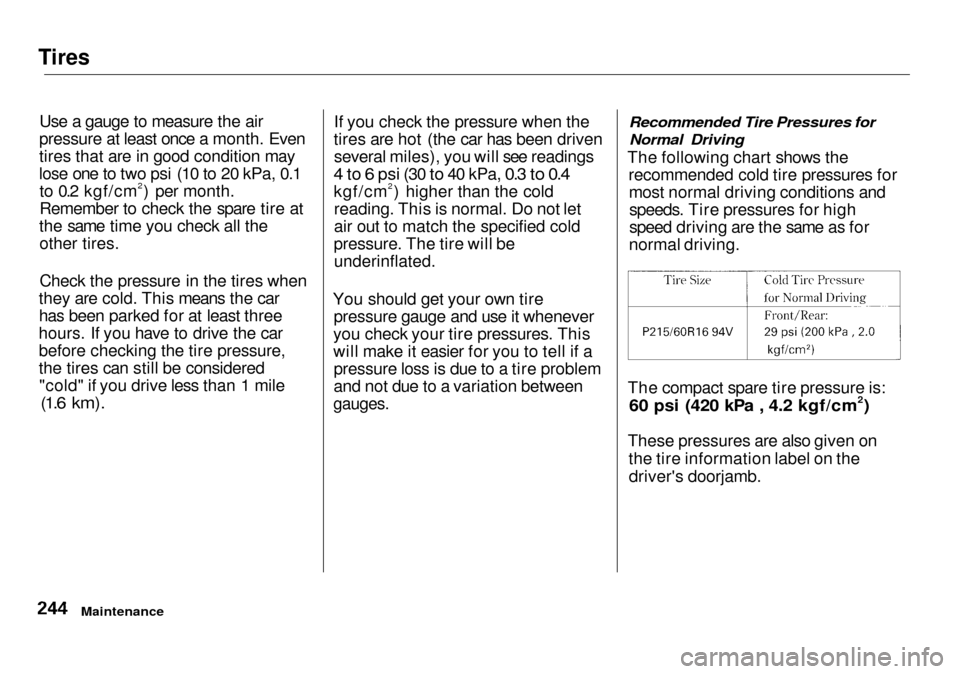
Recommended Tire Pressures for
Normal Driving
The following chart shows the recommended cold tire pressures formost normal driving conditions andspeeds. Tire pressures for high
speed driving are the same as for
normal driving.
The compact spare tire pressure is:60 psi (420 kPa , 4.2 kgf/cm2)
These pressures are also given on the tire information label on thedriver's doorjamb.
Maintenance
Page 292 of 333

Brake System Indicator
The Brake System Indicator normally comes on when you turn
the ignition switch ON (II). It is a
reminder to check the parking brake.It comes on and stays lit if you do not
fully release the parking brake. If it comes on at any other time, it
indicates a problem with the car's
brake system. In most cases, the
problem is a low fluid level in the
brake fluid reservoir. Press lightly on
the brake pedal to see if it feels
normal. If it does, check the brake
fluid level the next time you stop at a service station (see page 230 ). If the
fluid level is low, take the car to your dealer and have the brake system
inspected for leaks or worn brake
pads.
However, if the brake pedal does not
feel normal, you should take immediate action. Because of the
brake system's dual-circuit design, a
problem in one part of the system
will still give you braking at two
wheels. You will feel the brake pedal
go down much farther before the car
begins to slow down, and you will
have to press harder on the pedal.
The distance needed to stop will be much longer. Slow down by shifting to a lower
gear, and pull to the side of the road
when it is safe. Because of the
longer distance needed to stop, it is
hazardous to drive the car. You should have it towed, and repaired as
soon as possible. (See Emergency
Towing on page 296 .)
If you must drive the car a shortdistance in this condition, drive
slowly and cautiously.
If the ABS indicator and the VSA system indicator come on with this
indicator, have the car inspected by
your dealer immediately.
Taking Care of the Unexpected
BRAKE SYSTEM INDICATOR*
"U.S. indicator shown
Page 311 of 333

Emissions Controls
The burning of gasoline in your car's engine produces several byproducts.
Some of these are carbon monoxide (CO), oxides of nitrogen (NOx) and
hydrocarbons (HC). Gasoline evaporating from the tank also
produces hydrocarbons. Controlling
the production of NOx, CO, and HC is important to the environment.
Under certain conditions of sunlight
and climate, NOx and HC react to
form photochemical "smog." Carbon monoxide does not contribute tosmog creation, but it is a poisonous
gas.
The Clean Air Act
The United States Clean Air Act*
sets standards for automobile
emissions. It also requires that
automobile manufacturers explain to owners how their emissions controls
work and what to do to maintain
them. This section summarizes how the emissions controls work.
Scheduled maintenance is on page 208.
* In Canada, Acura vehicles comply
with the Canadian Motor Vehicle Safety Standards (CMVSS) for
Emissions valid at the time they are
manufactured.
Crankcase Emissions Control
System
Your car has a Positive Crankcase
Ventilation System. This keeps gasses that build up in the engine'scrankcase from going into the
atmosphere. The Positive Crankcase
Ventilation valve routes them from the crankcase back to the intake
manifold. They are then drawn into
the engine and burned.
Evaporative Emissions Control
System
As gasoline evaporates in the fuel tank, an evaporative emissionscontrol canister filled with charcoaladsorbs the vapor. It is stored in this
canister while the engine is off. After
the engine is started and warmed up,
the vapor is drawn into the engine and burned during driving.
Onboard Refueling Vapor
Recovery
The Onboard Refueling Vapor Recovery (ORVR) system captures
the fuel vapors during refueling. The
vapors are adsorbed in a canister filled with activated carbon. Whiledriving, the fuel vapors are drawn
into the engine and burned off.
Technical Information
Page 312 of 333

Emissions Controls
Exhaust Emissions Controls
The exhaust emissions controls include four systems: PGM-FI,
Ignition Timing Control, Exhaust
Gas Recirculation and Three Way
Catalytic Converter. These four
systems work together to control the
engine's combustion and minimize
the amount of HC, CO, and NOx that comes out the tailpipe. The exhaust
emissions control systems are
separate from the crankcase and
evaporative emissions control
systems.
PGM-FI System
The PGM-FI System uses sequential multiport fuel injection.
It has three subsystems: Air Intake,
Engine Control, and Fuel Control.
The Powertrain Control Module (PCM) uses various sensors to
determine how much air is going
into the engine. It then controls how
much fuel to inject under all operat-
ing conditions. Ignition Timing Control System
This system constantly adjusts the ignition timing, reducing the amount
of HC, CO and NOx produced.
Exhaust Gas Recirculation (EGR)
System
The Exhaust Gas Recirculation (EGR) system takes some of the
exhaust gas and routes it back into
the intake manifold. Adding exhaust
gas to the air/fuel mixture reduces
the amount of NOx produced when
the fuel is burned.
Three Way Catalytic Converter
The three way catalytic converter is in the exhaust system. Through
chemical reactions, it converts HC,CO, and NOx in the engine's exhaust
to carbon dioxide (CO2), dinitrogen (N2), and water vapor. Replacement Parts
The emissions control systems are designed and certified to work to-
gether in reducing emissions to
levels that comply with the Clean Air
Act. To make sure the emissions remain low, you should use only newGenuine Acura replacement parts or
their equivalent for repairs. Using
lower quality parts may increase the emissions from your car.
Technical Information
Page 324 of 333

Index
Accessories and Modifications.... 174 Accessories................................. 174
Additional Safety Precautions.. 175Modifications............................. 175
ACCESSORY (Ignition Key
Position)........................................ 80
Accessory Power Socket.............. 115
Additives, Engine Oil..................... 218
Airbag (SRS).......................... 9, 43, 45
Air Cleaner Element...................... 231
Air Conditioning Filter.................. 242
Air Conditioning System............... 122 Maintenance............................... 241
Usage..................................124, 129
Air Outlets (Vents)........................ 122
Air Pressure, Tires........................ 243
Alarm, Anti-theft............................ 164
Alcohol in Gasoline........................ 306
Aluminum Wheels, Cleaning........ 265
Antifreeze....................................... 221
Anti-lock Brakes (ABS) Indicator................................ 56, 189Operation.................................... 188
Anti-theft, Audio System............... 164
Anti-theft Steering Column
Lock...............................................80
Anti-theft System........................... 165
Appearance Care........................... 263
Armrest............................................. 97
Ashtrays.......................................... 117
Audio Controls, Remote................ 163
Audio System................................. 136
Automatic Climate Control
System......................................... 122
Automatic Lighting.......................... 64
Automatic Seat Belt Tensioners.................................... 41
Automatic Speed Control................ 73
Automatic Transmission............... 182
Capacity, Fluid........................... 302
Checking Fluid Level................228
Shifting........................................ 182
Shift Lever Position Indicator.. 182
Shift Lever Positions................. 182
Shift Lock Release..................... 185 Battery
Charging SystemIndicator............................ 54, 286
Jump Starting............................. 280 Maintenance............................... 236
Specifications............................. 303
Before Driving............................... 167
Belts, Seat..................................... 8, 40
Beverage Holder............................ 112
Body Repair.................................... 270
Brakes
Anti-lock System (ABS)............ 188
Break-in, New Linings .............. 168
Bulb Replacement..................... 256
Fluid............................................229
Parking........................................ 109
System Indicator.................. 54, 289
Wear Indicators......................... 187
Braking System.............................. 187
Break-in, New Car......................... 168
Brightness Control, Instruments... 66
Brights, Headlights......................... 63
CONTINUED