Page 204 of 285

Tire
s
Tir e Rotatio n
To help increase tire life and distribute wear more evenly, you
should have the tires rotated every
7,500 miles (12,000 km). Move the
tires to the positions shown in the chart each time they are rotated. When shopping for replacement
tires, you may find that some tiresare "directional." This means they
are designed to rotate only in one
direction. If you use directional tires,
they should be rotated only front-to-
back.
Tir
e Wea r
Type-R model only
The tires on your Type-R were designed and constructed to provide
superior grip during acceleration,
braking, and cornering. They will
wear more rapidly than normal passenger vehicle tires. Tire life may
be less than 15,000 miles (24,000
km), depending on how you drive.
You should carefully inspect your vehicle's tires for wear, damage, andproper inflation every 2,000 miles (3,200 km), see page 199.
These tires are not suitable for winter driving. Refer to Winte r
Driving , page 203.
Maintenance
Fron
t Front
(Fo r Non-directiona l
tire s an d Wheels )(Fo
r Directiona l
Tire s an d Wheels )
Page 228 of 285

Takin
g Car e o f th e Unexpecte d
This section covers the more- common problems that motoristsexperience with their vehicles. It
gives you information about how to safely evaluate the problem and what
to do to correct it. If the problem has stranded you on the side of the road,
you may be able to get going again. If not, you will also find instructionson getting your car towed. Compact Spare Tire....................... 226
Changing a Flat Tire..................... 227
If Your Engine Won't Start........... 231 Nothing Happens or theStarter Motor OperatesVery Slowly............................. 232
The Starter Operates Normally................................. 233
Jump Starting................................. 233 If Your Engine Overheats............. 236
Low Oil Pressure Indicator.......... 238Charging System Indicator........... 239
Malfunction Indicator Lamp........ 240
Brake System Indicator................ 241 Closing the Moonroof................... 242
Fuses............................................... 243 Checking and Replacing........... 244
Emergency Towing....................... 248
Takin g Care o f th e Unexpecte d
Page 229 of 285

Compac
t Spar e Tir e
Your car has a compact spare tire that takes up less space. Use this spare tire as a temporary replace-
ment only. Get your regular tire
repaired or replaced and put it back on your car as soon as you can.
Check the inflation pressure of the
compact spare tire every time you
check the other tires. It should be
inflated to:
60 psi (420 kPa , 4.20 kgf/cm2)
Follow these precautions whenever
you are using the compact spare tire: Do not exceed 50 mph (80 km/h)
under any circumstances.
This tire gives a harsher ride and
less traction on some road sur-
faces than the regular tire. Usegreater caution while driving on
this tire.
Do not mount snow chains on the
compact spare.
The wheel of the compact spare
tire is designed especially to fit
your car. Do not use your spare
tire on another vehicle unless it is
the same make and model.
Type-R model only
Do not drive with the compact spare tire mounted on the front
wheels for a long period; it will
damage the Limited Slip
Differential.
INDICATO
R LOCATIO N MAR K
The compact spare tire has a shorter
tread life than a regular tire. Replace
it when you can see the tread wear
indicator bars. The replacement
should be the same size and design
tire, mounted on the same wheel.
The compact spare tire is not designed to be mounted on a regular
wheel, and the compact wheel is not
designed for mounting a regular tire.
Takin g Car e o f th e Unexpecte d
TREA
D WEA R INDICATO R BA R
Page 230 of 285

Changin
g a Fla t Tir e
If you have a flat tire while driving, stop in a safe place to change it.
Stopping in traffic or on the shoulder
of a busy road is dangerous. Driveslowly along the shoulder until you
get to an exit or an area to stop that is far away from the traffic lanes.
JAC
K
SPAR E TIR E
TOOL KI T
1. Park the car on firm, level and non-slippery ground away from
traffic. Put the transmission in Park (automatic) or Reverse (manual). Apply the parking brake.
If you are towing a trailer, unhitch
the trailer. 2. Turn on the hazard warning lights
and turn the ignition switch to
LOCK (0). Have all the
passengers get out of the car while
you change the tire.
3. Open the hatch. Pull up the floor mat and remove the spare tire
cover.
4. Take the tool kit out of the spare tire well.
5. Unscrew the wing bolt and take the spare tire out of its well.
CONTINUED
Takin g Car e o f th e Unexpecte d
The car can easily roll off the
jack, seriously injuring anyone
underneath.
Follow the directions for
changing a tire exactly, and never get under the car when it
is supported only by the jack.
Page 232 of 285
Changin
g a Fla t Tir e
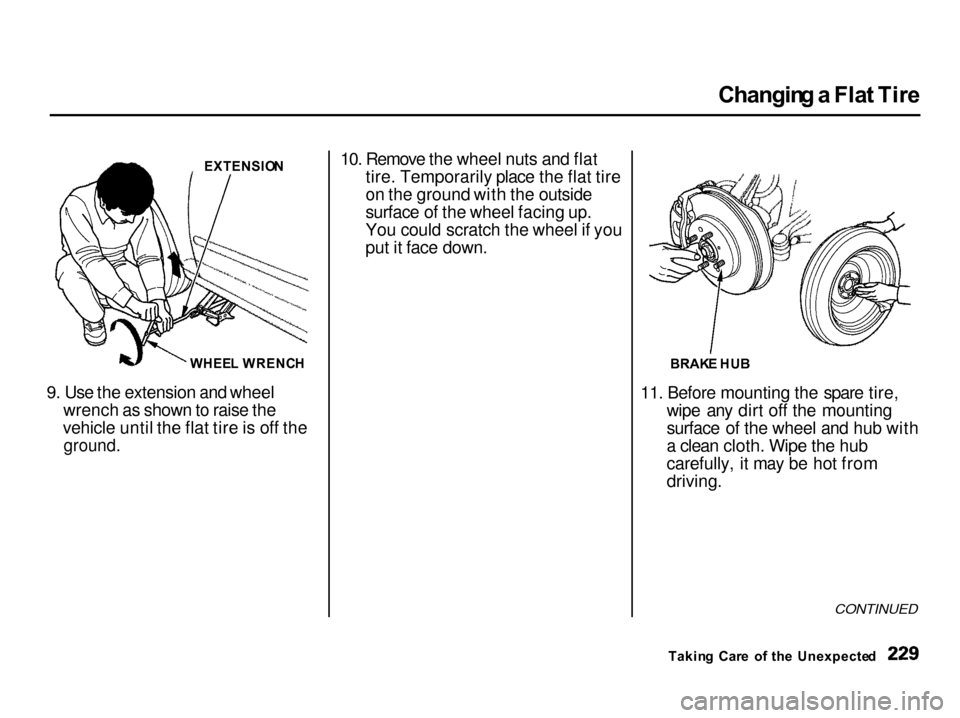
9. Use the extension and wheel wrench as shown to raise the
vehicle until the flat tire is off the
ground.
10. Remove the wheel nuts and flat
tire. Temporarily place the flat tire
on the ground with the outside
surface of the wheel facing up.
You could scratch the wheel if you
put it face down.
11. Before mounting the spare tire,wipe any dirt off the mounting
surface of the wheel and hub with
a clean cloth. Wipe the hub
carefully, it may be hot from
driving.
CONTINUED
Takin g Car e o f th e Unexpecte d
EXTENSIO
N
WHEE L WRENC H
BRAKE HU B
Page 234 of 285

Changin
g a Fla t Tire , I f You r Engin e Won' t Star t
15. Remove the wheel cover or center
cap.
Place the flat tire face down in the
spare tire well.
16. Remove the spacer cone from the wing bolt, turn it over, and put it
back on the bolt. 17. Secure the flat tire by screwing
the wing bolt back into its hole.
18. Store the jack in its holder with the end bracket facing to the right.
Turn the jack's end bracket to lock
it in place. Store the tool kit.
19. Store the wheel cover or center cap in the cargo area. Make sure it
will not get scratched or damaged.
20. Reinstall the floor mat and spare tire cover, then close the hatch. I
f You r Engin e Won' t Star t
Diagnosing why your engine won't start falls into two areas, depending
on what you hear when you turn the
key to START (III): You hear nothing, or almost
nothing. The engine's starter
motor does not operate at all, oroperates very slowly. You can hear the starter motor
operating normally, or the starter
motor sounds like it is spinning
faster than normal, but the engine does not start up and run.
Takin g Car e o f th e Unexpecte d
WIN
G BOL T
SPACER
CON E
Loose items can fly around the
interior in a crash and could
seriously injure the occupants.
Store the wheel, jack and tools
securely before driving.
Page 251 of 285

Emergenc
y Towin g
If your car needs to be towed, call a
professional towing service or, if you
belong to one, an organization that
provides roadside assistance. Never
tow your car behind another vehicle
with just a rope or chain. It is very
dangerous.
There are three popular types of professional towing equipment.
Flat-bed Equipment — The operator
loads your car on the back of a truck.
Thi s is th e bes t wa y to transpor t
you r Acura .
Wheel-lift Equipment — The tow
truck uses two pivoting arms that go under the tires (front or rear) and lift
them off the ground. The other two
tires remain on the ground. Thi s is
a n acceptabl e wa y to to w you r
Acura .
Sling-type Equipment — The tow
truck uses metal cables with hooks on the ends. These hooks go around
parts of the frame or suspension and
the cables lift that end of the car off
the ground. Your car's suspension and body can be seriously damaged.
Thi s metho d o f towin g is
unacceptable .
If your Acura cannot be transported
by flat-bed, it should be towed by
wheel-lift equipment with the front
wheels off the ground. If, due to damage, your car must be towed
with the front wheels on the ground, do the following.
5-speed Manual Transmission
Release the parking brake.
Shift the transmission to Neutral.
Automatic Transmission
Release the parking brake.
Start the engine.
Shift to D4, then to N.
Turn off the engine.
Improper towing preparation will damage the transmission. Follow the
above procedure exactly. If you cannot
shift the transmission or start the engine (automatic transmission), your
car must be transported with the front
wheels off the ground.
With the front wheels on the ground, it is best to tow the vehicle no farther
than 50 miles (80 km), and keep thespeed below 35 mph (55 km/h).
Takin g Car e o f th e Unexpecte d
NOTIC
E
Page 260 of 285

DO
T Tir e Qualit y Gradin g (U.S . Cars )
Temperatur e — A, B , C
The temperature grades are A (the highest), B, and C, representing the
tire's resistance to the generation of
heat and its ability to dissipate heat
when tested under controlled conditions on a specified indoor
laboratory test wheel. Sustained high
temperature can cause the material of the tire to degenerate and reduce
tire life, and excessive temperature can lead to sudden tire failure. The
grade C corresponds to a level of
performance which all passenger car tires must meet under the FederalMotor Vehicle Safety Standard No. 109. Grades B and A represent
higher levels of performance on the
laboratory test wheel than the minimum required by law. Warning: The temperature grade for
this tire is established for a tire that
is properly inflated and not over-
loaded. Excessive speed, underinfla-
tion, or excessive loading, eitherseparately or in combination, can
cause heat buildup and possible tire
failure.
Technical Informatio n