Page 68 of 149
BRAKESII-3
54
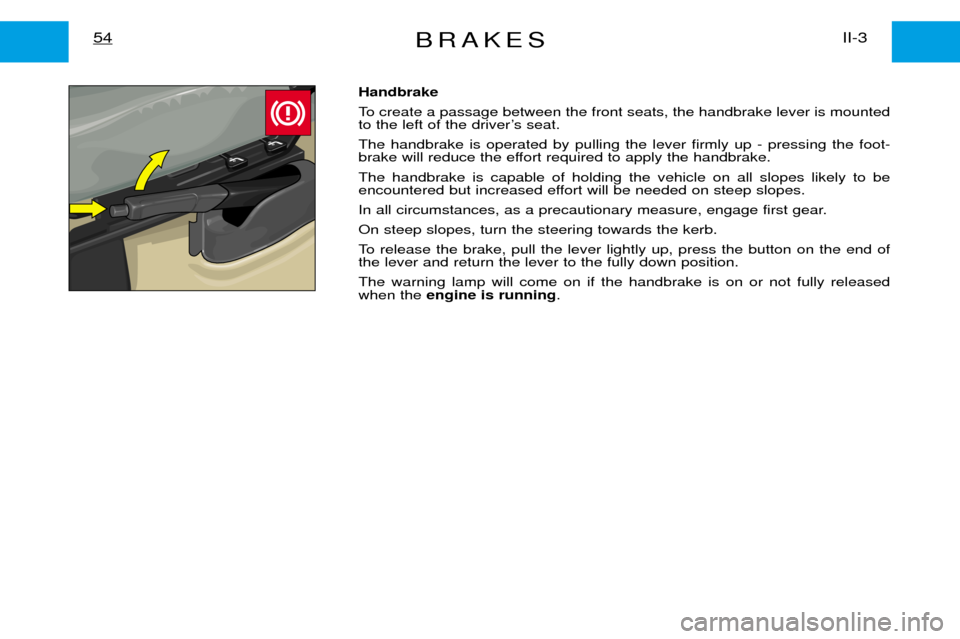
Handbrake
To create a passage between the front seats, the handbrake lever is mounted
to the left of the driverÕs seat. The handbrake is operated by pulling the lever firmly up - pressing the foot-
brake will reduce the effort required to apply the handbrake. The handbrake is capable of holding the vehicle on all slopes likely to be
encountered but increased effort will be needed on steep slopes.
In all circumstances, as a precautionary measure, engage first gear.On steep slopes, turn the steering towards the kerb.
To release the brake, pull the lever lightly up, press the button on the end of the lever and return the lever to the fully down position. The warning lamp will come on if the handbrake is on or not fully released when the engine is running .
Page 69 of 149

BRAKES55II-4
ABS - Anti-lock Braking System* This system improves vehicle safety by preventing the wheels from locking under emergency braking or when
braking on surfaces offering poor adhesion.
It thus also allows control of the steering to be retained. The operation of the various electronic components of the system is continuously monitored, both before and during your
journey. On switching on the ignition, the ABS lamp will light for approximately two seconds. If it stays on or lights when
driving, the ABS computer has detected a fault and has disconnected the ABS system. If the lamp lights whilst driving, it
again indicates that a fault has been detected and that the ABS system is inactive. In both situations, the normal braking
system is not affected and will continue to function as a conventional braking system without ABS. Nevertheless, to re-
establish the full safety features of the ABS system, It is recommended that the vehicle be examined by a dealer as soonas possible.
On slippery roads (loose stones, snow, ice, etc.), it is imperative to drive with caution.
* According to model or country
Protection fuses under the dashboardF12
(under the bonnet)
MF4 (with ABS)
Page 71 of 149
CRUISE CONTROL*57II-5
BEWARE
Cruise control must only be used where road condi- tions permit. Do not use it on congested roads nor
when weather and road conditions are poor.
Disengaging the cruise control The cruise control will be disengaged on pressing either the clutch or brake pedal. Flicking stalk
Atoward you will also disengage the crui-
se control.The memorised speed is not cancelled. Recalling the memorised speed Following a disengagement, flick the stalk Arapidly
upwards or downwards and your vehicle will resume the last speed memorised. Increasing the memorised speed Move stalk Aupwards, hold until the new speed is rea-
ched and then release the stalk to memorise it. Reducing the memorised speed Move stalk Adownwards, hold until the new speed is
reached and then release the stalk to memorise it. (Minimum regulated speed = 25 mph). Cancelling the cruise control operation Either when the vehicle is stationary: ignition switched
off. Or Press switch B. The warning lamp will go out. AdviceDo not position your foot under the accelerator pedal
while the cruise control is operating. Your reactions maybe impeded and movement of your foot restricted.
* According to model or country
Protection fuses (under the dashboard)F3
Page 75 of 149

GEAR LEVER61II-6
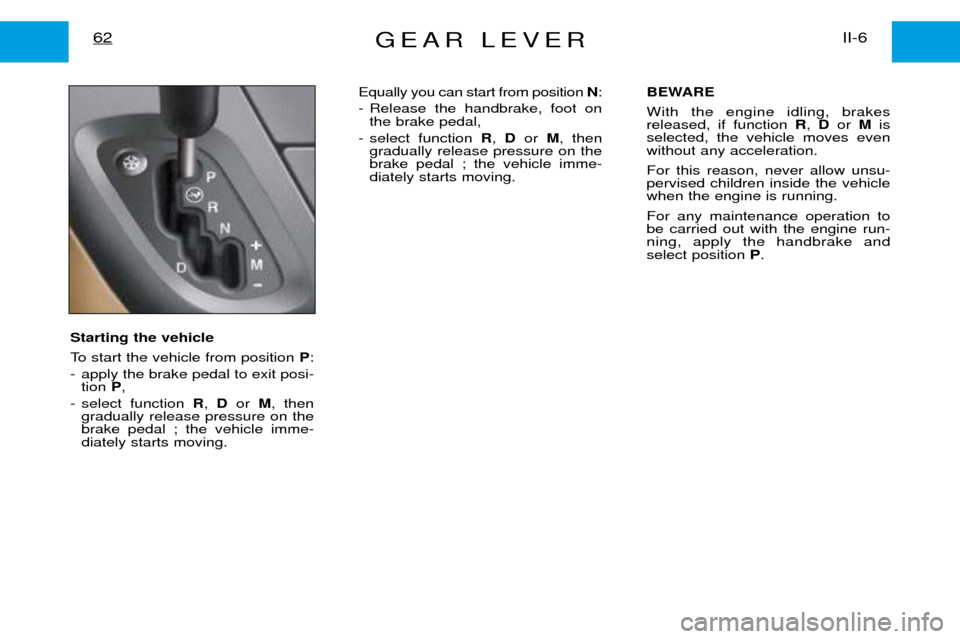
Starting position
The engine can only be started
when the lever is at position P or N.
A safety device ensures that starting is impossible in the other positions.
Park Do not engage until the vehicle is completely sta-
tionary. To avoid any
movement of the vehicle when par-ked, select position Pand apply the
handbrake firmly. Check that theselector is in the Pposition to ensure
that the driving wheels are locked. When leaving the vehicle, make
absolutely certain that the PARK orP position is selected.
Automatic gearboxes - safety mea-sures:
¥ The gear lever can only be disen- gaged from position Pif the brake
pedal is pressed down.
¥ An audible warning* sounds if the gear lever is not in position P
when a door is opened. Also works with the ignition switched
off. Reverse gear Engage only when statio- nary and with the footbra-
ke firmly applied. To avoid
any transmission snatch or harsh-ness, wait several seconds before
pressing the accelerator. Neutral Do not select this position,
even momentarily, whenthe vehicle is in motion.
Warning If N is selected inadvertently when the vehicle is moving,allow the vehicle to stop beforeengaging other functions.
* According to model or country
Page 76 of 149
GEAR LEVERII-6
62
Equally you can start from position N:
- Release the handbrake, foot on the brake pedal,
- select function R, D or M, then
gradually release pressure on the brake pedal ; the vehicle imme-diately starts moving. BEWARE With the engine idling, brakes released, if function
R, D or Mis
selected, the vehicle moves evenwithout any acceleration. For this reason, never allow unsu- pervised children inside the vehiclewhen the engine is running. For any maintenance operation to be carried out with the engine run-ning, apply the handbrake andselect position P.
Starting the vehicle
To start the vehicle from position P:
- apply the brake pedal to exit posi- tion P,
- select function R, D or M, then
gradually release pressure on the brake pedal ; the vehicle imme-diately starts moving.
Page 127 of 149
CHANGING A WHEEL107V- 5
Removal1 - If possible, place the car on firm, level ground. Engage the handbrake firmly.
2 - Wait until the vehicle has reached maximum height then switch off the ignition and engage 1st or reverse gear depen-
ding on the incline.
3 - Position the jack at one of the four jacking points on the underside of the vehicle adjacent to the wheels. Using the
wheel brace, extend the jack until it touches the ground.
4 - To remove the embellisher, pull on one of the holes in the embellisher using the end of the wheel brace.
5 - Extend the jack until the wheel is a few centimetres off the ground.
6 - Unscrewing the wheel bolts and remove the wheel.
EE
E
Page 134 of 149
GENERAL INFORMATION*Glazed and panel vans113VI-2
Weights (kg) Unladen weight 1 370 1 375 1 400/1 415
Gross vehicle weight 2 185 2 190 2 215/2 315
Payload 815 815 815/900
Gross train weight 3 485 3 290 3 500
Gross trailer weight (with brakes)** 1 300 1 100 1 300
Gross trailer weight (without brakes)** 720 685 750Max. roof rack load 100 100 100
Engine type
2.0i 16V 1.9 D 2.0 HDi
(95bhp/110bhp)
Cubic capacity (cc) 1 997 1 868 1 997
French fiscal rating 11 6 6
Calculated maximum speed in km/h (mph) 175 (108) 138 (86) 160 (100)
* According to model or country
** Towing weights Always keep within the towing weight limits of your vehicle.
You must observe the towing loads and speed limits as specified by local legislation. To learn more about the towing
capacity of your vehicle and its maximum authorised GTW, contact your dealer.
Page 135 of 149
GENERAL INFORMATION*
Glazed and panel vans longwheelbaseVI-2
114
* According to model or country
** Towing weights Always keep within the towing weight limits of your vehicle.
You must observe the towing loads and speed limits as specified by local legislation. To learn more about the towing
capacity of your vehicle and its maximum authorised GTW, contact your dealer.
Weights (kg) Unladen weight 1 410 1 445
Gross vehicle weight 2 205 2 315
Payload 795 900
Gross train weight 3 305 3 500
Gross trailer weight (with brakes)** 1 100 1 300
Gross trailer weight (without brakes)** 705 730Max. roof rack load 100 100
Engine type
1.9 D 2.0 HDi
(95bhp/110bhp)
Cubic capacity (cc) 1 868 1 997
French fiscal rating 6 6
Calculated maximum speed in km/h (mph) 138 (86) 157 (98)