Page 28 of 121
INSTRUMENT AND CONTROL FUNCTIONS
3-14
3
EAU02969
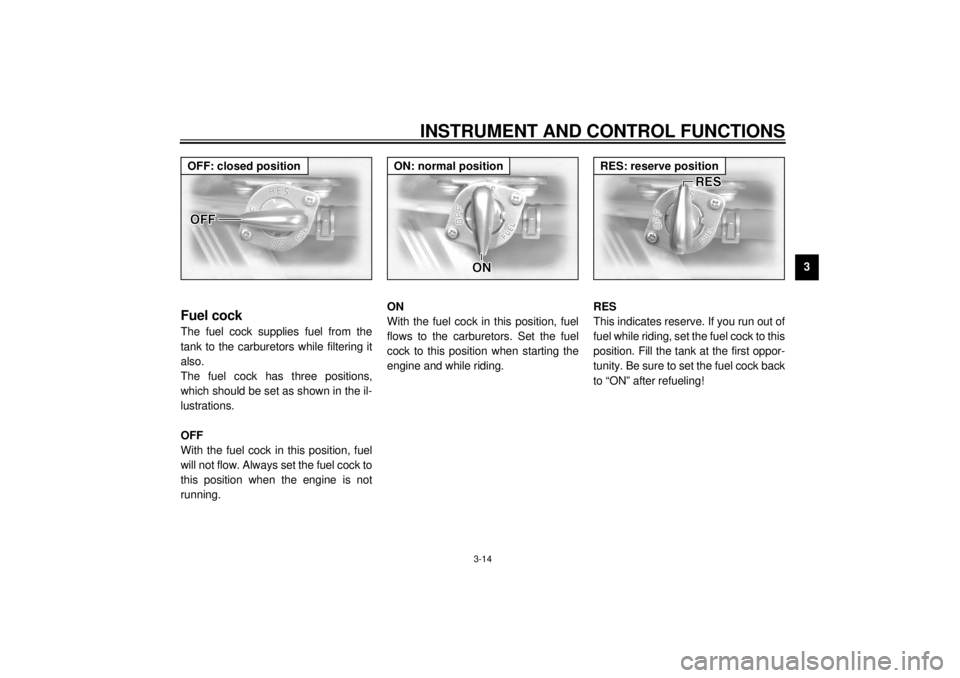
Fuel cockThe fuel cock supplies fuel from the
tank to the carburetors while filtering it
also.
The fuel cock has three positions,
which should be set as shown in the il-
lustrations.
OFF
With the fuel cock in this position, fuel
will not flow. Always set the fuel cock to
this position when the engine is not
running.ON
With the fuel cock in this position, fuel
flows to the carburetors. Set the fuel
cock to this position when starting the
engine and while riding.RES
This indicates reserve. If you run out of
fuel while riding, set the fuel cock to this
position. Fill the tank at the first oppor-
tunity. Be sure to set the fuel cock back
to “ON” after refueling!OFF: closed position
ON: normal position
RES: reserve position
E_5jc_Functions.fm Page 14 Saturday, October 16, 1999 1:08 PM
Page 29 of 121
INSTRUMENT AND CONTROL FUNCTIONS
3-15
3
EAU03032
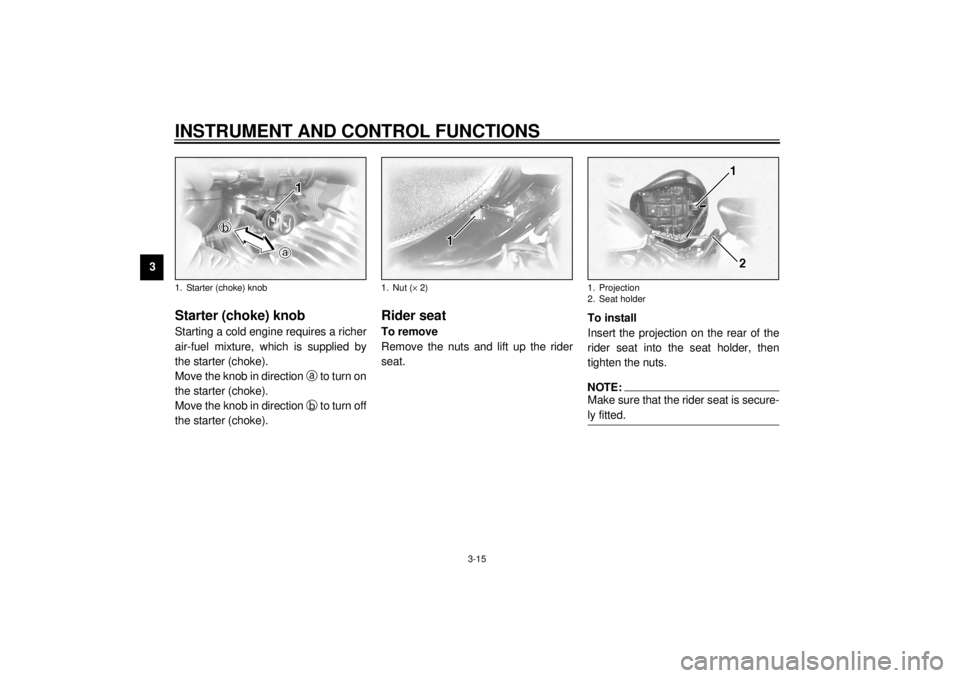
Starter (choke) knobStarting a cold engine requires a richer
air-fuel mixture, which is supplied by
the starter (choke).
Move the knob in direction
a to turn on
the starter (choke).
Move the knob in direction
b to turn off
the starter (choke).
EAU01781
Rider seatTo remove
Remove the nuts and lift up the rider
seat.To install
Insert the projection on the rear of the
rider seat into the seat holder, then
tighten the nuts.
NOTE:@ Make sure that the rider seat is secure-
ly fitted. @
1. Starter (choke) knob
1. Nut (´ 2)
1. Projection
2. Seat holder
E_5jc_Functions.fm Page 15 Saturday, October 16, 1999 1:08 PM
Page 40 of 121
AUDIO SYSTEM
4-2
4
WARNING
@ l
It is dangerous to operate the
audio system controls while
riding. Never take your hands
off the handlebars while riding.
l
Keep the volume at a low
enough level to be aware of traf-
fic conditions and ensure safety.
@CAUTION:@ l
Do not use the audio system for
a long period of time when the
engine is not running as the bat-
tery may discharge.
l
The control unit, cassette deck
and speakers are water-resis-
tant; however, it is good prac-
tice to cover them with plastic
bags when washing the motor-
cycle.
l
When cleaning the control unit
display, use a neutral detergent.
Never use strong abrasive
cleaning products, fuel (gaso-
line), thinner, etc.
@
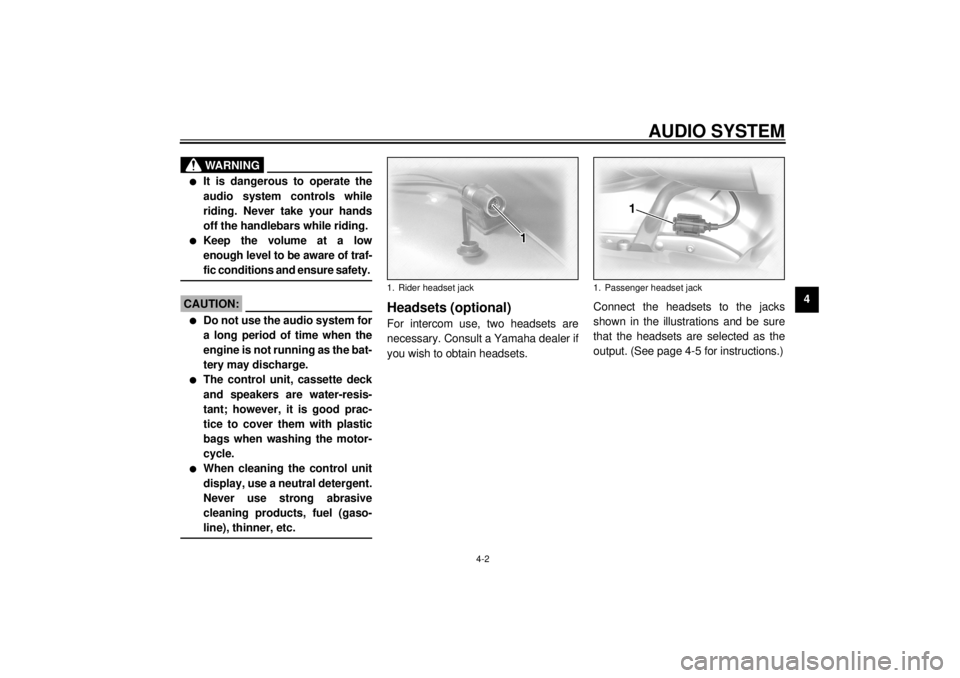
Headsets (optional)For intercom use, two headsets are
necessary. Consult a Yamaha dealer if
you wish to obtain headsets.Connect the headsets to the jacks
shown in the illustrations and be sure
that the headsets are selected as the
output. (See page 4-5 for instructions.)1. Rider headset jack
1. Passenger headset jack
E_5jc_Audio.fm Page 2 Saturday, October 16, 1999 1:09 PM
Page 58 of 121
PRE-OPERATION CHECKS
5-2
5
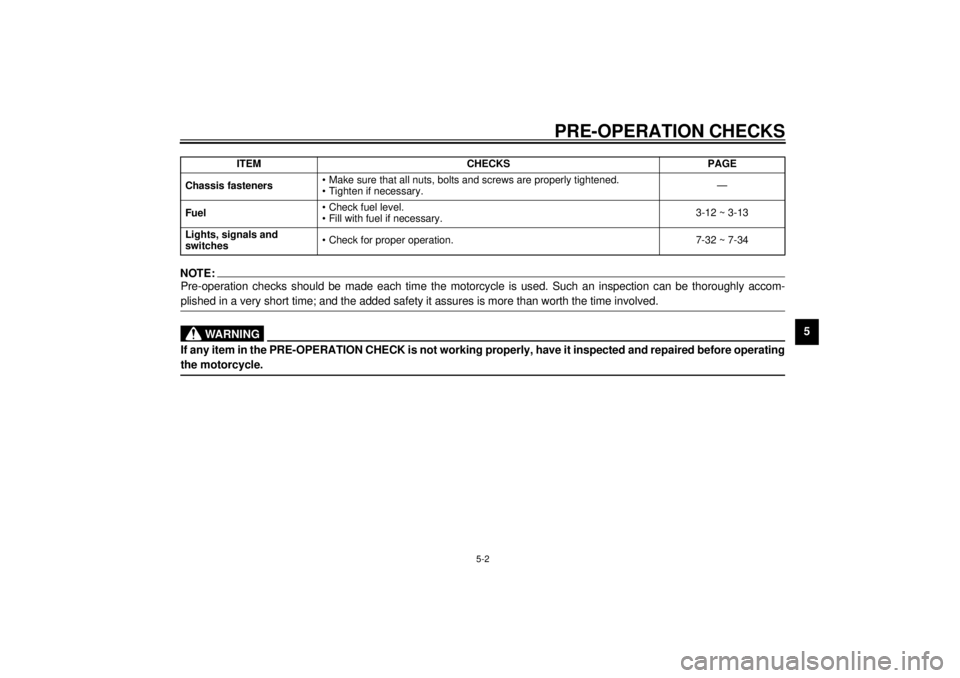
NOTE:Pre-operation checks should be made each time the motorcycle is used. Such an inspection can be thoroughly accom-
plished in a very short time; and the added safety it assures is more than worth the time involved.
WARNING
If any item in the PRE-OPERATION CHECK is not working properly, have it inspected and repaired before operating
the motorcycle.Chassis fasteners• Make sure that all nuts, bolts and screws are properly tightened.
• Tighten if necessary.—
Fuel• Check fuel level.
• Fill with fuel if necessary.3-12 ~ 3-13
Lights, signals and
switches• Check for proper operation. 7-32 ~ 7-34 ITEM CHECKS PAGE
E_5jc_Preop.fm Page 2 Saturday, October 16, 1999 1:10 PM
Page 60 of 121
OPERATION AND IMPORTANT RIDING POINTS
6
Starting the engine ............................................................................. 6-1
Starting a warm engine ...................................................................... 6-3
Shifting ............................................................................................... 6-3
Recommended shift points (for Switzerland only) .............................. 6-4
Tips for reducing fuel consumption .................................................... 6-4
Engine break-in .................................................................................. 6-4
Parking ............................................................................................... 6-5
E_5jc_OperationTOC.fm Page 1 Saturday, October 16, 1999 1:10 PM
Page 62 of 121

OPERATION AND IMPORTANT RIDING POINTS
6-2
6 1. Turn the fuel cock to “ON”.
2. Turn the main switch to “ON” and
the engine stop switch to “ ”.
EC000037
CAUTION:@ If the fuel level indicator light comes
on, check the fuel level. If neces-
sary, add fuel. @3. Shift the transmission into neutral.NOTE:@ When the transmission is in neutral, the
neutral indicator light should be on. If
the light does not come on, ask a
Yamaha dealer to inspect it. @
4. Turn on the starter (choke) and
completely close the throttle grip.
5. Start the engine by pushing the
start switch.NOTE:@ If the engine fails to start, release the
start switch, wait a few seconds, then
try again. Each attempt should be as
short as possible to preserve the bat-
tery. Do not crank the engine more
than 10 seconds on any one attempt. @
ECA00031
CAUTION:@ The engine trouble indicator light
should come on when the start
switch is pushed and should go off
when the start switch is released. If
the engine trouble indicator light re-
mains on, have a Yamaha dealer
check the self-diagnosis system. @6. After starting the engine, move the
starter (choke) to the halfway posi-
tion.NOTE:@ For maximum engine life, never accel-
erate hard with a cold engine! @7. After the engine is warm, turn off
the starter (choke) completely.NOTE:@ The engine is warm when it responds
normally to the throttle with the starter
(choke) turned off. @
E_5jc_Operation.fm Page 2 Saturday, October 16, 1999 1:10 PM
Page 64 of 121
OPERATION AND IMPORTANT RIDING POINTS
6-4
6
EAU02941
Recommended shift points
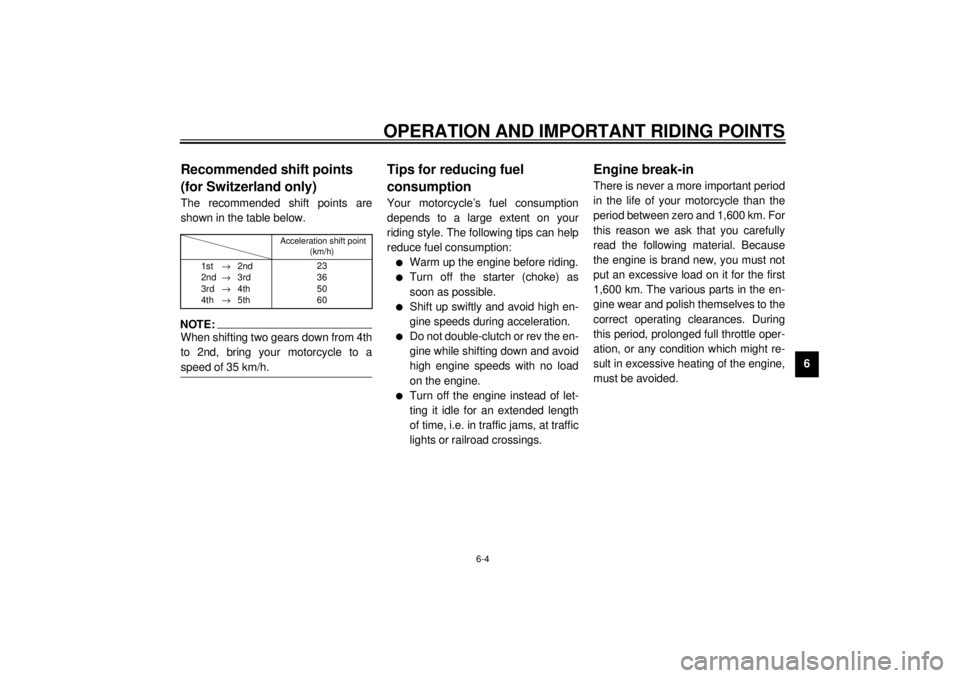
(for Switzerland only)The recommended shift points are
shown in the table below.CF-25ENOTE:@ When shifting two gears down from 4th
to 2nd, bring your motorcycle to a
speed of 35 km/h. @
EAU00424
Tips for reducing fuel
consumptionYour motorcycle’s fuel consumption
depends to a large extent on your
riding style. The following tips can help
reduce fuel consumption:l
Warm up the engine before riding.
l
Turn off the starter (choke) as
soon as possible.
l
Shift up swiftly and avoid high en-
gine speeds during acceleration.
l
Do not double-clutch or rev the en-
gine while shifting down and avoid
high engine speeds with no load
on the engine.
l
Turn off the engine instead of let-
ting it idle for an extended length
of time, i.e. in traffic jams, at traffic
lights or railroad crossings.
EAU01128
Engine break-inThere is never a more important period
in the life of your motorcycle than the
period between zero and 1,600 km. For
this reason we ask that you carefully
read the following material. Because
the engine is brand new, you must not
put an excessive load on it for the first
1,600 km. The various parts in the en-
gine wear and polish themselves to the
correct operating clearances. During
this period, prolonged full throttle oper-
ation, or any condition which might re-
sult in excessive heating of the engine,
must be avoided.
Acceleration shift point
(km/h)
1st®2nd
2nd®3rd
3rd®4th
4th®5th23
36
50
60
E_5jc_Operation.fm Page 4 Saturday, October 16, 1999 1:10 PM
Page 65 of 121
OPERATION AND IMPORTANT RIDING POINTS
6-5
6
EAU01171
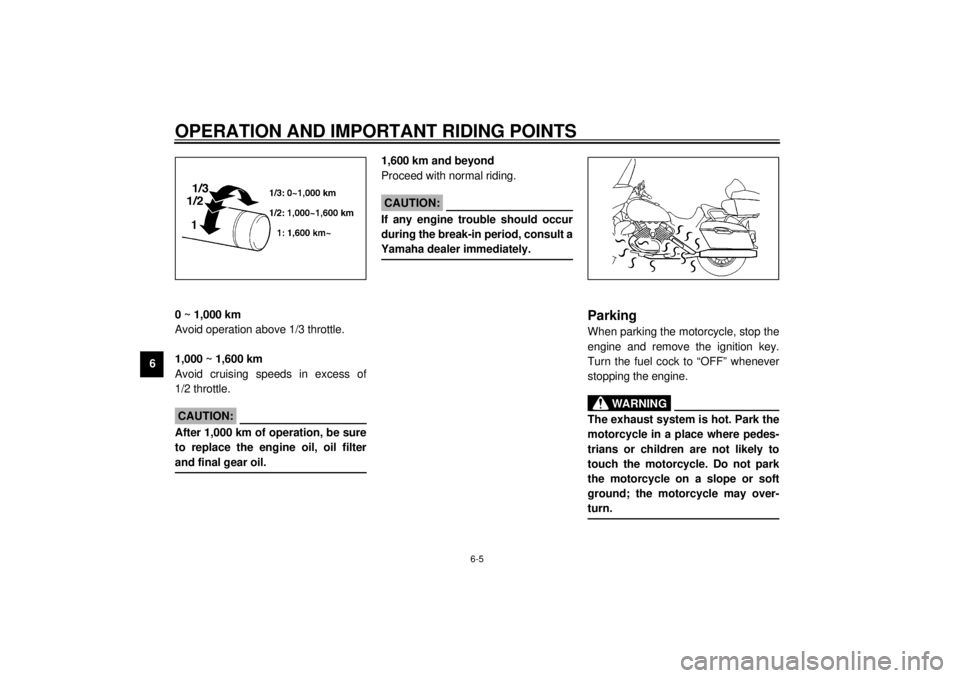
0 ~ 1,000 km
Avoid operation above 1/3 throttle.
1,000 ~ 1,600 km
Avoid cruising speeds in excess of
1/2 throttle.
EC000056
CAUTION:@ After 1,000 km of operation, be sure
to replace the engine oil, oil filter
and final gear oil. @
1,600 km and beyond
Proceed with normal riding.
EC000049
CAUTION:@ If any engine trouble should occur
during the break-in period, consult a
Yamaha dealer immediately. @
EAU00457
ParkingWhen parking the motorcycle, stop the
engine and remove the ignition key.
Turn the fuel cock to “OFF” whenever
stopping the engine.
EW000058
WARNING
@ The exhaust system is hot. Park the
motorcycle in a place where pedes-
trians or children are not likely to
touch the motorcycle. Do not park
the motorcycle on a slope or soft
ground; the motorcycle may over-
turn. @
E_5jc_Operation.fm Page 5 Saturday, October 16, 1999 1:10 PM