Page 35 of 91
5-1
5
EAU00372
5-OPERATION AND IMPORTANT RIDING POINTS
EAU00373
WARNING
@ l
Before riding this motorcycle,
become thoroughly familiar
with all operating controls and
their functions. Consult a
Yamaha dealer regarding any
control or function that you do
not thoroughly understand.
l
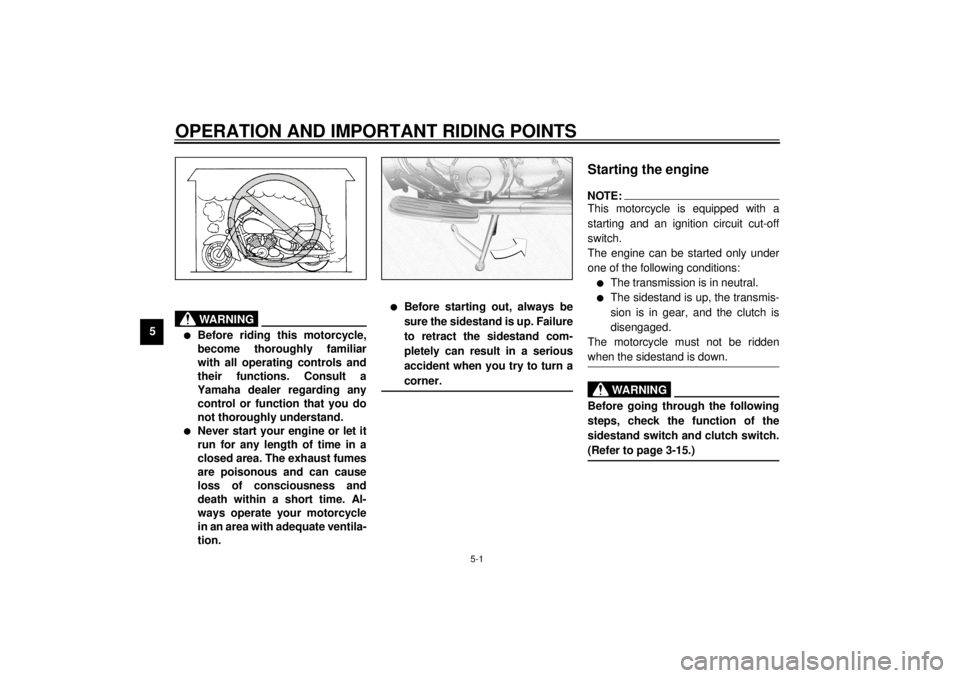
Never start your engine or let it
run for any length of time in a
closed area. The exhaust fumes
are poisonous and can cause
loss of consciousness and
death within a short time. Al-
ways operate your motorcycle
in an area with adequate ventila-
tion.
l
Before starting out, always be
sure the sidestand is up. Failure
to retract the sidestand com-
pletely can result in a serious
accident when you try to turn a
corner.
@
EAU01588
Starting the engineNOTE:@ This motorcycle is equipped with a
starting and an ignition circuit cut-off
switch.
The engine can be started only under
one of the following conditions:l
The transmission is in neutral.
l
The sidestand is up, the transmis-
sion is in gear, and the clutch is
disengaged.
The motorcycle must not be ridden
when the sidestand is down.
@
EW000054
WARNING
@ Before going through the following
steps, check the function of the
sidestand switch and clutch switch.
(Refer to page 3-15.) @
E_4YP_Operation.fm Page 1 Wednesday, October 6, 1999 10:05 AM
Page 40 of 91
OPERATION AND IMPORTANT RIDING POINTS
5-6
5
EAU00457
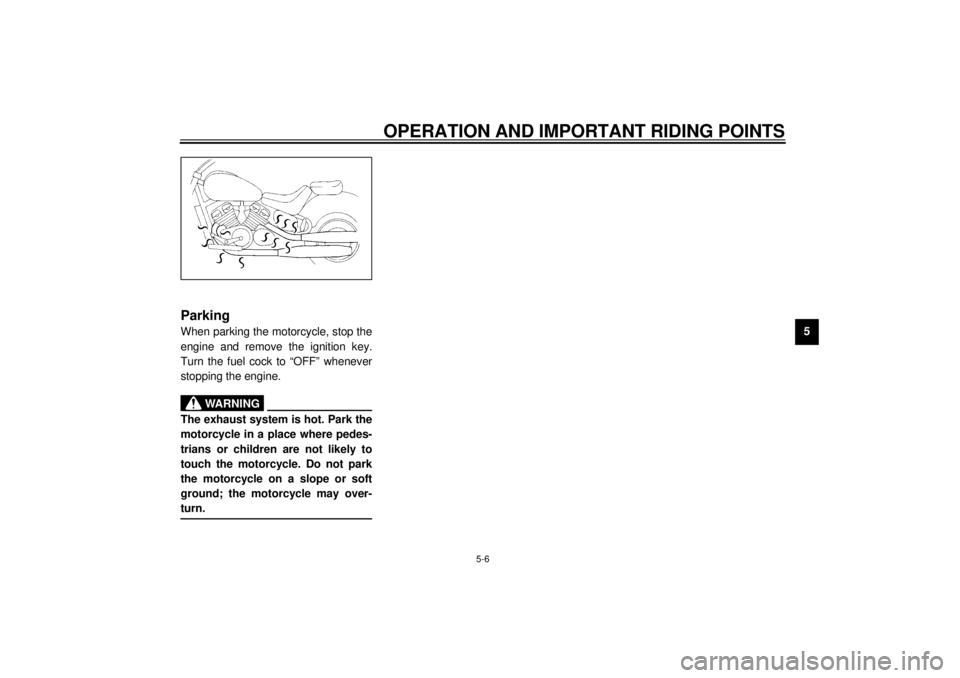
ParkingWhen parking the motorcycle, stop the
engine and remove the ignition key.
Turn the fuel cock to “OFF” whenever
stopping the engine.
EW000058
WARNING
@ The exhaust system is hot. Park the
motorcycle in a place where pedes-
trians or children are not likely to
touch the motorcycle. Do not park
the motorcycle on a slope or soft
ground; the motorcycle may over-
turn. @
E_4YP_Operation.fm Page 6 Wednesday, October 6, 1999 10:05 AM
Page 43 of 91

6-1
6
EAU00462
6-PERIODIC MAINTENANCE AND MINOR REPAIR
EAU00464
Periodic inspection, adjustment and lu-
brication will keep your motorcycle in
the safest and most efficient condition
possible. Safety is an obligation of the
motorcycle owner. The maintenance
and lubrication schedule chart should
be considered strictly as a guide to
general maintenance and lubrication
intervals. YOU MUST TAKE INTO
CONSIDERATION THAT WEATHER,
TERRAIN, GEOGRAPHICAL LOCA-
TIONS, AND A VARIETY OF INDIVID-
UAL USES ALL TEND TO DEMAND
THAT EACH OWNER ALTER THIS
TIME SCHEDULE TO SHORTER IN-
TERVALS TO MATCH THE ENVI-RONMENT. The most important points
of motorcycle inspection, adjustment,
and lubrication are explained in the fol-
lowing pages.
EW000060
WARNING
@ If you are not familiar with motor-
cycle service, this work should be
done by a Yamaha dealer. @
EAU00469
Tool kitThe service information included in this
manual is intended to provide you, the
owner, with the necessary information
for completing some of your own pre-
ventive maintenance and minor re-
pairs. The tools provided in the owner’s
tool kit are to assist you in the perfor-
mance of periodic maintenance. How-
ever, some other tools such as a torque
wrench are also necessary to perform
the maintenance correctly.1. Tool kit
E_4YP_Periodic.fm Page 1 Wednesday, October 6, 1999 10:05 AM
Page 44 of 91
PERIODIC MAINTENANCE AND MINOR REPAIR
6-2
6
NOTE:@ If you do not have necessary tools re-
quired during a service operation, take
your motorcycle to a Yamaha dealer for
service. @
EW000063
WARNING
@ Modifications to this motorcycle not
approved by Yamaha may cause
loss of performance, and render it
unsafe for use. Consult a Yamaha
dealer before attempting any chang-
es. @
E_4YP_Periodic.fm Page 2 Wednesday, October 6, 1999 10:05 AM
Page 55 of 91

PERIODIC MAINTENANCE AND MINOR REPAIR
6-13
6
EAU01226
TiresTo ensure maximum performance,
long service and safe operation, note
the following:
Tire air pressure
Always check and adjust the tire pres-
sure before operating the motorcycle.
EW000082
WARNING
@ Tire inflation pressure should be
checked and adjusted when the
temperature of the tire equals the
ambient air temperature. Tire infla-
tion pressure must be adjusted ac-
cording to total weight of cargo,
rider, passenger, and accessories
(fairing, saddlebags, etc. if approved
for this model), and vehicle speed. @CE-40EEW000083
WARNING
@ Proper loading of your motorcycle
is important for several characteris-
tics of your motorcycle, such as
handling, braking, performance and
safety. Do not carry loosely packed
items that can shift. Securely pack
your heaviest items close to the
center of the motorcycle, and dis-
tribute the weight evenly from side
to side. Properly adjust the suspen-
sion for your load, and check the
condition and pressure of your tires.
NEVER OVERLOAD YOUR MOTOR-
CYCLE. Make sure the total weight
of the cargo, rider, passenger, and
accessories (fairing, saddlebags,
etc. if approved for this model) does
not exceed the maximum load of the
motorcycle. Operation of an over-
loaded motorcycle could cause tire
damage, an accident, or even injury. @
Maximum load* 203 kg
Cold tire pressure Front Rear
Up to 90 kg load*250 kPa
(2.50 kg/cm
2,
2.50 bar)250 kPa
(2.50 kg/cm
2,
2.50 bar)
90 kg load ~
Maximum load*250 kPa
(2.50 kg/cm
2,
2.50 bar)280 kPa
(2.80 kg/cm
2,
2.80 bar)
* Load is the total weight of cargo, rider, passenger,
and accessories.
E_4YP_Periodic.fm Page 13 Wednesday, October 6, 1999 10:05 AM
Page 56 of 91
PERIODIC MAINTENANCE AND MINOR REPAIR
6-14
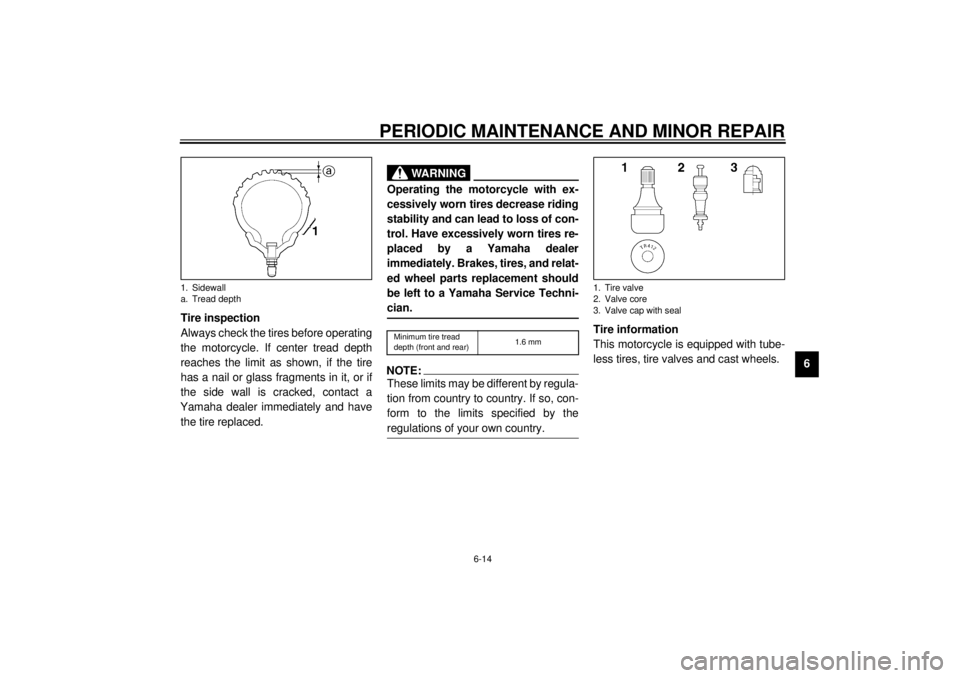
6 Tire inspection
Always check the tires before operating
the motorcycle. If center tread depth
reaches the limit as shown, if the tire
has a nail or glass fragments in it, or if
the side wall is cracked, contact a
Yamaha dealer immediately and have
the tire replaced.
EW000079
WARNING
@ Operating the motorcycle with ex-
cessively worn tires decrease riding
stability and can lead to loss of con-
trol. Have excessively worn tires re-
placed by a Yamaha dealer
immediately. Brakes, tires, and relat-
ed wheel parts replacement should
be left to a Yamaha Service Techni-
cian. @CE-11ENOTE:@ These limits may be different by regula-
tion from country to country. If so, con-
form to the limits specified by the
regulations of your own country. @
Tire information
This motorcycle is equipped with tube-
less tires, tire valves and cast wheels.
1. Sidewall
a. Tread depth
Minimum tire tread
depth (front and rear)1.6 mm
1. Tire valve
2. Valve core
3. Valve cap with seal
E_4YP_Periodic.fm Page 14 Wednesday, October 6, 1999 10:05 AM
Page 57 of 91
PERIODIC MAINTENANCE AND MINOR REPAIR
6-15
6
EW000132
WARNING
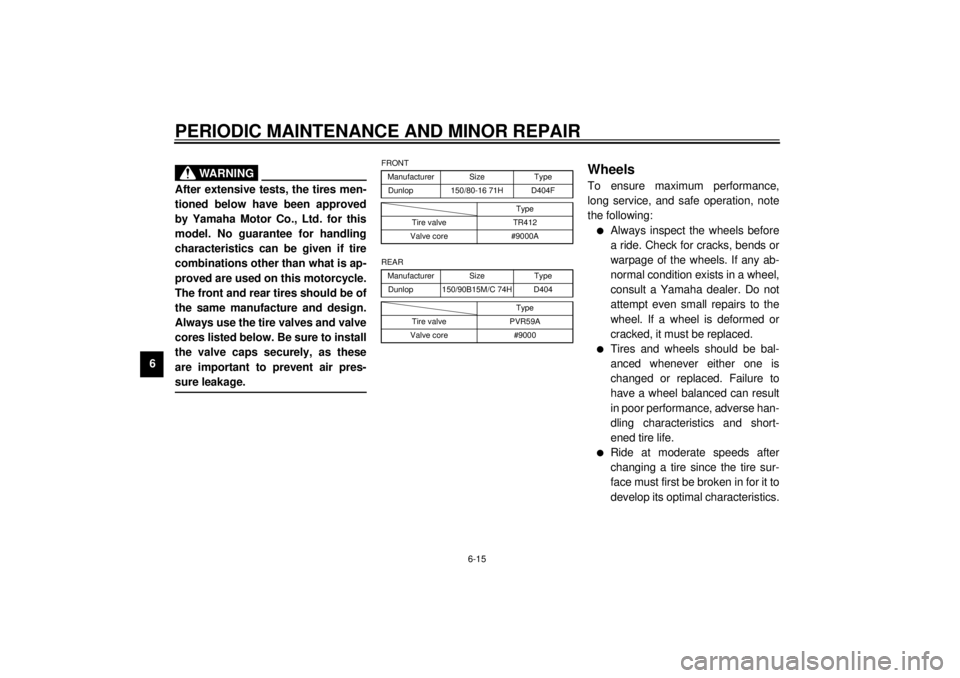
@ After extensive tests, the tires men-
tioned below have been approved
by Yamaha Motor Co., Ltd. for this
model. No guarantee for handling
characteristics can be given if tire
combinations other than what is ap-
proved are used on this motorcycle.
The front and rear tires should be of
the same manufacture and design.
Always use the tire valves and valve
cores listed below. Be sure to install
the valve caps securely, as these
are important to prevent air pres-
sure leakage. @
CE-41E
CE-42EEAU01230
WheelsTo ensure maximum performance,
long service, and safe operation, note
the following:l
Always inspect the wheels before
a ride. Check for cracks, bends or
warpage of the wheels. If any ab-
normal condition exists in a wheel,
consult a Yamaha dealer. Do not
attempt even small repairs to the
wheel. If a wheel is deformed or
cracked, it must be replaced.
l
Tires and wheels should be bal-
anced whenever either one is
changed or replaced. Failure to
have a wheel balanced can result
in poor performance, adverse han-
dling characteristics and short-
ened tire life.
l
Ride at moderate speeds after
changing a tire since the tire sur-
face must first be broken in for it to
develop its optimal characteristics.
FRONT
Manufacturer Size Type
Dunlop 150/80-16 71H D404F
Type
Tire valve TR412
Valve core #9000A
REAR
Manufacturer Size Type
Dunlop 150/90B15M/C 74H D404
Type
Tire valve PVR59A
Valve core #9000
E_4YP_Periodic.fm Page 15 Wednesday, October 6, 1999 10:05 AM
Page 59 of 91

PERIODIC MAINTENANCE AND MINOR REPAIR
6-17
6
EAU00696
Front brake lever free play
adjustmentThe free play at the front brake lever
should be 2 ~ 5 mm.
1. Loosen the locknut.
2. Turn the adjusting bolt in
direction
a to increase free play
or in direction
b to decrease free
play.
3. After adjusting, tighten the locknut.
EW000099
WARNING
@ l
Check the brake lever free play.
Be sure the brake is working
properly.
l
A soft or spongy feeling in the
brake lever can indicate the
presence of air in the brake sys-
tem. This air must be removed
by bleeding the brake system
before the motorcycle is operat-
ed. Air in the system will cause
greatly diminished braking ca-
pability and can result in loss of
control and an accident. Have a
Yamaha dealer inspect and
bleed the system if necessary.
@
EAU00712
Rear brake pedal height
adjustmentThe top of the brake pedal should be
positioned 100 mm below the top of the
footrest. If not, ask a Yamaha dealer to
adjust it.
1. Locknut
2. Adjusting bolt
c. Free play
a. Brake pedal height
E_4YP_Periodic.fm Page 17 Wednesday, October 6, 1999 10:05 AM