Page 28 of 91

INSTRUMENT AND CONTROL FUNCTIONS
3-14
3
EC000015
CAUTION:@ Never attempt to turn an adjuster
beyond the maximum or minimum
setting. @3. Tighten the locknut to the speci-
fied torque.
EC000018
CAUTION:@ Always tighten the locknut against
the spring adjusting nut and tighten
the locknut to the specified torque. @
EAU00315
WARNING
@ This shock absorber contains high-
ly pressurized nitrogen gas. Read
and understand the following infor-
mation before handling the shock
absorber. The manufacturer cannot
be held responsible for property
damage or personal injury that may
result from improper handling.l
Do not tamper with or attempt to
open the cylinder assembly.
l
Do not subject the shock ab-
sorber to an open flame or other
high heat source. This may
cause the unit to explode due to
excessive gas pressure.
l
Do not deform or damage the
cylinder in any way. Cylinder
damage will result in poor
damping performance.
l
Take your shock absorber to a
Yamaha dealer for any service.
@
Spring preload:
Minimum (soft):
Distance “A” = 48.5 mm
Standard:
Distance “A” = 45.5 mm
Maximum (hard):
Distance “A” = 40.5 mm
Tightening torque:
Locknut:
25 Nm (2.5 m·kg)
E_4YP_Functions.fm Page 14 Wednesday, October 6, 1999 10:03 AM
Page 29 of 91
INSTRUMENT AND CONTROL FUNCTIONS
3-15
3
EAU00330
SidestandThis model is equipped with an ignition
circuit cut-off system. The motorcycle
must not be ridden when the sidestand
is down. The sidestand is located on
the left side of the frame. (Refer to
page 5-1 for an explanation of this sys-
tem.)
EW000044
WARNING
@ This motorcycle must not be operat-
ed with the sidestand in the down
position. If the stand is not properly
retracted, it could contact the
ground and distract the operator, re-
sulting in a possible loss of control.
Yamaha has designed into this
motorcycle a lockout system to as-
sist the operator in fulfilling the re-
sponsibility of retracting the
sidestand. Please check carefully
the operating instructions listed be-
low and if there is any indication of a
malfunction, return the motorcycle
to a Yamaha dealer immediately for
repair. @
EAU00331
Sidestand/clutch switch
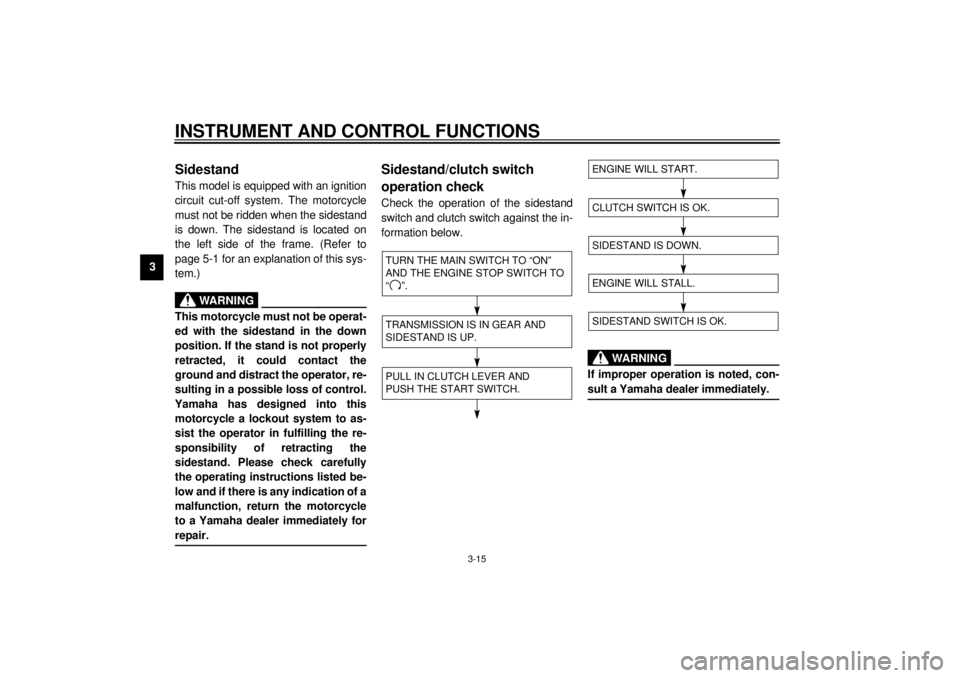
operation checkCheck the operation of the sidestand
switch and clutch switch against the in-
formation below.CD-11E
CD-11E
EW000045
WARNING
@ If improper operation is noted, con-
sult a Yamaha dealer immediately. @
TURN THE MAIN SWITCH TO “ON”
AND THE ENGINE STOP SWITCH TO
“”.TRANSMISSION IS IN GEAR AND
SIDESTAND IS UP.PULL IN CLUTCH LEVER AND
PUSH THE START SWITCH.
ENGINE WILL START.SIDESTAND IS DOWN.ENGINE WILL STALL.SIDESTAND SWITCH IS OK.CLUTCH SWITCH IS OK.
E_4YP_Functions.fm Page 15 Wednesday, October 6, 1999 10:03 AM
Page 58 of 91
PERIODIC MAINTENANCE AND MINOR REPAIR
6-16
6
l
After repairing or replacing the
rear tire, tighten the valve stem nut
and locknut to the specified
torque.
EAU00695
Clutch lever free play
adjustmentThis motorcycle has a hydraulic clutch.
There are no adjustments to perform
but the clutch system must be inspect-
ed periodically for proper fluid level and
leakage. If the control lever free play
becomes excessive and the motor-
cycle creeps or stalls when shifted into
gear, or if the clutch slips, causing ac-
celeration to lag behind engine speed,
there is probably air in the clutch sys-
tem and it must be bled out. Ask a
Yamaha dealer to do this service. Tightening torque:
Valve stem nut:
1.6 Nm (0.16 m·kg)
Valve stem locknut:
1.6 Nm (0.16 m·kg)
E_4YP_Periodic.fm Page 16 Wednesday, October 6, 1999 10:05 AM
Page 59 of 91

PERIODIC MAINTENANCE AND MINOR REPAIR
6-17
6
EAU00696
Front brake lever free play
adjustmentThe free play at the front brake lever
should be 2 ~ 5 mm.
1. Loosen the locknut.
2. Turn the adjusting bolt in
direction
a to increase free play
or in direction
b to decrease free
play.
3. After adjusting, tighten the locknut.
EW000099
WARNING
@ l
Check the brake lever free play.
Be sure the brake is working
properly.
l
A soft or spongy feeling in the
brake lever can indicate the
presence of air in the brake sys-
tem. This air must be removed
by bleeding the brake system
before the motorcycle is operat-
ed. Air in the system will cause
greatly diminished braking ca-
pability and can result in loss of
control and an accident. Have a
Yamaha dealer inspect and
bleed the system if necessary.
@
EAU00712
Rear brake pedal height
adjustmentThe top of the brake pedal should be
positioned 100 mm below the top of the
footrest. If not, ask a Yamaha dealer to
adjust it.
1. Locknut
2. Adjusting bolt
c. Free play
a. Brake pedal height
E_4YP_Periodic.fm Page 17 Wednesday, October 6, 1999 10:05 AM
Page 62 of 91
PERIODIC MAINTENANCE AND MINOR REPAIR
6-20
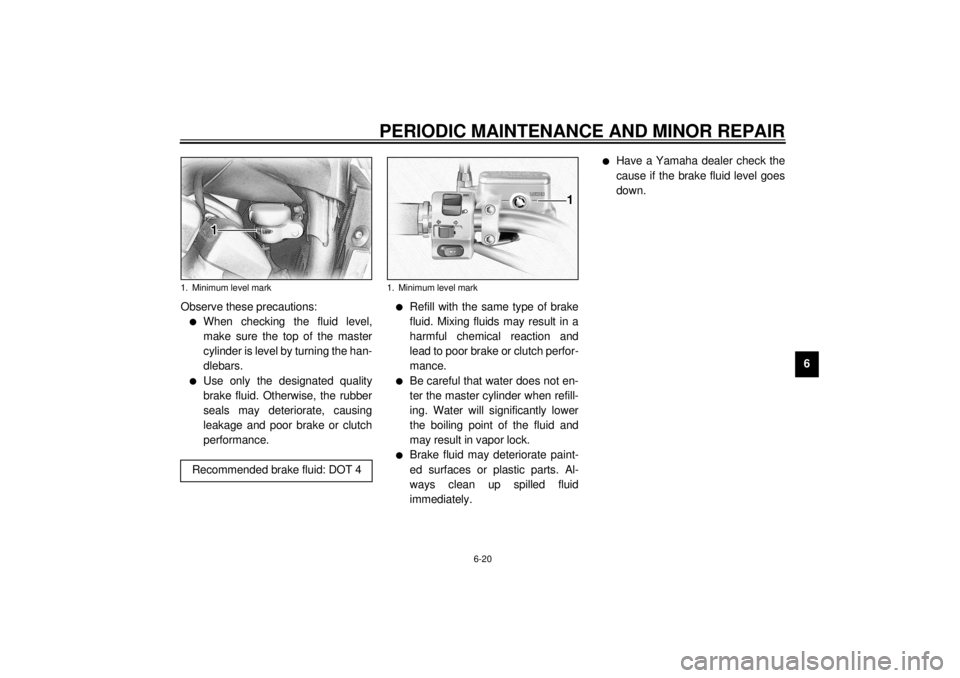
6 Observe these precautions:
l
When checking the fluid level,
make sure the top of the master
cylinder is level by turning the han-
dlebars.
l
Use only the designated quality
brake fluid. Otherwise, the rubber
seals may deteriorate, causing
leakage and poor brake or clutch
performance.
l
Refill with the same type of brake
fluid. Mixing fluids may result in a
harmful chemical reaction and
lead to poor brake or clutch perfor-
mance.
l
Be careful that water does not en-
ter the master cylinder when refill-
ing. Water will significantly lower
the boiling point of the fluid and
may result in vapor lock.
l
Brake fluid may deteriorate paint-
ed surfaces or plastic parts. Al-
ways clean up spilled fluid
immediately.
l
Have a Yamaha dealer check the
cause if the brake fluid level goes
down.
1. Minimum level mark
Recommended brake fluid: DOT 4
1. Minimum level mark
E_4YP_Periodic.fm Page 20 Wednesday, October 6, 1999 10:05 AM
Page 69 of 91
PERIODIC MAINTENANCE AND MINOR REPAIR
6-27
6
EAU00833
Headlight bulb replacementThis motorcycle is equipped with a
quartz bulb headlight.
If the headlight bulb burns out, replace
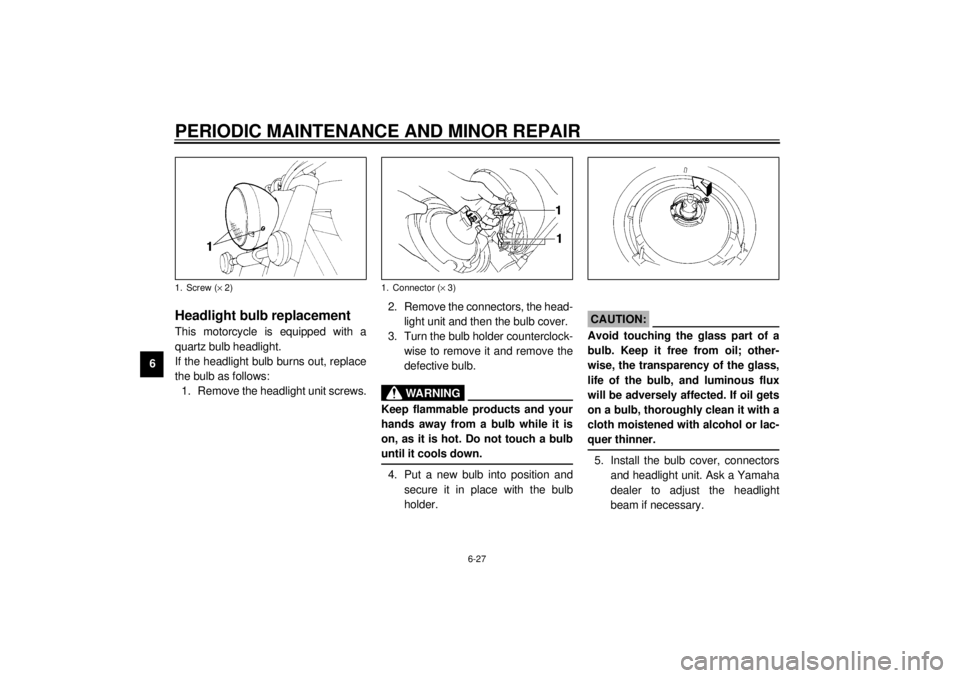
the bulb as follows:
1. Remove the headlight unit screws.2. Remove the connectors, the head-
light unit and then the bulb cover.
3. Turn the bulb holder counterclock-
wise to remove it and remove the
defective bulb.
EW000119
WARNING
@ Keep flammable products and your
hands away from a bulb while it is
on, as it is hot. Do not touch a bulb
until it cools down. @4. Put a new bulb into position and
secure it in place with the bulb
holder.
EC000105
CAUTION:@ Avoid touching the glass part of a
bulb. Keep it free from oil; other-
wise, the transparency of the glass,
life of the bulb, and luminous flux
will be adversely affected. If oil gets
on a bulb, thoroughly clean it with a
cloth moistened with alcohol or lac-
quer thinner. @5. Install the bulb cover, connectors
and headlight unit. Ask a Yamaha
dealer to adjust the headlight
beam if necessary.
1. Screw (´ 2)
1. Connector (´ 3)
E_4YP_Periodic.fm Page 27 Wednesday, October 6, 1999 10:05 AM
Page 70 of 91

PERIODIC MAINTENANCE AND MINOR REPAIR
6-28
6
EAU00855
Turn signal and taillight bulb
replacement1. Remove the screws and the lens.
2. Push the bulb inward and turn it
counterclockwise.
3. Place a new bulb in the socket.
Push the bulb inward and turn it
clockwise until it engages into the
socket.
4. Install the lens and the screws.
EC000108
CAUTION:@ Do not over-tighten the screws as
the lens may break. @
EAU01008
TroubleshootingAlthough Yamaha motorcycles receive
a rigid inspection before shipment from
the factory, trouble may occur during
operation.
Any problem in the fuel, compression,
or ignition systems can cause poor
starting and loss of power. The trouble-
shooting chart describes a quick, easy
procedure for making checks.
If your motorcycle requires any repair,
bring it to a Yamaha dealer. The skilled
technicians at a Yamaha dealership
have the tools, experience, and know-
how to properly service your motor-
cycle. Use only genuine Yamaha parts
on your motorcycle. Imitation parts may
look like Yamaha parts, but they are of-
ten inferior. Consequently, they have a
shorter service life and can lead to ex-
pensive repair bills.
1. Screw (´ 2)
1. Screw (´ 3)
E_4YP_Periodic.fm Page 28 Wednesday, October 6, 1999 10:05 AM
Page 72 of 91

PERIODIC MAINTENANCE AND MINOR REPAIR
6-30
6
5. Engine overheating
EW000070
WARNING
@ Do not remove the radiator cap when the engine and radiator are hot. Scalding hot fluid and steam may be blown
out under pressure, which could cause serious injury. Open the radiator cap as follows. Wait until the engine has
cooled. Remove the radiator cap stopper by removing the screw. Place a thick rag like a towel over the radiator cap
and slowly rotate the cap counterclockwise to the detent. This procedure allows any residual pressure to escape.
When the hissing sound has stopped, press down on the cap while turning counterclockwise and remove it. @NOTE:@ If it is difficult to get the recommended coolant, tap water can be temporarily used, provided that it is changed to the recom-
mended coolant as soon as possible. @
Wait until the
engine has cooled.
Check the coolant level in the
reservoir tank and/or radiator.
Level is OK.Level is low, check the
cooling system for leakage.
No
leakage.Leakage.
Ask a Yamaha dealer to inspect
and repair the cooling system.Add coolant. (See NOTE.)
Restart the engine. If the engine overheats again, ask a
Yamaha dealer to inspect and repair the cooling system.
E_4YP_Periodic.fm Page 30 Wednesday, October 6, 1999 10:05 AM