2000 YAMAHA XT500E oil
[x] Cancel search: oilPage 79 of 96

7-1
CareThe exposure of its technology
makes a motorcycle charming but
also vulnerable. Although high-quality
components are used, they are not
all rust-resistant. While a rusty
exhaust pipe may remain unnoticed
on a car, it does look unattractive on
a motorcycle. Frequent and proper
care, however, will keep your motor-
cycle looking good, extend its life and
maintain its performance. Moreover,
the warranty states that the vehicle
must be properly taken care of. For
all these reasons, it is recommended
that you observe the following clean-
ing and storing precautions.Before cleaning
1.Cover up the muffler outlet with a
plastic bag.
2.Make sure that all caps and cov-
ers as well as all electrical cou-
plers and connectors, including
the spark plug cap, are tightly
installed.
3.Remove extremely stubborn dirt,
like oil burnt onto the crankcase,
with a degreasing agent and a
tooth or bottle brush, but never
apply such products onto seals,
gaskets, sprockets, the drive
chain and wheel axles. Always
rinse the dirt and degreaser off
with water.Cleaning
After normal use
Remove dirt with warm water, a neu-
tral detergent and a soft clean
sponge, then rinse with plenty of
clean water. Use a brush for hard-to-
reach parts. Tougher dirt and insects
will come off more easily if the area is
covered with a wet cloth for a few
minutes before cleaning.
ECA00010
cC8 8
Avoid using strong acidic
wheel cleaners, especially on
spoked wheels. If you do use
such products for hard-to-
remove dirt, do not leave it on
any longer than instructed,
then thoroughly rinse it off
with water, immediately dry
the area and apply a corrosion
protection spray.
EAU01518
MOTORCYCLE CARE AND STORAGE
1
2
3
4
5
67
8
94PT-9-E6 (ENG) 7~9 12/27/00 1:30 PM Page 2
Page 81 of 96

7-3
EWA00001
wMake sure that there is no oil or
wax on the brakes and tires. If nec-
essary, clean the brake discs and
linings with a regular brake disc
cleaner or acetone, and wash the
tires with warm water and mild
soap. Then, carefully test the
motorcycle for its braking perfor-
mance and cornering behavior.
ECA00013
cC8
8
Apply spray oil and wax spar-
ingly and wipe off any excess.
8 8
Never apply oil or wax on rub-
ber and plastic parts, but treat
them with a suitable care prod-
uct.
8 8
Avoid using abrasive polish-
ing compounds as they wear
away the paint.
MOTORCYCLE CARE AND STORAGE
1
2
3
4
5
67
8
9
NOTE:
Consult a Yamaha dealer for advice
on what products to use.
After cleaning
1.Dry the motorcycle with a
chamois or an absorbing cloth.
2.Immediately dry the drive chain
and lubricate it to prevent it from
rusting.
3.Use a chrome polish to shine
chrome, aluminum and stainless-
steel parts, including the exhaust
system. (Even the thermally
induced discoloring of stainless-
steel exhaust systems can be
removed through polishing.)
4.To prevent corrosion, it is recom-
mended to apply a corrosion pro-
tection spray on all (even
chrome- and nickel-plated) metal
surfaces.
5.Use spray oil as a universal
cleaner to remove any remaining
dirt.
6.Touch up minor paint damage
caused by stones, etc.
7.Wax all painted surfaces.
8.Let the motorcycle dry complete-
ly before storing it or covering it.
4PT-9-E6 (ENG) 7~9 12/27/00 1:30 PM Page 4
Page 82 of 96

7-4
a.Remove the spark plug cap and
spark plug.
b.Pour a teaspoonful of engine oil
into the spark plug bore.
c.Install the spark plug cap onto
the spark plug and place the
spark plug on the cylinder head
so that the electrodes are
grounded. (This will limit spark-
ing during the next step.)
d.Turn the engine over several
times with the starter. (This will
coat the cylinder wall with oil.)
e.Remove the spark plug cap from
the spark plug, install the spark
plug and then the spark plug
cap.
EWA00003
wWhen turning the engine over, be
sure to ground the spark plug elec-
trodes to prevent damage or injury
from sparking.
MOTORCYCLE CARE AND STORAGE
1
2
3
4
5
67
8
9
StorageShort-term
Always store your motorcycle in a
cool, dry place and, if necessary, pro-
tect it against dust with a porous
cover.
ECA00014
cC8
8
Storing the motorcycle in a
poorly ventilated room or cov-
ering it with a tarp while it is
still wet will allow water and
humidity to seep in and cause
rust.
8 8
To prevent corrosion, avoid
damp cellars, stables (because
of the presence of ammonia)
and areas where strong chemi-
cals are stored.
Long-termBefore storing your motorcycle for
several months:
1.Follow all the instructions in the
ÒCareÓ section of this chapter.
2.Drain the carburetor float cham-
ber by loosening the drain bolt;
this will prevent fuel deposits
from building up. Pour the
drained fuel into the fuel tank.
3.Only for motorcycles equipped
with a fuel cock which has an
ÒOFFÓ position: Turn the fuel
cock to
ÒOFFÓ.
4.Fill up the fuel tank and add fuel
stabilizer (if available) to prevent
the fuel tank from rusting and the
fuel from deteriorating.
5.Perform the following steps to
protect the cylinder, piston rings,
etc. from corrosion.
4PT-9-E6 (ENG) 7~9 12/27/00 1:30 PM Page 5
Page 85 of 96
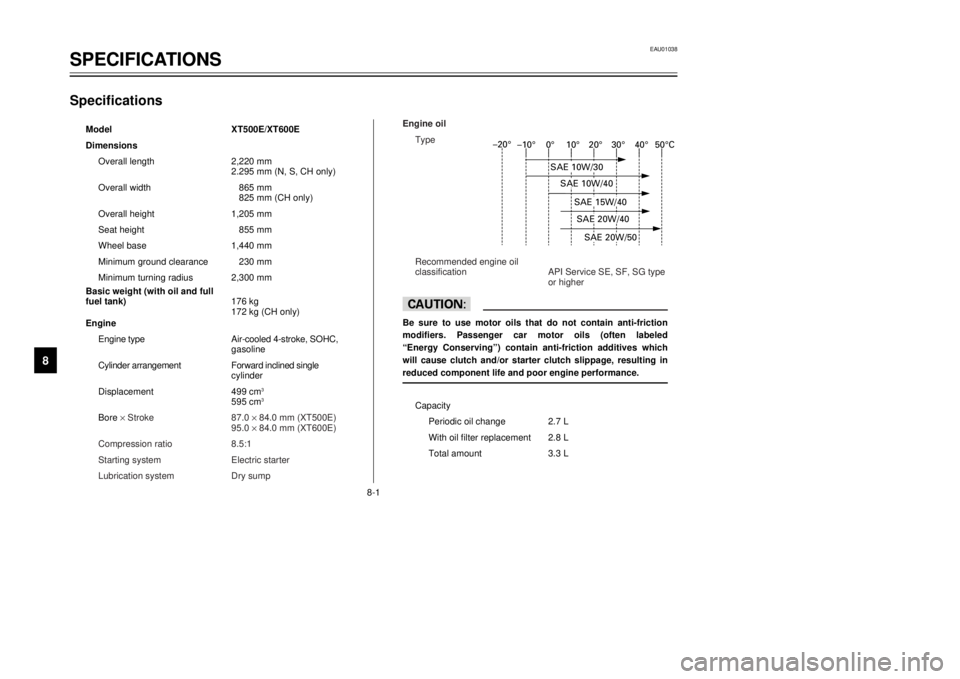
SPECIFICATIONS
1
2
3
4
5
6
78
9
Specifications
ModelXT500E/XT600E
Dimensions
Overall length2,220 mm
2.295 mm (N, S, CH only)
Overall width865 mm
825 mm (CH only)
Overall height1,205 mm
Seat height855 mm
Wheel base1,440 mm
Minimum ground clearance230 mm
Minimum turning radius2,300 mm
Basic weight (with oil and full
fuel tank)176 kg
172 kg (CH only)
Engine
Engine typeAir-cooled 4-stroke, SOHC,
gasoline
Cylinder arrangementForward inclined single
cylinder
Displacement499 cm
3
595 cm
3
Bore
´Stroke87.0 ´84.0 mm (XT500E)
95.0 ´84.0 mm (XT600E)
Compression ratio8.5:1
Starting systemElectric starter
Lubrication systemDry sumpEngine oil
Type
Recommended engine oil
classificationAPI Service SE, SF, SG type
or higher
cCBe sure to use motor oils that do not contain anti-friction
modifiers. Passenger car motor oils (often labeled
ÒEnergy ConservingÓ) contain anti-friction additives which
will cause clutch and/or starter clutch slippage, resulting in
reduced component life and poor engine performance.
Capacity
Periodic oil change2.7 L
With oil filter replacement2.8 L
Total amount3.3 L
EAU01038
SPECIFICATIONS
8-1
–10° 0° 10° 20° 30°
40°
SAE 10W/30
SAE 10W/40
SAE 20W/40
SAE 20W/50
–20°
SAE 15W/40 50°C
4PT-9-E6 (ENG) 7~9 12/27/00 1:30 PM Page 8
Page 87 of 96

SPECIFICATIONS
1
2
3
4
5
6
78
9
Air pressure (cold tire)
up to 90 kg load*
Front150 kPa (1.50 kg/cm
2, 1.50 bar)
Rear150 kPa (1.50 kg/cm2, 1.50 bar)
90 kg load ~ Maximum
load*
Front150 kPa (1.50 kg/cm2, 1.50 bar)
Rear225 kPa (2.25 kg/cm2, 2.25 bar)
Off-road riding
Front125 kPa (1.25 kg/cm2, 1.25 bar)
Rear125 kPa (1.25 kg/cm2, 1.25 bar)
High speed riding
Front150 kPa (1.50 kg/cm2, 1.50 bar)
Rear150 kPa (1.50 kg/cm2, 1.50 bar)
* Load is total weight of cargo, rider, passenger and accessories.
Wheels
Front
TypeSpoke wheel
Size21 ´1.85
Rear
TypeSpoke wheel
Size17 ´MT2.50 Brakes
Front
TypeSingle disc brake
OperationRight hand operation
FluidDOT 3 or DOT 4
Rear
TypeSingle disc brake
OperationRight foot operation
FluidDOT 4
Suspension
Front
TypeTelescopic fork
Rear
TypeSwingarm (new monocross)
Shock absorber
FrontCoil spring/oil damper
RearCoil spring/gas-oil damper
Wheel travel
Front225 mm
Rear200 mm
8-3
4PT-9-E6 (ENG) 7~9 12/27/00 1:30 PM Page 10
Page 93 of 96

INDEX
Front brake lever free play
adjustment..........................................6-18
Front fork inspection..............................6-26
Front wheel installation..........................6-34
Front wheel removal..............................6-33
Fuel.........................................................3-6
Fuel cock.................................................3-7
Fuel tank cap...........................................3-6
Fuse replacement..................................6-29
H
Handlebar switches.................................3-3
Dimmer switch......................................3-3
Engine stop switch................................3-4
Horn switch...........................................3-3
Lights switch.........................................3-3
Pass switch...........................................3-3
Start switch...........................................3-4
Turn signal switch.................................3-3
Headlight bulb replacement...................6-29
Helmet holder..........................................3-9
High beam indicator light.........................3-2
Horn switch..............................................3-3
How to use the conversion table.............9-3
I
Identification number records..................9-1
Idle speed adjustment...........................6-14
Indicator lights.........................................3-2
High beam indicator light......................3-2
Neutral indicator light............................3-2
Turn indicator light................................3-2
Inspecting the brake fluid level..............6-21
K
Key identification number........................9-1
L
Lights switch............................................3-3
M
Main switch/Steering lock........................3-1
Model label..............................................9-2
N
Neutral indicator light...............................3-2
P
Panel A, B...............................................6-7
Parking....................................................5-6
Pass switch.............................................3-3
Periodic maintenance and
lubrication chart....................................6-3
Pre-operation check list...........................4-1
R
Rear brake pedal.....................................3-5
Rear brake pedal height adjustment.....6-19
Rear shock absorber adjustment..........3-10
Rear suspension lubrication..................6-26
Rear wheel installation..........................6-36
Rear wheel removal..............................6-35
Recommended shift point
(for Switzerland only)............................5-4
S
Seat.........................................................3-9
Shift pedal ..............................................3-5
Shifting....................................................5-4
Sidestand..............................................3-11
Sidestand lubrication.............................6-25
A
Air filter..................................................6-12
B
Battery...................................................6-28
Brake and clutch lever lubrication.........6-25
Brake and shift pedal lubrication...........6-25
Brake fluid replacement.........................6-22
Brake light switch adjustment................6-20
C
Cable inspection and lubrication...........6-24
Carburetor adjustment...........................6-13
Care.........................................................7-1
Carrier (optional)...................................3-11
Checking the front and rear brake
pads....................................................6-20
Clutch lever.............................................3-4
Clutch lever free play adjustment..........6-18
Cowling A................................................6-7
Cowling and panel removal and
installation.............................................6-6
D
Description..............................................2-1
Dimmer switch.........................................3-3
Drive chain lubrication...........................6-23
Drive chain slack adjustment.................6-23
Drive chain slack check.........................6-22
E
Engine break-in.......................................5-5
Engine oil...............................................6-10
Engine stop switch..................................3-4
F
Front brake lever.....................................3-5
4PT-9-E6 (ENG) 7~9 12/27/00 1:30 PM Page 16