2000 VOLVO C70 wheel
[x] Cancel search: wheelPage 44 of 89
WARNING!
· The jack's attachment must engage the bar in the jack attachment (A). The car's weight must not rest on the jack
attachment (B).
· Be sure the jack is on a firm, level, non-slippery surface.
· Never allow any part of your body to be extended under a car supported by a jack.
· Use the jack intended for the car when replacing a wheel. For any other job, use stands to support the side of the
car being worked on. -
· Apply the parking brake, select position P (automatic transmission) or Reverse gear (manual transmission).
· Block the wheels standing on the ground, use rigid wooden blocks or large stones.
· The jack should be kept well-greased.
CAUTION : Correct tightening torque on wheel bolts must be observed. The wheel bolts should never be greased or
lubricated. The extended, chromed wheel bolts must not be used with steel rims, as they make it impossible to fit the
hub caps.
Correct tightening order for wheel bolts
pg. 84 Spare tire
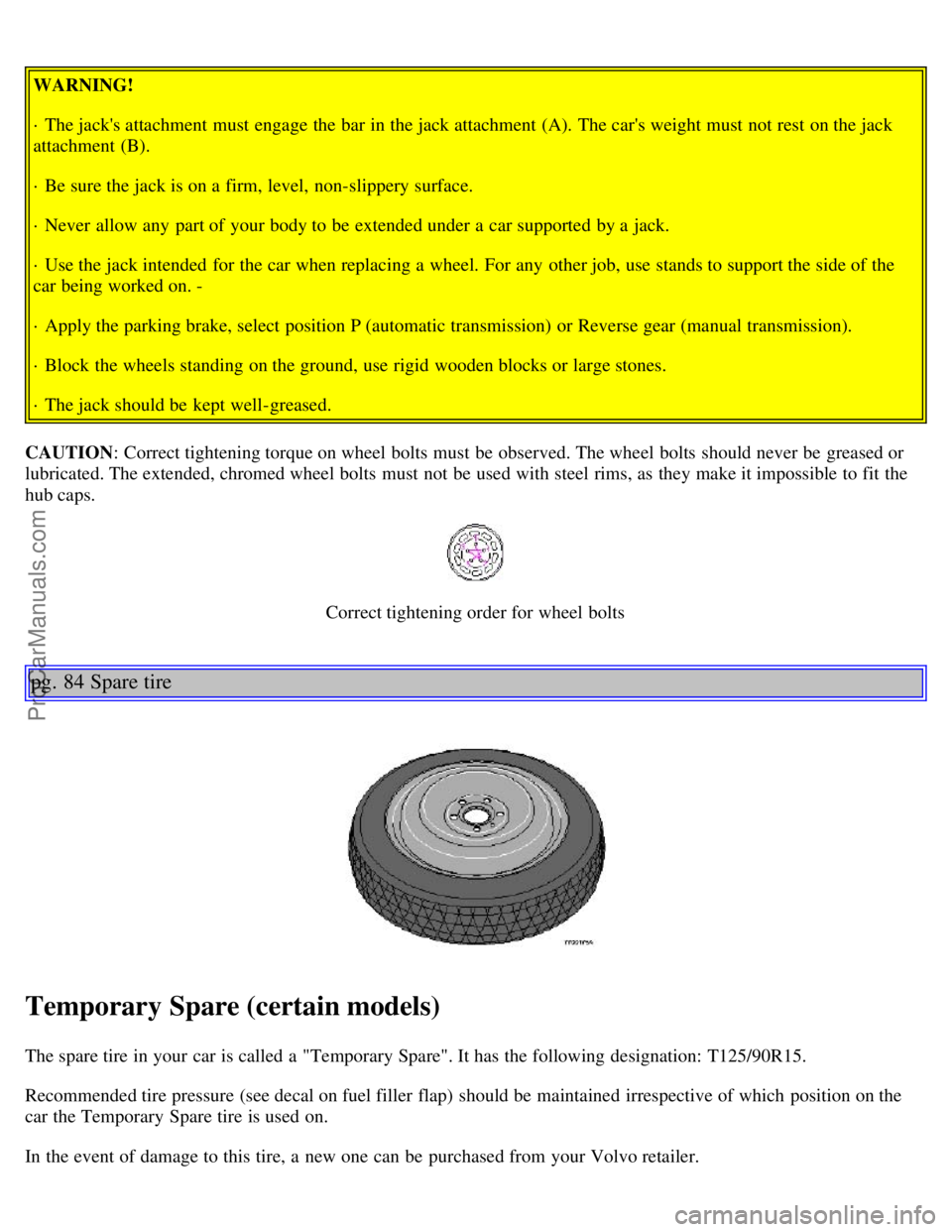
Temporary Spare (certain models)
The spare tire in your car is called a "Temporary Spare". It has the following designation: T125/90R15.
Recommended tire pressure (see decal on fuel filler flap) should be maintained irrespective of which position on the
car the Temporary Spare tire is used on.
In the event of damage to this tire, a new one can be purchased from your Volvo retailer.
ProCarManuals.com
Page 45 of 89

CAUTION: The car must not be driven with wheels of different dimensions or with a spare tire other than the one that
came with the car. The use of different size wheels can seriously damage your car's transmission.
WARNING!
Current legislation prohibits the use of the "Temporary Spare" tire other than as a temporary replacement for a
punctured tire. In other words, it must be replaced as soon as possible by a standard tire. Roadholding, etc., may be
affected with the "Temporary Spare" in use. Do not, therefore, exceed 50 mph (80 km/h).
pg. 85 Replacing bulbs
Parking light/direction indicator
1. From the front of the car, use a screwdriver to press down on the silver catch (located in the space between the
inside of the fender and the headlight unit) to release the lamp housing from the front fender.
2. Turn the bulb holder 1/4 turn clocKWise (viewed from the front) and withdraw it from the from the lamp housing.
Leave the connector with its wires in the bulb holder.
4. Remove the bulb from the holder by pulling it straight out.
5. Press a new bulb into the holder and reinstall the unit in the reverse order.
ProCarManuals.com
Page 50 of 89

Washing the car
· The car should be washed at regular intervals since dirt, dust, insects and tar spots adhere to the paint and may cause
damage.
NOTE: It is particularly important to wash the car frequently in the wintertime to prevent corrosion, when salt has
been used on the roads.
· When washing the car, do not expose it to direct sunlight. Use lukewarm water to soften the dirt before you wash
with a sponge, and plenty of water, to avoid scratching.
· Bird droppings: Remove from paintwork as soon as possible. Otherwise the finish may be permanently damaged.
· A detergent can be used to facilitate the softening of dirt and oil.
· A water-soluble grease solvent may be used in cases of sticky dirt. However, use a wash place equipped with a
drainage separator.
· Dry the car with a clean chamois and remember to clean the drain holes in the doors and rocker panels *.
· The power radio antenna must be dried after washing.
· Tar spots can be removed with kerosene or tar remover after the car has been washed.
· A stiff-bristle brush and lukewarm soapy water can be used to clean the wiper blades. Frequent cleaning improves
visibility considerably.
· Wash off the dirt from the underside (wheel housings, fenders, etc.).
· In areas of high industrial fallout, more frequent washing is recommended.
CAUTION: During high pressure washing, the spray mouthpiece must never be closer to the vehicle than 13" (30
cm). Do not spray into the locks.
· When washing or steam cleaning the engine, avoid spraying water or steam directly on the electrical components or
toward the rear side of the engine.
· After cleaning the engine, the spark plug wells should be inspected for water and blown dry if necessary.
Suitable detergents
Special car washing detergents should be used. A suitable mixture is about 2.5 fl. oz. (8.5 cl) of detergent to 2.6 US
gal. (10 liters) of warm water. After washing with a detergent the car should be well rinsed with clean water.
WARNING!
· When the car is driven immediately after being washed, apply the brakes several times in order to remove any
moisture from the brake linings.
· Engine cleaning agents should not be used when the engine is warm. This constitutes a fire risk.
ProCarManuals.com
Page 57 of 89

Brakes
Inspect brake pads, replace components as necessary I II II I I I II I
Brake fluid level
2 - check
I I I I I I
Steering/suspension
Tires
3, check pressure, wear and condition I
I II II I I I II I
Check power steering fluid level I I I I I
Body
Power antenna (clean) L L L L L L
Trunk/hood, hinges and latches L L L
Cabin air filter (see page 111)
R R R R R R
1) Replace at 105,000 miles (168,000 km)
2) Brake fluid should be changed at owner request every second year or 30,000 miles (48,000 km). The fluid
should be replaced once a year or every 15,000 miles (24,000 km) when driving under extremely hard
conditions (mountain driving, etc.).
3) Rotate tires at owner request.
The following items should be checked weekly by the driver (it takes only a few minutes):
Engine oil level, brake fluid level, radiator coolant level, operation of all lights, horns, windshield wipers, tire
pressure (all five tires), windshield washer fluid level
The following should also be carried out at regular intervals:
Washing (check all drain holes), polishing, cleaning
pg. 110 Servicing
Hoisting the car
If a garage jack is used to lift the car, the two jack attachments points should be used. They are specially reinforced to
bear the weight of the car. A garage jack can also be placed under the front of the engine support frame and under the
reinforced plate in the spare wheel well. Take care not to damage the splash guard under the engine. Ensure that the
jack is positioned so that the car cannot slide off it. Always use axle stands or similar structures.
If a twopost hoist is used to lift the car, the front lift arm pads should be positioned under the rear engine frame
ProCarManuals.com
Page 64 of 89

Spring strut suspension with integrated shock absorbers and control arms linked to the support frame. Powerassisted
rack and pinion steering. Safety type steering column.
The alignment specifications apply to an unladen car but include fuel, coolant and spare wheel.
Toe-in measured on the wheel rims: 2.4 mm +/ 0.7 mm
Toe-in measured on tire sides: 2.9 +/ 0.9 mm
Rear suspension
Deltalink individual rear wheel suspension with longitudinal support arms, double link arms and track rods.
Toe-in measured on the tire sides: 4° +/ 10°
All specifications are subject to change without notice.
pg. 125 Specifications
Power transmission
Manual transmission: M 56 H
Singledisc dry plate clutch. Allsynchromesh on all gears including reverse; integrated final drive. Operation via a floor
mounted gear lever.Final drive ratio 4.00:1
Reduction ratios
1st gear 3.07:1
2nd gear 1.77:1
3rd gear 1.19:1
4th gear 0.87:1
5th gear 0.70:1
Reverse 2.99:1
Automatic transmission: AW 5050 LE and AW 50-42 LE
4 or 5speed automatic electronically controlled gearbox comprising a hydraulic torque converter with a lockup
function; planetary gear, integrated final drive.
Operation via a floor mounted gear selector lever. Drive shafts with symmetrical joint location. Overdrive. Final drive ratio 2.76:1 (Turbocharged models: 2.56:1)
Reduction ratios AW5 AW4
1st gear 4.77:1 3.61:1
2nd gear 2.10:1 2.06:1
3rd gear 1.96:1 1.37:1
4th gear 1.32:1 0.98:1
ProCarManuals.com
Page 67 of 89

Width71.7 in. (182 cm)
Height55.1 in. (140 cm)
Wheelbase 104.7 in. (266 cm)
Track, front 59.8 in. (151.8 cm)
Track, rear 59.7 in. (151.6 cm)
Turning circle (between curbs) 39 ft. (11.9 m)
Cargo capacity 13.1 cu. ft. (0.37m
3)
WARNING!
When adding accessories, equipment, luggage and other cargo to your vehicle, the total loaded weight capacity of
the vehicle must not be exceeded. USACanada
Gross vehicle weight (GVW)
(aut.) 4190 lbs (1900 kg)1900 kg
(man.) 4140 lbs (1878 kg)1880 kg
Capacity weight * 785 lbs (356 kg) 355 kg
Curb weight 3305-3405 lbs (1499-1544 kg)1500-1545 kg
Permissible axle weight, front
(aut.) 2360 lbs (1070 kg)1070 kg
(man.) 2310 lbs (1048 kg)1050 kg
Permissible axle weight, rear 1940 lbs (880 kg)880 kg
Max roof load 220 lbs (100 kg)100 kg
Max trailer weight (w/o brakes) 1100 lbs (500 kg)500 kg
Max trailer weight (with brakes)
2" ball 3300 lbs (1500 kg) 1500 kg
1 7/8" ball 2000 lbs (908 kg)900 kg
Max tongue weight **165 lbs (75 kg) 75 kg
* The max permissible axle loads or the gross vehicle weight must not be exceeded.
** See also section "Trailer towing"
All specifications are subject to change without notice.
pg. 128 Road Assistance
ProCarManuals.com
Page 81 of 89

Brake warning light17
Bulb failure warning17,19
Bulbs126
C
Capacities125
Central locking button36
Chains (snow)77
Changing a wheel82
Child booster cushion12
Child Restraint Anchorages10
Child safety12
Clock16
Clock - resetting25
Clutch fluid116
Clutch interlock60
Coolant - checking/changing118
Coolant level sensor19
Coolant level warning light17
Cooling system66,124
Courtesy lights - exterior20
Courtesy lights - front49
Cruise control29
D
Daytime running lights24
Demister - rear window23
Dimensions127
Distributor ignition system124
Diversity antenna185
Doors and locks42
Driving economy58
Driving mode W62,64
E
EBD (Electronic Brake-force Distribution)72
ECC - Electronic Climate Control34,35
Electrical system66,126
Electrically heated front seats30
Electrically operated front seats46,47
Electrically operated sun roof41
Electrically-operated windows36
Electronic Brake Distribution (EBD)72
Electronic Brake-force Distribution (EBD)72
Emergency towing68
Emergency warning flashers23
Engine123
ProCarManuals.com
Page 85 of 89

SRS5,6,7
SRS diagnostic system19
SRS warning light5,17,19
Stability and Traction Control (STC)19,23,72
Start inhibitor (immobilizer)42
Starting the engine59
Steering wheel adjustment32
Steering wheel lock21
Storage compartments40
Studded tires77
Sun roof23,41
T
Tachometer16
Temperature gauge16
Temporary spare tire84
Tire pressure78
Tires - changing82
Towing68,69
Towing a trailer73
Trailer towing73
Trip computer23,26,27,28
Trip odometer16
Trunk - opening/locking52
Trunk light53
Turn signals17,20
U
Uniform tire quality grading79
Upholstery - cleaning104
V
Vanity mirrors49
Vehicle Identification Number (VIN)106
Vehicle loading125
Whiplash Protection System (WHIPS)9
WHIPS9
Winter/Wet driving mode62,64
Volvo On Call128
W
Warning flashers23
Warning lights18,19
Warranty107
Washer fluid level17
Washer fluid reservoir117
Washing102
Waxing103
ProCarManuals.com