Page 20 of 283
TUNDRA (34413U)
20
Adjust the driver's seat so that the foot
pedals, steering wheel and instrument
panel controls are within easy reach of
the driver.
CAUTION
�Adjustments should not be made
while the vehicle is moving, as the
seat may unexpectedly move and
cause the driver to lose control of
the vehicle.
�When adjusting the seat, be careful
not to hit the seat against a pas-
senger or luggage.
�After adjusting the seat position,
try sliding it forward and backward
to make sure it is locked in posi-
tion.
�After adjusting the seatback, exert
body pressure to make sure it is
locked in position.
�Do not put objects under the seats.
The objects may interfere with the
seat- lock mechanism or unexpect-
edly push up the seat position ad-
justing lever; the seat may suddenly
move, causing the driver to lose
control of the vehicle.
�While adjusting the seat, do not put
your hands under the seat or near
the moving parts. You may catch
and injure your hands or fingers.
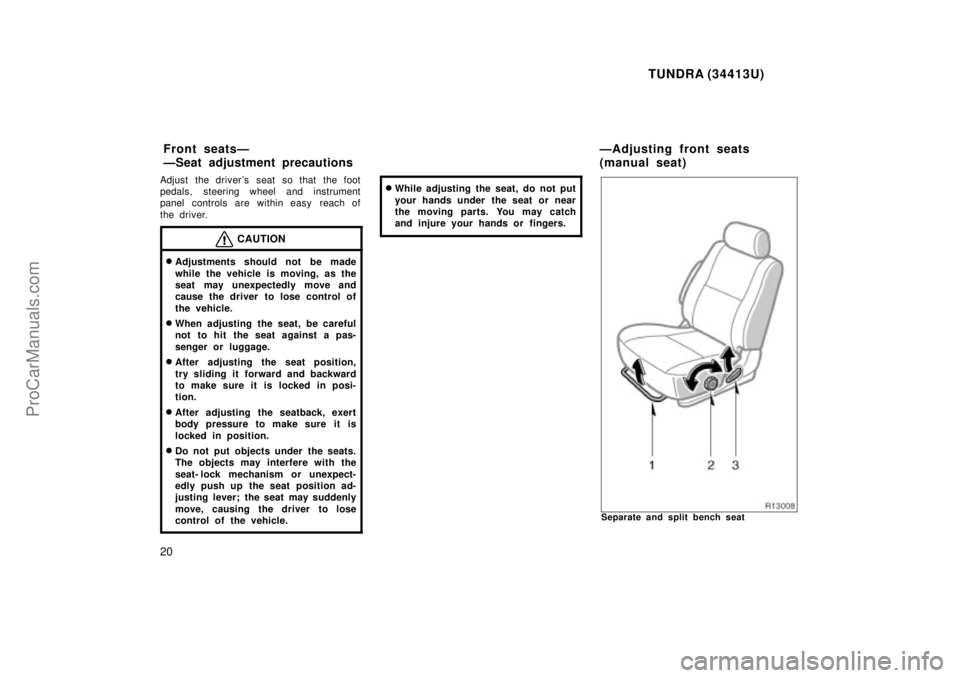
Separate and split bench seat
Front seatsÐ
ÐSeat adjustment precautionsÐAdjusting front seats
(manual seat)
ProCarManuals.com
Page 27 of 283

TUNDRA (34413U)
27
Do not allow the child to stand up or
kneel on either rear or front seats. An
unrestrained child could suffer serious in-
jury or death during emergency braking or
a collision. Also, do not let the child sit
on your lap. It does not provide sufficient
restraint.
Small- framed person or youth in a
3- point type seat belt. On models with
a non- split bench seat, have a small-
framed person or youth sit slightly closer
to the center of the vehicle (so the shoul-
der belt does not cross over the neck).
On models with separate seats and split
bench seat, move the seat fully backward.
Pregnant woman. Toyota recommends the
use of a seat belt. Ask your doctor for
specific recommendations. The lap belt
should be worn securely and as low as
possible over the hips and not on the
waist.
Injured person. Toyota recommends the
use of a seat belt. Depending on the inju-
ry, first check with your doctor for specific
recommendationsCAUTION
Persons should ride in their seats
properly wearing their seat belts
whenever the vehicle is moving.
Otherwise, they are much more likely
to suffer serious bodily injury or
death in the event of sudden braking
or a collision.
When using the seat belts, observe
the following:
�Use the belt for only one person at
a time. Do not use a single belt for
two or more peopleÐeven children.
�Avoid reclining the seatbacks too
much. The seat belts provide maxi-
mum protection when the seatbacks
are in the upright position. (Refer
to the seat adjustment instructions.)
�Be careful not to damage the belt
webbing or hardware. Take care that
they do not get caught or pinched
in the seat or side doors.
�Inspect the belt system periodically.
Check for cuts, fraying, and loose
parts. Damaged parts should be re-
placed. Do not disassemble or
modify the system.
�Keep the belts clean and dry. If
they need cleaning, use a mild soap
solution or lukewarm water. Never
use bleach, dye, or abrasive clean-
ersÐthey may severely weaken the
belts. (See Cleaning the interiorº
in Part 5.)
�Replace the belt assembly (includ-
ing bolts) if it has been used in a
severe impact. The entire assembly
should be replaced even if damage
is not obvious.
ProCarManuals.com
Page 29 of 283
TUNDRA (34413U)
29
Seat belts with an adjustable shoulder
anchorÐ
Adjust the shoulder anchor position to
your size.
Standard cab modelsÐ
To raise: Slide the anchor up.
To lower: Push in the lock release button
and slide the anchor down.
Access cab modelsÐ
To raise: Slide the anchor up.
To lower: Pull the lock release knob and
slide the anchor down.
After adjustment, make sure the anchor is
locked in position.
CAUTION
Always make sure the shoulder belt
is positioned across the center of
your shoulder. The belt should be
kept away from your neck, but not
falling off your shoulder. Failure to
do so could reduce the amount of
protection in an accident and cause
severe injuries in a co llision.
Take up slack
To o h i g h
Keep as low on
hips as possible
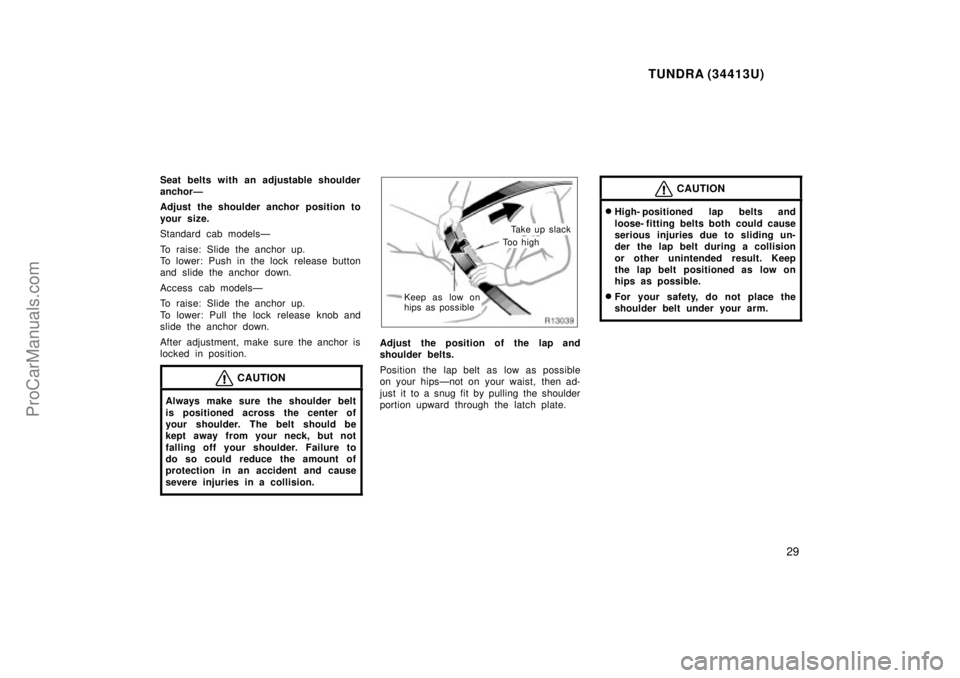
Adjust the position of the lap and
shoulder belts.
Position the lap belt as low as possible
on your hipsÐnot on your waist, then ad-
just it to a snug fit by pulling the shoulder
portion upward through the latch plate.
CAUTION
�High- positioned lap belts and
loose- fitting belts both could cause
serious injuries due to sliding un-
der the lap belt during a collision
or other unintended result. Keep
the lap belt positioned as low on
hips as possible.
�For your safety, do not place the
shoulder belt under your arm.
ProCarManuals.com