Page 214 of 283
TUNDRA (34413U)
214
Four- wheel drive modelsÐ
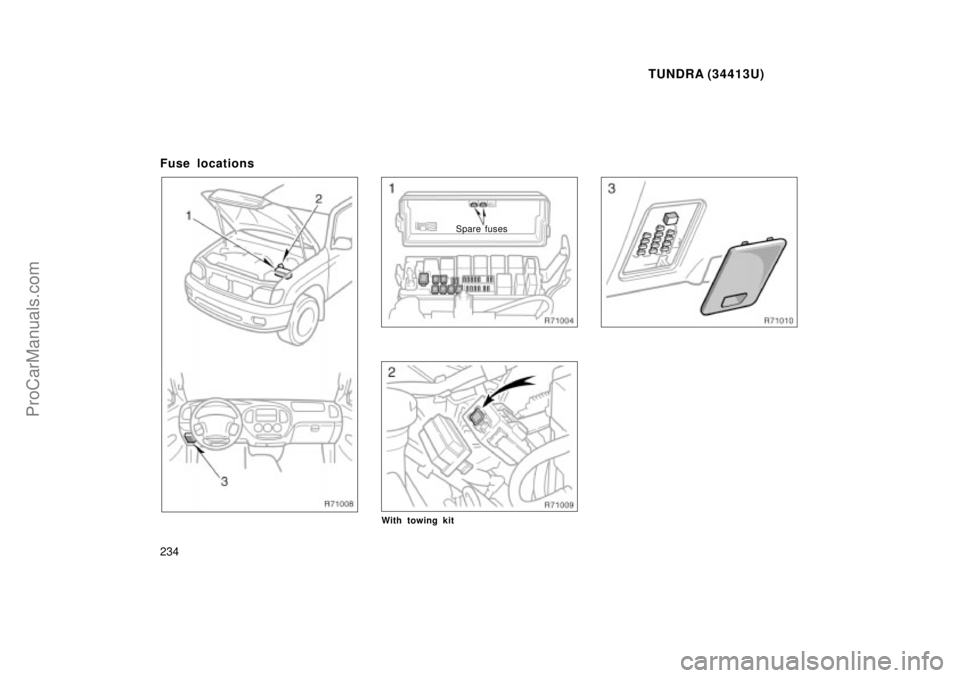
(a) Towing with wheel lift type truck
From frontÐ
�Manual transmission:
We recommend using a towing dolly under
the rear wheels. If you do not use a tow-
ing dolly, release the parking brake, put
the transmission in neutral and set the
transfer in H2º mode.
�Automatic transmission:
Use a towing dolly under the rear wheels.
NOTICE
Never tow a vehicle with an automatic transmission from the front with therear wheels on the ground, as thismay cause serious damage to the
transmission.
From rearÐ We recommend using a tow-
ing dolly under the front wheels. If you do
not use a towing dolly, place the ignition
key in the ACCº position, put the trans-
mission in neutral and set the transfer in
H2º (lever type) or 2WDº (button type)
mode.
NOTICE
Do not tow with the key removed or
in the LOCKº position when towingfrom the rear without a towing dolly.The steering lock mechanism is not
strong enough to hold the frontwheels straight.
(b) Using flat bed truck
(c) Towing with sling type truck
All modelsÐ
(c) Towing with sling type truck
NOTICE
Do not tow with sling type truck, ei-
ther from the front or rear. This maycause body damage.
ProCarManuals.com
Page 215 of 283
TUNDRA (34413U)
215
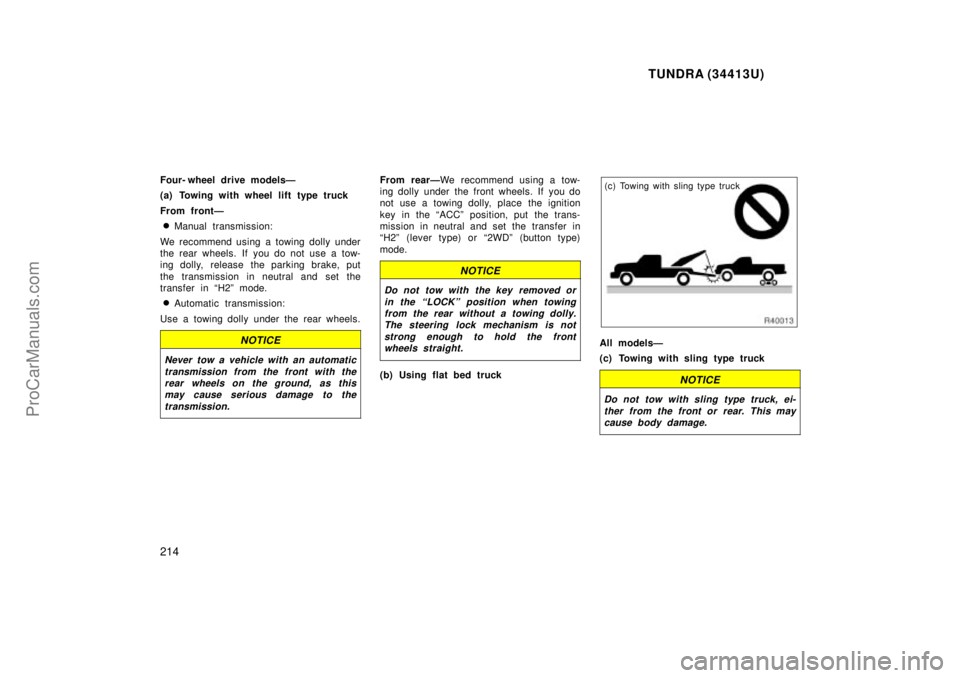
If towing is necessary, we recommend
you to have it done by your Toyota
dealer or a commercial tow truck ser-
vice.
If towing service is not available in an
emergency, your vehicle may be tempo-
rarily towed by a cable or chain se-
cured to one of the emergency towing
eyelets under the front of the vehicle.
Use extreme caution when towing the
vehicle.
A driver must be in the vehicle to steer
it and operate the brakes.Towing in this manner may be done only
on hard- surfaced roads for a short dis-
tance and at low speeds. Also, the
wheels, axles, drive train, steering and
brakes must all be in good condition.
CAUTION
Use extreme caution when towing the
vehicle. Avoid sudden starts or errat-
ic driving maneuvers which would
place excessive stress on the emer-
gency towing eyelet and towing cable
or chain. The eyelet and towing cable
or chain may break and cause serious
injury or damage.
NOTICE
Use only a cable or chain specifically
intended for use in towing vehicles.Securely fasten the cable or chain tothe towing eyelet provided.
Before towing, release the parking brake
and put the transmission in neutral (manu-
al) or Nº (automatic). The key must be
in ACCº (engine off) or ONº (engine run-
ning).
CAUTION
If the engine is not running, the pow-
er assist for the brakes and steering
will not work so steering and braking
will be much harder than usual.
ÐEmergency towing
(two- wheel drive models)
ProCarManuals.com
Page 216 of 283
TUNDRA (34413U)
216
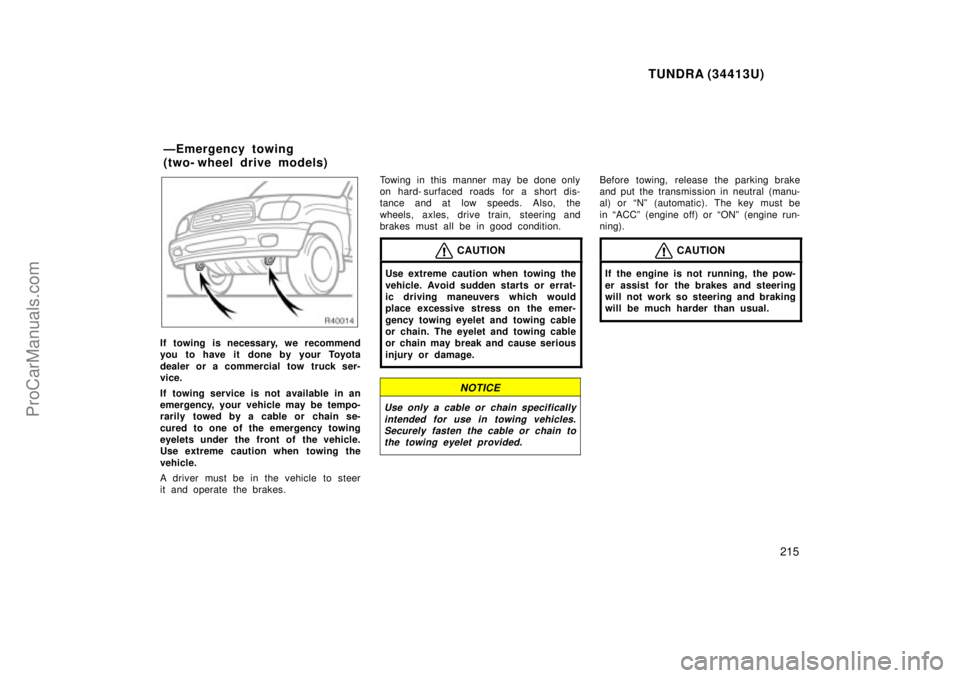
If towing is necessary, we recommend
you to have it done by your Toyota
dealer or a commercial tow truck ser-
vice.
If towing service is not available in an
emergency, your vehicle may be tempo-
rarily towed by a cable or chain se-
cured to the emergency towing hook
under the front of the vehicle. Use ex-
treme caution when towing the vehicle.
A driver must be in the vehicle to steer
it and operate the brakes.Towing in this manner may be done only
on hard- surfaced roads for a short dis-
tance and at low speeds. Also, the
wheels, axles, drive train, steering and
brakes must all be in good condition.
CAUTION
Use extreme caution when towing the
vehicle. Avoid sudden starts or errat-
ic driving maneuvers which would
place excessive stress on the emer-
gency towing hook and towing cable
or chain. The hook and towing cable
or chain may break and cause serious
injury or damage.
NOTICE
Use only a cable or chain specifically
intended for use in towing vehicles.Securely fasten the cable or chain tothe towing hook provided.
Before towing, release the parking brake,
put the transmission in neutral (manual) or
Nº (automatic) and set the transfer in
H2º (lever type) or 2WDº (button type)
mode. The key must be in ACCº (engine
off) or ONº (engine running).
CAUTION
If the engine is not running, the pow-
er assist for the brakes and steering
will not work so steering and braking
will be much harder than usual.
ÐEmergency towing
(four- wheel drive models)
ProCarManuals.com
Page 217 of 283

TUNDRA (34413U)
217
�
Before emergency towing, check that
the hook is not broken or damaged and
that the installation bolts are not loose.
�Fasten the towing cable or chain se-
curely to the hook.
�Do not jerk the hook. Apply steady and
even force.
�To avoid damaging the hook, do not
pull from the side or at a vertical
angle. Always pull straight ahead.
CAUTION
If the emergency towing hook is used
to get out when your vehicle becomes
stuck in the mud, sand or other
condition from which the vehicle can-
not be driven out under its own pow-
er, make sure to observe the precau-
tions mentioned below. Otherwise, ex-
cessive stress will be put on the
hook and the towing cable or chain
may break, causing serious injury or
damage.
�If the towing vehicle can hardly
move, do not forcibly continue the
towing. Contact your Toyota dealer
or a commercial tow truck service
for assistance.
�Tow the vehicle as straight ahead
as possible.
�Keep away from the vehicle during
towing.
The following methods are effective to
use when your vehicle is stuck in the
mud, sand or other condition from
which the vehicle cannot be driven out
under its own power. Use extreme cau-
tion when towing the vehicle. In addi-
tion, keep away from the vehicles and
towing cable or chain when towing.
�Remove the sand and soil in the front
and the back of the tires.
�Place stones or wood under the tires.
ÐEmergency towing hook
precautions
(four- wheel drive models)
Ð Tip s fo r to win g a st u ck
vehicle
(four- wheel drive models)
ProCarManuals.com
Page 221 of 283
TUNDRA (34413U)
221
1. Rinse off loose dirt with a hose. Re-move any mud or road salt from the
underside of the vehicle or in the
wheel wells.
2. Wash with a mild car- wash soap, mixed according to the manufacturer 's
instructions. Use a soft cotton mitt and
keep it wet by dipping it frequently into
the wash water. Do not rub hardÐlet
the soap and water remove the dirt.
Aluminum wheels: Use only a mild soap
or neutral detergent.
Plastic bumpers: Wash carefully. Do not
scrub with abrasive cleaners. The bumper
faces are soft.
Road tar: Remove with turpentine or
cleaners that are marked safe for painted
surfaces.
NOTICE
Do not use gasoline or strong sol- vents, which may be toxic or causedamage.
3. Rinse thoroughlyÐdried soap can cause streaking. In hot weather you
may need to rinse each section right
after you wash it. 4. To prevent water spots, dry the vehicle
using a clean soft cotton towel. Do not
rub or press hardÐyou might scratch
the paint.
Waxing your Toyota
Polishing and waxing is recommended
to maintain the original beauty of your
Toyota's finish.
Once a month or if the vehicle does not
repel water well, apply wax.
1. Always wash and dry the vehicle be- fore you begin waxing, even if you are
using a combined cleaner and wax.
2. Use a good quality polish and wax. If the finish has become extremely weath-
ered, use a car- cleaning polish, fol-
lowed by a separate wax. Carefully fol-
low the manufacturer 's instructions and
precautions. Be sure to polish and wax
the chrome trim as well as the paint.
3. Wax the vehicle again when water does not bead but remains on the sur-
face in large patches.
NOTICE
Always remove the plastic bumpers ifyour vehicle is re- painted and placedin a high heat paint waxing booth.High temperatures could damage the
bumpers.
ProCarManuals.com
Page 234 of 283
TUNDRA (34413U)
234
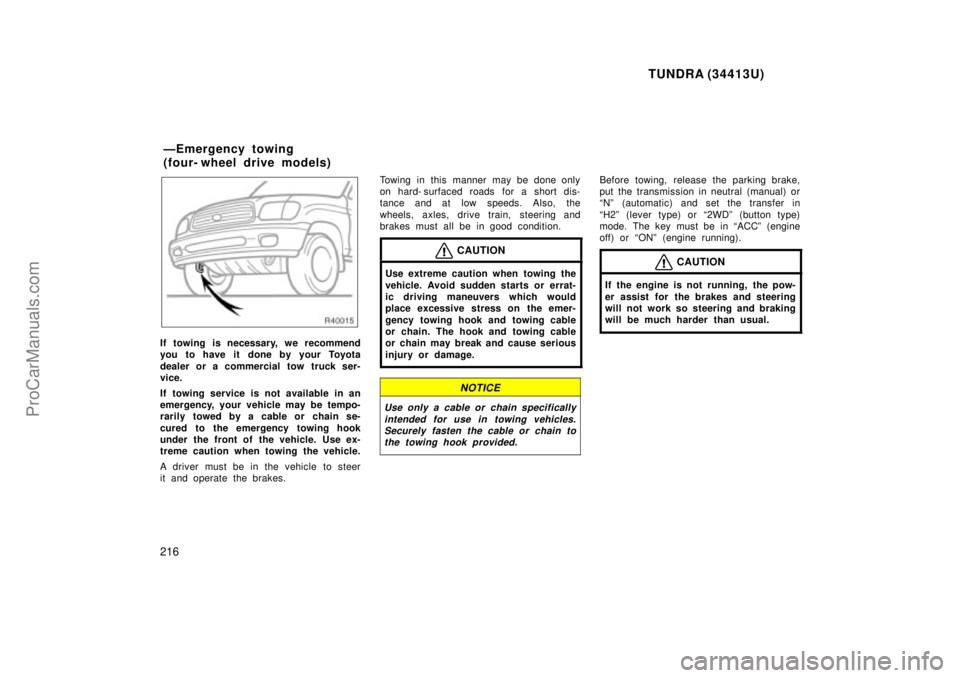
Fuse locations
Spare fuses
With towing kit
ProCarManuals.com
Page 236 of 283

TUNDRA (34413U)
236
NOTICE
�Remember that battery and ignitioncables carry high currents or volt-ages. Be careful of accidentallycausing a short circuit.
�Add only demineralized or distilledwater to fill the radiator. And if youspill some of the coolant, be sure
to wash it off with water to preventit from damaging the parts or paint.
�Do not allow dirt or anything elseto fall through the spark plug holes.
�Do not pry the outer electrode of a
spark plug against the center elec-trode.
�Use only spark plugs of the speci-fied type. Using other types willcause engine damage, loss of per-
formance or radio noise.
�Do not overfill automatic transmis-sion fluid, or the transmissioncould be damaged.
�Do not drive with the air cleaner
filter removed, or excessive enginewear could result. Also backfiringcould cause a fire in the engine
compartment.
�Be careful not to scratch the glasssurface with the wiper frame.
�When closing the engine hood,check to see that you have not for-
gotten any tools, rags, etc.
Parts and tools
Here is a list of parts and tools you will
need on performing do- it- yourself mainte-
nance. Remember all Toyota parts are de-
signed in metric sizes, so your tools must
be metric.
Checking the engine oil level
Parts (if level is low):
�Engine oil API grade SJ,
Energy- Conservingº or ILSAC
multigrade having viscosity proper for
your climate
Tools:
�Rag or paper towel
�Funnel (only for adding oil)
Checking the engine coolant level
Parts (if level is low):
�TOYOTA Long Life Coolantº or equiva-
lent
See Chapter 7- 2 for details about cool-
ant type selection.
�Demineralized or distilled water
Tools:
�Funnel (only for adding coolant)
ProCarManuals.com
Page 237 of 283
TUNDRA (34413U)
237
Checking brake fluid
Parts (if level is low):
�SAE J1703 or FMVSS No.116 DOT 3
brake fluid
Tools:
�Rag or paper towel
�Funnel (only for adding fluid)
Checking power steering fluid
Parts (if level is low):
�Automatic transmission fluid DEXRON� II
or III
Tools:
�Rag or paper towel
�Funnel (only for adding fluid)
Checking battery condition
Tools:
�Warm water
�Baking soda
�Grease
�Conventional wrench (for terminal
clamp bolts) Checking and replacing fuses
Parts (if replacement is necessary):
�Fuse with same amperage rating as
original
Adding washer fluid
Parts:
�Water
�Washer fluid containing antifreeze
(for winter use)
Tools:
�Funnel
Replacing light bulbs
Parts:
�Bulb with same number and wattage
rating as original (See charts in Re-
placing light bulbsº in Chapter 7- 3.)
Tools:
�Screwdriver
�Wrench
ProCarManuals.com