Page 45 of 283
TUNDRA (34413U)
45
Toyota strongly urges the use of child
restraint systems for children small
enough to use them.
The laws of all fifty states in the U.S.A.
and Canada now require the use of a
child restraint system.
Your vehicle conforms to SAEJ1819.
If a child is too large for a child restraint
system, the child should sit in the seat
and must be restrained using the vehicle's
seat belt. See Seat beltsº for details.
CAUTION
�For effective protection in automo-
bile accidents and sudden stops,
children must be properly re-
strained using a seat belt or child
restraint system depending on the
age and size of the child. Holding
a child in your arms is not a sub-
stitute for a child restraint system.
In an accident, the child can be
crushed against the windshield, or
between you and the vehicle's inte-
rior.
�STANDARD CAB MODELSÐ
Toyota strongly urges use of a
proper child restraint system which
conforms to the size of the child.
ACCESS CAB MODELSÐ
Toyota strongly urges use of a
proper child restraint system which
conforms to the size of the child
and is put on the rear seat. Accord-
ing to accident statistics, the child
is safer when properly restrained in
the rear seat than in the front seat.
�Never put infant or child age 1 to
12 in a passenger risk group on the
right front seat with the passenger
airbag manual on- off switch in the
ONº position. In the event of an
accident, the force of the rapid
inflation of the passenger airbag
can cause death or serious injury
to the child.
If you must put infant or child age
1 to 12 in a passenger risk group
on the right front seat, make sure
the passenger airbag manual on- off
switch is in the OFFº position and
that the indicator light is on. (For
details, see SRS driver and front
passenger airbagsº in this chapter.)
�Make sure that you have complied
with all installation instructions pro-
vided by the child restraint
manufacturer and that the system is
properly secured.
Child restraintÐ
ÐChild restraint precautions
ProCarManuals.com
Page 46 of 283
TUNDRA (34413U)
46
ÐChild restraint system
A child restraint system for a small
child or baby must itself be properly
restrained on the seat with either the
lap belt or the lap portion of the lap/
shoulder belt. You must carefully con-
sult the manufacturer 's instructions
which accompany your child restraint
system.
To provide proper restraint, use a child
restraint system following the manufactur-
er 's instructions about the appropriate age
and size of the child for the child restraint
system.
Install the child restraint system correctly
following the instructions provided by its
manufacturer of the system. General
directions are also provided under the fol-
lowing illustrations.
The child restraint system should be
installed on the rear seat if your vehicle
is equipped with rear seats. According to
accident statistics, the child is safer when
properly restrained in the rear seat than
in the front seat.CAUTION
�Never put infant or child age 1 to
12 in a passenger risk group on the
right front seat with the passenger
airbag manual on- off switch in the
ONº position. In the event of an
accident, the force of the rapid
inflation of the passenger airbag
can cause death or serious injury
to the child.
If you must put infant or child age
1 to 12 in a passenger risk group
on the right front seat, make sure
the passenger airbag manual on- off
switch is in the OFFº position and
that the indicator light is on. (For
details, see SRS driver and front
passenger airbagsº in this chapter.)
�After installing the child restraint
system, make sure it is secured in
place according to the manufactur-
er's instructions. If it is not re-
strained securely, it may cause
death or serious injury to the child
in the event of a sudden stop or
accident.
When not using the child restraint system,
keep it secured with the seat belt or place
it somewhere other than the passenger
compartment. This will prevent it from in-
juring passengers in the event of a sud-
den stop or accident.
Your vehicle has anchors for securing the
top strap of a child restraint system.
For instructions on how to use the anchor
bracket, see Using a top strapº in this
chapter.
ProCarManuals.com
Page 48 of 283
TUNDRA (34413U)
48
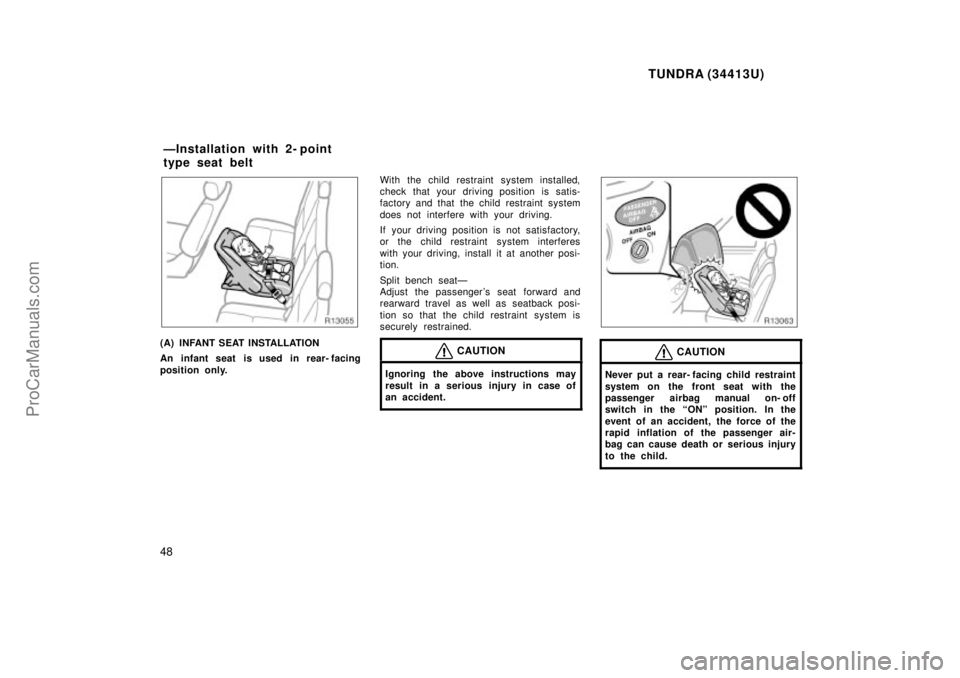
(A) INFANT SEAT INSTALLATION
An infant seat is used in rear- facing
position only.With the child restraint system installed,
check that your driving position is satis-
factory and that the child restraint system
does not interfere with your driving.
If your driving position is not satisfactory,
or the child restraint system interferes
with your driving, install it at another posi-
tion.
Split bench seatÐ
Adjust the passenger 's seat forward and
rearward travel as well as seatback posi-
tion so that the child restraint system is
securely restrained.CAUTION
Ignoring the above instructions may
result in a serious injury in case of
an accident.
CAUTION
Never put a rear- facing child restraint
system on the front seat with the
passenger airbag manual on- off
switch in the ONº position. In the
event of an accident, the force of the
rapid inflation of the passenger air-
bag can cause death or serious injury
to the child.
ÐInstallation with 2- point
type seat belt
ProCarManuals.com
Page 49 of 283
TUNDRA (34413U)
49
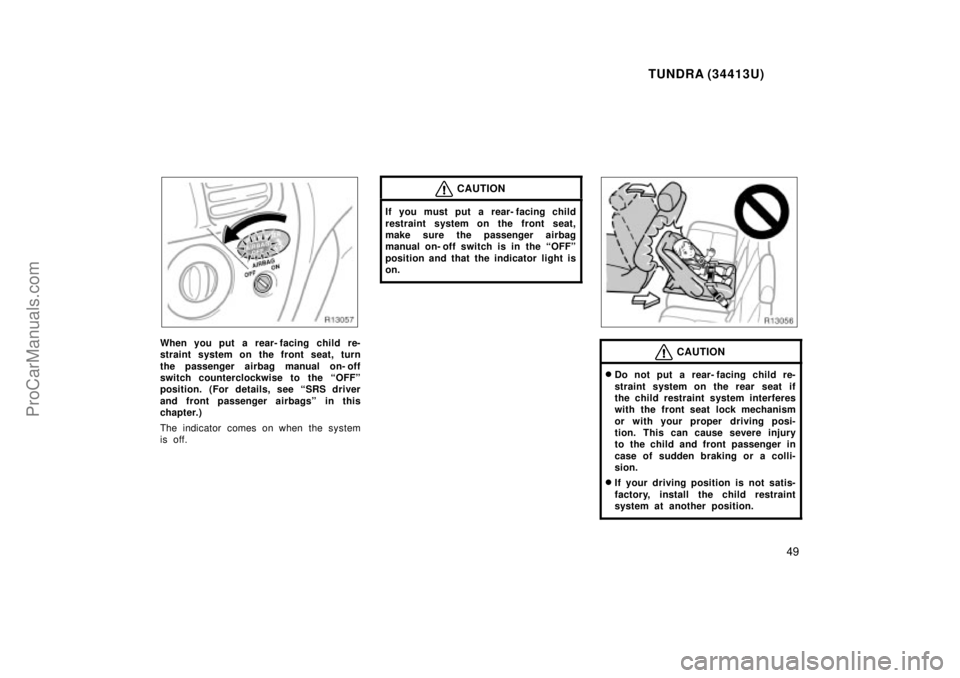
When you put a rear- facing child re-
straint system on the front seat, turn
the passenger airbag manual on- off
switch counterclockwise to the OFFº
position. (For details, see SRS driver
and front passenger airbagsº in this
chapter.)
The indicator comes on when the system
is off.
CAUTION
If you must put a rear- facing child
restraint system on the front seat,
make sure the passenger airbag
manual on- off switch is in the OFFº
position and that the indicator light is
on.
CAUTION
�Do not put a rear- facing child re-
straint system on the rear seat if
the child restraint system interferes
with the front seat lock mechanism
or with your proper driving posi-
tion. This can cause severe injury
to the child and front passenger in
case of sudden braking or a colli-
sion.
�If your driving position is not satis-
factory, install the child restraint
system at another position.
ProCarManuals.com
Page 52 of 283
TUNDRA (34413U)
52
With the child restraint system installed,
check that your driving position is satis-
factory and that the child restraint system
does not interfere with your driving.
If your driving position is not satisfactory,
or the child restraint system interferes
with your driving, install it at another posi-
tion.
Split bench seatÐ
Adjust the passenger 's seat forward and
rearward travel as well as seatback posi-
tion so that the child restraint system is
securely restrained.
CAUTION
Ignoring the above instructions may
result in a serious injury in case of
an accident.
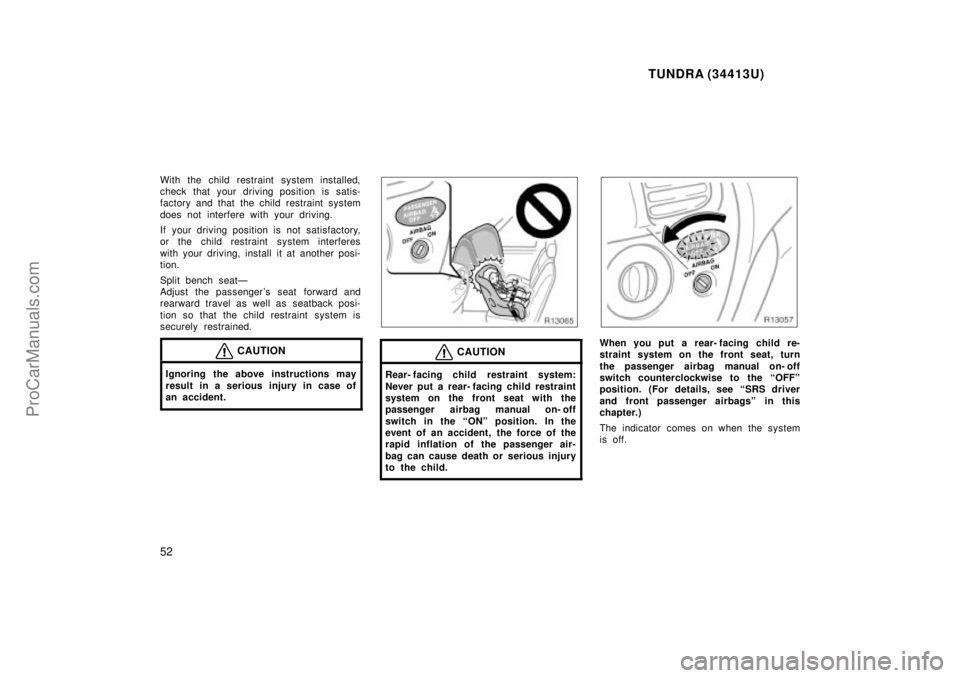
CAUTION
Rear- facing child restraint system:
Never put a rear- facing child restraint
system on the front seat with the
passenger airbag manual on- off
switch in the ONº position. In the
event of an accident, the force of the
rapid inflation of the passenger air-
bag can cause death or serious injury
to the child.
When you put a rear- facing child re-
straint system on the front seat, turn
the passenger airbag manual on- off
switch counterclockwise to the OFFº
position. (For details, see SRS driver
and front passenger airbagsº in this
chapter.)
The indicator comes on when the system
is off.
ProCarManuals.com
Page 53 of 283
TUNDRA (34413U)
53
CAUTION
If you must put a rear- facing child
restraint system on the front seat,
make sure the passenger airbag
manual on- off switch is in the OFFº
position and that the indicator light is
on.
CAUTION
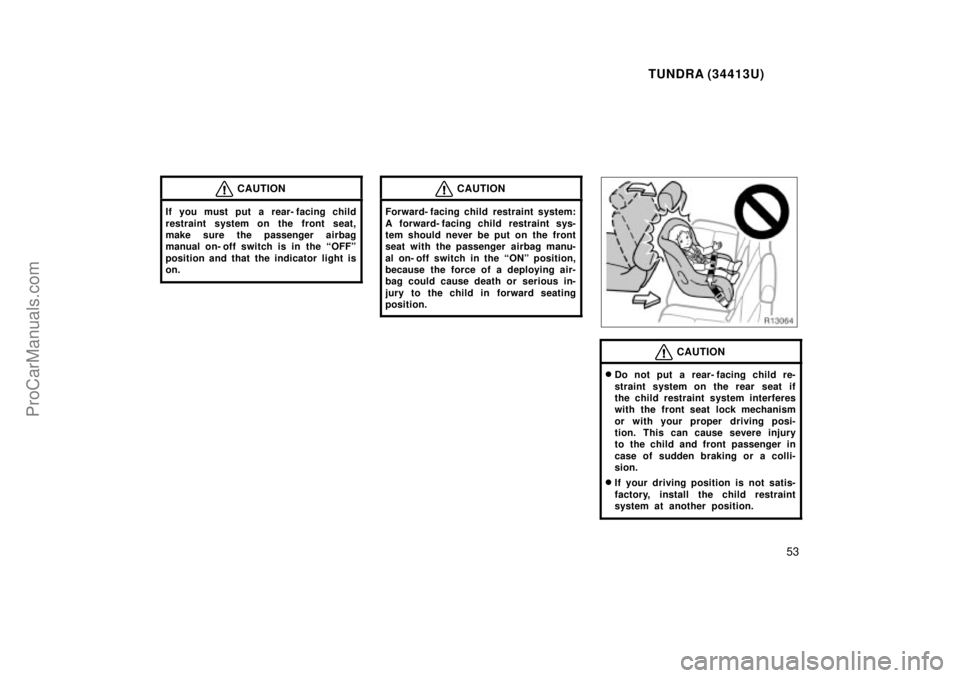
Forward- facing child restraint system:
A forward- facing child restraint sys-
tem should never be put on the front
seat with the passenger airbag manu-
al on- off switch in the ONº position,
because the force of a deploying air-
bag could cause death or serious in-
jury to the child in forward seating
position.
CAUTION
�Do not put a rear- facing child re-
straint system on the rear seat if
the child restraint system interferes
with the front seat lock mechanism
or with your proper driving posi-
tion. This can cause severe injury
to the child and front passenger in
case of sudden braking or a colli-
sion.
�If your driving position is not satis-
factory, install the child restraint
system at another position.
ProCarManuals.com
Page 56 of 283
TUNDRA (34413U)
56
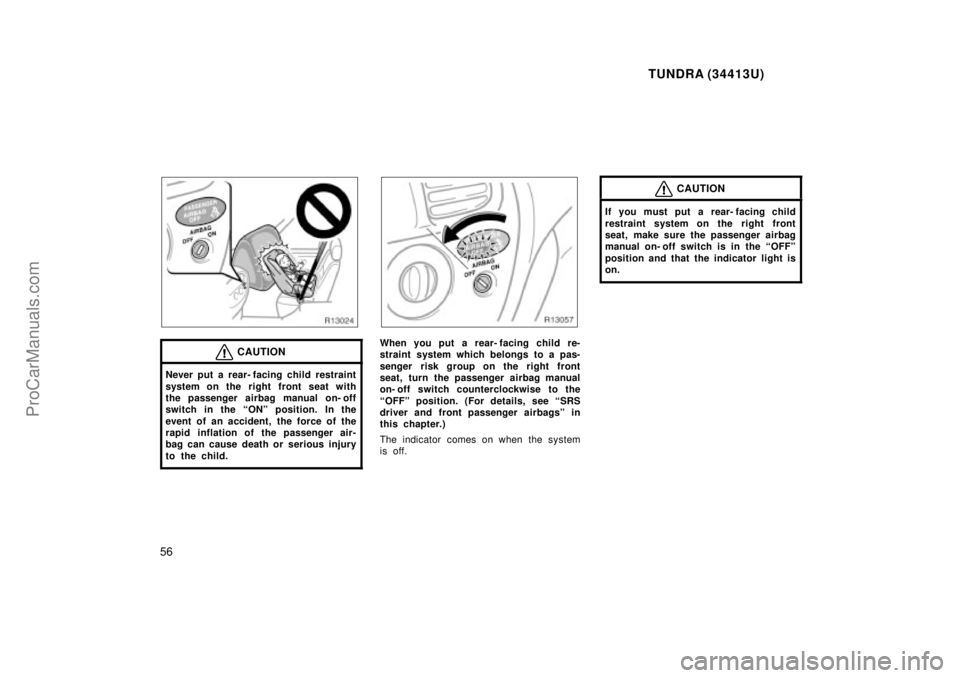
CAUTION
Never put a rear- facing child restraint
system on the right front seat with
the passenger airbag manual on- off
switch in the ONº position. In the
event of an accident, the force of the
rapid inflation of the passenger air-
bag can cause death or serious injury
to the child.
When you put a rear- facing child re-
straint system which belongs to a pas-
senger risk group on the right front
seat, turn the passenger airbag manual
on- off switch counterclockwise to the
OFFº position. (For details, see SRS
driver and front passenger airbagsº in
this chapter.)
The indicator comes on when the system
is off.
CAUTION
If you must put a rear- facing child
restraint system on the right front
seat, make sure the passenger airbag
manual on- off switch is in the OFFº
position and that the indicator light is
on.
ProCarManuals.com
Page 59 of 283
TUNDRA (34413U)
59
4. To remove the infant seat, press thebuckle- release button and allow the
belt to retract completely. The belt will
move freely again and be ready to
work for an adult or older child passen-
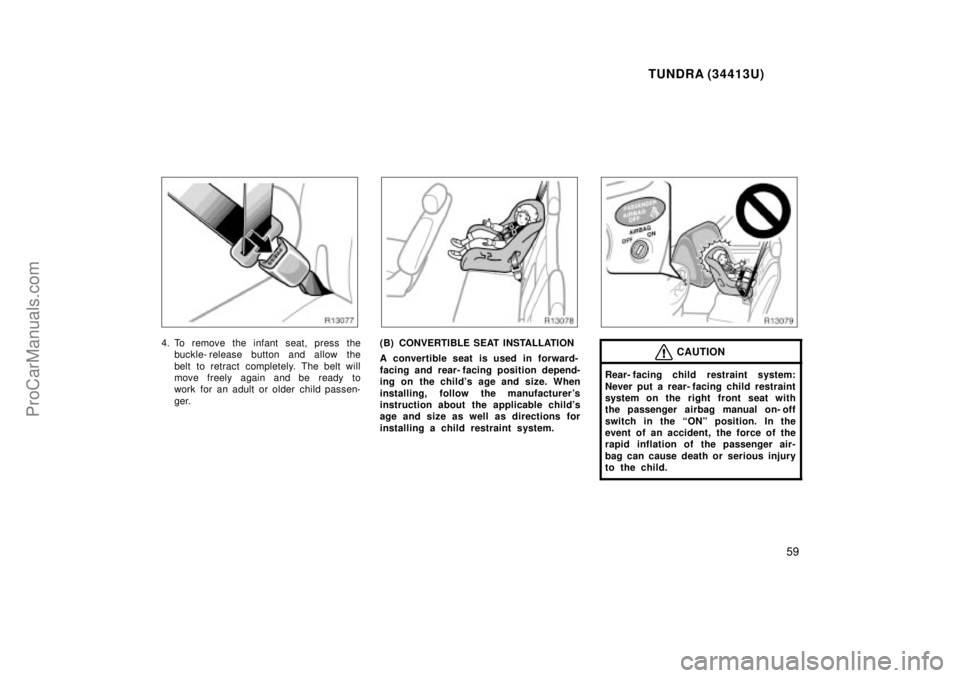
ger.(B) CONVERTIBLE SEAT INSTALLATION
A convertible seat is used in forward-
facing and rear- facing position depend-
ing on the child's age and size. When
installing, follow the manufacturer's
instruction about the applicable child's
age and size as well as directions for
installing a child restraint system.CAUTION
Rear- facing child restraint system:
Never put a rear- facing child restraint
system on the right front seat with
the passenger airbag manual on- off
switch in the ONº position. In the
event of an accident, the force of the
rapid inflation of the passenger air-
bag can cause death or serious injury
to the child.
ProCarManuals.com