00 SIENNA(U)
207 �
Avoid long engine idling. If you have
a long wait and you are not in traffic,
it is better to turn off the engine and
start again later.
�Avoid engine lug or overrevving. Use
a gear position suitable for the road on
which you are travelling.
�Avoid continuous speeding up and
slowing down. Stop−and−go driving
wastes fuel.
�Avoid unnecessary stopping and
braking. Maintain a steady pace. Try
to time the traffic signals so you only
need to stop as little as possible or
take advantage of through streets to
avoid traffic lights. Keep a proper dis-
tance from other vehicles to avoid sud-
den braking. This will also reduce wear
on your brakes.
�Avoid heavy traffic or traffic jams
whenever possible.
�Do not rest your foot on the brake
pedal. This causes needless wear,
overheating and poor fuel economy.
�Maintain a moderate speed on high-
ways. The faster you drive,the greater
the fuel consumption. By reducing your
speed, you will cut down on fuel con-
sumption.
�Keep the front wheels in proper
alignment. Avoid hitting the curb and
slow down on rough roads. Improper
alignment not only causes faster tire
wear but also puts an extra load on
the engine, which, in turn, wastes fuel.
�Keep the bottom of your vehicle free
from mud, etc. This not only lessens
weight but also helps prevent corro-
sion.
�Keep your vehicle tuned−up and in
top shape. A dirty air cleaner, improp-
er valve clearance, dirty plugs, dirty oil
and grease,brakes not adjusted, etc. all
lower engine performance and contrib-
ute to poor fuel economy. For longer
life of all parts and lower operating
costs, keep all maintenance work on
schedule, and if you often drive under
severe conditions, see that your vehicle
receives more frequent maintenance.
(For scheduled maintenance informa-
tion, please refer to the separate
“Scheduled Maintenance Guide” or
“Owner ’s Manual Supplement”).
CAUTION
Never turn off the engine to coast
down hills. Your power steering and
brake booster will not function with-
out the engine running. Also, the
emission control system operates
properly only when the engine is run-
ning.
ProCarManuals.com
00 SIENNA(U)
252
Initial adjustment of the tire pressure
warning system is necessary after you
have replaced your tires. See ”Tire
pressure warning system” in Section
1−8.
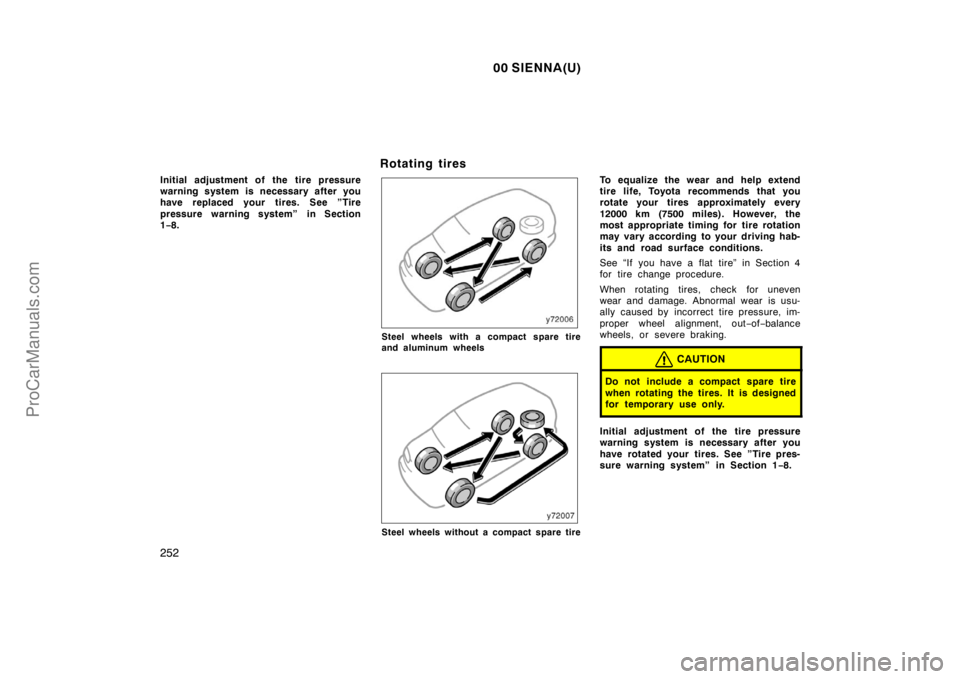
Rotating tires
Steel wheels with a compact spare tire
and aluminum wheels
Steel wheels without a compact spare tire
To equalize the wear and help extend
tire life, Toyota recommends that you
rotate your tires approximately every
12000 km (7500 miles). However, the
most appropriate timing for tire rotation
may vary according to your driving hab-
its and road surface conditions.
See “If you have a flat tire” in Section 4
for tire change procedure.
When rotating tires, check for uneven
wear and damage. Abnormal wear is usu-
ally caused by incorrect tire pressure, im-
proper wheel alignment, out−of−balance
wheels, or severe braking.
CAUTION
Do not include a compact spare tire
when rotating the tires. It is designed
for temporary use only.
Initial adjustment of the tire pressure
warning system is necessary after you
have rotated your tires. See ”Tire pres-
sure warning system” in Section 1−8.
ProCarManuals.com