Page 94 of 282
00 SIENNA(U)
88
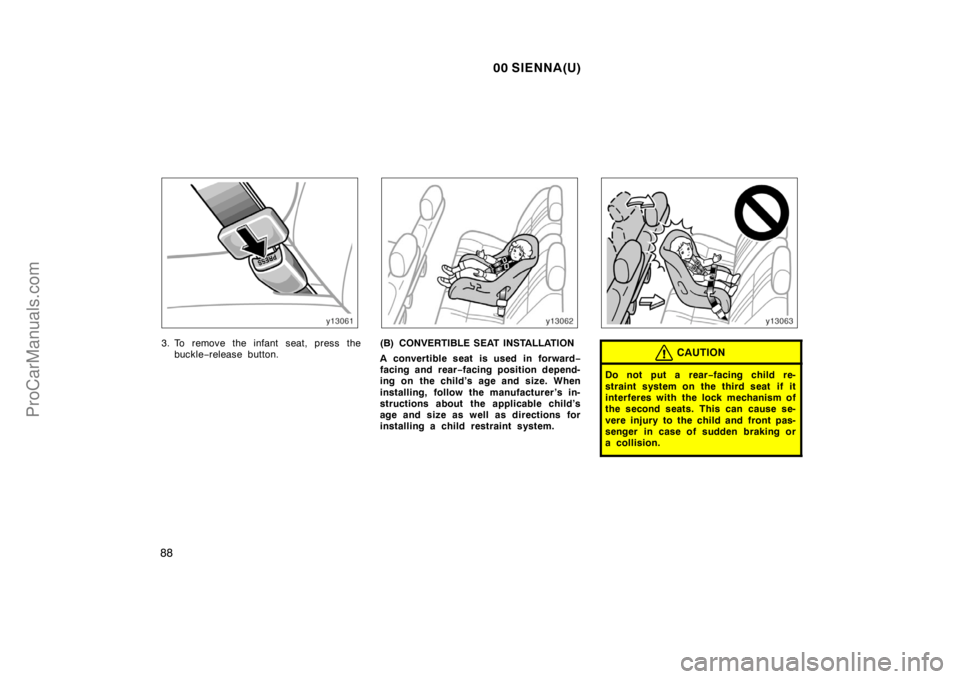
3. To remove the infant seat, press the
buckle−release button.(B) CONVERTIBLE SEAT INSTALLATION
A convertible seat is used in forward−
facing and rear−facing position depend-
ing on the child’s age and size. When
installing, follow the manufacturer’s in-
structions about the applicable child’s
age and size as well as directions for
installing a child restraint system.CAUTION
Do not put a rear−facing child re-
straint system on the third seat if it
interferes with the lock mechanism of
the second seats. This can cause se-
vere injury to the child and front pas-
senger in case of sudden braking or
a collision.
ProCarManuals.com
Page 97 of 282
00 SIENNA(U)
91
CAUTION
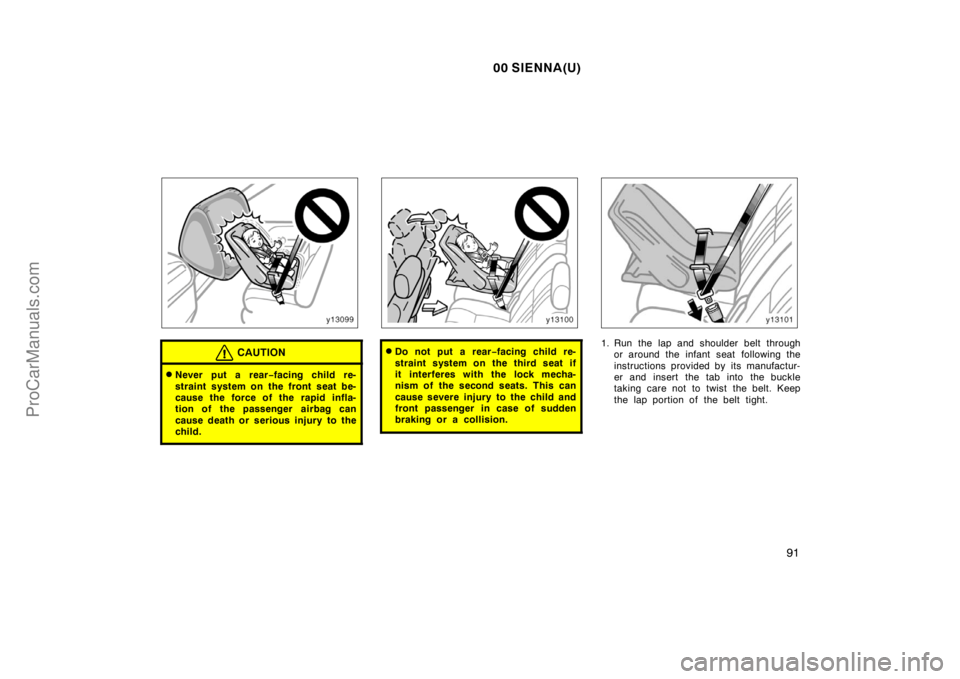
�Never put a rear−facing child re-
straint system on the front seat be-
cause the force of the rapid infla-
tion of the passenger airbag can
cause death or serious injury to the
child.
�Do not put a rear−facing child re-
straint system on the third seat if
it interferes with the lock mecha-
nism of the second seats. This can
cause severe injury to the child and
front passenger in case of sudden
braking or a collision.1. Run the lap and shoulder belt through
or around the infant seat following the
instructions provided by its manufactur-
er and insert the tab into the buckle
taking care not to twist the belt. Keep
the lap portion of the belt tight.
ProCarManuals.com
Page 100 of 282
00 SIENNA(U)
94
CAUTION
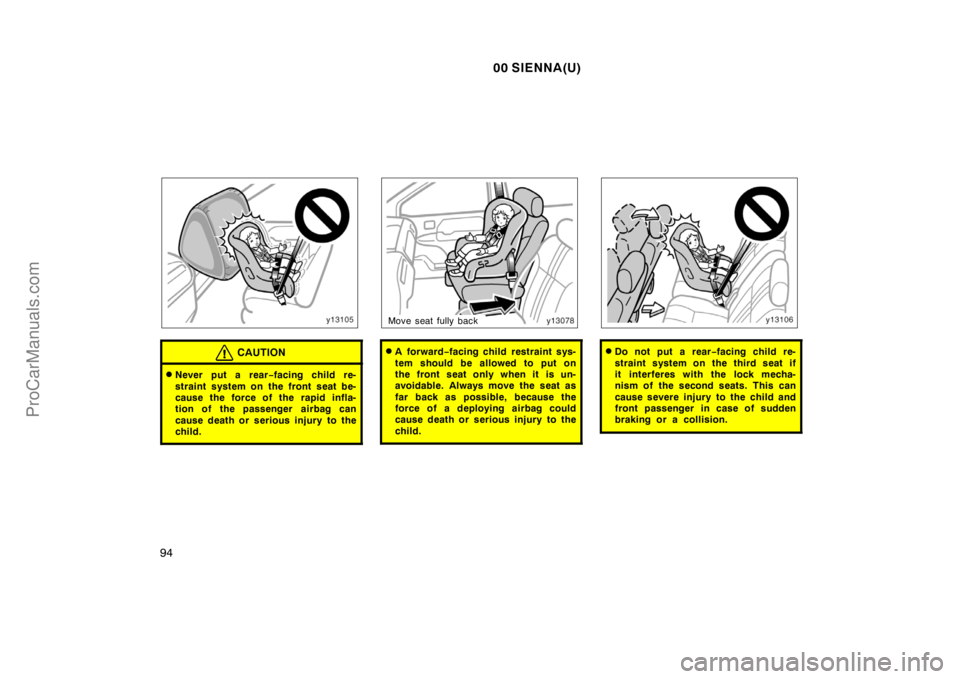
�Never put a rear−facing child re-
straint system on the front seat be-
cause the force of the rapid infla-
tion of the passenger airbag can
cause death or serious injury to the
child.
Move seat fully back
�A for war d−facing child restraint sys-
tem should be allowed to put on
the front seat only when it is un-
avoidable. Always move the seat as
far back as possible, because the
force of a deploying airbag could
cause death or serious injury to the
child.�Do not put a rear−facing child re-
straint system on the third seat if
it interferes with the lock mecha-
nism of the second seats. This can
cause severe injury to the child and
front passenger in case of sudden
braking or a collision.
ProCarManuals.com
Page 169 of 282
00 SIENNA(U)
163
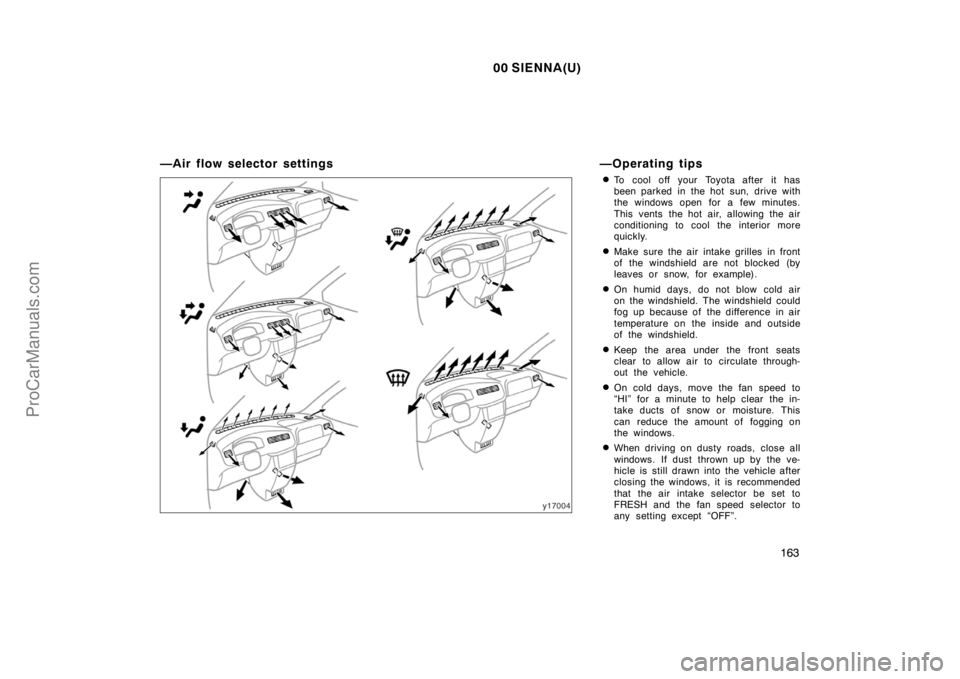
—Air flow selector settings —Operating tips
�To cool off your Toyota after it has
been parked in the hot sun, drive with
the windows open for a few minutes.
This vents the hot air, allowing the air
conditioning to cool the interior more
quickly.
�Make sure the air intake grilles in front
of the windshield are not blocked (by
leaves or snow, for example).
�On humid days, do not blow cold air
on the windshield. The windshield could
fog up because of the difference in air
temperature on the inside and outside
of the windshield.
�Keep the area under the front seats
clear to allow air to circulate through-
out the vehicle.
�On cold days, move the fan speed to
“HI” for a minute to help clear the in-
take ducts of snow or moisture. This
can reduce the amount of fogging on
the windows.
�When driving on dusty roads, close all
windows. If dust thrown up by the ve-
hicle is still drawn into the vehicle after
closing the windows, it is recommended
that the air intake selector be set to
FRESH and the fan speed selector to
any setting except “OFF”.
ProCarManuals.com
Page 198 of 282
00 SIENNA(U)
192
Luggage stowage precautions
When stowing luggage or cargo in the
vehicle, observe the following:
�Put luggage or cargo in the luggage
compartment when at all possible. Be
sure all items are secured in place.
�Be careful to keep the vehicle bal-
anced. Locating the weight as far for-
ward as possible helps maintain bal-
ance.
�For better fuel economy, do not carry
unneeded weight.
CAUTION
�To prevent luggage or packages
from sliding forward during braking,
do not stack anything in the lug-
gage compartment higher than the
seatbacks. Keep luggage or pack-
ages low, as close to the floor as
possible.
�Never allow anyone to ride in the
luggage compartment. It is not de-
signed for passengers. They should
ride in their seats with their seat
belts properly fastened. Otherwise,
they are much more likely to suffer
serious bodily injury, in the event
of sudden braking or a collision.
�Do not drive with objects left on
top of the instrument panel. They
may interfere with the driver’s field
of view. Or they may move during
sharp vehicle acceleration or turn-
ing, and impair the driver’s control
of the vehicle. In an accident they
may injure the vehicle occupants.
NOTICE
Do not load the vehicle beyond the
vehicle capacity weight specified in
Section 8.
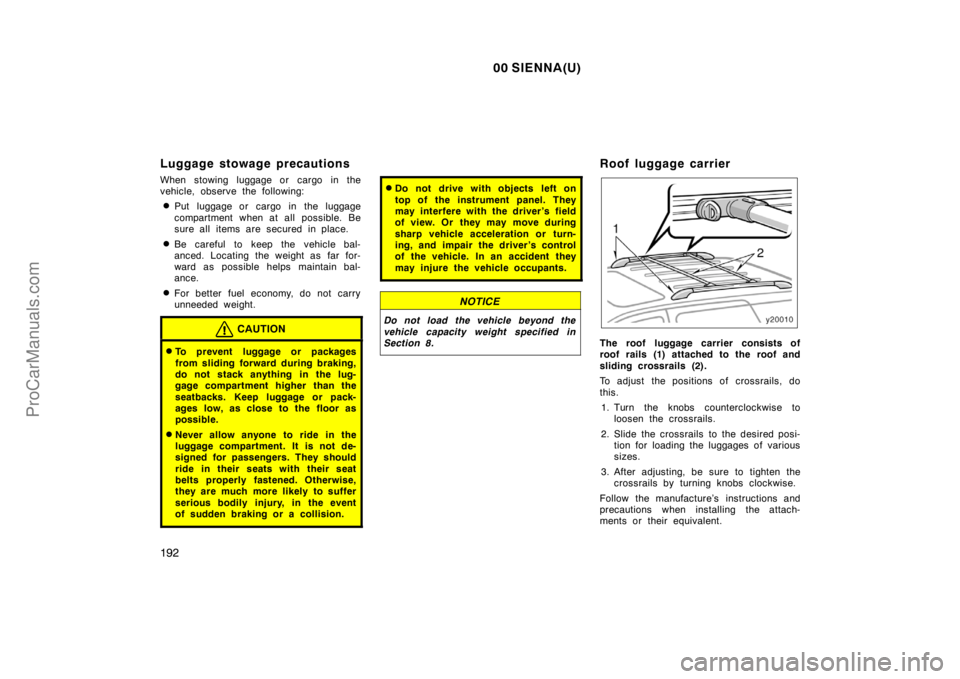
Roof luggage carrier
The roof luggage carrier consists of
roof rails (1) attached to the roof and
sliding crossrails (2).
To adjust the positions of crossrails, do
this.
1. Turn the knobs counterclockwise to
loosen the crossrails.
2. Slide the crossrails to the desired posi-
tion for loading the luggages of various
sizes.
3. After adjusting, be sure to tighten the
crossrails by turning knobs clockwise.
Follow the manufacture’s instructions and
precautions when installing the attach-
ments or their equivalent.
ProCarManuals.com
Page 242 of 282

00 SIENNA(U)
236
Lights
Make sure the headlights, stop lights, tail
lights, turn signal lights, and other lights
are all working. Check headlight aim.
Service reminder indicators and warning
buzzers
Check that all service reminder indicators
and warning buzzers function properly.
Steering wheel
Be alert for changes in steering condition,
such as hard steering or strange noise.
Seats
Check that all seat controls such as seat
adjusters, seatback recliner, etc. operate
smoothly and that all latches lock securely
in any position. Check that the head re-
straints move up and down smoothly and
that the locks hold securely in any latched
position. For folding−down rear seatbacks
and detachable rear seats, check that the
latches lock securely.
Seat belts
Check that the seat belt system such as
buckles, retractors and anchors operate
properly and smoothly. Make sure the belt
webbing is not cut, frayed, worn or dam-
aged.Accelerator pedal
Check the pedal for smooth operation and
uneven pedal effort or catching.
Brake pedal
Check the pedal for smooth operation and
that the pedal has the proper clearance.
Check the brake booster function.
Brakes
At a safe place, check that the brakes do
not pull to one side when applied.
Parking brake
Check that the pedal has the proper travel
and that, on a safe incline, your vehicle
is held securely with only the parking
brake applied.
Automatic transmission “Park” mecha-
nism
On a safe incline, check that your vehicle
is held securely with the selector lever in
“P” position and all brakes released.IN THE ENGINE COMPARTMENT
Items listed below should be checked
from time to time, e.g. each time when
refueling.
Washer fluid
Make sure there is sufficient fluid in the
tank. See Section 7−3 for additional infor-
mation.
Engine coolant level
Make sure the coolant level is between
the “FULL” and “LOW” lines on the see−
through reservoir when the engine is cold.
See Section 7−2 for additional information.
Battery electrolyte level
Make sure the electrolyte level of all bat-
tery cells is between upper and lower lev-
el lines on the case. Add only distilled
water when replenishing. See Section 7−3
for additional information.
Brake fluid level
Make sure the brake fluid level is correct.
See Section 7−2 for additional information.
Engine oil level
Check the level on the dipstick with the
engine turned off and the vehicle parked
on a level spot. See Section 7−2 for addi-
tional information.
ProCarManuals.com
Page:
< prev 1-8 9-16 17-24