2000 TOYOTA LAND CRUISER overheating
[x] Cancel search: overheatingPage 22 of 235
L/C 100_U
44 2000 L/C 100 (OM60866U)
For your safety and comfort, adjust the
head restraint before driving.
To raise: Pull it up.
To lower: Push it down while pressing the
lock release button.
Front head restraint only—You can also
move the head restraint forward or back-
ward. If such adjustment is desired, pull
or push the head restraint.
Rear center head restraint—When an oc-
cupant sits on the rear center seat, al-
ways pull up the rear center head re-
straint to the lock position.
The head restraint is most effective when
it is close to your head. Therefore, using
a cushion on the seatback is not recom-
mended.
CAUTION
Adjust the center of the head re-
straint so that it is closest to the
top of your ears.
After adjusting the head restraint,
make sure it is locked in position.
Do not drive with the head re-
straints removed.
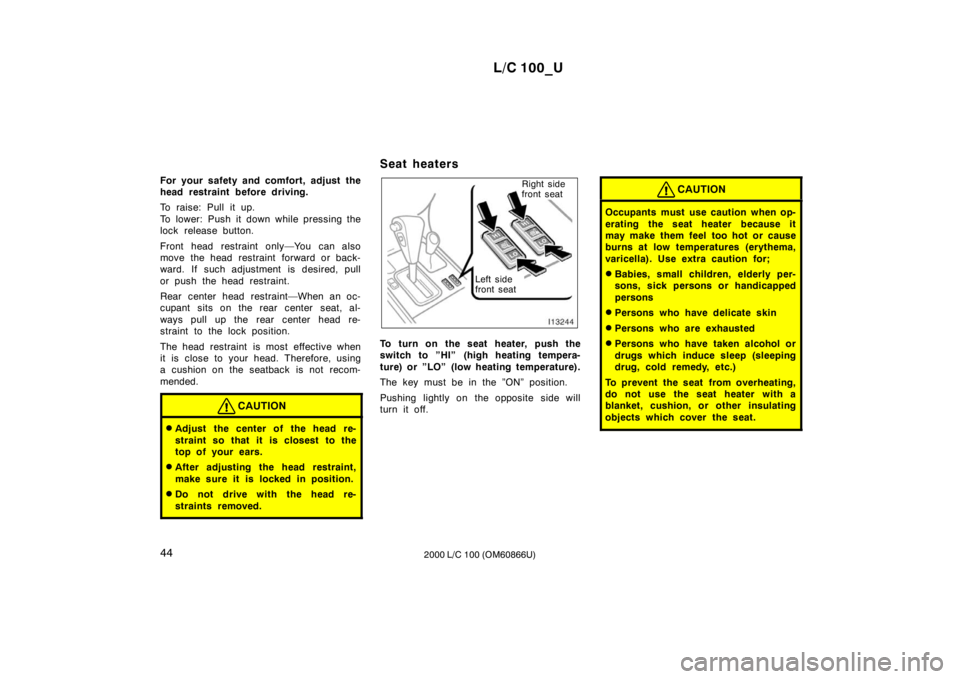
Seat heaters
Left side
front seat Right side
front seat
To turn on the seat heater, push the
switch to ”HI” (high heating tempera-
ture) or ”LO” (low heating temperature).
The key must be in the ”ON” position.
Pushing lightly on the opposite side will
turn it off.
CAUTION
Occupants must use caution when op-
erating the seat heater because it
may make them feel too hot or cause
burns at low temperatures (erythema,
varicella). Use extra caution for; Babies, small children, elderly per-
sons, sick persons or handicapped
persons
Persons who have delicate skin
Persons who are exhausted
Persons who have taken alcohol or
drugs which induce sleep (sleeping
drug, cold remedy, etc.)
To prevent the seat from overheating,
do not use the seat heater with a
blanket, cushion, or other insulating
objects which cover the seat.
Page 85 of 235
L/C 100_U107
2000 L/C 100 (OM60866U)
CAUTION
Never put your foot on the accelera-
tor pedal while shifting.
3. Release the parking brake and brake
pedal. Depress the accelerator pedal
slowly for smooth starting.
(c) Using engine braking
To use engine braking, you can downshift
the transmission as follows:
Turn off the overdrive switch. The ”O/D
OFF” indicator light will come on and
the transmission will downshift to the
third gear.
Shift into the ”2” position. The trans-
mission will downshift to the second
gear when the vehicle speed drops
down to or lower than following speed
for second gear, and more powerful
engine braking will be obtained.
Four –wheel drive control lever
in ”H” 112 km/h (70 mph) . . . . . . . . . . .
Four –wheel drive control lever
in ”L” 39 km/h (24 mph) . . . . . . . . . . .
Shift into the ”L” position. The trans-
mission will downshift to the first gear
when the vehicle speed drops down to
or lower than following speed for ”L”
position and maximum engine braking
will be applied.
Four –wheel drive control lever
in ”H” 57 km/h (35 mph) . . . . . . . . . . .
Four –wheel drive control lever
in ”L” 12 km/h (7 mph) . . . . . . . . . . .
When the cruise control is being used,
even if you downshift the transmission by
turning off the overdrive switch, engine
braking will not be applied because the
cruise control is not cancelled.
For ways to decrease the vehicle speed,
see ”Cruise control” in this section.
CAUTION
Be careful when downshifting on a
slippery surface. Abrupt shifting
could cause the vehicle to spin or
skid.
(d) Using ”2” and ”L” positions
The ”2” and ”L” positions are used for
strong engine braking as described pre-
viously. With the selector lever in ”2” or ”L”, you
can start the vehicle in motion as with the
lever in ”D”.
With the selector lever in ”2”, the vehicle
will start in the first gear and automatical-
ly shift to the second gear.
With the selector lever in ”L”, the trans-
mission is engaged in the first gear.
NOTICE
Be careful not to overrev the en-
gine. Watch the tachometer to keep
engine rpm from going into the red
zone. The approximate maximum al-
lowable speed for each position is
given below for your reference:
km/h (mph)
Transmission Transfer L H
2 42 (26) 104 (65) . . . . . . .
L 23 (14) 57 (35) . . . . . . .
Do not continue hill climbing or
hard towing for a long time in the
”2” or ”L” position. This may cause
severe automatic transmission dam-
age from overheating. To prevent
such damage, ”D” position should
be used in hill climbing or hard
towing.
Page 162 of 235
L/C 100_U
198 2000 L/C 100 (OM60866U)
If you cannot incr
ease the en-
gine speed
If the engine speed does not increase
when the accelerator pedal is de-
pressed, the electronic throttle control
system may be faulty. Move the vehicle
to a safe place by means of creeping
and call a Toyota dealer for assistance:
1. Depress the brake pedal and shift to the ”D” position.
2. Gradually release the brake pedal, and the vehicle starts to move by creeping.
After arriving at a safe place, stop the
vehicle and call a Toyota dealer for
assistance.
CAUTION
The above method of moving the
vehicle is for emergency. Use it
only for moving minimum distances
to a safe place.
Be especially careful to prevent er-
roneous pedal operation.
If your vehicle overheats
If your engine coolant temperature
gauge indicates overheating, if you ex-
perience a loss of power, or if you hear
a loud knocking or pinging noise, the
engine has probably overheated. You
should follow this procedure...
1. Pull safely off the road, stop the ve- hicle and turn on your emergency
flashers. Put the transmission in ”P”
and apply the parking brake. Turn off
the air conditioning if it is being used.
2. If coolant or steam is boiling out of the radiator or reservoir, stop the engine.
Wait until the steam subsides before
opening the hood. If there is no coolant
boiling over or steam, leave the engine
running.
CAUTION
To help avoid personal injury, keep
the hood closed until there is no
steam. Escaping steam or coolant is
a sign of very high pressure.
3. Visually check to see if the engine drive belt (fan belt) is broken or loose.
Look for obvious coolant leaks from the
radiator, hoses, and under the vehicle.
However, note that water draining from
the air conditioning is normal if it has
been used.
CAUTION
When the engine is running, keep
hands and clothing away from the
moving fan and engine drive belts.
4. If the engine drive belt is broken or thecoolant is leaking, stop the engine im-
mediately. Call a Toyota dealer for as-
sistance.
5. If the engine drive belt is O.K. and there are no obvious leaks, you may
help the engine cool down more quickly
by running it at about 1500 rpm for a
few minutes with the accelerator pedal
lightly depressed.
6. Check the coolant reservoir. If it is dry, add coolant to the reservoir while the
engine is running. Fill it about half full.