2000 TOYOTA LAND CRUISER ECU
[x] Cancel search: ECUPage 165 of 235
L/C 100_U201
2000 L/C 100 (OM60866U)
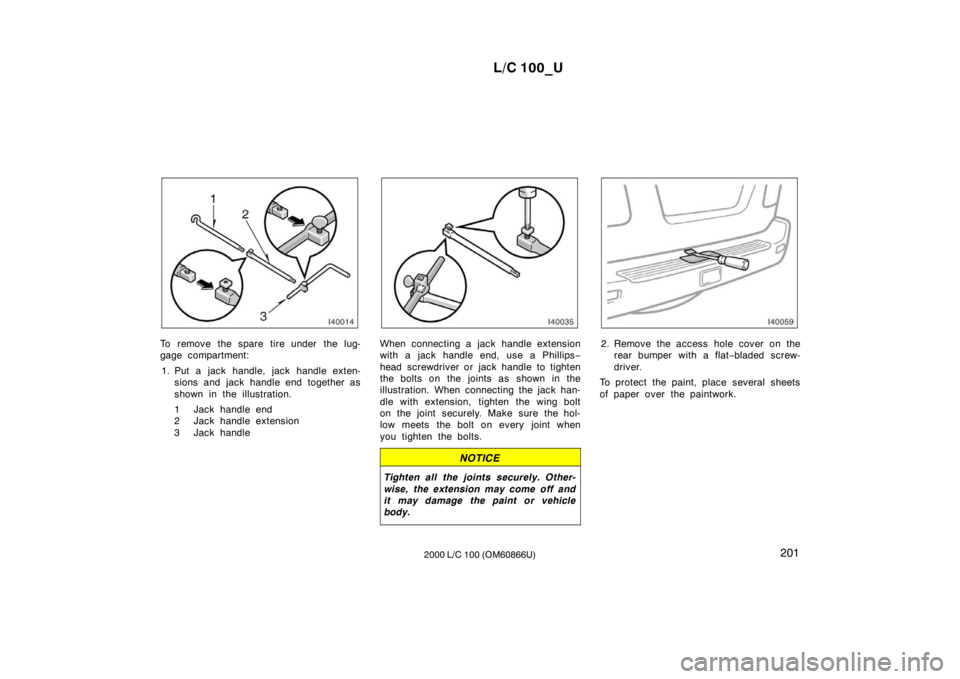
To remove the spare tire under the lug-
gage compartment:
1. Put a jack handle, jack handle exten- sions and jack handle end together as
shown in the illustration.
1 Jack handle end
2 Jack handle extension
3 Jack handleWhen connecting a jack handle extension
with a jack handle end, use a Phi llips−
head screwdriver or jack handle to tighten
the bolts on the joints as shown in the
illustration. When connecting the jack han-
dle with extension, tighten the wing bolt
on the joint securely. Make sure the hol-
low meets the bolt on every joint when
you tighten the bolts.
NOTICE
Tighten all the joints securely. Other-
wise, the extension may come off and
it may damage the paint or vehicle
body.
2. Remove the access hole cover on the rear bumper with a flat −bladed screw-
driver.
To protect the paint, place several sheets
of paper over the paintwork.
Page 166 of 235
L/C 100_U
202 2000 L/C 100 (OM60866U)
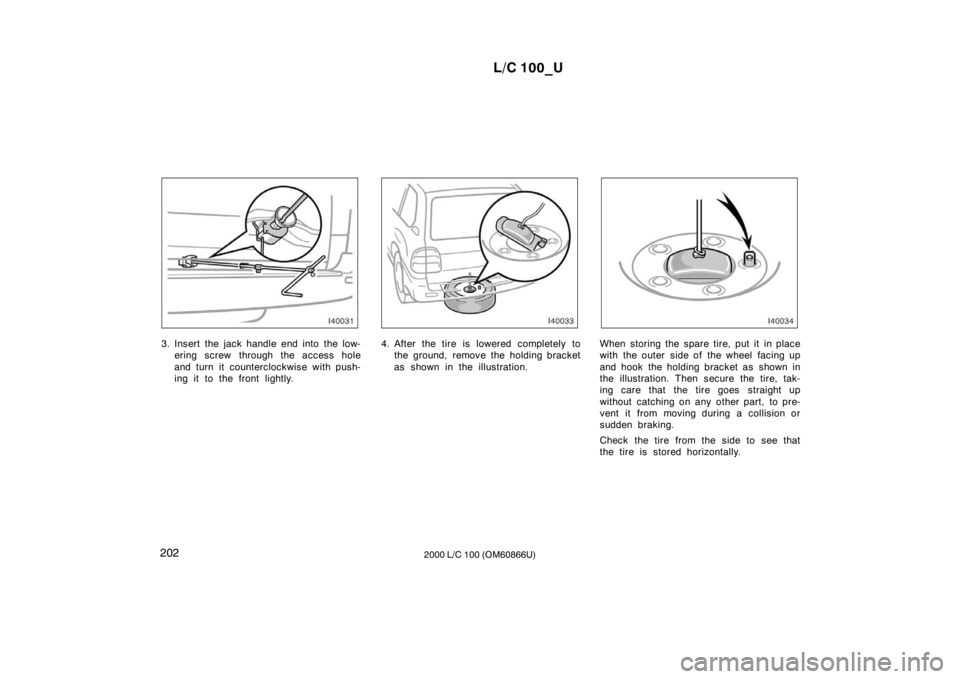
3. Insert the jack handle end into the low-
ering screw through the access hole
and turn it counterclockwise with push-
ing it to the front lightly.4. After the tire is lowered completely tothe ground, remove the holding bracket
as shown in the illustration.When storing the spare tire, put it in place
with the outer side of the wheel facing up
and hook the holding bracket as shown in
the illustration. Then secure the tire, tak-
ing care that the tire goes straight up
without catching on any other part, to pre-
vent it from moving during a collision or
sudden braking.
Check the tire from the side to see that
the tire is stored horizontally.
Page 169 of 235
L/C 100_U205
2000 L/C 100 (OM60866U)
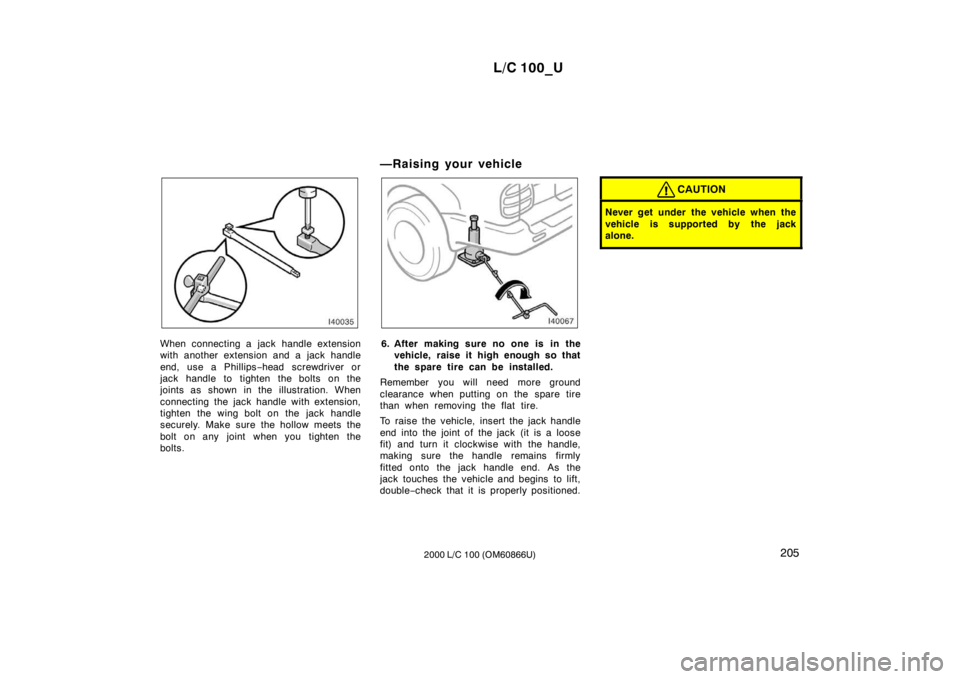
When connecting a jack handle extension
with another extension and a jack handle
end, use a Ph illips−head screwdriver or
jack handle to tighten the bolts on the
joints as shown in the illustration. When
connecting the jack handle with extension,
tighten the wing bolt on the jack handle
securely. Make sure the hollow meets the
bolt on any joint when you tighten the
bolts. —Raising your vehicle6. After making sure no one is in the
vehicle, raise it high enough so that
the spare tire can be installed.
Remember you will need more ground
clearance when putting on the spare tire
than when removing the flat tire.
To raise the vehicle, insert the jack handle
end into the joint of the jack (it is a loose
fit) and turn it clockwise with the handle,
making sure the handle remains firmly
fitted onto the jack handle end. As the
jack touches the vehicle and begins to lift,
double −check that it is properly positioned.
CAUTION
Never get under the vehicle when the
vehicle is supported by the jack
alone.
Page 171 of 235
L/C 100_U207
2000 L/C 100 (OM60866U)
—Lowering your vehicle
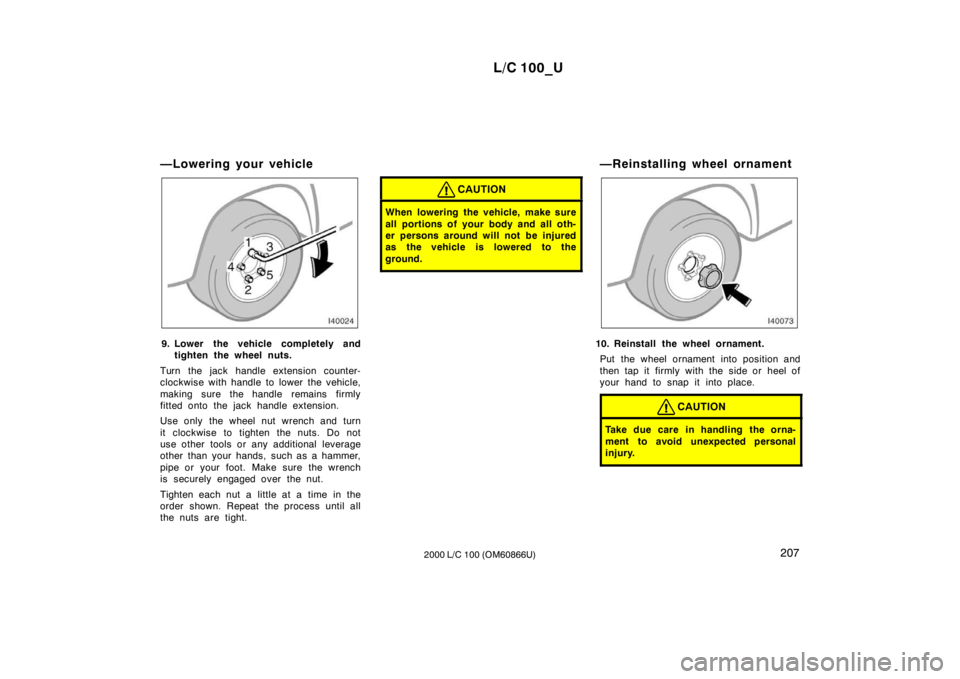
9. Lower the vehicle completely and
tighten the wheel nuts.
Turn the jack handle extension counter-
clockwise with handle to lower the vehicle,
making sure the handle remains firmly
fitted onto the jack handle extension.
Use only the wheel nut wrench and turn
it clockwise to tighten the nuts. Do not
use other tools or any additional leverage
other than your hands, such as a hammer,
pipe or your foot. Make sure the wrench
is securely engaged over the nut.
Tighten each nut a little at a time in the
order shown. Repeat the process until all
the nuts are tight.
CAUTION
When lowering the vehicle, make sure
all portions of your body and all oth-
er persons around will not be injured
as the vehicle is lowered to the
ground.
—Reinstalling wheel ornament
10. Reinstall the wheel ornament. Put the wheel ornament into position and
then tap it firmly with the side or heel of
your hand to snap it into place.
CAUTION
Take due care in handling the orna-
ment to avoid unexpected personal
injury.
Page 172 of 235
L/C 100_U
208 2000 L/C 100 (OM60866U)
—After changing wheels
11. Check the air pressure of the re- placed tire.
Adjust the air pressure to the specification
designated in Section 8. If the pressure is
lower, drive slowly to the nearest service
station and fill to the correct pressure.
Do not forget to reinstall the tire inflation
valve cap as dirt and moisture could get
into the valve core and possibly cause air
leakage. If the cap is missing, have a new
one put on as soon as possible.
12. Restow all the tools, jack and flat tire securely.
As soon after changing wheels as pos-
sible, tighten the wheel nuts to the torque
specified in Section 8 with a torque
wrench. Have a technician repair the flat
tire.
This is the same procedure for changing
or rotating your tires.
CAUTION
Before driving, make sure all the
tools, jack and flat tire are securely
in place in their storage location to
reduce the possibility of personal in-
jury during a collision or s udden
braking.
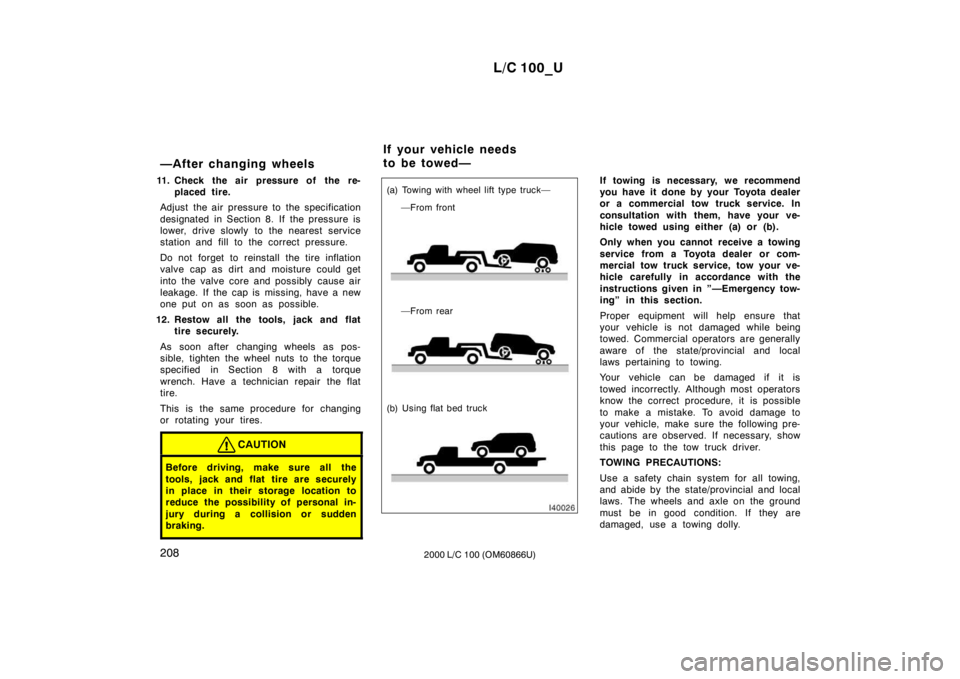
(a) Towing with wheel lift type truck—
—From rear
(b) Using flat bed truck —From front
If towing is necessary, we recommend
you have it done by your Toyota dealer
or a commercial tow truck service. In
consultation with them, have your ve-
hicle towed using either (a) or (b).
Only when you cannot receive a towing
service from a Toyota dealer or com-
mercial tow truck service, tow your ve-
hicle carefully in accordance with the
instructions given in ”—Emergency tow-
ing” in this section.
Proper equipment will help ensure that
your vehicle is not damaged while being
towed. Commercial operators are generally
aware of the state/provincial and local
laws pertaining to towing.
Your vehicle can be damaged if it is
towed incorrectly. Although most operators
know the correct procedure, it is possible
to make a mistake. To avoid damage to
your vehicle, make sure the following pre-
cautions are observed. If necessary, show
this page to the tow truck driver.
TOWING PRECAUTIONS:
Use a safety chain system for all towing,
and abide by the state/provincial and local
laws. The wheels and axle on the ground
must be in good condition. If they are
damaged, use a towing dolly.
If your vehicle needs
to be towed—
Page 174 of 235
L/C 100_U
210 2000 L/C 100 (OM60866U)
If towing is necessary, we recommend
you to have it done by your Toyota
dealer or a commercial tow truck ser-
vice.
If towing service is not available in an
emergency, your vehicle may be tempo-
rarily towed by a cable or chain se-
cured to one of the following parts:
Front: Front emergency towing hook
Rear: Rear emergency towing hook
Use extreme caution when towing the
vehicle.
A driver must be in the vehicle to steer it
and operate the brakes.
Towing in this manner may be done only
on hard
−surfaced roads for a short dis-
tance and at low speeds. Also, the
wheels, axles, drive train, steering and
brakes must all be in good condition.
CAUTION
Use extreme caution when towing ve-
hicle. Avoid sudden starts or erratic
driving maneuvers which would place
excessive stress on the emergency
towing hook and towing cable or
chain. The hook and towing cable or
chain may break and cause serious
injury or damage.
NOTICE
Do not use front and rear eyelets.
It is not designed for towing.
Use only a cable or chain specifi-
cally intended for use in towing ve-
hicles. Securely fasten the cable or
chain to the towing hook provided.
Before towing, release the parking brake
and put the transmission in ”N”. Unlock
the center differential. The key must be in
”ACC” (engine off) or ”ON” (engine run-
ning).
CAUTION
If the engine is not running, the pow-
er assist for the brakes and steering
will not work so steering and braking
will be much harder than usual.
Page 185 of 235
L/C 100_U221
2000 L/C 100 (OM60866U)
If you are a skilled do
−it−yourself
mechanic, the Toyota service manuals are
recommended. Please be aware that do −it−yourself maintenance can affect your
warranty coverage. See ”Owner ’s Warranty
Information Booklet” or ”Owner ’s Manual
Supplement” for the details. General maintenance
Listed below are the general maintenance
items that should be performed as fre-
quently as specified. In addition to check-
ing the items listed, if you notice any
unusual noise, smell or vibration, you
should investigate the cause or take your
vehicle to your Toyota dealer or a quali-
fied service shop immediately. It is recom-
mended that any problem you notice be
brought to the attention of your dealer or
the qualified service shop for their advice.
CAUTION
Make these checks only where ade-
quate ventilation can be obtained if
you run the engine.
OUTSIDE THE VEHICLE
Items listed below should be performed
from time to time, unless otherwise
specified.
Tire pressure
Check the pressure with a gauge every
two weeks, or at least once a month. See
Section 7
−2 for additional information. Tire surface and wheel nuts
Check the tires carefully for cuts, damage
or excessive wear. See Section 7
−2 for
additional information. When checking the
tires, make sure no nuts are missing, and
check the nuts for looseness. Tighten
them if necessary.
Tire rotation
Rotate the tires every 12000 km (7500
miles). See Section 7 −2 for additional in-
formation.
Fluid leaks
Check underneath for leaking fuel, oil, wa-
ter or other fluid after the vehicle has
been parked for a while. If you smell fuel
fumes or notice any leak, have the cause
found and corrected immediately.
Doors and engine hood
Check that all doors and back door oper-
ate smoothly and all latches lock securely.
Make sure the engine hood secondary
latch secures the hood from opening when
the primary latch is released.
Page 186 of 235

L/C 100_U
222 2000 L/C 100 (OM60866U)
INSIDE THE VEHICLE
Items listed below should be checked
regularly, e.g. while performing periodic
services, cleaning the vehicle, etc.
Lights
Make sure the headlights, stop lights, tail
lights, turn signal lights, and other lights
are all working. Check headlight aim.
Service reminder indicators and warning
buzzers
Check that all service reminder indicators
and warning buzzers function properly.
Steering wheel
Be alert for changes in steering condition,
such as hard steering or strange noise.
Seats
Check that all front seat controls such as
seat adjusters, seatback recliner, etc. op-
erate smoothly and that all latches lock
securely in any position. Check that the
head restraint move up and down smooth-
ly and that the locks hold securely in any
latched position. For folding
−down rear
seatbacks, swing −up rear seat cushions
and detachable third seats, check that the
latches lock securely. Seat belts
Check that the seat belt system such as
buckles, retractors and anchors operate
properly and smoothly. Make sure the belt
webbing is not cut, frayed, worn or dam-aged.
Accelerator pedal
Check the pedal for smooth operation and
uneven pedal effort or catching.
Brake pedal
Check the pedal for smooth operation and
that the pedal has the proper clearance.
Check the brake booster function.
Brakes
At a safe place, check that the brakes do
not pull to one side when applied.
Parking brake
Check that the lever has the proper travel
and that, on a safe incline, your vehicle
is held securely with only the parking
brake applied.
Automatic transmission ”Park” mecha-
nism
Check the lock release button of the se-
lector lever for proper and smooth opera-
tion. On a safe incline, check that your
vehicle is held securely with the selector
lever in ”P” position and all brakes re-
leased.
IN THE ENGINE COMPARTMENT
Items listed below should be checked
from time to time, e.g. each time when
refueling.
Washer fluid
Make sure there is sufficient fluid in the
tank. See Section 7
−3 for additional in-
formation.
Engine coolant level
Make sure the coolant level is between
the ”FULL” and ”LOW” lines on the see −
through reservoir when the engine is cold.
See Section 7 −2 for additional information.
Battery electrolyte level
Make sure the electrolyte level of all bat-
tery cells is between upper and lower lev-
el lines on the case. Add only distilled
water when replenishing. See Section 7 −3
for additional information.