2000 TOYOTA LAND CRUISER warning light
[x] Cancel search: warning lightPage 147 of 235
L/C 100_U169
2000 L/C 100 (OM60866U)
For detailed information on oil level check,
see ”Checking the engine oil level” in Sec-
tion 7
−2.
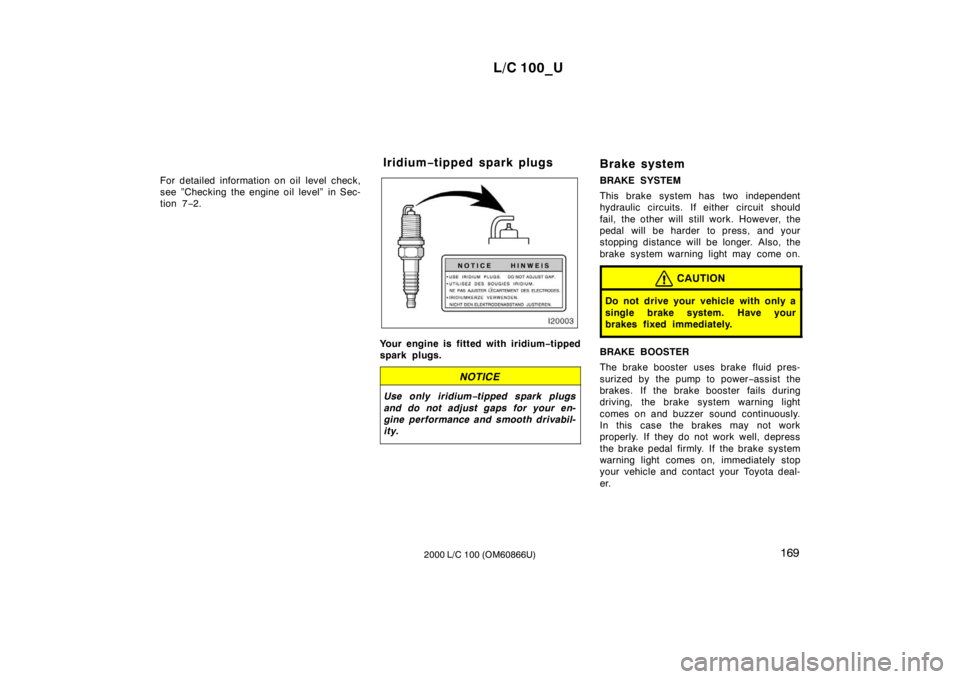
Your engine is fitted with iridium −tipped
spark plugs.
NOTICE
Use only iridium −tipped spark plugs
and do not adjust gaps for your en-
gine performance and smooth drivabil-
ity.
Brake system
BRAKE SYSTEM
This brake system has two independent
hydraulic circuits. If either circuit should
fail, the other will still work. However, the
pedal will be harder to press, and your
stopping distance will be longer. Also, the
brake system warning light may come on.
CAUTION
Do not drive your vehicle with only a
single brake system. Have your
brakes fixed immediately.
BRAKE BOOSTER
The brake booster uses brake fluid pres-
surized by the pump to power −assist the
brakes. If the brake booster fails during
driving, the brake system warning light
comes on and buzzer sound continuously.
In this case the brakes may not work
properly. If they do not work well, depress
the brake pedal firmly. If the brake system
warning light comes on, immediately stop
your vehicle and contact your Toyota deal-
er.
Iridium
−tipped spark plugs
Page 148 of 235
L/C 100_U
170 2000 L/C 100 (OM60866U)
There may be the case that the brake
system warning light stays on for a
bout
60 seconds after the engine is started. It
is normal if the light goes out after a
while.
Depressing the brake pedal repeatedly
may turn on the brake system warning
light and buzzer. It is normal if the light
goes out and the buzzer stops sounding
after a few seconds.
You may hear a small sound in the engine
compartment after the engine is started or
the brake pedal is depressed repeatedly.
This is a pump pulsating sound of the
brake system, and it is not a malfunction.
CAUTION
Do not pump the brake pedal if the
engine stalls. Each push on the
pedal uses up your brake fluid
pressure reserve.
Even if the power assist is com-
pletely lost, the brakes will still
work. But you will have to push the
pedal hard, much harder than nor-
mal. And your braking distance will
be longer.
ANTI −LOCK BRAKE SYSTEM
(with “ABS” warning light)
The anti −lock brake system is designed
to help prevent lock −up of the wheels
during a sudden braking or braking on
slippery road surfaces. This assists in
providing stability and steering perfor-
mance of the vehicle under these cir-
cumstances.
Effective way to press the ”ABS” brake
pedal: When the anti −lock brake system
function is in action, just hold the brake
pedal down more firmly. Especially in a
panic stop, you need to keep it de-
pressed more firmly, and do not pump
the brake. Pumping the brake pedal
makes the stopping distance longer.
The anti −lock brake system becomes op-
erative after the vehicle has accelerated
to a speed in excess of approximately 10
km/h (6 mph). It stops operating when the
vehicle decelerates to a speed below
approximately 5 km/h (3 mph).
Depressing the brake pedal on slippery
road surfaces such as on the manhole
cover, the steel plate under the construc-
tion, joints in the bridge, etc. on a rainy
day tends to activate the anti −lock brake
system. You may hear a click or motor sound in
the engine compartment for a few seconds
when the engine is started or just after
the vehicle is started. This means that the
anti
−lock brake system is in the self
check mode, and does not indicate a mal-
function.
When the anti −lock brake system is ac-
tivated, the following conditions may
occur, however, do not indicate a mal-
function of the system:
You may hear the anti −lock brake sys-
tem operating and feel the brake pedal
pulsating and the vibrations of the body
and steering wheel. You may also hear
the motor sound in the engine compart-
ment even after the vehicle is stopped.
At the end of the anti −lock brake sys-
tem activation, the brake pedal may
move a little forward.
Page 149 of 235
L/C 100_U171
2000 L/C 100 (OM60866U)
CAUTION
Do not overestimate the anti −lock
brake system: Although the anti −lock
brake system assists in providing ve-
hicle control, it is still important to
drive with all due care and maintain
a moderate speed and safe distance
from the vehicle in front of you, be-
cause there are limits to the vehicle
stability and effectiveness of steering
wheel operation even with the anti −
lock brake system on.
If tires grip performance exceeds its
capability, or if hydroplaning occurs
during high speed driving in the rain,
the anti −lock brake system does not
provide vehicle control.
Anti −lock brake system is not de-
signed to shorten the stopping dis-
tance: Always drive at the moderate
speed and maintain a safe distance
from the vehicle in front of you.
Compared with vehicles not fitted
with an anti −lock brake system, your
vehicle may require a longer stopping
distance in the following cases: Driving on rough, gravel or snow −
covered roads.
Driving with tire chains installed.
Driving over the steps such as the
joints on the road.
Driving on roads where the road
surface is pitted or has other differ-
ences in surface height.
Install all 4 tires of specified size at
designated pressure: The anti −lock
brake system detects vehicle speeds
using the speed sensors for respec-
tive wheels’ turning speeds. The use
of tires other than specified may fail
to detect the accurate turning speed,
resulting in a longer stopping dis-
tance.
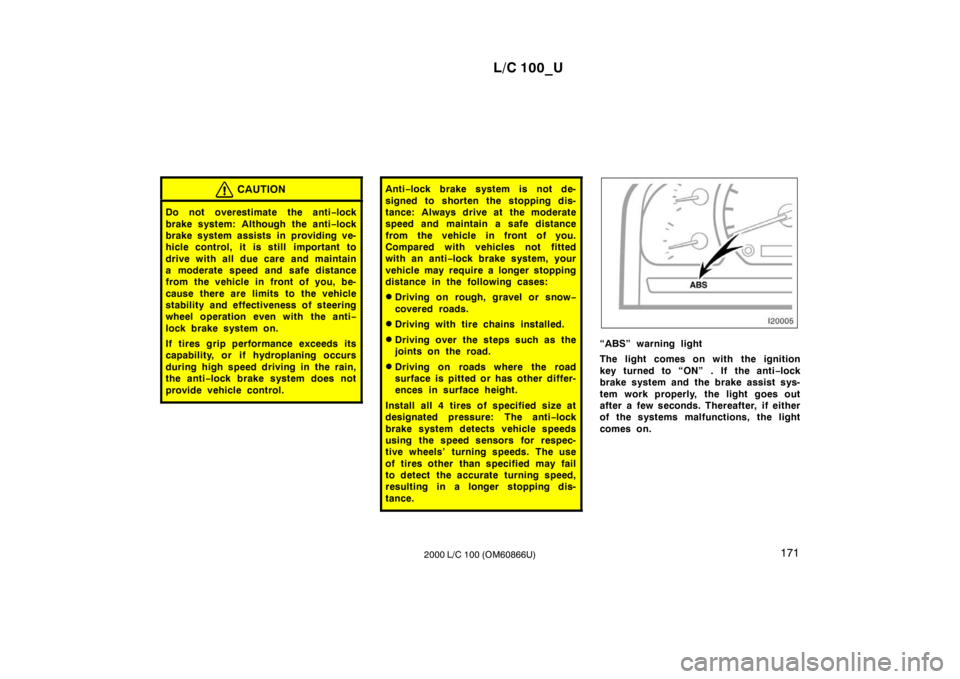
“ABS” warning light
The light comes on with the ignition
key turned to “ON” . If the anti −lock
brake system and the brake assist sys-
tem work properly, the light goes out
after a few seconds. Thereafter, if either
of the systems malfunctions, the light
comes on.
Page 150 of 235
L/C 100_U
172 2000 L/C 100 (OM60866U)
When the “ABS” warning light is on (and
the brake system warning light is off), the
anti
−lock brake system, the brake assist
system, the vehicle skid control system
and/or active traction control system do/
does not operate, but the brake system
still operates conventionally.
When the “ABS” warning light is on (and
the brake system warning light is off), the
anti −lock brake system does not operate
so that the wheels could lock up during
a sudden braking or braking on slippery
road surfaces.
If the following conditions occurs, this
indicates a malfunction somewhere in
the parts monitored by the warning
light system. Contact your Toyota deal-
er as soon as possible to service the
vehicle.
The light does not come on with the
ignition key turned to “ON”, or remainson.
The light comes on while driving.
If the light lit during driving goes out and
does not come on again, it is a normal
operation.
CAUTION
If the “ABS” warning light remains on
together with the brake system warn-
ing light, immediately stop your ve-
hicle at a safe place and contact your
Toyota dealer.
In this case, the vehicle may become
harder to control or skid during hard
braking or braking on slippery road
surfaces.
Either of the following conditions may
occur, but do not indicate the malfunc-
tion. The light may stay on for about 60
seconds after the engine is started. It
is normal if it goes out after a while.
Depressing the brake pedal repeatedly
may turn on the light. It is normal if it
goes off after a few seconds. DRUM
−IN −DISC TYPE PARKING BRAKE
SYSTEM
Your vehicle has a drum −in −disc type
parking brake system. This type of brake
system n eeds bedding −down of the brake
shoes periodically or whenever the parking
brake shoes and/or drums are replaced.
Have your Toyota dealer perform the bed-
ding −down.
BRAKE ASSIST SYSTEM
When you slam the brakes on, the
brake assist system judges as an emer-
gency stop and provides more powerful
braking for a driver who cannot hold
down the brake pedal firmly.
When you slam the brakes on, more pow-
erful braking will be applied. At this time,
you may hear a sound in the engine
compartment and feel the vibrations of the
brake pedal. This does not indicate a mal-
function.
The brake assist system becomes opera-
tive after the vehicle has accelerated to
a speed in excess of approximately 10
km/h (6 mph). It stops operating when the
vehicle decelerates to a speed below
approximately 5 km/h (3 mph).
Page 151 of 235
L/C 100_U173
2000 L/C 100 (OM60866U)
The brake assist system may not work for
about 60 seconds after the engine is
started.
For an explanation of this system’s warn-
ing light, see “Service reminder indicators
and warning buzzers” in Section 1
−5. Brake pad wear limit indicators
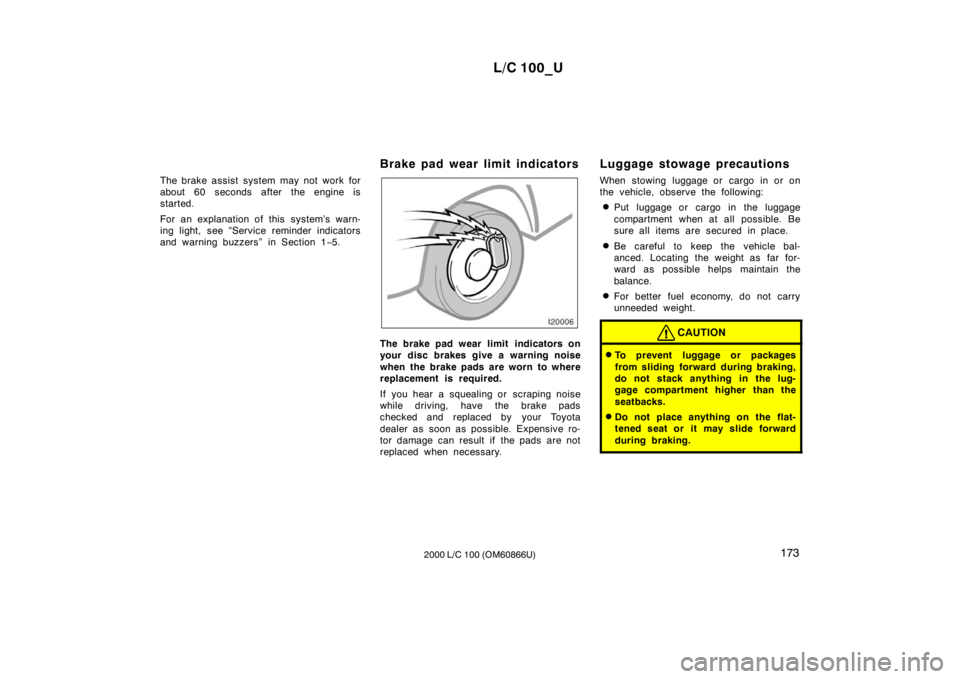
The brake pad wear limit indicators on
your disc brakes give a warning noise
when the brake pads are worn to where
replacement is required.
If you hear a squealing or scraping noise
while driving, have the brake pads
checked and replaced by your Toyota
dealer as soon as possible. Expensive ro-
tor damage can result if the pads are not
replaced when necessary. Luggage stowage pr
ecautions
When stowing luggage or cargo in or on
the vehicle, observe the following: Put luggage or cargo in the luggage
compartment when at all possible. Be
sure all items are secured in place.
Be careful to keep the vehicle bal-
anced. Locating the weight as far for-
ward as possible helps maintain the
balance.
For better fuel economy, do not carry
unneeded weight.CAUTION
To prevent luggage or packages
from sliding forward during braking,
do not stack anything in the lug-
gage compartment higher than the
seatbacks.
Do not place anything on the flat-
tened seat or it may slide forward
during braking.
Page 186 of 235
L/C 100_U
222 2000 L/C 100 (OM60866U)
INSIDE THE VEHICLE
Items listed below should be checked
regularly, e.g. while performing periodic
services, cleaning the vehicle, etc.
Lights
Make sure the headlights, stop lights, tail
lights, turn signal lights, and other lights
are all working. Check headlight aim.
Service reminder indicators and warning
buzzers
Check that all service reminder indicators
and warning buzzers function properly.
Steering wheel
Be alert for changes in steering condition,
such as hard steering or strange noise.
Seats
Check that all front seat controls such as
seat adjusters, seatback recliner, etc. op-
erate smoothly and that all latches lock
securely in any position. Check that the
head restraint move up and down smooth-
ly and that the locks hold securely in any
latched position. For folding
−down rear
seatbacks, swing −up rear seat cushions
and detachable third seats, check that the
latches lock securely. Seat belts
Check that the seat belt system such as
buckles, retractors and anchors operate
properly and smoothly. Make sure the belt
webbing is not cut, frayed, worn or dam-aged.
Accelerator pedal
Check the pedal for smooth operation and
uneven pedal effort or catching.
Brake pedal
Check the pedal for smooth operation and
that the pedal has the proper clearance.
Check the brake booster function.
Brakes
At a safe place, check that the brakes do
not pull to one side when applied.
Parking brake
Check that the lever has the proper travel
and that, on a safe incline, your vehicle
is held securely with only the parking
brake applied.
Automatic transmission ”Park” mecha-
nism
Check the lock release button of the se-
lector lever for proper and smooth opera-
tion. On a safe incline, check that your
vehicle is held securely with the selector
lever in ”P” position and all brakes re-
leased.
IN THE ENGINE COMPARTMENT
Items listed below should be checked
from time to time, e.g. each time when
refueling.
Washer fluid
Make sure there is sufficient fluid in the
tank. See Section 7
−3 for additional in-
formation.
Engine coolant level
Make sure the coolant level is between
the ”FULL” and ”LOW” lines on the see −
through reservoir when the engine is cold.
See Section 7 −2 for additional information.
Battery electrolyte level
Make sure the electrolyte level of all bat-
tery cells is between upper and lower lev-
el lines on the case. Add only distilled
water when replenishing. See Section 7 −3
for additional information.
Page 224 of 235

L/C 100_U
260 2000 L/C 100 (OM60866U)
16. HEAD (RH
−UPR) 20 A: Right−hand
headlight (high beam)
17. HEAD (LH −LWR) 10 A: Left−hand
headlight (low beam), front fog lights
18. HEAD (RH −LWR) 10 A: Right−hand
headlight (low beam)
19. MIRR 10 A: Power rear view mirror
20. SRS 15 A: SRS airbag system, seat
belt pretensioners
21. CIGAR 15 A: Cigarette lighter, car au-
dio system, power antenna
22. IGN 10 A: Multiport fuel injection sys-
tem/sequential multiport fuel injection
system, anti −lock brake system, SRS
airbag system, seat belt pretensioners,
discharge warning light
23. DOME 10 A: Interior lights, personal
lights
24. AHC −IG 20 A: No circuit
25. DIFF 20 A: Rear differential lock sys-
tem 26. GAUGE 15 A:
Gauges and meters,
service reminder indicators and warning
buzzer (except discharge, open door
and SRS airbag warning lights), back −
up lights, air conditioning system, elec-
tronically controlled automatic transmis-
sion system, wireless remote control
system, daytime running light system
27. WIPER 20 A: Windshield wipers and
washer, rear window wiper and washer
28. I/UP 7.5 A: Engine idle up system
29. FR FOG 15 A: Front fog lights
30. STOP 15 A: Stop lights, high mounted
stoplight
31. RR A.C 30 A: Air conditioning system
32. DEFOG 20 A: Rear window defogger
33. ECU −B 15 A: Power tilt and telescopic
steering system, daytime running light
system, theft deterrent system
34. TAIL 15 A: Tail lights, license plate
lights, parking lights, instrument panel
lights
35. AHC −B 15 A: No circuit
36. OBD 10 A: On−board diagnosis system
37. RR HTR 10 A: Air conditioning system 38. ECU
−IG 15 A: Anti−lock brake system,
shift lock system, power seats, power
antenna, power tilt and telescopic
steering system
39. PWR OUTLET 15 A: Power outlets
Fuses (type B)
40. ABS NO.1 50 A: Anti
−lock brake sys-
tem
41. AHC 50 A: No circuit
42. ACC 50 A: All components in ”PWR
OUTLET” fuse
43. ABS NO.2 40 A: Anti−lock brake sys-
tem
44. STARTER 30 A: Starting system
45. POWER 40 A: Power door lock control
system, power wi ndows, electric moon
roof, power seat, power tilt and tele-
scopic steering system
Fuses (type C)
46. MAIN 100 A: No circuit
47. ALT 140 A: All components in ”J/B
NO.2”, ”MIR HTR”, ”AM1 NO.1”, ”ACC”,
”CDS FAN”, ”HTR” and ”ABS NO.1”
fuses
48. J/B NO.2 100 A: All components in
”ECU −B”, ”FR FOG”, ”DEFOG”, ”AHC −
B”, ”TAIL”, ”STOP”, ”DOME”, ”POWER”,
”OBD”, ”RR A.C” and ”RR HTR” fuses