Page 217 of 246
2000 Corolla(U)
199
DO- IT- YOURSELF MAINTENANCE
Introduction
Engine compartment overview200 . . . . . . . . . . . . . . . . . . . . . . . . . . . . . . .
Fuse locations201 . . . . . . . . . . . . . . . . . . . . . . . . . . . . . . . . . . . . . . . . . . . . .
Do- it- yourself service precaution202 . . . . . . . . . . . . . . . . . . . . . . . . . . . .
Parts and tools203 . . . . . . . . . . . . . . . . . . . . . . . . . . . . . . . . . . . . . . . . . . . . .
SECTION 7- 1
ProCarManuals.com
Page 218 of 246
2000 Corolla(U)
200
Engine compartment overview
1. Power steering fluid reservoir
2. Engine oil level dipstick
3. Engine oil filler cap
4. Brake fluid reservoir
5. Fuse blocks
6. Battery
7. Engine coolant reservoir
8. Electric cooling fans
9. Windshield washer fluid tank
ProCarManuals.com
Page 220 of 246

2000 Corolla(U)
202
If you perform maintenance by yourself,
be sure to follow the correct procedure
given in this section.
You should be aware that improper or in-
complete servicing may result in operating
problems.
Performing do- it- yourself maintenance
during the warranty period may affect your
warranty coverage. Read the separate
Toyota Warranty statement for details and
suggestions.
This section gives instructions only for
those items that are relatively easy for an
owner to perform. As explained in Section
6, there are still a number of items that
must be done by a qualified technician
with special tools.
For information on tools and parts for do-
it- yourself maintenance, see Parts and
toolsº.
Utmost care should be taken when work-
ing on your vehicle to prevent accidental
injury. Here are a few precautions that
you should be especially careful to ob-
serve:CAUTION
�When the engine is running, keep
hands, clothing, and tools away
from the moving fan and engine
drive belts. (Removing rings,
watches, and ties is advisable.)
�Right after driving, the engine
compartmentÐthe engine, radiator,
exhaust manifold and spark plug
boots, etc.Ðwill be hot. So be care-
ful not to touch them. Oil, fluids
and spark plugs may also be hot.
�If the engine is hot, do not remove
the radiator cap or loosen the drain
plugs to prevent burning yourself.
�Do not smoke, cause sparks or al-
low open flames around fuel or the
battery. Their fumes are flammable.
�Be extremely cautious when work-
ing on the battery. It contains poi-
sonous and corrosive sulfuric acid.
�Do not get under your vehicle with
just the body jack supporting it. Al-
ways use automotive jack stands or
other solid supports.
�Be sure that the ignition is off if
you work near the electric cooling
fans or radiator grille. With the
ignition on, the electric cooling fans
will automatically start to run if the
engine coolant temperature is high
and/or the air conditioning is on.
�Use eye protection whenever you
work on or under your vehicle
where you may be exposed to flying
or falling material, fluid spray, etc.
�Used engine oil contains potentially
harmful contaminants which may
cause skin disorders such as in-
flammation or skin cancer, so care
should be taken to avoid prolonged
and repeated contact with it. To re-
move used engine oil from your
skin, wash thoroughly with soap
and water.
�Do not leave used oil within the
reach of children.
Do- it- yourself service
precautions
ProCarManuals.com
Page 221 of 246

2000 Corolla(U)
203
�Dispose of used oil and filter only
in a safe and acceptable manner.
Do not dispose of used oil and fil-
ter in household trash, in sewers or
onto the ground. Call your dealer or
a service station for information
concerning recycling or disposal.
NOTICE
�Remember that battery and ignition
cables carry high currents or volt-
ages. Be careful of accidentally
causing a short circuit.
�Add only demineralized or distilled
water to fill the radiator. And if you
spill some of the coolant, be sure
to wash off with water to prevent it
from damaging the parts or paint.
�Do not allow dirt or anything else
to fall through the spark plugholes.
�Use only spark plugs of the speci-
fied type. Using other types will
cause engine damage, loss of per-
formance or radio noise.
�Do not reuse iridium- tipped spark
plugs by cleaning or regapping.
�Do not overfill automatic transmis-
sion fluid, or the transmission
could be damaged.
�Do not drive with the air cleaner
filter removed, or excessive engine
wear could result. Also backfiring
could cause a fire in the engine
compartment.
�Be careful not to scratch the glass
surface with the wiper frame.
�When closing the engine hood,
check to see that you have not for-
gotten any tools, rags, etc.
Parts and tools
Here is a list of parts and tools you will
need on performing do- it- yourself mainte-
nance. Remember all Toyota parts are de-
signed in metric sizes, so your tools must
be metric.
Checking the engine oil level
Parts (if level is low):
�Engine oil API grade SJ,
Energy- Conservingº or ILSAC
multigrade having viscosity proper for
your climate
Tools:
�Rag or paper towel
�Funnel (only for adding oil)
Checking the engine coolant level
Parts (if level is low):
�TOYOTA Long Life Coolantº or equiva-
lent
See Section 7- 2 for details about cool-
ant type selection.
�Demineralized or distilled water
Tools:
�Funnel (only for adding coolant)
ProCarManuals.com
Page 223 of 246

2000 Corolla(U)
205
DO- IT- YOURSELF MAINTENANCE
Engine and Chassis
Checking the engine oil level206 . . . . . . . . . . . . . . . . . . . . . . . . . . . . . . . . .
Checking the engine coolant level207 . . . . . . . . . . . . . . . . . . . . . . . . . . . .
Checking brake fluid208 . . . . . . . . . . . . . . . . . . . . . . . . . . . . . . . . . . . . . . . .
Checking power steering fluid209 . . . . . . . . . . . . . . . . . . . . . . . . . . . . . . . .
Checking tire pressure210 . . . . . . . . . . . . . . . . . . . . . . . . . . . . . . . . . . . . . .
Checking and replacing tires211 . . . . . . . . . . . . . . . . . . . . . . . . . . . . . . . . .
Rotating tires212 . . . . . . . . . . . . . . . . . . . . . . . . . . . . . . . . . . . . . . . . . . . . . . .
Installing snow tires and chains213 . . . . . . . . . . . . . . . . . . . . . . . . . . . . . .
Replacing wheels214 . . . . . . . . . . . . . . . . . . . . . . . . . . . . . . . . . . . . . . . . . . .
Aluminum wheel precautions214 . . . . . . . . . . . . . . . . . . . . . . . . . . . . . . . .
SECTION 7- 2
ProCarManuals.com
Page 224 of 246
2000 Corolla(U)
206
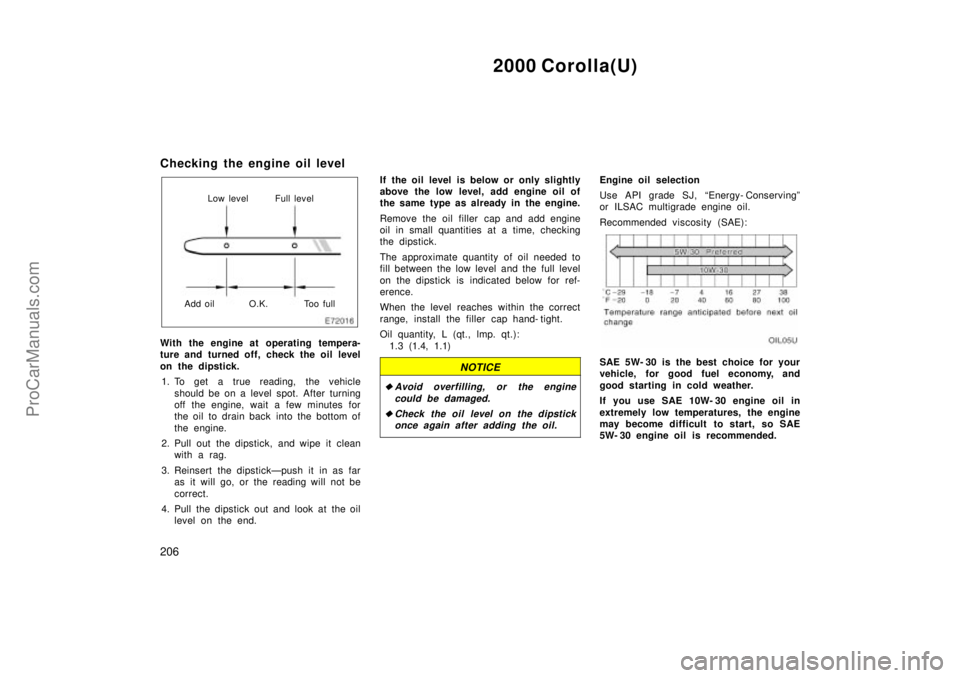
Checking the engine oil level
Low level Full level
Add oil O.K. Too full
With the engine at operating tempera-
ture and turned off, check the oil level
on the dipstick.
1. To get a true reading, the vehicle
should be on a level spot. After turning
off the engine, wait a few minutes for
the oil to drain back into the bottom of
the engine.
2. Pull out the dipstick, and wipe it clean
with a rag.
3. Reinsert the dipstickÐpush it in as far
as it will go, or the reading will not be
correct.
4. Pull the dipstick out and look at the oil
level on the end.If the oil level is below or only slightly
above the low level, add engine oil of
the same type as already in the engine.
Remove the oil filler cap and add engine
oil in small quantities at a time, checking
the dipstick.
The approximate quantity of oil needed to
fill between the low level and the full level
on the dipstick is indicated below for ref-
erence.
When the level reaches within the correct
range, install the filler cap hand- tight.
Oil quantity, L (qt., lmp. qt.):
1.3 (1.4, 1.1)
NOTICE
�Avoid overfilling, or the engine
could be damaged.
�Check the oil level on the dipstick
once again after adding the oil.
Engine oil selection
Use API grade SJ, Energy- Conservingº
or ILSAC multigrade engine oil.
Recommended viscosity (SAE):
SAE 5W- 30 is the best choice for your
vehicle, for good fuel economy, and
good starting in cold weather.
If you use SAE 10W- 30 engine oil in
extremely low temperatures, the engine
may become difficult to start, so SAE
5W- 30 engine oil is recommended.
ProCarManuals.com
Page 225 of 246

2000 Corolla(U)
207
API service symbol
ILSAC certification mark
Oil identification marks
Either or both API registered marks are
added to some oil containers to help
you select the oil you should use.
The API Service Symbol is located any-
where on the outside of the container.
The top portion of the label shows the oil
quality by API (American Petroleum Insti-
tute) designations such as SJ. The center
portion of the label shows the SAE viscos-
ity grade such as SAE 5W- 30. Energy-
Conservingº shown in the lower portion,
indicates that the oil has fuel- saving ca-
pabilities.
The ILSAC (International Lubricant Stan-
dardization and Approval Committee) Certi-
fication Mark is displayed on the front of
the container.Look at the see- through coolant reser-
voir when the engine is cold. The cool-
ant level is satisfactory if it is between
the FULLº and LOWº lines on the
reservoir. If the level is low, add ethyl-
ene- glycol type coolant for a proper
corrosion protection of aluminum com-
ponents.
The coolant level in the reservoir will vary
with engine temperature. However, if the
level is on or below the LOWº line, add
coolant. Bring the level up to the FULLº
line.
Always use ethylene- glycol type coolant
for a proper corrosion protection of alumi-
num components. See information in the
next column.
If the coolant level drops within a short
time after replenishing, there may be a
leak in the system. Visually check the
radiator, hoses, engine coolant filler cap,
radiator cap and drain cock and water
pump.
If you can find no leak, have your Toyota
dealer test the cap pressure and check
for leaks in the cooling system.
Checking the engine coolant
level
ProCarManuals.com
Page 226 of 246
2000 Corolla(U)
208
CAUTION
To prevent burning yourself, do not
remove the radiator cap when the en-
gine is hot.
Coolant type selection
Use of improper coolants may damage
your engine cooling system. Your coolant
must contain ethylene- glycol type coolant
for a proper corrosion protection of your
engine that contains aluminum compo-
nents. Use TOYOTA Long Life Coolantº
or equivalent.
In addition to preventing freezing and sub-
sequent damage to the engine, this will
also prevent corrosion. Further supplemen-
tal inhibitors or additives are neither need-
ed nor recommended.
Read the coolant container for information
on freeze protection. Follow the manufac-
turer's directions for how much to mix
with plain water (preferably demineralized
water or distilled water). The total capacity
of the cooling system is given in Section
8.We recommend to use 50% solution for
your Toyota, to provide protection down to
about -35�C (- 31�F). When it is extreme-
ly cold, to provide protection down to
about -50�C (- 58�F), 60% solution is rec-
ommended. Do not use more than 70%
solution for better coolant performance.NOTICE
Do not use alcohol type antifreeze or
plain water alone.
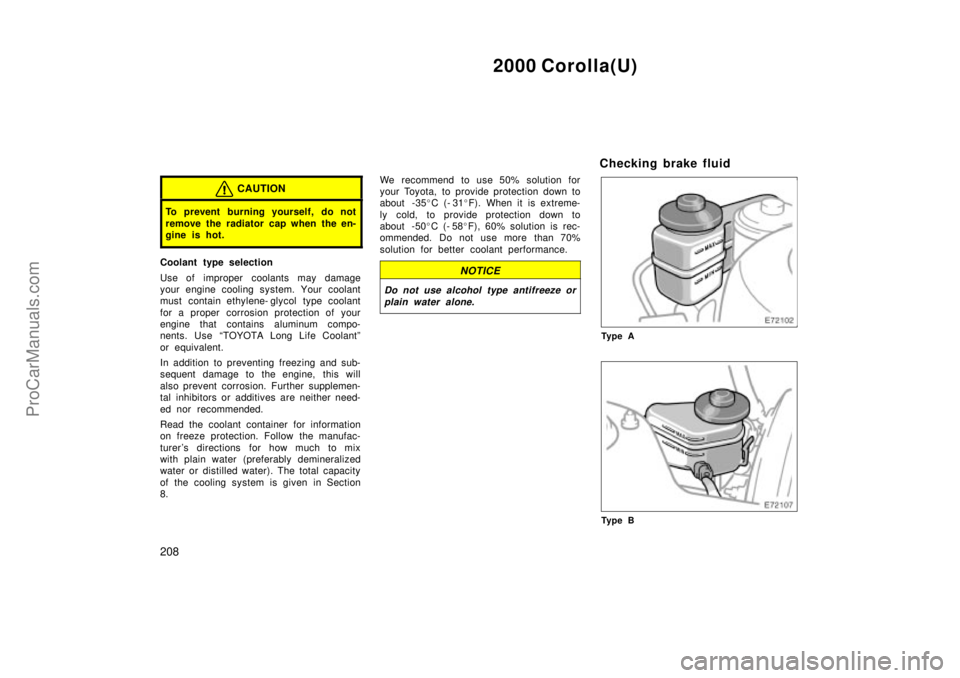
Checking brake fluid
Ty p e A
Ty p e B
ProCarManuals.com

