Page 224 of 246
2000 Corolla(U)
206
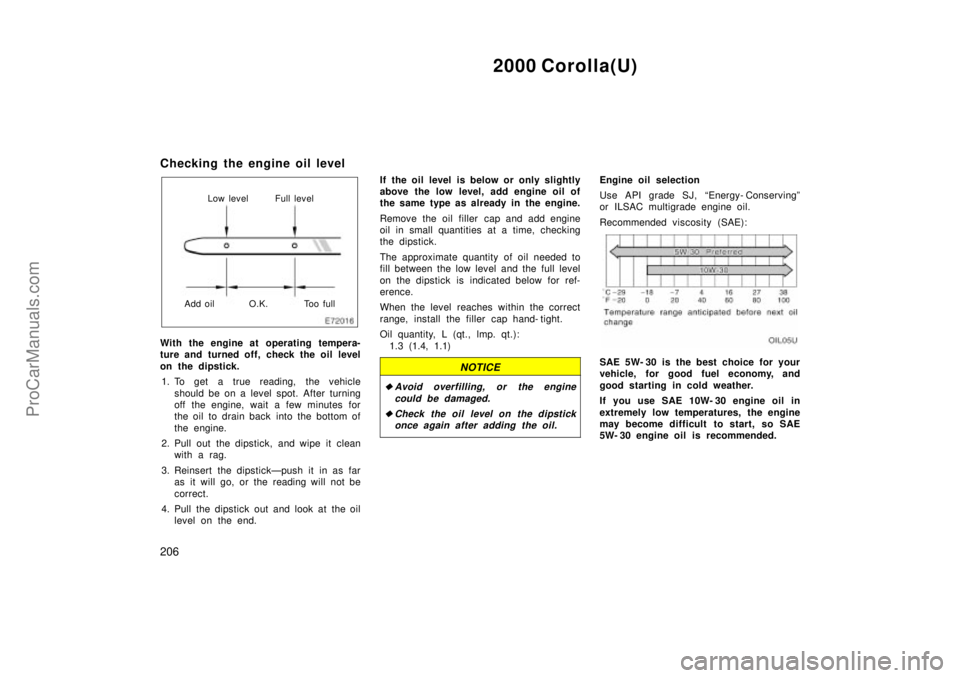
Checking the engine oil level
Low level Full level
Add oil O.K. Too full
With the engine at operating tempera-
ture and turned off, check the oil level
on the dipstick.
1. To get a true reading, the vehicle
should be on a level spot. After turning
off the engine, wait a few minutes for
the oil to drain back into the bottom of
the engine.
2. Pull out the dipstick, and wipe it clean
with a rag.
3. Reinsert the dipstickÐpush it in as far
as it will go, or the reading will not be
correct.
4. Pull the dipstick out and look at the oil
level on the end.If the oil level is below or only slightly
above the low level, add engine oil of
the same type as already in the engine.
Remove the oil filler cap and add engine
oil in small quantities at a time, checking
the dipstick.
The approximate quantity of oil needed to
fill between the low level and the full level
on the dipstick is indicated below for ref-
erence.
When the level reaches within the correct
range, install the filler cap hand- tight.
Oil quantity, L (qt., lmp. qt.):
1.3 (1.4, 1.1)
NOTICE
�Avoid overfilling, or the engine
could be damaged.
�Check the oil level on the dipstick
once again after adding the oil.
Engine oil selection
Use API grade SJ, Energy- Conservingº
or ILSAC multigrade engine oil.
Recommended viscosity (SAE):
SAE 5W- 30 is the best choice for your
vehicle, for good fuel economy, and
good starting in cold weather.
If you use SAE 10W- 30 engine oil in
extremely low temperatures, the engine
may become difficult to start, so SAE
5W- 30 engine oil is recommended.
ProCarManuals.com
Page 225 of 246

2000 Corolla(U)
207
API service symbol
ILSAC certification mark
Oil identification marks
Either or both API registered marks are
added to some oil containers to help
you select the oil you should use.
The API Service Symbol is located any-
where on the outside of the container.
The top portion of the label shows the oil
quality by API (American Petroleum Insti-
tute) designations such as SJ. The center
portion of the label shows the SAE viscos-
ity grade such as SAE 5W- 30. Energy-
Conservingº shown in the lower portion,
indicates that the oil has fuel- saving ca-
pabilities.
The ILSAC (International Lubricant Stan-
dardization and Approval Committee) Certi-
fication Mark is displayed on the front of
the container.Look at the see- through coolant reser-
voir when the engine is cold. The cool-
ant level is satisfactory if it is between
the FULLº and LOWº lines on the
reservoir. If the level is low, add ethyl-
ene- glycol type coolant for a proper
corrosion protection of aluminum com-
ponents.
The coolant level in the reservoir will vary
with engine temperature. However, if the
level is on or below the LOWº line, add
coolant. Bring the level up to the FULLº
line.
Always use ethylene- glycol type coolant
for a proper corrosion protection of alumi-
num components. See information in the
next column.
If the coolant level drops within a short
time after replenishing, there may be a
leak in the system. Visually check the
radiator, hoses, engine coolant filler cap,
radiator cap and drain cock and water
pump.
If you can find no leak, have your Toyota
dealer test the cap pressure and check
for leaks in the cooling system.
Checking the engine coolant
level
ProCarManuals.com
Page 226 of 246
2000 Corolla(U)
208
CAUTION
To prevent burning yourself, do not
remove the radiator cap when the en-
gine is hot.
Coolant type selection
Use of improper coolants may damage
your engine cooling system. Your coolant
must contain ethylene- glycol type coolant
for a proper corrosion protection of your
engine that contains aluminum compo-
nents. Use TOYOTA Long Life Coolantº
or equivalent.
In addition to preventing freezing and sub-
sequent damage to the engine, this will
also prevent corrosion. Further supplemen-
tal inhibitors or additives are neither need-
ed nor recommended.
Read the coolant container for information
on freeze protection. Follow the manufac-
turer's directions for how much to mix
with plain water (preferably demineralized
water or distilled water). The total capacity
of the cooling system is given in Section
8.We recommend to use 50% solution for
your Toyota, to provide protection down to
about -35�C (- 31�F). When it is extreme-
ly cold, to provide protection down to
about -50�C (- 58�F), 60% solution is rec-
ommended. Do not use more than 70%
solution for better coolant performance.NOTICE
Do not use alcohol type antifreeze or
plain water alone.
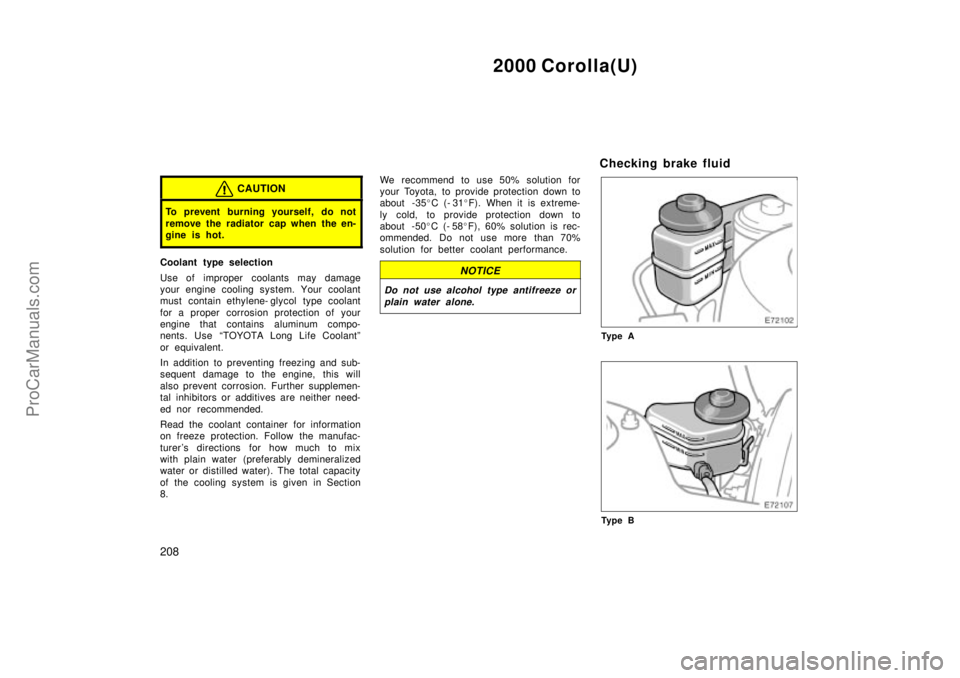
Checking brake fluid
Ty p e A
Ty p e B
ProCarManuals.com
Page 227 of 246
2000 Corolla(U)
209
To check the fluid level, simply look at
the see- through reservoir. The level
should be between the MAXº and
MINº lines on the reservoir.
It is normal for the brake fluid level to go
down slightly as the brake pads wear. So
be sure to keep the reservoir filled.
If the reservoir needs frequent refilling, it
may indicate a serious mechanical prob-
lem.
If the level is low, add SAE J1703 or
FMVSS No.116 DOT 3 brake fluid to the
brake reservoir.
Remove and replace the reservoir cover
by hand.Use only newly opened brake fluid. Once
opened, brake fluid absorbs moisture from
the air, and excess moisture can cause a
dangerous loss of braking.
CAUTION
Take care when filling the reservoir
because brake fluid can harm your
eyes and damage painted surfaces. If
fluid gets in your eyes, flush your
eyes with clean water.
NOTICE
If you spill some of the fluid, be sure
to wash it off with water to prevent
it from damaging the parts or paint.
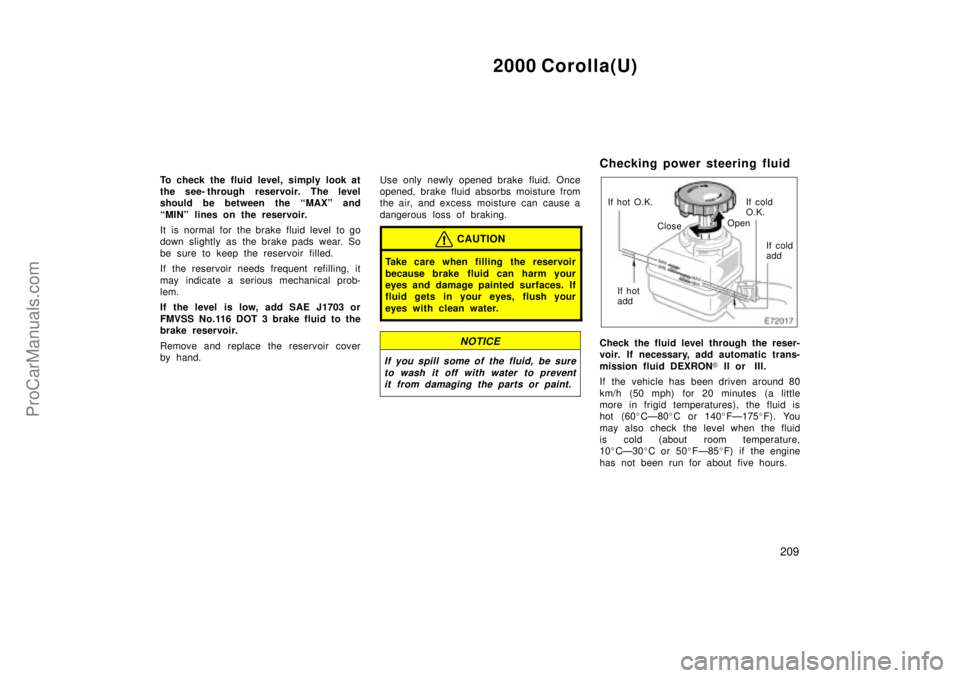
Checking power steering fluid
If hot
addIf cold
add If cold
O.K. If hot O.K.
CloseOpen
Check the fluid level through the reser-
voir. If necessary, add automatic trans-
mission fluid DEXRON� II or III.
If the vehicle has been driven around 80
km/h (50 mph) for 20 minutes (a little
more in frigid temperatures), the fluid is
hot (60�CÐ80�C or 140�FÐ175�F). You
may also check the level when the fluid
is cold (about room temperature,
10�CÐ30�C or 50�FÐ85�F) if the engine
has not been run for about five hours.
ProCarManuals.com
Page 235 of 246
2000 Corolla(U)
217
NOTICE
�Be sure the engine and all accesso-
ries are off before performing main-
tenance.
�When checking the battery, remove
the ground cable from the negative
terminal (- º mark) first and rein-
stall it last.
�Be careful not to cause a short cir-
cuit with tools.
�Take care no solution gets into the
battery when washing it.
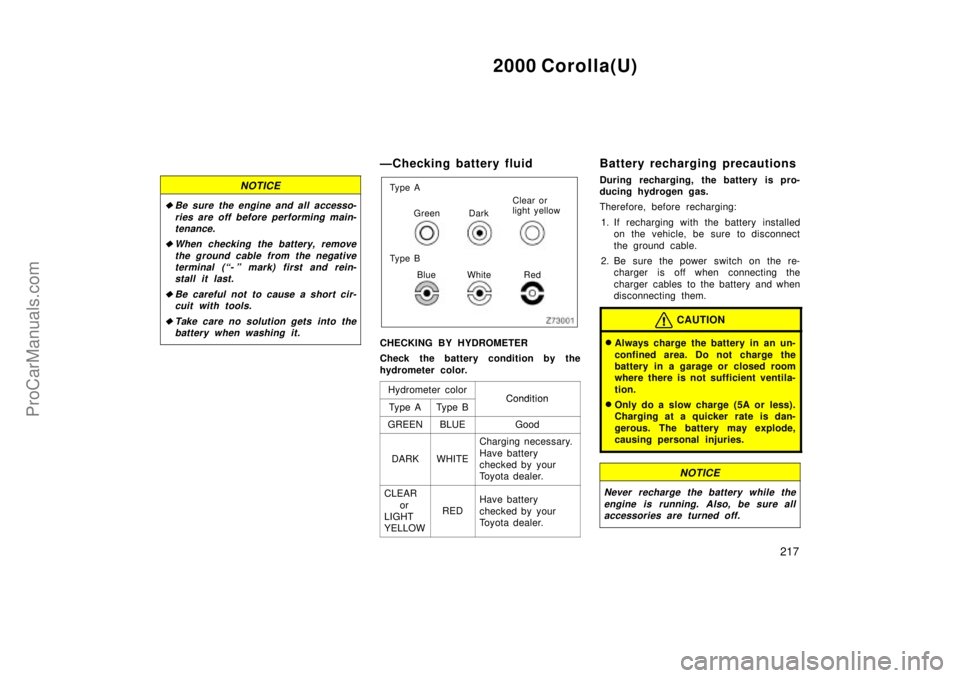
ÐChecking battery fluid
Ty p e A
Ty p e BGreen DarkClear or
light yellow
Blue White Red
CHECKING BY HYDROMETER
Check the battery condition by the
hydrometer color.
Hydrometer color
ConditionTy p e ATy p e BCondition
GREENBLUEGood
DARKWHITE
Charging necessary.
Have battery
checked by your
Toyota dealer.
CLEAR
or
LIGHT
YELLOW
RED
Have battery
checked by your
Toyota dealer.
Battery recharging precautions
During recharging, the battery is pro-
ducing hydrogen gas.
Therefore, before recharging:
1. If recharging with the battery installed
on the vehicle, be sure to disconnect
the ground cable.
2. Be sure the power switch on the re-
charger is off when connecting the
charger cables to the battery and when
disconnecting them.
CAUTION
�Always charge the battery in an un-
confined area. Do not charge the
battery in a garage or closed room
where there is not sufficient ventila-
tion.
�Only do a slow charge (5A or less).
Charging at a quicker rate is dan-
gerous. The battery may explode,
causing personal injuries.
NOTICE
Never recharge the battery while the
engine is running. Also, be sure all
accessories are turned off.
ProCarManuals.com