Page 159 of 246
2000 Corolla(U)
85
The gauge indicates the engine coolant
temperature when the ignition switch is
on. The engine operating temperature
will vary with changes in weather and
engine load.
If the needle moves into the red zone,
your engine is too hot. If your vehicle
overheats, stop your vehicle and allow the
engine to cool.
Your vehicle may overheat during severe
operating conditions, such as:
�Driving up a long hill on a hot day.
�Reducing speed or stopping after high
speed driving.
�Idling for a long period with the air
conditioning on in stop- and- go traffic.
�Towing a trailer.
NOTICE
�Do not remove the thermostat in
the engine cooling system as this
may cause the engine to overheat.
The thermostat is designed to con-
trol the flow of coolant to keep the
temperature of the engine within
the specified operating range.
�Do not continue driving with an
overheated engine. See If your ve-
hicle overheatsº in Section 4.
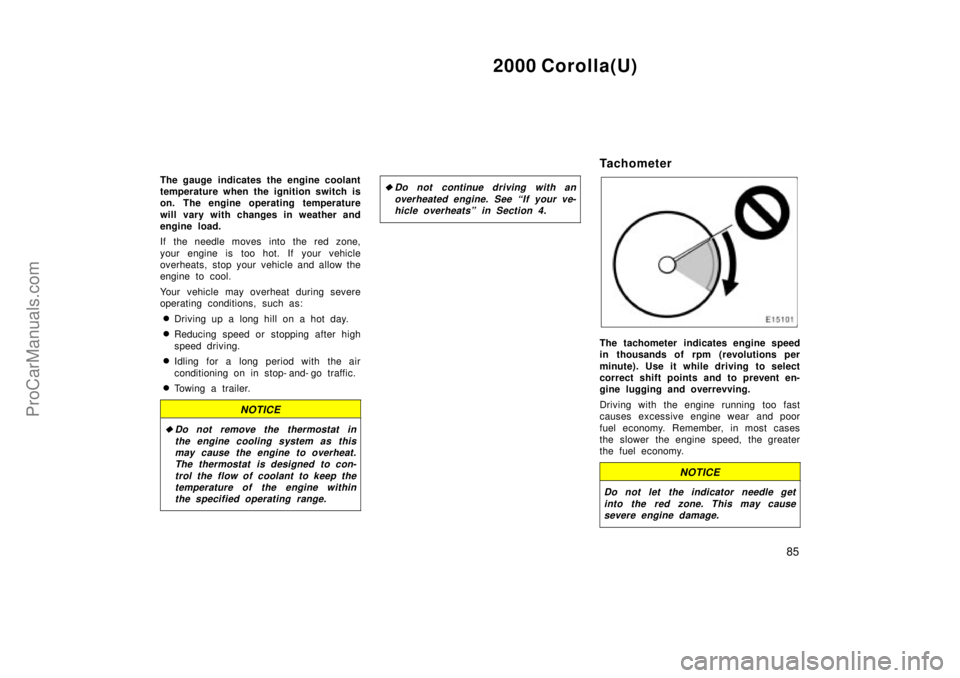
Tachometer
The tachometer indicates engine speed
in thousands of rpm (revolutions per
minute). Use it while driving to select
correct shift points and to prevent en-
gine lugging and overrevving.
Driving with the engine running too fast
causes excessive engine wear and poor
fuel economy. Remember, in most cases
the slower the engine speed, the greater
the fuel economy.
NOTICE
Do not let the indicator needle get
into the red zone. This may cause
severe engine damage.
ProCarManuals.com
Page 172 of 246
2000 Corolla(U)
98
For ways to decrease the vehicle speed,
see Cruise controlº in this section.
CAUTION
Be careful when downshifting on a
slippery surface. Abrupt shifting
could cause the vehicle to spin or
skid.
(e) Using 2º and Lº positions
The 2º and Lº positions are used for
strong engine braking as described pre-
viously.
With the selector lever in 2º or Lº, you
can start the vehicle in motion as with the
lever in Dº.
With the selector lever in 2º, the vehicle
will start in the first gear and automatical-
ly shift to second gear.
With the selector lever in Lº, the trans-
mission is engaged in first gear.
NOTICE
�Be careful not to overrev the en-
gine. Watch the tachometer to keep
engine rpm from going into the red
zone. The approximate maximum al-
lowable speed for each position is
given below for your reference:
2º 123 km/h (76 mph). . . . . . . . . . . .
Lº 67 km/h (42 mph). . . . . . . . . . . .
�Do not continue hill climbing or
hard towing for a long time in the
2º or Lº position. This may cause
severe automatic transmission dam-
age from overheating. To prevent
such damage, Dº position should
be used in hill climbing or hard
towing.
(f) Backing up
1. Bring the vehicle to a complete stop.
2. With the brake pedal held down with
your foot, shift the selector lever to the
Rº position.
NOTICE
Never shift into reverse while the ve-
hicle is moving.
(g) Parking
1. Bring the vehicle to a complete stop.
2. Pull the parking brake lever up fully to
securely apply the parking brake.
3. With the brake pedal pressed down,
shift the selector lever to the Pº posi-
tion.
CAUTION
Never attempt to move the selector
lever into Pº position under any cir-
cumstances while the vehicle is mov-
ing. Serious mechanical damage and
loss of vehicle control may result.
(h) Good driving practice
�If the transmission repeatedly shifts up
and down between the third gear and
overdrive when climbing a gentle slope,
the overdrive should be turned off. Be
sure to turn the switch on immediately
afterward.
�When towing a trailer, in order to main-
tain engine braking efficiency, do not
use overdrive.
ProCarManuals.com
Page 175 of 246
2000 Corolla(U)
101
Good driving practice
�If it is difficult to shift into reverse, put
the transmission in neutral, release the
clutch pedal momentarily, and then try
again.
�When towing a trailer, in order to main-
tain engine braking efficiency, do not
use the fifth gear.
CAUTION
Be careful when downshifting on a
slippery surface. Abrupt shifting
could cause the vehicle to spin or
skid.
NOTICE
Make sure the vehicle is completely
stopped before shifting into reverse.
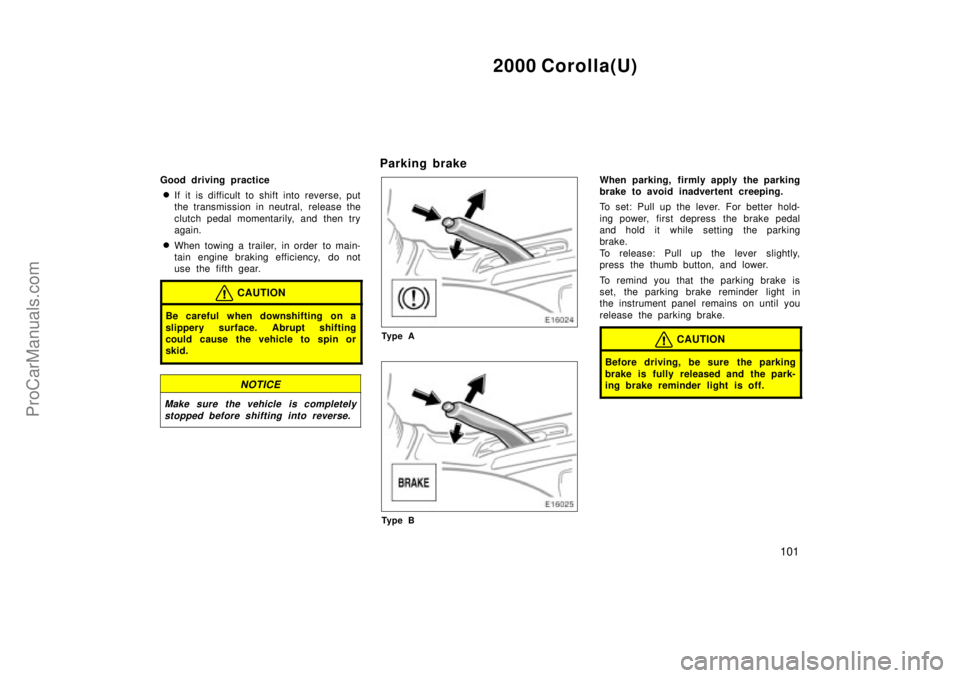
Parking brake
Ty p e A
Ty p e B
When parking, firmly apply the parking
brake to avoid inadvertent creeping.
To set: Pull up the lever. For better hold-
ing power, first depress the brake pedal
and hold it while setting the parking
brake.
To release: Pull up the lever slightly,
press the thumb button, and lower.
To remind you that the parking brake is
set, the parking brake reminder light in
the instrument panel remains on until you
release the parking brake.
CAUTION
Before driving, be sure the parking
brake is fully released and the park-
ing brake reminder light is off.
ProCarManuals.com