2000 Corolla(U)
203
�Dispose of used oil and filter only
in a safe and acceptable manner.
Do not dispose of used oil and fil-
ter in household trash, in sewers or
onto the ground. Call your dealer or
a service station for information
concerning recycling or disposal.
NOTICE
�Remember that battery and ignition
cables carry high currents or volt-
ages. Be careful of accidentally
causing a short circuit.
�Add only demineralized or distilled
water to fill the radiator. And if you
spill some of the coolant, be sure
to wash off with water to prevent it
from damaging the parts or paint.
�Do not allow dirt or anything else
to fall through the spark plugholes.
�Use only spark plugs of the speci-
fied type. Using other types will
cause engine damage, loss of per-
formance or radio noise.
�Do not reuse iridium- tipped spark
plugs by cleaning or regapping.
�Do not overfill automatic transmis-
sion fluid, or the transmission
could be damaged.
�Do not drive with the air cleaner
filter removed, or excessive engine
wear could result. Also backfiring
could cause a fire in the engine
compartment.
�Be careful not to scratch the glass
surface with the wiper frame.
�When closing the engine hood,
check to see that you have not for-
gotten any tools, rags, etc.
Parts and tools
Here is a list of parts and tools you will
need on performing do- it- yourself mainte-
nance. Remember all Toyota parts are de-
signed in metric sizes, so your tools must
be metric.
Checking the engine oil level
Parts (if level is low):
�Engine oil API grade SJ,
Energy- Conservingº or ILSAC
multigrade having viscosity proper for
your climate
Tools:
�Rag or paper towel
�Funnel (only for adding oil)
Checking the engine coolant level
Parts (if level is low):
�TOYOTA Long Life Coolantº or equiva-
lent
See Section 7- 2 for details about cool-
ant type selection.
�Demineralized or distilled water
Tools:
�Funnel (only for adding coolant)
ProCarManuals.com
2000 Corolla(U)
216
CAUTION
BATTERY PRECAUTIONS
The battery produces flammable and
explosive hydrogen gas.
�Do not cause a spark from the bat-
tery with tools.
�Do not smoke or light a match near
the battery.
The electrolyte contains poisonous
and corrosive sulfuric acid.
�Avoid contact with eyes, skin or
clothes.
�Never ingest electrolyte.
�Wear protective safety glasses when
working near the battery.
�Keep children away from the bat-
tery.
EMERGENCY MEASURES
�If electrolyte gets in your eyes,
flush your eyes with clean water
immediately and get immediate
medical attention. If possible, con-
tinue to apply water with a sponge
or cloth while en route to the medi-
cal office.
�If electrolyte gets on your skin,
thoroughly wash the contact area. If
you feel pain or burning, get medi-
cal attention immediately.
�If electrolyte gets on your clothes,
there is a possibility of its soaking
through to your skin, so immediate-
ly take off the exposed clothing and
follow the procedure above, if nec-
essary.
�If you accidentally swallow electro-
lyte, drink a large quantity of water
or milk. Follow with milk of magne-
sia, beaten raw egg or vegetable
oil. Then go immediately for emer-
gency help.
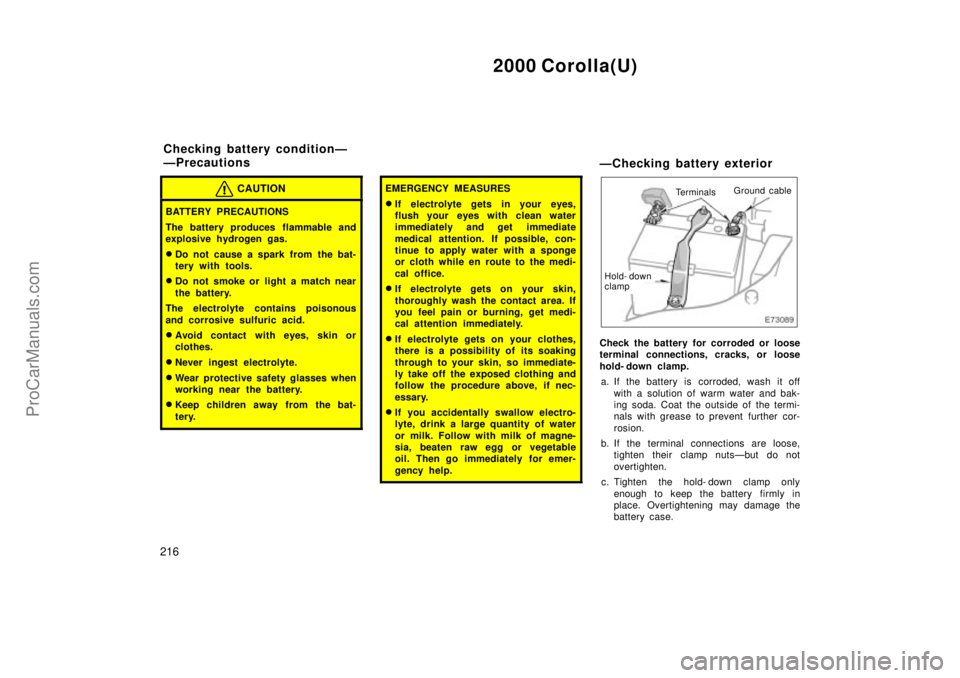
ÐChecking battery exterior
TerminalsGround cable
Hold- down
clamp
Check the battery for corroded or loose
terminal connections, cracks, or loose
hold- down clamp.
a. If the battery is corroded, wash it off
with a solution of warm water and bak-
ing soda. Coat the outside of the termi-
nals with grease to prevent further cor-
rosion.
b. If the terminal connections are loose,
tighten their clamp nutsÐbut do not
overtighten.
c. Tighten the hold- down clamp only
enough to keep the battery firmly in
place. Overtightening may damage the
battery case.
Checking battery conditionÐ
ÐPrecautions
ProCarManuals.com