Page 164 of 246

2000 Corolla(U)
90
If the light lit during driving goes out and
does not come on again, it is a normal
operation.
(h) Open Door Warning Light
This light remains on until all the doors
are completely closed.
(i) SRS Warning Light
This light will come on when the igni-
tion key is turned to the ACCº or
ONº position. After about 6 seconds,
the light will go off. This means the
system of the airbag and front seat belt
pretensioners are operating properly.
The warning light system monitors the air-
bag sensor assemblies, front airbag sen-
sors, seat belt pretensioner assemblies,
inflators, warning light, interconnecting wir-
ing and power sources.
If either of the following conditions occurs,
this indicates a malfunction somewhere in
the parts monitored by the warning light
system. Contact your Toyota dealer as
soon as possible to service the vehicle.
�The light does not come on when the
ignition key is turned to the ACCº or
ONº position or remains on.
�The light comes on or flashes while
driving.(j) Low Windshield Washer Fluid Level
Warning Light
The light warns that the windshield washer
fluid level is too low. Add washer fluid at
your earliest opportunity. (For instructions,
see Adding washer fluidº in Section 7- 3.)
(k) Key Reminder Buzzer
This buzzer reminds you to remove the
key when you open the driver 's door with
the ignition key in the ACCº or LOCKº
position.
(l) Light Reminder Buzzer
This buzzer will sound if the head light
switch is left on and the driver's door is
opened with the key removed from the
ignition switch.CHECKING SERVICE REMINDER INDICA-
TORS (except the low fuel level warning
light and low windshield washer fluid
level warning light)
1. Apply the parking brake.
2. Open one of the doors.
The open door warning light should
come on.
3. Close the door.
The open door warning light should go
off.
4. Turn the ignition key to ACCº.
The SRS warning light should come on.
It goes off after about 6 seconds.
5. Turn the ignition key to ONº, but do
not start the engine.
All the service reminder indicators ex-
cept the open door warning light and
SRS warning light should come on. The
ABSº warning light goes off after a
few seconds.
If any service reminder indicator or warn-
ing buzzer does not function as described
above, either the bulb is burned out or the
circuit is in need of repair. Have it
checked by your Toyota dealer as soon as
possible.
ProCarManuals.com
Page 218 of 246
2000 Corolla(U)
200
Engine compartment overview
1. Power steering fluid reservoir
2. Engine oil level dipstick
3. Engine oil filler cap
4. Brake fluid reservoir
5. Fuse blocks
6. Battery
7. Engine coolant reservoir
8. Electric cooling fans
9. Windshield washer fluid tank
ProCarManuals.com
Page 222 of 246
2000 Corolla(U)
204
Checking brake fluid
Parts (if level is low):
�SAE J1703 or FMVSS No.116 DOT 3
brake fluid
Tools:
�Rag or paper towel
�Funnel (only for adding fluid)
Checking power steering fluid
Parts (if level is low):
�Automatic transmission fluid
DEXRON�II or III
Tools:
�Rag or paper towel
�Funnel (only for adding fluid)
Checking battery condition
Tools:
�Warm water
�Baking soda
�Grease
�Conventional wrench (for terminal
clamp bolts)Checking and replacing fuses
Parts (if replacement is necessary):
�Genuine Toyota fuse or equivalent with
same amperage rating as original
Adding washer fluid
Parts:
�Water
�Washer fluid containing antifreeze (for
winter use)
Tools:
�Funnel
Replacing light bulbs
Parts:
�Bulb with same number and wattage
rating as original (See charts in Re-
placing light bulbsº in Section 7- 3.)
Tools:
�Screwdriver
ProCarManuals.com
Page 223 of 246

2000 Corolla(U)
205
DO- IT- YOURSELF MAINTENANCE
Engine and Chassis
Checking the engine oil level206 . . . . . . . . . . . . . . . . . . . . . . . . . . . . . . . . .
Checking the engine coolant level207 . . . . . . . . . . . . . . . . . . . . . . . . . . . .
Checking brake fluid208 . . . . . . . . . . . . . . . . . . . . . . . . . . . . . . . . . . . . . . . .
Checking power steering fluid209 . . . . . . . . . . . . . . . . . . . . . . . . . . . . . . . .
Checking tire pressure210 . . . . . . . . . . . . . . . . . . . . . . . . . . . . . . . . . . . . . .
Checking and replacing tires211 . . . . . . . . . . . . . . . . . . . . . . . . . . . . . . . . .
Rotating tires212 . . . . . . . . . . . . . . . . . . . . . . . . . . . . . . . . . . . . . . . . . . . . . . .
Installing snow tires and chains213 . . . . . . . . . . . . . . . . . . . . . . . . . . . . . .
Replacing wheels214 . . . . . . . . . . . . . . . . . . . . . . . . . . . . . . . . . . . . . . . . . . .
Aluminum wheel precautions214 . . . . . . . . . . . . . . . . . . . . . . . . . . . . . . . .
SECTION 7- 2
ProCarManuals.com
Page 226 of 246
2000 Corolla(U)
208
CAUTION
To prevent burning yourself, do not
remove the radiator cap when the en-
gine is hot.
Coolant type selection
Use of improper coolants may damage
your engine cooling system. Your coolant
must contain ethylene- glycol type coolant
for a proper corrosion protection of your
engine that contains aluminum compo-
nents. Use TOYOTA Long Life Coolantº
or equivalent.
In addition to preventing freezing and sub-
sequent damage to the engine, this will
also prevent corrosion. Further supplemen-
tal inhibitors or additives are neither need-
ed nor recommended.
Read the coolant container for information
on freeze protection. Follow the manufac-
turer's directions for how much to mix
with plain water (preferably demineralized
water or distilled water). The total capacity
of the cooling system is given in Section
8.We recommend to use 50% solution for
your Toyota, to provide protection down to
about -35�C (- 31�F). When it is extreme-
ly cold, to provide protection down to
about -50�C (- 58�F), 60% solution is rec-
ommended. Do not use more than 70%
solution for better coolant performance.NOTICE
Do not use alcohol type antifreeze or
plain water alone.
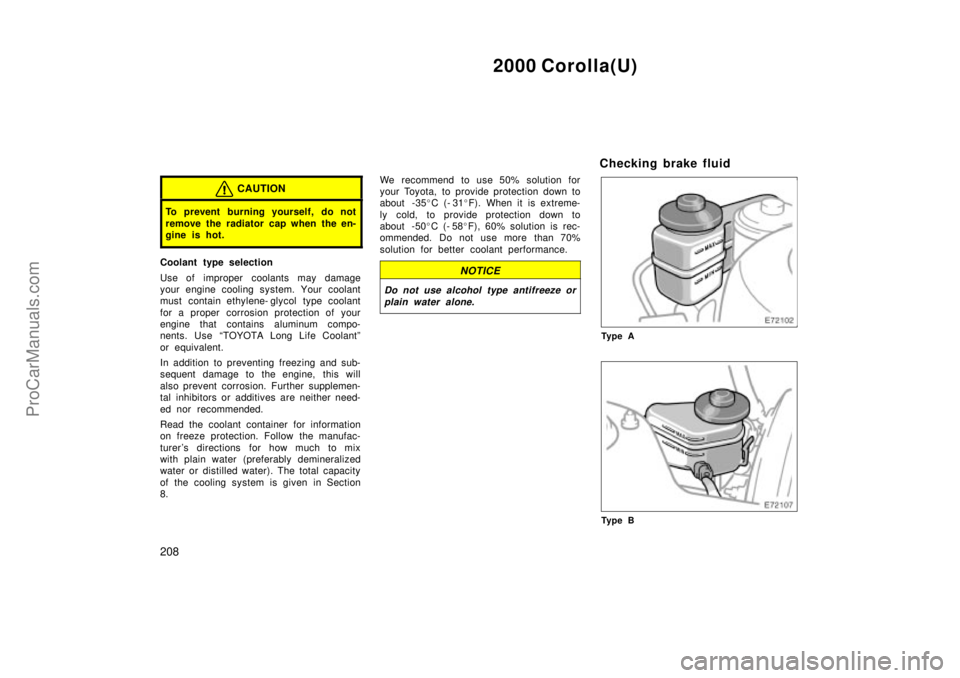
Checking brake fluid
Ty p e A
Ty p e B
ProCarManuals.com
Page 227 of 246
2000 Corolla(U)
209
To check the fluid level, simply look at
the see- through reservoir. The level
should be between the MAXº and
MINº lines on the reservoir.
It is normal for the brake fluid level to go
down slightly as the brake pads wear. So
be sure to keep the reservoir filled.
If the reservoir needs frequent refilling, it
may indicate a serious mechanical prob-
lem.
If the level is low, add SAE J1703 or
FMVSS No.116 DOT 3 brake fluid to the
brake reservoir.
Remove and replace the reservoir cover
by hand.Use only newly opened brake fluid. Once
opened, brake fluid absorbs moisture from
the air, and excess moisture can cause a
dangerous loss of braking.
CAUTION
Take care when filling the reservoir
because brake fluid can harm your
eyes and damage painted surfaces. If
fluid gets in your eyes, flush your
eyes with clean water.
NOTICE
If you spill some of the fluid, be sure
to wash it off with water to prevent
it from damaging the parts or paint.
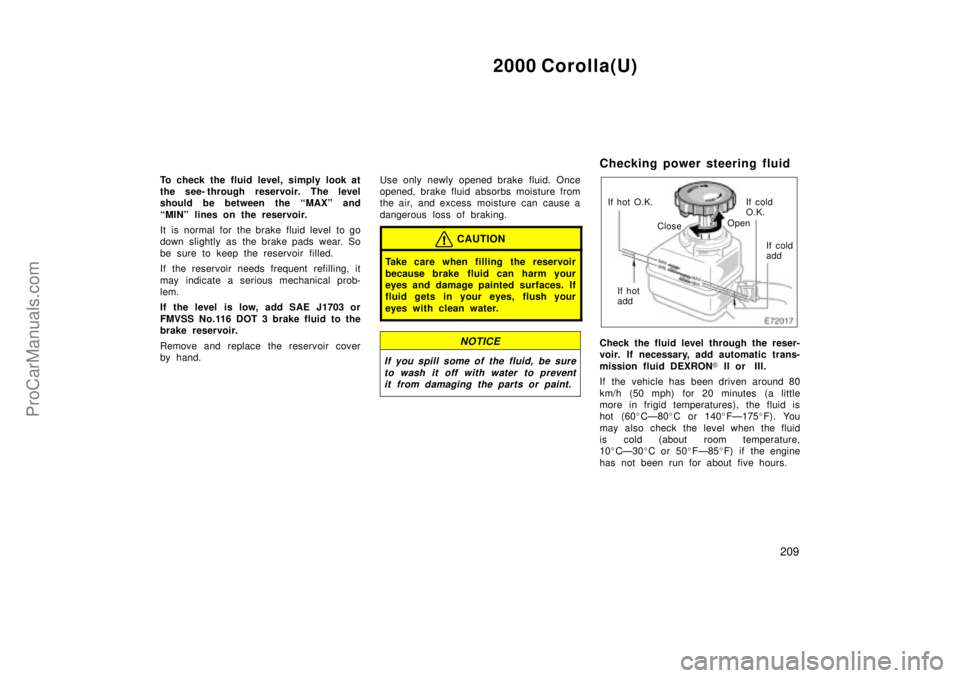
Checking power steering fluid
If hot
addIf cold
add If cold
O.K. If hot O.K.
CloseOpen
Check the fluid level through the reser-
voir. If necessary, add automatic trans-
mission fluid DEXRON� II or III.
If the vehicle has been driven around 80
km/h (50 mph) for 20 minutes (a little
more in frigid temperatures), the fluid is
hot (60�CÐ80�C or 140�FÐ175�F). You
may also check the level when the fluid
is cold (about room temperature,
10�CÐ30�C or 50�FÐ85�F) if the engine
has not been run for about five hours.
ProCarManuals.com

