Page 178 of 256
Celica_U
1772000 CELICA (OM20735U)
�Stop the vehicle on a level firm
ground, firmly set the parking brake
and put the transmission in “P”
(automatic) or reverse (manual).
Block the wheel diagonally opposite
to the one being changed if neces-
sary.
�Make sure to set the jack properly
in the jack point. Raising the ve-
hicle with jack improperly posi-
tioned will damage the vehicle or
may allow the vehicle to fall off the
jack and cause personal injury.
�Never get under the vehicle when
the vehicle is supported by the jack
alone.
�Use the jack only for lifting your
vehicle during wheel changing.
�Do not raise the vehicle with some-
one in the vehicle.
�When raising the vehicle, do not
put an object on or under the jack.
�Raise the vehicle only high enough
to remove and change the tire.
NOTICE
Do not continue driving with a de-
flated tire. Driving even a short dis-
tance can damage a tire beyond re-
pair.
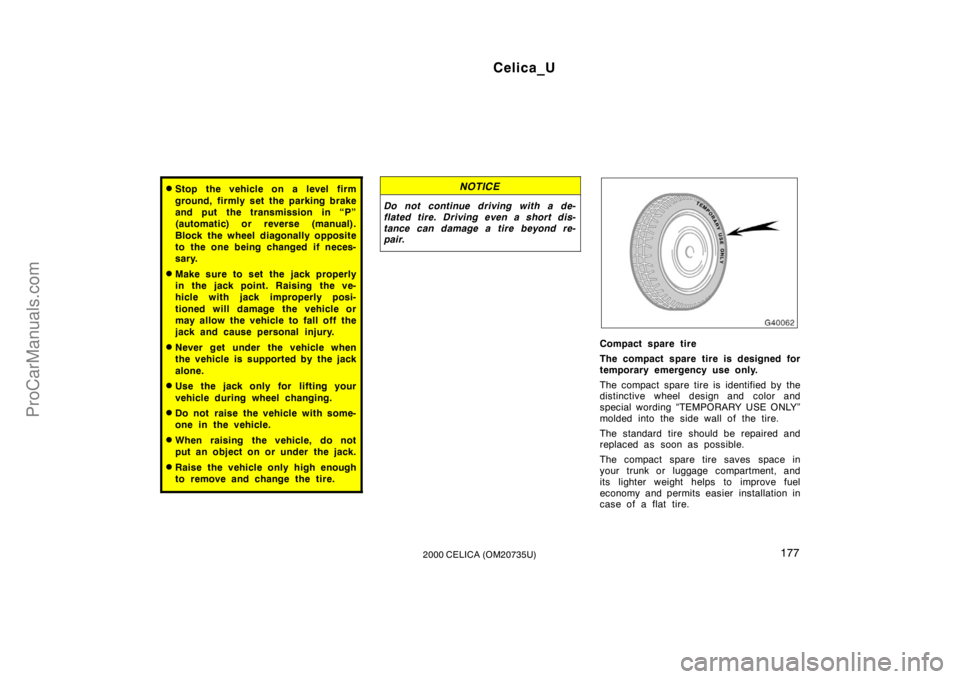
Compact spare tire
The compact spare tire is designed for
temporary emergency use only.
The compact spare tire is identified by the
distinctive wheel design and color and
special wording “TEMPORARY USE ONLY”
molded into the side wall of the tire.
The standard tire should be repaired and
replaced as soon as possible.
The compact spare tire saves space in
your trunk or luggage compartment, and
its lighter weight helps to improve fuel
economy and permits easier installation in
case of a flat tire.
ProCarManuals.com
Page 217 of 256
Celica_U
2162000 CELICA (OM20735U)
Checking tire pressure
Keep your tire pressures at the proper
level.
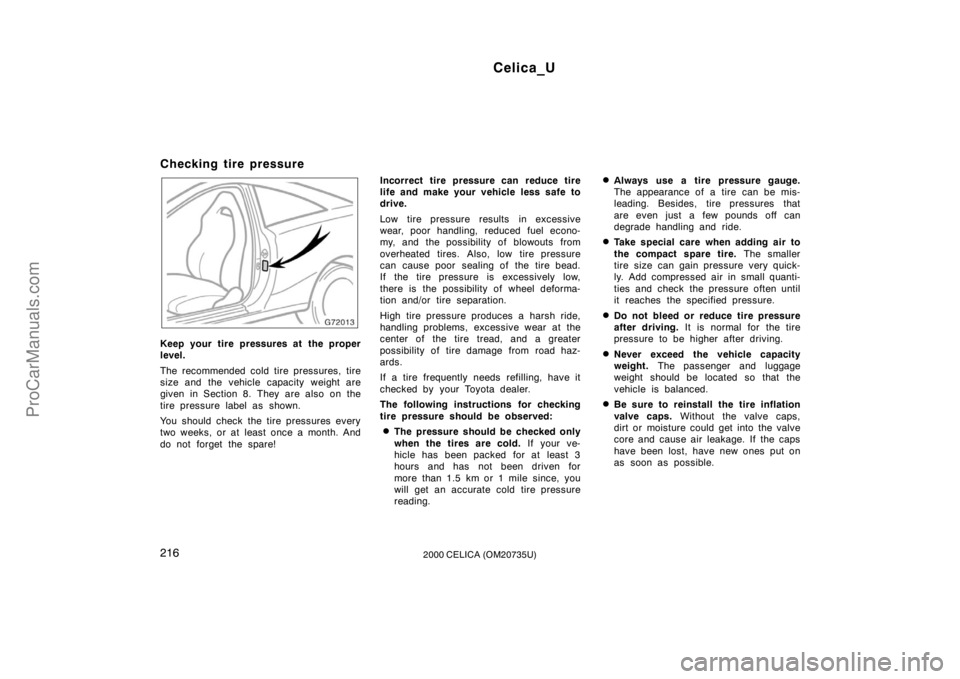
The recommended cold tire pressures, tire
size and the vehicle capacity weight are
given in Section 8. They are also on the
tire pressure label as shown.
You should check the tire pressures every
two weeks, or at least once a month. And
do not forget the spare!Incorrect tire pressure can reduce tire
life and make your vehicle less safe to
drive.
Low tire pressure results in excessive
wear, poor handling, reduced fuel econo-
my, and the possibility of blowouts from
overheated tires. Also, low tire pressure
can cause poor sealing of the tire bead.
If the tire pressure is excessively low,
there is the possibility of wheel deforma-
tion and/or tire separation.
High tire pressure produces a harsh ride,
handling problems, excessive wear at the
center of the tire tread, and a greater
possibility of tire damage from road haz-
ards.
If a tire frequently needs refilling, have it
checked by your Toyota dealer.
The following instructions for checking
tire pressure should be observed:
�The pressure should be checked only
when the tires are cold.
If your ve-
hicle has been packed for at least 3
hours and has not been driven for
more than 1.5 km or 1 mile since, you
will get an accurate cold tire pressure
reading.
�Always use a tire pressure gauge.
The appearance of a tire can be mis-
leading. Besides, tire pressures that
are even just a few pounds off can
degrade handling and ride.
�Take special care when adding air to
the compact spare tire. The smaller
tire size can gain pressure very quick-
ly. Add compressed air in small quanti-
ties and check the pressure often until
it reaches the specified pressure.
�Do not bleed or reduce tire pressure
after driving. It is normal for the tire
pressure to be higher after driving.
�Never exceed the vehicle capacity
weight. The passenger and luggage
weight should be located so that the
vehicle is balanced.
�Be sure to reinstall the tire inflation
valve caps. Without the valve caps,
dirt or moisture could get into the valve
core and cause air leakage. If the caps
have been lost, have new ones put on
as soon as possible.
ProCarManuals.com
Page 222 of 256

Celica_U
2212000 CELICA (OM20735U)
Replacing wheels
WHEN TO REPLACE YOUR WHEELS
If you have wheel damage such as
bending, cracks or heavy corrosion, the
wheel should be replaced.
If you fail to replace damaged wheels, the
tire may slip off the wheel or cause loss
of handling control.
WHEEL SELECTION
When replacing wheels, care should be
taken to ensure that the wheels are re-
placed by ones with the same load ca-
pacity, diameter, rim width, and offset.
This must be observed on compact spare
tires, too.
Correct replacement wheels are available
at your Toyota dealer.
A wheel of a different size or type may
adversely affect handling, wheel and bear-
ing life, brake cooling, speedometer/odom-
eter calibration, stopping ability, headlight
aim, bumper height, vehicle ground clear-
ance, and tire or snow chain clearance to
the body and chassis.Replacement with used wheels is not rec-
ommended as they may have been sub-
jected to rough treatment or high mileage
and could fail without warning. Also, bent
wheels which have been straightened may
have structural damage and therefore
should not be used. Never use an inner
tube in a leaking wheel which is designed
for a tubeless tire.
Aluminum wheel precautions
�After driving your vehicle the first 1600
km (1000 miles), check that the wheel
nuts are tight.
�If you have rotated, repaired, or
changed your tires, check that the
wheel nuts are still tight after driving
1600 km (1000 miles).
�When using tire chains, be careful not
to damage the aluminum wheels.
�Use only the Toyota wheel nuts and
wrench designed for your aluminum
wheels.
�When balancing your wheels, use only
Toyota balance weights or equivalent
and a plastic or rubber hammer.
�As with any wheel, periodically check
your aluminum wheels for damage. If
damaged, replace immediately.
ProCarManuals.com
Page 245 of 256
Celica_U
2442000 CELICA (OM20735U)
SPECIFICATIONS
Dimensions and weight245
. . . . . . . . . . . . . . . . . . . . . . . . . . . . . . . . . . . . \
. .
Engine 245
. . . . . . . . . . . . . . . . . . . . . . . . . . . . . . . . . . . . \
. . . . . . . . . . . . . . . .
Fuel 245
. . . . . . . . . . . . . . . . . . . . . . . . . . . . . . . . . . . . \
. . . . . . . . . . . . . . . . . . .
Service specifications 246
. . . . . . . . . . . . . . . . . . . . . . . . . . . . . . . . . . . . \
. . .
Tires 248
. . . . . . . . . . . . . . . . . . . . . . . . . . . . . . . . . . . . \
. . . . . . . . . . . . . . . . . .
Fuses 249
. . . . . . . . . . . . . . . . . . . . . . . . . . . . . . . . . . . . \
. . . . . . . . . . . . . . . . .
SECTION 8
ProCarManuals.com
Page 246 of 256
Celica_U
2452000 CELICA (OM20735U)
Dimensions and weight
Overall length mm (in.) 4330 (170.5)
Overall width mm (in.) 1735 (68.3)
Overall height mm (in.) 1305 (51.8)
∗
Wheelbase mm (in.) 2600 (102.4)
Front tread mm (in.) 1490 (58.7)
Rear tread mm (in.) 1480 (58.3)
Vehicle capacity weight
(occupants + luggage)kg (lb.) 329 (725)
∗:Unladen vehicle
Engine
Model: 1ZZ −FE and 2ZZ −GE
Type: 4 cylinder in line, 4 cycle, gasoline
Bore and stroke, mm (in.): 1ZZ −FE engine
79.0 � 91.5 (3.11 � 3.60)
2ZZ −GE engine
82.0 � 85.0 (3.23 � 3.35)
Displacement, cm
3 (cu. in.):
1ZZ −FE engine 1794 (109.5)
2ZZ −GE engine 1796 (109.6)
Fuel
Fuel type:
1ZZ −FE engine
Unleaded gasoline, Octane Rating 87
(Research Octane Number 91) or
higher
2ZZ −GE engine
Select premium unleaded gasoline with
an Octane Rating of 95 (Research Oc-
tane Number 96) or higher for opti-
mum engine performance
Fuel tank capacity, L (gal., Imp. gal.): 55 (14.5, 12.1)
ProCarManuals.com

SPECIFICATIONS
Dimensions and weight245
. . . . . . . . . . . . . . . . . . . . . . . . . . . . . . . . . . . . \
. .
Engine 245
. . . . . . . . . . . . . . . . . .")